
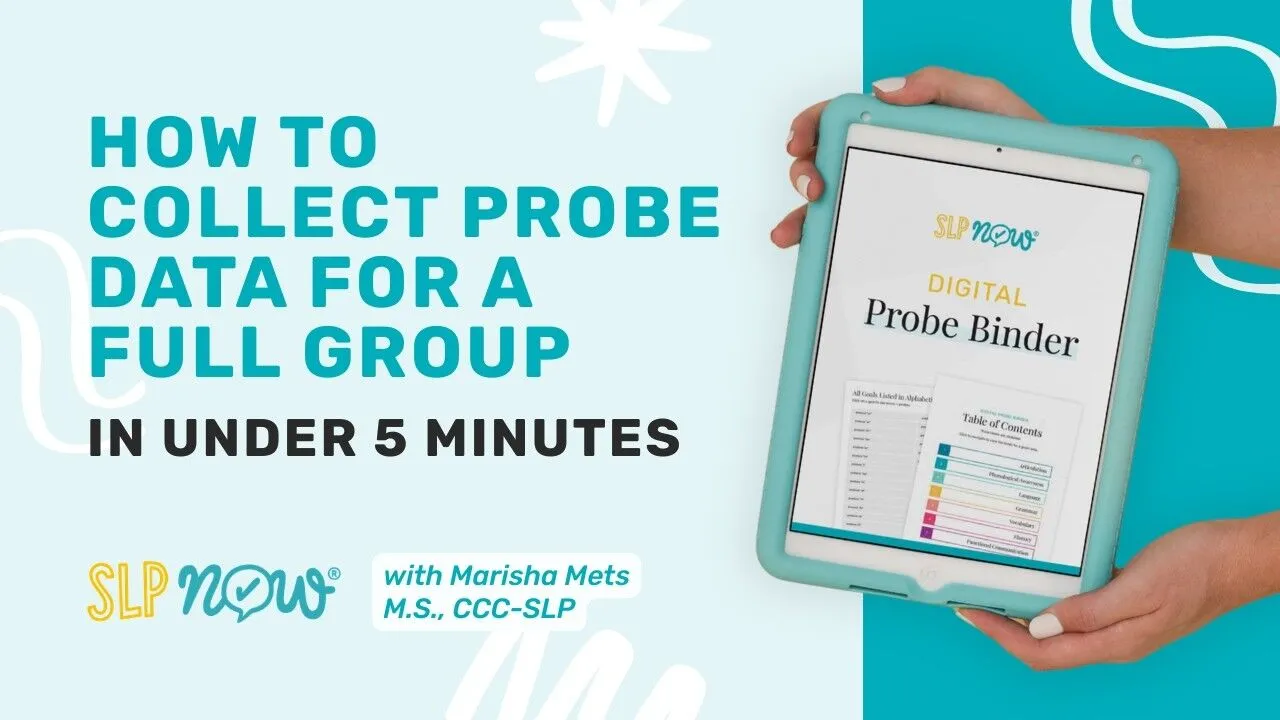
Ever finish writing a goal and then realize you have no clear way to measure it at progress report time? You’re not alone, and this episode has a fix. Taking accurate data for a mixed speech therapy group doesn’t have to hijack your entire session. You can collect probe data for a full group in under five minutes by establishing a quick, independent routine at the very beginning of your session, using targeted probe questions, and utilizing streamlined tools. This combo keeps sessions moving, tells you exactly where each student is at, and makes progress reporting way less stressful.
Why the First 5 Minutes Are Crucial for Data Collection
There’s a specific kind of panic that hits at progress report time. You pull up a student’s goal and realize you haven’t been consistently collecting data. Or you have data, but it’s scattered, inconsistent, and hard to make sense of.
If you’ve been there, you’re not alone. I’ve been there too. And it’s part of why we built the Digital Probe Binder. But before I get into the binder itself, I want to talk about the system it lives inside. The combination that changed how I collect data is the goal card plus probe binder workflow. Together, they make it possible to run a quick, meaningful probe for every student in a group in under five minutes. Every single session.
The 5-Minute “Quick Probe” Routine
Here is exactly how to structure the first few minutes of your session to get reliable data without the stress:
- Step 1: Set the Routine with Goal Cards. Goal cards are exactly what they sound like: a simple card that captures a student’s goal in student-friendly language. At the start of every session, each student reviews their goal cards. We pull them out, look at the goals, and pick one to focus on that day.
- Step 2: Run Targeted Probes. That focus then drives which probe we run. I pull up the probe binder, go to the page number written on the card, and run through the probe. For three students, this takes a few minutes total.
- Step 3: Let the Data Drive the Session. What I get from that quick probe is genuinely useful. If a student is below 80% accuracy, I know we need more direct teaching. At 80% or above, I shift to generalization. We’re not just going through the motions; the probe tells me what kind of session to run.
This is worth the upfront time. Students who understand their goals are more engaged. They know what they’re working on, and they have a stake in it.
Tools to Streamline Your Data Collection
The reason this combo is so effective isn’t just efficiency—it’s that both pieces are doing real clinical work. The Digital Probe Binder has nearly 2,300 pages of goal-aligned probes organized by skill area (articulation, phonological awareness, language, grammar, vocabulary, fluency, and functional communication), each with multiple levels so you can meet students exactly where they are.
Resources Mentioned:
- Digital Probe Binder
- Data Collection Course
If you’re already an SLP Now member, head to the academy and find the Data Collection course. Complete it and we’ll automatically send you the binder! If you’re not yet a member, sign up for a free trial to SLP Now. You’ll get access to the course, and once you complete it, the binder is yours.
Transcript
Hello there and welcome back to the podcast. Today we are continuing our mini series of some resources to make your job as an SLP just a little bit easier. And today's episode is perfect for the SLP who has ever written a goal and then realized at progress note time that they don't have a clear way to measure that goal.
If you have been in that boat, you're not alone. I have definitely been there too, and that's why we built the Digital Probe Binder. So this is a digital binder with nearly 2300 pages of goal aligned probes. And we have everything from articulation to phonological awareness, language, grammar, vocabulary, fluency, functional communication, a number of goal areas with different levels for all of them.
So for articulation, we have all of the phonemes as well as different variations of r and blends and, clusters. If you're trying to get data for one of your student's goals, you just click on the appropriate section and then browse through the goal library and select the goal that matches.
And then once you select a goal, we have different levels. Like for articulation, we might be working on isolation, syllables, initial, medial, final, or mixed positions of words, depending on where the student is at. There's interactive links in the PDF. I highly, highly recommend having this on your iPad, but you would just click on the appropriate goal, appropriate level, and then that would take you to the assessment. So the first page will just give you your prompts, and then if there are visuals associated with that probe, then the visuals will be on the following page. And so you could use this at progress report time. I use this to collect a quick probe at the beginning of every session, but this is a game changing resource. And one thing that I recommend for all SLPs is to create goal cards. Goal cards are a a great solution if you're feeling like students are not engaged in the session, you're seeing a lot of disengagement, students aren't excited about what they're doing in speech therapy. They don't know what they're working on. The goal cards are a solution to a lot of those types of problems. The easiest way to do this is grab a stack of index cards and go through your student's goals and have them write it in their own words or put it in student friendly terms, depending on the student's age and language abilities and all of that.
You can write out the goals for them and have them draw a little picture or they can write their own goal. What you'll want to do is have a discussion about their goals and talk about why the goals matter. Why are they important? How does it connect to their personal goals?
Do they want to become a famous YouTuber one day? How will this goal help them do that? This is a great opportunity to have these conversations and summarize that conversation in this little goal card. Use student friendly words, add in visuals and pictures, let the students draw if that is helpful.
This is something that you revisit every single session so you can keep these goal cards on a big binder ring or you can add them to the student's folder. Just find a way that makes sense to you to keep these cards organized.
I would highly recommend revisiting these cards at the beginning of every single session. So as kind of the introduction to the session, I have my students review their goals and we typically pick one goal to focus on. And when we pick that goal, we jump to the probe binder and we go to the appropriate page and run through that probe.
If I have three students in a group, we're focusing on one goal per student, and I'm able to run through their probe in just a few minutes. This gives me really, really, really important data to use throughout the session. If a student has low accuracy, I know that we need to spend a lot more time teaching. 80% accuracy or above tells me that we need to jump focus on generalization. I don't want to hinder their progress by not meeting them where they're at. This all starts with a probe binder because if you have the goal cards, you can figure out which probe makes the most sense and just jot down the page number that that probe is on. You can type in the page number and it'll jump to that probe. The goal card plus the binder combo is just like chef's kiss when it comes to session efficiency and progress for students. Jot down the page number of the probe that you want to use. You can just type that in. And then in future sessions, you'll know exactly where to pick up and you'll have the bonus of having the student's goal in student friendly words with their visual reminders of what the goal is, why it matters, and how it's going to help them and impact their lives. So that's what that looks like.
That's a tour of how goal cards fit in, how you can use the goal cards to connect with that binder and make it easy to collect solid data. I hope that this is super helpful and gives you some ideas and inspiration.
And then if you're wanting access to this binder. A top secret tip. If you sign up for a free trial, you can go to slpnow.com/pod. Or if you're already a member, go to the academy and take the Data Collection course. If you complete that course, we'll automatically send you the binder because then you'll be fully equipped to use it and get the most value out of it.
Go check out that course. If you are not yet an SLP Now member, just go to slpnow.com/pod and you'll get free access to the course. You can run through it. It's a short course. Then we'll send you this probe binder for you to use.
That's a wrap for today. I hope this was helpful, and we'll see you in the next one.
Sign up to receive email updates
Enter your name and email address below and I'll send you periodic updates about the podcast.
FAQ
How can I take speech therapy data faster?
Shift your data collection to the first five minutes of the session. Use a quick, targeted probe for each student's goal right when they sit down, rather than trying to track data throughout a complex group activity.
What is probe data in speech therapy?
Probe data is a quick, unprompted assessment of a student's baseline skill level on a specific goal. It gives you an accurate snapshot of their progress before any teaching or prompting occurs in the session.)
Can I take data for a mixed group all at once?
Yes! By using a structured routine and individualized goal cards, you can rotate through each student in a mixed group quickly, gathering data points per student in just a few minutes.)


