
Twenty-three years into this career, I did not expect to find something that changed how I work.
But then I talked to Robin.
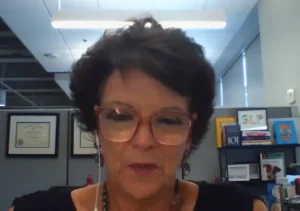
Robin (M.A., CCC-SLP) is a school-based SLP in Tucson, Arizona. Pre-K through fifth grade. A caseload between 50 and 55 students, four days a week. Twenty-three years of experience across multiple states, districts, and settings.
She is not easily impressed. She has seen it all. And she had a very specific problem.
The Thing No One Talks About: Avoiding Goals You’re Not Comfortable With
Robin’s specialty has always been speech sound disorders. Articulation. Phonology. The artic world.
That’s where she felt confident. That’s where she felt at home.
But language goals? Those gave her anxiety.
So she did what a lot of SLPs do, quietly and without realizing it. She leaned into artic. And if a student had both artic and language goals, the language work would slide.
“God forbid a kid had both kinds of goals. I would focus on articulation, and then progress note time comes around and I’m like, oh my gosh, I have no data on language. What was I doing?” — Robin
This is not a character flaw. It is a systems problem. When you don’t have a clear framework for planning language sessions, when you’re also managing a bulky clipboard schedule and trying to prep for your SLPA and track Medicaid billing, you default to what feels manageable.
Language planning felt like one more thing to figure out from scratch.
What Changed When Robin Found a System That Actually Worked
Robin joined SLP Now primarily because she saw a colleague using the scheduling and caseload tools. She needed organization. That was the draw.
But what happened next surprised her.
The literacy-based therapy framework gave her structure for language planning that she hadn’t had before. Not just activities to download, but a way of thinking about sessions. A framework for how to approach language goals in a meaningful, contextual way.
“I’m having a lot less anxiety about planning for language therapy and I’m better at it and enjoying it more.” — Robin
After 23 years of leaning on articulation, she started actually enjoying the language side of her caseload.
That is a before/after transformation that no amount of marketing copy can manufacture.
How the Daily Schedule Tool Changed Her Whole Workflow
One of Robin’s most-used features is something that might surprise you: the daily schedule.
Before, she had a clipboard. Big, unwieldy, full of papers she had to flip through to remember where she was going and who she was seeing. Planning for her SLPA meant separate communication, separate prep.
Now she prints her schedule, knows exactly what she’s doing all day, and has a plan ready for her SLPA too.
“I know what I’m supposed to be doing all day and I don’t have to flip through my clipboard. I’ve got my day planned out and I can add things and I can have an SLPA who can help me and I have it planned out for her.” — Robin
This freed up mental bandwidth. And that bandwidth went somewhere good.
When Organization Frees Up Your Creativity
Robin is a creative SLP. She uses mini erasers, stampers, manipulables, artsy activities. Her hallway is full of student work. She loves bringing unexpected, multisensory moments into sessions.
But here is the thing about creativity: it requires energy. It requires margin.
When you’re scrambling to figure out your schedule, your goals, your data, and your billing, there is no room left for creative thinking. You default to whatever is close.
“I feel like I can do that because my time is freed up because I have SLP Now and I can just print my sheet.” — Robin
The system did not make her sessions more formulaic. It made her more free to be the kind of SLP she actually wanted to be.
The Imposter Syndrome Moment That Hit Close to Home
Robin mentioned something toward the end of our conversation that I want to sit with for a second.
There were times in her career, even with 20-plus years of experience, when a teacher would ask her to screen a student at a grade level she wasn’t as comfortable with. And the feeling that came up was imposter syndrome. A sense of “I shouldn’t even be here.”
The probes tool changed that. Having structured screening tools right there, ready to go, meant she could walk in prepared.
“You’ve got it all right there, literally.” — Robin
That is not a small thing. That is a veteran SLP feeling like a veteran SLP.
She Pays Out of Pocket. And She’d Do It Again.
Robin started using SLP Now as a contractor, when her company covered the cost. Now she’s a direct hire in a district without that budget.
She still pays for it herself.
“I pay for this out of pocket now because I’m no longer a contractor and I think it’s worth it.” — Robin
She also presented SLP Now to a whole team of SLPs at a neighboring district a couple of years ago. She showed them how she uses it, why it works, what it does for her day. That district later signed up.
She did that because she believed in it. Not because anyone asked her to.
What This Means for You
If you have been a school-based SLP for a while and you think SLP Now is for new grads or CFs, Robin’s story is for you.
If you have a strong specialty area and quietly avoid the stuff that makes you less confident, Robin’s story is for you.
If you are creative and fun and love your students but feel like the admin work is squeezing out the part of the job you actually love, Robin’s story is very much for you.
The system does not replace your clinical judgment or your personality. It gives you the structure that lets both of those things show up.
Ready to See If It Works for You?
Start with a free 14-day trial. No credit card required. Full access to the platform, including scheduling tools, caseload management, literacy-based therapy materials, and more.
You can even just poke around. See what Robin keeps talking about.
The floor is yours.
x Marisha




Leave a Reply