• Skip to primary navigation
  • Skip to main content
SLPNOW_Logo_Color
  • For SLPs
  • For Districts
  • Success Stories
  • Resources
    • Blog
    • Podcasts
    • SLP Goal Bank
    • Speech Therapy Tools
    • Contact
  • Pricing
Login
Free Trial

Marisha

Why I Tossed My Decks of Cards

December 12, 2017 by Marisha 5 Comments

Don’t worry. I didn’t throw out hundreds of dollars of therapy materials. 🙂

Here’s what actually happened…

My first therapy room was brimming with materials. I felt like I had every therapy material out of every catalog I ever looked at! I had shelves filled with therapy decks.

When I moved out of state, I was given a completely fresh slate. My therapy room was empty (with the exception of a few games).

First, I started to panic…

How am I going to do therapy without all of my stuff?!

But then I realized… I don’t need all that!

After some trial and error at my previous job, I started implementing curriculum- and literacy-based (i.e., contextualized) therapy.

I wasn’t using those materials anyway.

I no longer had a lot of materials on my shelves, and it ended up being a good thing!

• Students were no longer distracted by piles of materials floating around my room.
• I felt less overwhelmed.
• It was easier to plan for therapy.
• My students were making more progress!

Therapy Without Materials?!

Okay, okay. I did have some materials.

The best part about contextualized therapy is that it’s really easy to find free materials!

The library was filled with picture books (which I paired to match what my students’ were learning in the classroom).

I was also able to pull curriculum-based activities (e.g., a reading passage, a research paper, etc.) from the classroom.

That’s pretty much all I needed to plan my therapy sessions! *

How is that Therapy?

Great question.

If we’re just using the curriculum, aren’t we teachers (not speech/language pathologists)?

The good news is that we can use our therapy toolbox (the one we worked so hard to build in graduate school) in just about any context.

It can be a little uncomfortable to step away from what we’ve always known.

After all, a therapy deck and board game reinforcer were definitely not uncommon therapy choices as I went through my training!

Sidenote: There is a time and a place for this kind of therapy. (I know, right?! If only things could be black and white.) This is where clinical judgment comes in–that mushy skill we worked so hard to build!

I found that I was able to make a more significant impact on my students’ when I stepped out of my “card deck/board game” therapy box.

The best part? It doesn’t have to be hard!

That said, I know it can be overwhelming to think about making that shift.

I’ve made a lot of mistakes along the way (and learned a lot, too!). I’m so excited to share what I’ve found with you. We can do this together!

* More on this soon! Stay tuned! 🙂

Filed Under: Speech Room Organization Tagged With: Literacy-Based Therapy, Organizing Therapy Materials

The Two Biggest Mistakes I Made as an SLP Clinical Fellow

December 5, 2017 by Marisha Leave a Comment

So, there I am…walking into Johnny’s IEP meeting ready to celebrate all of the progress he’s made. He met all of his goals this year!

I make my way towards my usual seat when I overhear the general education teacher chatting with the resource room specialist…

“Johnny’s doing okay, but he just can’t seem to follow directions.”

“I agree. He needs so much support in the area.”

I quickly glance at Johnny’s IEP.

Johnny will follow two-step directions with 80% accuracy. Goal met.

via GIPHY

And then I panic…

What am I going to say?

What do I do?

Will they think I’m a fraud?

I’m really not the anxious type. 😉

In all seriousness, I just wanted to run and hide at this point!

Have you ever been in my shoes?

This happened when I was a CF.

I was so embarrassed.

I never wanted to be in that situation again.

So, I took action…

After the meeting, I called my clinical supervisor to debrief. We talked about what happened and did some brainstorming.

My Mistakes

I knew I should have checked in with the teachers ahead of time. That was Mistake #1.

I did chat with the teachers prior to the IEP meeting, but I should have checked in with them on a regular basis. I also should have asked for input on Johnny’s specific goals. (It turns out she didn’t even realize Johnny was working on following directions, so I had some work to do there, too!)

But then we started talking about the bigger issue… Mistake #2.

What I was doing in therapy was not relevant.

We were playing really cute games and having fun. However, what happened in the speech room, stayed in the speech room… And that’s not what we want!

It didn’t matter if Johnny could follow 38-step directions in my room. He needed to be able to follow directions in the classroom!

And Johnny wasn’t the exception…

I wasn’t doing enough to help my students connect the skills we were targeting in therapy to the “real world.”

And let’s be real… I was totally and completely overwhelmed.

How in the world was I supposed to help my 60+ students generalize what they were learning?

What I Found

I did some research and kept reading this phrase: Contextualized Language Intervention.

I started implementing some of the ideas and strategies that I found in the research, and I was hooked.

My students were just as engaged (if not more!), and we were making real progress.

I saw it. The student saw it. The teachers saw it.

It was amazing!

Contextualized Intervention?

Okay… Let’s back up a second.

What is contextualized intervention? It is when we “provide explicit skill instruction in ways that are meaningful and purposeful to the student” (Ukrainetz, 2007).

We can make sure that what we are doing is meaningful and purposeful by communicating with those around us! I started communicating with teachers to find out what students are working on in the classroom.

The context is clearly very different depending on the age of the student!

Preschool is filled with games, music, and crafts. Early elementary students are reading picture books and doing science projects. Secondary students are diving into textbooks and writing papers.

The context can also vary by classroom and by teacher, which is why it’s so important to communicate.

Being relevant is key!

We need to consider our students’ context when writing goals and developing treatment plans.

Don’t Just Take My Word for It

Here’s what others have to say about this approach…

“I have been advocating that SLPs engage in ‘curriculum-relevant therapy’… that they use curriculum as context for language therapy but not try to teach curriculum per se. In this approach, an SLP would focus on language processes, or ‘underpinnings'” (Ehren, 2009).

“Gillam, Gillam, and Reece (2012) provided small-group intervention three times a week over 6 weeks. The intent of the research study was to evaluate narrative intervention that is contextualized (literacy based) versus decontextualized commercially available games and drill cards designed to increase vocabulary, sentence complexity, and social language. The contextualized intervention used explicit and implicit questions, vocabulary, and syntax thematically tied to literature. The results indicated that students’ comprehension and story retelling/generation skills improved more with the contextualized intervention as compared to decontextualized intervention” (Brandel, 2014).

ASHA has something to say about it, too…

“Individualized programs always relate to the school work. Therefore, materials for treatment are taken from or are directly related to content from classes.” (ASHA Guidelines)

But…

Yeah, I know.

There’s a big “but” there.

This sounds amazing, but how do I find the time to implement this with my caseload of 100 students?

It sounds like a lot of work.

It definitely was not an overnight win for me, but it is totally do-able. We can do this together!

If you’re on board, stay tuned! I’m going to be sharing tips, tricks, and resources to help you make this happen.

Filed Under: Therapy Ideas Tagged With: Literacy-Based Therapy, Teacher Communication

3 Tips for Easy Data Collection

November 28, 2017 by Marisha 2 Comments

Does data collection make you feel… frustrated? overwhelmed?

via GIPHY

Especially when you’re working with mixed groups, it can be overwhelming to think about taking data for four students who each have three different goals. That’s a lot of data, right?!

Here are my top three tips to reduce overwhelm when taking data…

Tip 1: Start with One Goal

If the process is entirely too overwhelming, pull out a quick probe at the beginning of session. Spend 5 minutes collecting data for all students in the group (one goal each). Rotate through the goals every week. (This is a great time for all of the students to review their goals and “check in” to speech.)

This way you don’t have to worry about taking perfect data during the session. You can focus on what matters–the students!

Over time, you’ll find it easier to track data while juggling all the other tasks involved with running therapy for a mixed group, and you’ll be able to collect more data during the session.

What do the probes look like?

For articulation goals, I have my students jot down a list of words on their goal card. This makes it possible to quickly run through the words (at the appropriate level).

For vocabulary and grammar goals, I pull targets from the book or reading passage that we’re reading. The book guides in the SLP Now membership make this really easy! Alternatively, you can use premade probes. Nicole Allison has a great data binder that can be used for this purpose!

For social skills goals, I tend to make observations during the session.

NOTE: This is different than quarterly progress monitoring! Especially with vocabulary and grammar goals, the complexity of targets will vary. Criterion-referenced tests are a great tool to use for a more consistent measure of progress.

Tip 2: Use a Rubric

If you are a fan of contextualized intervention, then you will be scaffolding your students throughout the session. You do not have to collect the probe data every session (especially if you have a good system in place).

I created this Level of Support Rubric so that I can consistently describe the level of support that I provide. When I’m reviewing my students’ progress, their accuracy may not change a lot, but I know they’re making progress if I’m able to fade my scaffolding (e.g., from maximal tactile cues to minimal visual cues).

Occasional probes (see step 1) are a good support measure. 🙂

Tip 3: Stick with a System

This is what I struggled with most! I always felt like there was a better way to take data. I was constantly making changes to my system throughout the year. (Mostly because I picked some horrible systems!)

Check out these blog posts so that you don’t make the same mistake!

• Here is a review of 10+ data collection options! I chat about the pros and cons of each so that you can decide which system will work best for you.
• I also wrote about the data collection system that I’m currently using.

You got this! Conquer that data! 🙂

Want to start taking Digital Data? Join our free Digital Data Bootcamp today and get started!

via GIPHY

Leave a comment below if you have any questions (or tips of your own to share)!

Filed Under: Caseload Management Tagged With: Curriculum-Based Therapy, Data, Organizing Therapy Materials, Productivity, Theme-Based Therapy, Therapy Plans, Tools

Data-Based Therapy Planning for SLPs

November 22, 2017 by Marisha 12 Comments

Why do you collect data?

Is it because it’s required?

Because you need it for Medicaid billing?

Because you know progress reports will be a pain if you don’t?

Or because it helps you provide better therapy?

Especially as a CF, I didn’t always know if I was being an effective therapist. I had a lot of doubts…

Data was the main thing I relied on to give myself a little boost of confidence. I was eager to get feedback from students, teachers, parents, my principal, and other SLPs, but there wasn’t a whole lot of that! Data was the only thing I could consistently use to evaluate how I was doing.

The only problem was that it was so incredibly time-consuming!

It took a lot of trial and error to streamline the process. (You don’t want to know how many data collection systems I’ve tried…!) After several years, I feel like I finally found a good routine. I finally feel (mostly) confident* about how I’m doing as a therapist.

* Let’s be real! We see so many students with a wide range of diagnoses. There’s no way we can know it all. There’s always something to keep me on my toes. Luckily, I can connect with colleagues, read research articles, and complete CEUs to figure things out. I use the data to “course correct” as needed.

It’s quite the overwhelming process, isn’t it?

We have anywhere from 30 to 100s of students… All of whom have multiple therapy goals.

How are we supposed to keep up with all of those goals?

I’m going to share how I keep up with the data using SLP Now, but I encourage you to find whatever system will work best for you.

Step 1: Gather Your Caseload Data

One of the biggest steps for me was getting all of my caseload data organized. Once I knew who was on my caseload and what each student’s goals were, I immediately felt more confident.

No more nightmares about completely forgetting a student’s goals (or a student altogether…!). 🙂

Am I doing this right? Am I good at my job? These are questions that I often asked myself--until I found a system. Now, I am much more confident in my skills and abilities! Click through to read more.

Step 2: Set Up Your Therapy Schedule

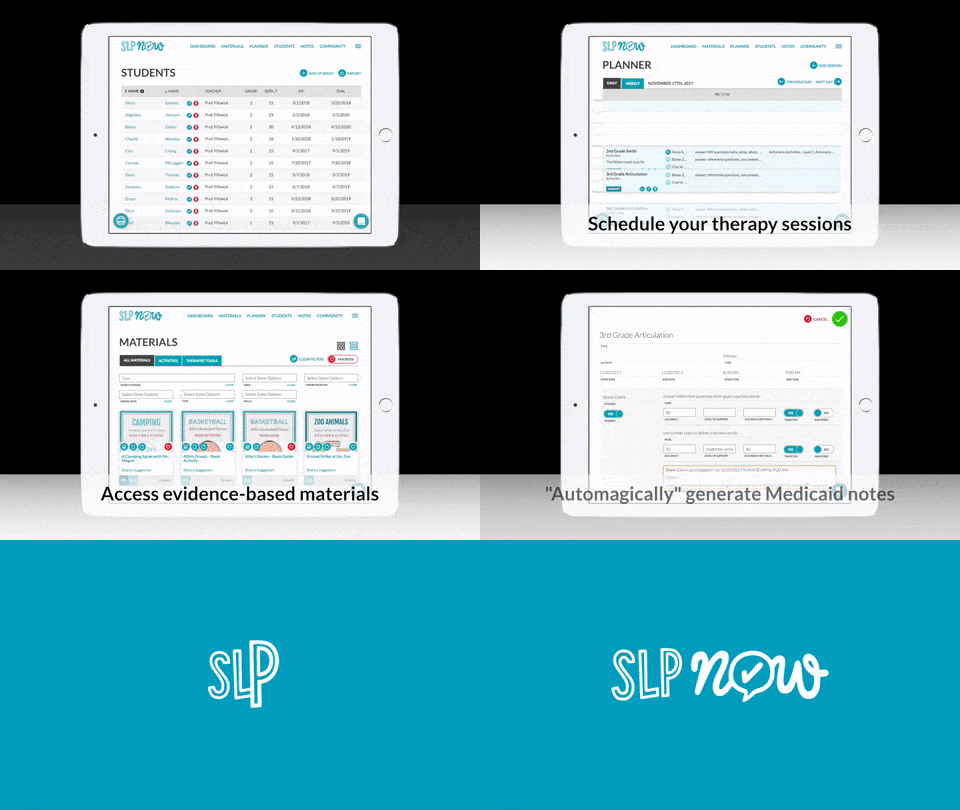
In order to plan for therapy, we need to know who we’re seeing and when. The SLP Now planner makes it really easy to do that! You can set up your schedule for the year in just a few clicks.

Am I doing this right? Am I good at my job? These are questions that I often asked myself--until I found a system. Now, I am much more confident in my skills and abilities! Click through to read more.

Step 3: Get Some Materials

Now, we need to figure out what we’re going to be doing in therapy. SLP Now includes a library of materials incorporating evidence-based strategies. We are incredibly busy as SLPs, but the low prep, engaging materials make it possible to plan effective therapy without spending hours every week.

Best part? You can easily add the materials to your session.

I got into a routine of reviewing my students’ progress and planning the next week of activities on Friday afternoons. Once I got into a routine, it only took me 10 minutes to plan the activities for the following week.

Especially during the crazy weeks filled with paperwork and meetings, it felt really good knowing that I had a plan for my students. No more running around like a headless chicken trying to gather materials!

Am I doing this right? Am I good at my job? These are questions that I often asked myself--until I found a system. Now, I am much more confident in my skills and abilities! Click through to read more.

Step 4: Collect the Data

The fun part… Collecting data!

I said goodbye to massive binders and folders taking over my speech room and started to take all of my data digitally.

I love it because I enter the data in one convenient place, and SLP Now organizes it for me. It makes it really easy to bill Medicaid, write progress reports, and fill in present levels for the IEP.

Want to start taking Digital Data? Join our free Digital Data Bootcamp today and get started!

Am I doing this right? Am I good at my job? These are questions that I often asked myself--until I found a system. Now, I am much more confident in my skills and abilities! Click through to read more.

Step 5: Adjust as Needed

When I’m doing my planning at the end of the week, I can quickly glance at a student’s graphs. Are they making adequate progress? Did I forget to target any goals?

This makes it really easy to be proactive! If a student isn’t making progress, I can do some troubleshooting. I can try a new technique or reach out to the IEP team. Being proactive has significantly reduced the number of awkward IEP meetings, and my students are making better progress!

Am I doing this right? Am I good at my job? These are questions that I often asked myself--until I found a system. Now, I am much more confident in my skills and abilities! Click through to read more.

So there you have it!

Leave us a comment and let us know how you plan for therapy!

Want to start taking Digital Data? Join our free Digital Data Bootcamp today and get started!

Filed Under: Caseload Management Tagged With: Apps, Curriculum-Based Therapy, Data, Organizing Therapy Materials, Productivity, Theme-Based Therapy, Therapy Plans, Tools

Easy Therapy for Preschool SLPs

November 18, 2017 by Marisha 2 Comments

Many of you have asked… Is SLP Now appropriate for preschool SLPs?

Now you don’t have to take my word for it! Kayla from Kayla SLP is guest blogging today to share how she uses SLP Now materials with her preschool caseload.

My caseload is made up of one-third preschoolers. This means, at any given time, I am planning speech and language activities for 20 three-to-four-year-olds. It can be a little overwhelming! Preschool requires a very different style of activities than my older students.

As you may already know, I am an SLP Now subscriber. I use materials from the site with almost every single student on my caseload, preschool included.

I’m here to tell you my favorite ways to use the SLP Now membership with my preschoolers.

1. Books and Companions

I often use books with my preschool students. SLP Now has tons of book suggestions appropriate for preschool, along with book guides and activities.

Let’s say you’re using themed therapy, and your current theme is bugs.

SLP Now has a book guide and activity pack for In the Tall, Tall Grass.

I typically spend one session just reading the book and talking about it with my students. We look at the pictures together, talk about the vocabulary, make our own sentences (“I see the ___ in the grass”), and describe the characters. Oftentimes, I will have the students take turns retelling the book by flipping through the pages and looking at the pictures. (I love hearing their storytelling abilities, and they love getting to “read” the book back to their peers.)

During the next session, I will bring out the comprehension activities in the book guide – answering wh- questions, sequencing the story, and doing a craft (as time allows). Sometimes I carry the craft over into a third session.

Speaking of crafts…

2. Crafts

In my opinion, the best preschool therapy is hands-on. One easy way to make therapy hands-on is to use crafts. The crafts on the website are themed to match the books and other activities, so you can build your therapy around a topic.

For example, let’s continue with the bugs theme. You can use In the Tall, Tall Grass craft alone or in conjunction with the book activities. If you read the book first, you can carry over the craft into the next session and send the finished product home as extra practice. The students are able to keep their hands busy while working on sequencing, vocabulary, articulation, and more! This makes the session more engaging for everyone!

3. Extension Activities

Finally, I tend to also use the extension activities with my preschool students. These activities are also hands-on and are a good way to continue building upon your theme.

Continuing with the bug theme, there is an extension activity for a scavenger hunt. Depending on your preferences, you can go on an actual bug hunt outside, hide printed bugs around the room, or hide plastic bugs in a sensory bin.

The extension activities are what I use for carryover. Students are able to use what they learned during previous lessons during a less structured activity, and we all know how important carryover is!

In summary, there are tons of ways to use the SLP Now materials with your preschool students. You can use the themes as a whole, or use bits and pieces of each theme, depending on your students and their needs. Either way, there’s plenty of activities that both you AND your preschool students will love!

Filed Under: Therapy Ideas Tagged With: Books, Crafts, Preschool, Theme-Based Therapy, Therapy Plans

How to Keep Track of ASHA CEUs

November 15, 2017 by Marisha 2 Comments

So, it’s New Year’s Eve, and you’re rushing to submit your ASHA dues.

But wait… You realize you need to submit your hours, too.

Oh man! You start racking your brain to figure out which CEUs you’ve completed.

You know you have some certificates in your desk at work… And some must be in the pile of papers in the kitchen.

What a mess, right?!

The good news is that ASHA doesn’t require you to submit your certificates when you enter your hours.

“You must keep documentation of these activities. You do not need to send your documentation to ASHA unless you are notified that you have been selected for an audit.” – ASHA

Yeah! That’s good news! No need to sneak into our speech rooms on New Year’s Eve.

However, we do need a way keep track of our hours in case we are audited.

ASHA gives us a handy record keeping form.

You could print the form and keep it in a special CEU folder. Just fill in the required information and attach your certificates. Easy enough, right?!

If you’re like me and will do anything to cut down on the paper clutter, you might be interested in the paperless system I set up for myself.

I made a Google Form, and you can use it, too.

Here’s how to set it up!

1. Click the link. (This will copy the form to your Google Drive.)
2. Bookmark the link. (BONUS: You can add the form to your iPhone home screen.)
3. Fill out the form whenever you complete a course.

Optional: Upload the certificate for the course. (You can even snap a picture of a certificate if you’re using the form on your phone/tablet.)

Just fill out the form every time you complete a course, and it’ll make a log for you!

If you’re taking courses in the SLP Now Academy, we will email you all of your course details and a certificate. You can easily copy and paste into your Google form!

Here’s how to view your log!

Click the “Response” link, and then click the little green icon (“View Responses in Sheets”).

This matches ASHA’s form, so it’ll be really easy to copy and paste the information if you are audited (or if you’re submitting hours to other organizations). You’ll also have easy access to all of your certificates (if you choose to upload them). Win, win!

You might be wondering…

How do I actually submit the hours I tracked myself?

If you signed up for the ASHA Registry, certain courses will automatically appear on your transcript. (Be sure to check with the CEU provider. Not all courses will appear on the Registry.)

If you are logging your own hours, ASHA gives us some helpful instructions. All you have to do is submit the compliance form at the end of your interval. You don’t have to enter your hours or share your log unless you are audited.

ASHA Compliance Form

What hours actually count?

ASHA outlines the requirements for professional development and acceptable activities that can count toward your 3-year interval.

Filed Under: Outside the Speech Room Tagged With: Google, Productivity, Professional Development

How to Set Up Working Student Folders for Speech Therapy

October 18, 2017 by Marisha 5 Comments

Piles of papers stacked on all desks and tables. Therapy materials scattered across the room. A to-do list that’s a mile long.

This unfortunately isn’t an uncommon situation in the life of a school-based SLP.

Sometimes some of that clutter is inevitable, but I absolutely hate it when I can’t find the materials that I need for a session.

I needed a streamlined and efficient way to organize my students’ data and activities.

I tried a number of systems (file folders, binders, portfolios) in attempt to keep track of it all.

The New Student Folder

Here’s a quick peek at how I organize my student folders:


View this post on Instagram


A post shared by SLP Therapy Materials and Organization (@slpnow)


I was browsing on Amazon for cheap solutions, and I came across these adhesive prongs.

I stick them in regular folders. They make it so easy to quickly add new pages (and flip through old ones).

I keep a two-hole punch by the therapy table. This makes it so that my students and I can quickly add new pages to the folder.

What Can You Keep in the Folder?

• Visuals: I love having easy access to visuals so students know what they’re working on, and it’s easy for me to quickly scaffold a new skill.  (I store most of my visuals in my therapy tote, but I use student folders to store visuals that I customized just for the student or visuals that the student created.)
• Vocabulary Journals: Vocabulary journals are my favorite! There is so much research on the benefits of vocabulary journals, and the sheets can be easily stored in the folder.
• Goal Cards: Increasing student goal awareness is related to better outcomes. I want to give my students ownership of their data.
• Therapy Activities: I also add in any paper activities completed during our sessions. It’s nice to have a mini-portfolio to share with parents/teachers at conferences.
• Curriculum-Based Therapy: I set up a folder for every student, but I also use it to keep track of activities that teachers share with me.


Here’s a link to some of the materials I used to set up my folders!

Filed Under: Speech Room Organization Tagged With: Organizing Therapy Materials, Progress Monitoring, Student Engagement, Therapy Plans, Visuals

How to Use a Pocket Chart for Easy Literacy-Based Therapy

October 11, 2017 by Marisha 7 Comments

How can I possibly target all of my students’ goal in one speech therapy session? Johnny is working on describing and past tense verbs. Chloe has goals to use pronouns and answer WH questions. Zach is working on multiple meaning words and compound sentences. Yikes! Those mixed groups seem tricky, don’t they?

They don’t have to be!

You can check out the video (above) for a walkthrough of my “system.”

Want a quick overview? Scroll down to read more!

Why Pocket Charts?

I was reading a lot about literacy-based therapy. I read a lot of articles, and the second chapter in Ukrainetz’s book (Contextualized Language Intervention) was what helped me piece everything together. Ronald B. Gillam and Teresa Ukrainetz shared a five-step “protocol” for literacy-based therapy.

Want to learn more about the five steps? Check out the book or the webinar in the SLP Now Membership for a closer look!

Now that I had a framework, I started trying to think of a way to actually implement this in therapy. I knew I needed…

– something visual, making it easy to scaffold a variety of skills (e.g., articulation, grammar, language, pragmatics).
– something simple, so I wouldn’t have to spend hours prepping for every unit.
– something versatile, with the ability to target basic levels (e.g., drill-based practice), as well as the ability to build up to larger skills (e.g., generating a narrative).

I was observing in a classroom where the teacher happened to be using a pocket chart to organize her sentence strips. The rest is history!

After some fine tuning, I was able to use a pocket chart to target my students’ goals in a visual, simple, and versatile way.

The Process

Now, let’s chat about how we can use the pocket chart in therapy!

NOTE: You’ll want to make sure your students are aware of their goals before jumping into using a pocket chart in therapy.

Step 1: Create Cards

We have two options here!

1. We can use index cards and write on words.

2. I created templates for the parts of speech (e.g., conjunctions, prepositions, etc.) and for vocabulary words (to guide students when defining the words). You can find these tools in the SLP Now Membership!

Ideally, we would involve students in as much of the process as possible. Stay tuned for more tips!

Step 2: Practice

This may happen before/during/after the actual book reading.

What does this actually look like?

  • Check out the video at the top of this post for some general suggestions.
  • I shared some ideas for grammar intervention.
  • I am working on more detailed posts/videos for a variety of target areas!

Step 3: Build Up

After repeated opportunities for practice, we’ll start building up. Students will start to combine sentences to retell the story and/or generate parallel stories.

The best part? We already have visuals on hand to scaffold these skills! We can use the target cards/sentence strips to support our students as they begin to use their new skills in an embedded context.

Want to learn more? Stay tuned for more blog posts with more specific activity ideas.

Filed Under: Therapy Ideas Tagged With: Language, Literacy-Based Therapy, Tools, Visuals, Vocabulary

Top 5 Sites for FREE Nonfiction Reading Passages

October 4, 2017 by Marisha 2 Comments

So you’re looking for materials for your therapy sessions, and you’re coming up blank…again?! You don’t want to spend $6 on another therapy activity, and you can’t find anything engaging enough in your therapy cabinet.

Good news, though! You can find thousands of FREE high-interest reading passages in a matter of seconds.

Before we start exploring the options, here are some of the reasons why I love using reading passages in therapy:

  1. They’re a great way to engage students.
  2. Reading passages are also an easy way to implement curriculum-based therapy.
  3. You can use them to target a variety of goals (like grammar and vocabulary).

Drum roll, please… 🙂 Here are five of my favorite sites!

1. ReadWorks

Struggling to find engaging activities for your therapy sessions? Check out these sites that have FREE nonfiction reading passages. They include a wide range of topics, and there’s bound to be something to engage the trickiest of students!

ReadWorks offers articles for a variety of topics (e.g., social studies, science, and literacy). They cover kindergarten through 12th grade.

They have a sidebar search (like NewsELA), which allows you to find articles by grade.

Once you open an article, you can view details about the text (e.g., reading level, vocabulary words, Common Core State Standards). Not all articles have the same features, but here are some features that ReadWorks offers:

  • Audio versions of the article (“human voice audio”)
  • The ability to modify the level of the text (they call this StepReads)
  • Vocabulary pages (with leveled definitions, pictures, and examples)
  • Question pages (with multiple choice and open-ended questions)

ReadWorks also lets you save articles and assign them to students (for free!). It’s also really easy to print out the articles, vocabulary targets, and question pages.

You do have to login to access the full article, but you can search for articles without logging in.

2. NewsELA

Struggling to find engaging activities for your therapy sessions? Check out these sites that have FREE nonfiction reading passages. They include a wide range of topics, and there’s bound to be something to engage the trickiest of students!

NewsELA has a variety of articles on a number of topics (e.g., arts, culture, health, history, science, sports, opinion pieces, and MORE!). They even have articles on dream jobs (how cool is that?!). They also offer some articles in Spanish. They cover kindergarten through 12th grade.

As you can see in the screenshot above, NewsELA also has a nifty search sidebar that lets you filter by grade, reading skill, language, and more.

While you’re reading an article, you have the ability to adjust the reading level, to highlight and annotate text, to complete vocabulary activities, and to take a quiz.

You can also create Text Sets (which allows you to save articles and share the link). This would be especially great if you’re implementing curriculum-based therapy. The teachers might be using Text Sets to keep track of the articles they want to read with their class.

They also have a paid “PRO” version. The allows you to assign articles to students, to track progress (e.g., quiz scores), and to access teacher created resources (to pair with the texts).

Note: You do have to login to access the articles.

3. Wonderopolis

Struggling to find engaging activities for your therapy sessions? Check out these sites that have FREE nonfiction reading passages. They include a wide range of topics, and there’s bound to be something to engage the trickiest of students!

Wonderopolis is PERFECT for those “why” students–the ones who are constantly asking, “Why?”

The passages include some nifty features. Students can listen to the passage being read aloud. (The voice is robotic, but it could work well as an independent activity!) They highlight key vocabulary words and included assessments for vocabulary and comprehension. There are extension activity/discussion ideas at the end of the passages.

Students are also able to submit their own questions (and vote on other students’ questions), which is pretty neat!

You can find companion activity ideas on their other site (Wonder Ground). These are created by teachers, but many of the ideas would pair well with a literacy-based approach to therapy.

They also offer Camp Wonderopolis. It is a “free online learning destination [that] is full of fun, interactive STEM- and literacy-building topics boosted by Maker experiments!”

Note: You don’t have to login to access the articles!


4. TweenTribune

Struggling to find engaging activities for your therapy sessions? Check out these sites that have FREE nonfiction reading passages. They include a wide range of topics, and there’s bound to be something to engage the trickiest of students!

TweenTribune includes articles for kindergarten through 12th grade. They search for relevant articles on the web and then modify them for a variety of Lexile levels. As you can see in the screenshot above, it’s easy to select articles based on Lexile levels.

You can create a teacher account and add students to your “class.” You can view their quiz scores and comments from your account.

They offer teacher resources on the site, as well. Great for extension activities!

There are quite a few advertisements on the site, which might distract students if you want to read the article from the browser. The advertisements don’t show up in print view, which makes prep easy!

You don’t have to login to view the articles, but you do have to login to access the quizzes.

5. CommonLit

Struggling to find engaging activities for your therapy sessions? Check out these sites that have FREE nonfiction reading passages. They include a wide range of topics, and there’s bound to be something to engage the trickiest of students!

CommonLit offers some MEATY texts for 5th through 12th graders. There are a wide range of texts (including author studies, thematic units, informational units, and book pairings).

CommonLit also has a sidebar search feature, which makes it easy to find articles by grade, theme, genre, literary devices (e.g., figurative language), and Common Core State Standards.

They have some awesome features in the browser. So many options here!

– They have numbers next to key vocabulary words (Tier 2 and Tier 3).

– They have clickable bubbles in the text for comprehension questions. This would be perfect for students working on citing the text when answering questions.

– They include higher level/analysis questions in the “Assessment” and “Discussion” sections.

– There is a bar on the top right with options to read the text aloud (with simultaneous highlighting of words being read), to translate to Spanish, to define vocabulary words, and to highlight text.

– There is a bar on the very top that lets you find related articles AND a parent guide.

They have a “Download PDF” option, which includes the article (and annotations for vocabulary words), text-based questions, and discussion questions.

You don’t have to login to access the texts/features. You do have to login to access the teacher guides. (A teacher account is FREE and allows you to assign texts, review student work, and more!)

If you work with younger students and are feeling a little jealous, it sounds like they are working on adding texts for 3rd and 4th grade students, as well!

The Final Verdict

These are all amazing FREE resources for us to use in therapy. They all include quality content that is bound to keep your students engaged.

All of the articles include nice photos, which is perfect for pre-reading and/or extension activities.

A few questions to ask yourself when picking your “go-to” resource…

– What ages do you work with?

– Are your teachers using any of these tools?

– Do you have any “must-have” tools (e.g., annotate/highlight text, vocabulary recommendations, reading level modification, skill search, Spanish articles)?

Let us know in the comments below! Which site is your favorite for free reading passages?

Filed Under: Therapy Ideas Tagged With: Apps, Curriculum-Based Therapy, Freebies, Language, Literacy-Based Therapy, Theme-Based Therapy, Therapy Plans, Vocabulary

My 6-Step Process to Quickly & Easily Collect Language Samples

September 22, 2017 by Marisha 44 Comments

When you’re first starting to work with a new student, one of the “go to” assessment tools is a language sample.

But wait…

What if you don’t have time to collect language samples?! Aren’t they incredibly time-consuming?

They don’t have to be!

What is a language sample? Why is it important?

Before we jump in, let’s chat a little bit about why we should even bother with language samples.

Language samples, and particularly narrative language samples, may offer a valid complement or even alternative to norm-referenced testing (Ebert & Scott, 2014).

1. Language samples address many of the weaknesses of norm-referenced testing.

2. They provide rich, in-depth information about a child’s use of language in real-world situations (Costanza-Smith, 2010; Hewitt, Hammer, Yont, & Tomblin, 2005), resulting in strong ecological validity and the ability to derive language treatment targets.

3. They place very few behavioral requirements on examinees, allowing for flexible use across children of diverse ages and types of impairment (Costanza-Smith, 2010).

4. They have been shown to be a valid assessment for diverse populations, including bilingual children (Restrepo, 1998) and speakers of nonstandard dialects (Stockman, 1996).

And guess what?! It doesn’t have to take you hours to analyze your samples.

6 Steps to Streamline Your Language Sample Collection

When documenting my language samples, I wanted some quick and easy data to share. The mean length of utterance (MLU), or the average number of morphemes per utterance, is a quick, easy, and useful measure. Several research studies cite MLU as an “index for language development” (e.g., Condouris, Meyer, & Tager-Flusberg, 2003; Tager-Flusberg et al., 2009). We also know that students with language delays/disorders produce shorter utterances and use fewer grammatical morphemes. We even have some norms that we can refer to when making clinical decisions. (MLU isn’t the only measure we can look at, but it is a very helpful starting point!)

I used to manually count all the morphemes/utterances and pull out a calculator to do the math, but I knew there had to be an easier way! I did some research, and I was able to create a smart spreadsheet that automatically calculates MLU for you!

A post shared by Marisha (SLP Now) (@slp_now) on May 1, 2017 at 7:48pm PDT

Here are the steps to use it!

1. Enter Student Information

I typically only include my student’s initials. My school district didn’t purchase the HIPAA-compliant version of Google Drive, so I want to avoid including too much student data.

I also include the date, time, and type of sample collected.

2. Start the Timer

Give the student a prompt (e.g., a conversation starter, a wordless picture book, sequencing cards, etc.) and start typing away!

To calculate mophemes (instead of words), just want to add a space in between every morpheme. For example, “The cats walked across the room” would be “The cat s walk ed across the room.”

I hit “Enter” to move each utterance to a new line.

I usually record the sample so I can refer back to it, if needed.

3. Add Relevant Notes

I make note of anything that struck me in regards to language content, form, or use.

4. Delete Extra Rows

I delete extra rows, so the spreadsheet only calculates the MLU using the student’s utterances.

5. Update the Number of Utterances

I highlight the utterances, and Google Sheets automatically calculates the number for me. I update that number on the bottom of the sheet. (We typically want to shoot for 100 utterances in a language sample.)

6. Language Sample = Complete

Now, it’s time to “plug and chug.” I move the data into my report. Because I took notes in “real time,” it makes it really easy to describe what actually happened during the language sample (rather than guessing…!).

You can also print the sheet to attach to your report.


Want access to this spreadsheet and a special cheat sheet?

Click here for a free copy!

Filed Under: Caseload Management Tagged With: Apps, Assessment, Productivity

3 Insanely Easy Steps to Inventory Your Books

September 20, 2017 by Marisha 2 Comments

Have you ever bought the same book twice? Three times? Four times?

I may or may not be guilty of that… 😀

Looking for an easy way to keep track of your books? Check out this blog post for a quick tutorial to easily inventory your books in your SLP library!

I started using the BookBuddy app, and it is AMAZING!

You can try it for free (up to 50 books). If you have more than 50 books, then you can upgrade for $4.99.

I was able to inventory hundreds of books in 1-2 hours. I did this about a month ago, and I’ve already used it several times. 🙂 Once when I was about to buy a book but I wasn’t sure if I already had it. A few more times when I wanted to use a book in therapy but couldn’t remember where I put it. I just pulled out the app and found the answer to my questions in seconds.

Why inventory books?

  • Easily find your books.
  • Avoid buying multiple copies.
  • Quickly identify books for specific therapy targets.

So, how does it work?

1. Scan the barcode.

This app has thousands of books in its library, so it automatically pulls a cover, title, and other details for most books.

Looking for an easy way to keep track of your books? Check out this blog post for a quick tutorial to easily inventory your books in your SLP library!

If a book isn’t in the app’s library, then you can enter your own details. I only had to do this for a few books!

2. Enter a tag.

You can use tags in a number of ways…

You can tag the location of the book. (The app also has a place to enter the physical location. It was just a little easier for me to add the tags.)

You can tag the age range.

You can tag possible goal targets. As I’m using books in therapy, I’m adding tags for possible goals. For example, Pirates Next Door would be perfect for a social skills group. I can add a “social group” tag. I could also tag certain speech sounds, specific language/vocabulary targets, etc.

3. Easily find your books!

Hit the search button on the bottom bar of the app. You can search by the title of the book, by author, by any of your tags…

The app also gives you the option to adding ratings, reading levels, genre, number of pages, and more.

The possibilities are endless! You can really customize this to organize your books in a way that makes sense to you.

Not ready to invest $4.99 on an app?
Sarah from SLP Toolkit also shares how she uses Evernote to inventory her books.

Wondering how to store your books?
Check out this post for some ideas!

Filed Under: Speech Room Organization Tagged With: Apps, Books, Organizing Digital Resources, Organizing Therapy Materials

Easy Craft Organization for SLPs

September 13, 2017 by Marisha 1 Comment

I’m always looking for ways to make therapy easier. It’s frustrating when I have an amazing activity planned, but I can’t find the materials!

I like using crafts to supplement my theme-based therapy activities. However, it can be easy to lose track of all the odds and ends.

I knew I had to do something to make this easier for myself!

Step 1: Choose Simple Crafts

The first step was simplifying my crafts!

Some crafts require a lot of little pieces. It’s easy to rack up quite the bill purchasing these materials, and we haven’t even found a way to keep track of all the bits and pieces! After a few “Pinterest fails,” I decided to only create crafts with a simple set of materials.

Side Note: If you’re looking for inspiration, the SLP Now Membership includes 50 different crafts that use a few inexpensive and easy-to-find materials. They also include visual directions, which work great as visual supports in therapy.

Step 2: Find a Storage Solution

Last year, I stored my materials in a therapy cart, which worked really well.

However, I changed jobs this year. I have a lot less space and am “on the go” quite a bit of the time. I needed something small and compact.

These craft boxes were the perfect craft organization solution! I found the satchels at a local craft store, but you can also find them on Amazon.

I love them because they’re stackable and easy to carry. It makes it so easy to keep everything organized!

Struggling to keep your craft materials organized? Check out this post for an SLP's favorite tips and tools for craft organization!

Anyone else obsessed with those compartments?!

I use one satchel with compartments to store odds and ends.

I use another satchel (without any compartments) to store the larger pieces (e.g., paper plates, paper bags).

Step 3: Reap the Benefits

Whenever we do a craft in therapy, I pull out the satchels. No more running around the room or digging through cabinets to find what I need!

Bonus! I may pull out the materials for my students, but–depending on the students’ goals–I can also use it as an opportunity to target a variety of skills (e.g., receptive vocabulary, following directions, and more!). Students can gather their own materials while practicing their speech and language skills. Perfect dual functionality! 🙂

How do you organize your crafts? Let us know by leaving a comment below!


Filed Under: Speech Room Organization Tagged With: Crafts, Organizing Therapy Materials, Theme-Based Therapy

  • « Go to Previous Page
  • Page 1
  • Interim pages omitted …
  • Page 28
  • Page 29
  • Page 30
  • Page 31
  • Page 32
  • Interim pages omitted …
  • Page 38
  • Go to Next Page »

Platform

  • For SLPs
  • For Districts
  • Pricing
  • Contact

Resources

  • Success Stories
  • SLP Now Blog
  • Podcasts
  • Speech Therapy Tools
  • Reviews

Policies

    • Cookie Policy
    • Privacy Policy
    • Terms of Service
    • Trust Center


social links

youtube

Youtube

instagram

Instagram

facebook

Facebook

© 2026 | All Rights Reserved | SLP Now®