• Skip to primary navigation
  • Skip to main content
SLPNOW_Logo_Color
  • For SLPs
  • For Districts
  • Success Stories
  • Resources
    • Blog
    • Podcasts
    • SLP Goal Bank
    • Speech Therapy Tools
    • Contact
  • Pricing
Login
Free Trial

Marisha

April Feature Recap

May 12, 2026 by Marisha Leave a Comment

In April, we focused on site performance improvements and security enhancements. We also launched two new features and updated two of our existing features! Read below for more info 👇

View the last time you targeted each stem level and the previous data for each stem level with the new Stem Level dropdown in the Planner. Check out this article for the details!

Batch printing options for interventions now include descriptions of strategies for any goal bank goal being used.

Click through sessions in the Planner without exiting the screen.

Set a default Planner view in your settings.

Let us know what you think and what you’d like to see next!

Filed Under: New Features

257: How to Run a Group When Everyone Has Different Goals

April 28, 2026 by Marisha Leave a Comment

Mixed groups are a reality for most school-based SLPs, and managing them well takes the right tools. In this episode, Marisha walks through how the SLP Now Visuals Binder makes it work, covering how to use it digitally in a pinch, how to test what works for your students, and why eventually printing and laminating your go-to visuals changes everything about session flow.

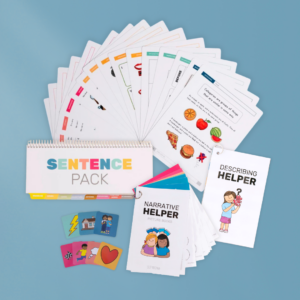
The binder covers preschool through 12th grade with 95 pages of evidence-based visuals across early language, grammar, vocabulary, and later language skills. No prep required. Just open it and use it.

Not a member yet? When you upgrade to a monthly or yearly membership within 7 days of starting your trial, we’ll send you the full bundle.

Start your free trial: slpnow.com/pod

If you’ve ever sat down to plan a session for a group of four students with four completely different goals and thought, “I have no idea how I’m going to make this work,” you are not alone.

Mixed groups are the norm in school-based practice. You might have one student working on following directions, one on past tense verbs, one on WH questions, and one on inferencing. And somehow you’re supposed to run a session that serves all of them, at the same time, without losing your mind.

For a long time, I was doing a lot of mental gymnastics to make that work. Flipping between materials, trying to remember what each student was targeting, losing the thread of the session because I was too busy managing logistics. It wasn’t good for my students and it definitely wasn’t good for me.

So I started building something different.

Why Visuals Change Everything in a Group Session

The core problem in a mixed group isn’t the goals themselves. It’s the cognitive load of trying to hold all of them in your head at once. When you’re tracking five different students, five different targets, and trying to deliver quality therapy at the same time, something always slips.

Visuals solve this in a surprisingly simple way. When each student has the visual for their skill in front of them, you stop being the only person holding the session together. The student can reference it independently. They can cue themselves. They don’t have to wait for you to redirect them. The visual does that work.

I’ve been using the same laminated visuals for ten years. Some of them I’ve updated, but many are exactly as I made them because they work. Once you find the right visual for a skill, it becomes a tool you reach for every time. Zero thinking required.

What’s Inside the Visuals Binder

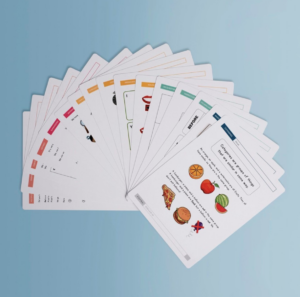
The SLP Now Visuals Binder is 95 pages of ready-to-use visuals that covers your preschool through 12th grade caseload. No prep. You open it, you use it.

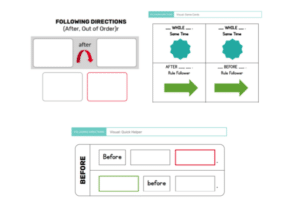
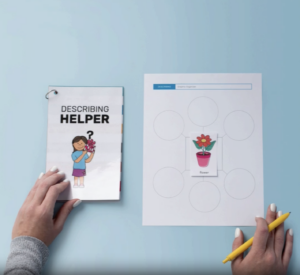
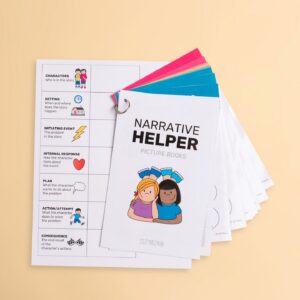
It’s organized into four main sections: early vocabulary and early language, grammar, and later vocabulary and later language. Within each section, you’ll find individual skill sets. Basic concepts, categories, following directions, narratives, WH questions, past tense verbs, plural nouns, pronouns, compound and complex sentences, affixes, context clues, idioms, multiple meaning words, inferences, main idea, summarizing, and more.

The binder has interactive links, so you click on a skill and it jumps directly to the visuals for that skill. That alone saves a lot of time when you’re looking for something specific mid-session.

How to Start Using It (Even If You’re Mid-Year)

The most common barrier to setting up a new system is the setup itself. You know you need better materials, but the idea of printing, laminating, and organizing 95 pages of visuals when you’re already behind feels impossible.

The digital binder handles that. Save it to your iPad. Pull it up when you need it. You can test different visuals, see what resonates with your students, and start getting the benefits of evidence-based visual supports right away. No need to wait for a perfect setup day that may never come.

Once you find a visual that works for a specific student, that’s your cue to print it. Log into SLP Now, go to the Materials Library, search for the skill, and download. Laminate it if you can. That one visual will probably serve you for years.

The Place Mat Strategy

My favorite way to use printed visuals in a group session is what I think of as a place mat setup. Each student gets the visual for their specific goal placed in front of them, like a place mat, before the session starts.

If Elliot is working on categories and Nelson is working on past tense verbs, each one has their visual in front of them. They know what they’re working on. They can self-cue. They’re not waiting on me to redirect them. It’s less mental gymnastics for me because I’m not flipping between pages. Each student’s reference point is already there.

It also opens up opportunities for generalization. If a visual is really working for a student, they can bring it back to the classroom. You can create a mini version. The skill stops living only in your session and starts connecting to the wider day.

The Research Behind the Visual

I didn’t put this binder together because it seemed like a good idea. I built it because I was managing a triple-digit caseload and I needed it to work. That meant going through the research and pulling out evidence-backed strategies that I could infuse directly into the visual design.

The result is that when you use these visuals, you’re not just showing a student a picture. You’re delivering therapy that’s grounded in how language learning actually works. The evidence is in the design. You don’t have to understand every study behind it to use it well.

Inside SLP Now, there are also courses and strategy resources for every goal area if you want to go deeper. But the visuals get you a long way there with very little effort.

Getting Access

If you’re not yet a member, the binder is included as a special bonus if you sign up for a membership within 7 days of starting your trial.

Ready to see how it works for your caseload? Start your free trial at https://slpnow.com/pod.

Transcript

Transcript
Email Download New Tab

Welcome back to the SLP Now podcast. The last two episodes we talked about streamlining your present levels for IEPs and evaluations. And then we talked about taking consistent data and having high student goal awareness and solid data for progress monitoring. And today we're talking about how to actually teach those skills.
So many of us have mixed groups. We have multiple students in a group. They all have different goals, and more often than not, there's zero overlap. We need to have tools to help our students know what they're working on. Also to have some built in queuing and just to help keep the session moving, especially if we have those mixed groups, multiple students, multiple goals, a lot of moving pieces.
So the Visuals Binder is a tool that is meant to make that process a little bit easier. The binder includes 95 pages of ready to use visuals and it'll cover your preschool through 12th grade caseload, zero prep. You just open it and you use it.
We have early vocabulary and early language, grammar, as well as later vocabulary and later language. For each section we have different skills, for example, basic concepts, and we have a lot of different resources there. And then we have categories, following directions, narratives, wh questions, a variety of different skills.
It moves through grammar, like past tense verbs, plural, nouns, pronouns, compound sentences, complex sentences, affixes, context clues, idioms, multiple meaning words, inferences, main ideas, summarizing, all of these great skills. There's interactive links so you click on the skill, and it'll jump to the visuals. You have a lot of things that you can test and try out. I personally really love having printed visuals, but if you are in the middle of the school year or you're just trying to get through, it can be challenging to get all of this set up, which is what the binder is meant to help you with.
You can, again, just save this on your iPad, have easy access to it. And then you can test out different visuals and see what works best for your students. And you might already have visuals that work really well, and you can just use this to fill in the holes. If you find a visual that you really like, you can print that out.
Log into SLP Now, go to the materials library, search for the skill, download that visual, and print it. I love laminating my visuals because I use them over and over and over. I've been using the same visuals for 10 years. I've made some additions and improvements, but some of them are just tried and true.
I created these visuals because I was managing a triple digits caseload. Honestly I was failing in the beginning, but I was determined to serve these students, because they deserve for me to be operating at the top of my license and giving them really high quality therapy.
So I dug through the research. I pulled out a bunch of evidence backed strategies, and I used these to inform how I put these visuals together. Inside of SLP Now, we also have strategies for every goal. We have courses to walk you through all of these evidence backed strategies that you can implement.
But these visuals get you a lot of the way there without a lot of effort. You just use the visuals and the evidence is infused in them. And of course, we are our best therapy tool and knowing the strategies and the evidence behind things makes it a lot easier. But this is surely a great way to get started.
You can use the digital binder to access the visuals that you need in a pinch. It is a great way to test out new visuals, see what works, and just get some quick, easy evidence-based strategies into your session right away.
Like I said, once you know what a student needs, I love using the visuals as a place mat, so then I know what each student is working on. And it's less mental gymnastics for me because flipping between a bunch of different pages does get a little confusing. So I do highly recommend printing them eventually.
If, Elliot is working on categories and Nelson is working on past tense verbs, each of the students has the visual for that skill in front of them. It's amazing because they can cue themselves independently. They don't have to rely on me as much. If it's helpful, they can bring the visual into the classroom, or we can make a mini version to help with generalization.
It makes things so much easier. That is our visuals binder and a quick overview of how you can use it and what's included.
If you want access to all of the binders in one nice little bundle, you can access that. If you are not yet a member, all you need to do is sign up for SLP Now.When you upgrade, we can send you that full bundle. So that is a wrap on this little series.

Scroll back to top

Sign up to receive email updates

Enter your name and email address below and I'll send you periodic updates about the podcast.

powered by

Filed Under: Podcast Tagged With: Curriculum-Based Therapy, Evidence Based Therapy, Grammar, How to Teach, Literacy-Based Therapy, Mixed Groups, Therapy Plans, Tools, Visuals, visuals binder, Vocabulary

256: How to Collect Probe Data for a Full Group in Under 5 Minutes

April 21, 2026 by Marisha Leave a Comment

Ever finish writing a goal and then realize you have no clear way to measure it at progress report time? You’re not alone, and this episode has a fix.

I’m walking you through the Digital Probe Binder (nearly 2,300 pages of goal-aligned probes) and showing you exactly how I pair it with goal cards to collect solid data for every student in a group in under five minutes. This combo keeps sessions moving, tells you exactly where each student is at, and makes progress reporting way less stressful.

Resources Mentioned:

  • Digital Probe Binder
  • Data Collection Course

You can access both of these resources when you sign up for free trial to SLP Now!


There’s a specific kind of panic that hits at progress report time. You pull up a student’s goal and realize you haven’t been consistently collecting data. Or you have data, but it’s scattered, inconsistent, and hard to make sense of.

If you’ve been there, you’re not alone. I’ve been there too. And it’s part of why we built the Digital Probe Binder.

But before I get into the binder itself, I want to talk about the system it lives inside, because the binder alone isn’t the whole answer. The combination that changed how I collect data is the goal card plus probe binder workflow. Together, they make it possible to run a quick, meaningful probe for every student in a group in under five minutes. Every session.

Here’s how it works.

Start With Goal Cards

Goal cards are exactly what they sound like: a simple card that captures a student’s goal in student-friendly language. Most students have multiple goals, so each goal gets its own card. You can use index cards, add them to a student folder, or put them on a binder ring. The format doesn’t matter as much as the content.

The goal is to make each goal visible, understandable, and personal.

When I create goal cards with students, I don’t just write the goal in IEP language and hand it over. I have a conversation first. We talk about why the goal matters. What it connects to. If a student wants to be a YouTuber someday, we talk about how the goal supports that. That conversation gets summarized on the card, in their words, with a visual if it helps.

This is worth the upfront time. Students who understand their goals are more engaged. They know what they’re working on. They care about it.

Once the cards exist, I revisit them at the start of every single session. We pull them out, look at the goals, and pick one to focus on that day. That focus then drives which probe we run.

The Digital Probe Binder

The Digital Probe Binder has nearly 2,300 pages of goal-aligned probes organized by skill area. Articulation, phonological awareness, language, grammar, vocabulary, fluency, functional communication, each with multiple levels so you can meet students exactly where they are.

For articulation, that means probes across every phoneme, including r variations, blends, and clusters, at every level of the hierarchy: isolation, syllables, words, phrases, sentences, structured conversation, spontaneous speech, and more. You’re not guessing which probe matches the goal. You find the goal in the library, click through, and you’re there.

The first page of each probe gives you prompts. If the probe uses visuals, they’re on the following page. It’s designed to be used on an iPad, and I’d highly recommend that setup. It makes the whole process faster.

Here’s the piece that ties it together with the goal cards: once you know which probe matches a student’s goal, jot the page number right on that goal card. Next session, you don’t have to search. You open the card, type in the page number, and run the probe.

What This Looks Like in a Group Session

I have groups of three students. At the start of every session, each student reviews their goal cards. We pick one goal per student to focus on. I pull up the probe binder, go to the page number written on the card, and run through the probe. For three students, this takes a few minutes total.

What I get from that quick probe is genuinely useful. If a student is below 80% accuracy, I know we need more direct teaching. At 80% or above, I shift to generalization. We’re not just going through the motions of a session. The probe tells me what kind of session to run.

That’s the part that matters most. The data isn’t just for the progress report. It’s shaping what happens next.

Why This System Works

The reason this combo is so effective isn’t just efficiency. It’s that both pieces are doing real clinical work.

Goal cards build student buy-in. Students who understand their goals engage differently. They’re not just going along with whatever activity you’ve planned. They have a stake in it.

The probe binder gives you fast, reliable data at the goal level. It’s not a screener. It’s not a general language sample. It’s a probe tied directly to the IEP goal you’re targeting. That specificity is what makes it useful at progress report time.

Together, they create a loop: clear goal, matched probe, real data, informed session, better outcomes. And it all fits into the first few minutes of every session.

How to Get the Probe Binder

If you’re already an SLP Now member, head to the academy and find the Data Collection course. Complete it and we’ll automatically send you the binder. That sequencing is intentional. The course sets you up to actually use it well, not just collect it and let it sit.

If you’re not yet a member, sign up for a free trial. You’ll get access to the course, and once you complete it, the binder is yours.

Start with the goal cards this week. They cost nothing and they’ll change how your sessions open. Then layer in the probe binder and you’ll have a data collection routine that actually holds up, session after session, progress report after progress report.

Start Your Free Trial

Transcript

Transcript
Email Download New Tab

Hello there and welcome back to the podcast. Today we are continuing our mini series of some resources to make your job as an SLP just a little bit easier. And today's episode is perfect for the SLP who has ever written a goal and then realized at progress note time that they don't have a clear way to measure that goal.
If you have been in that boat, you're not alone. I have definitely been there too, and that's why we built the Digital Probe Binder. So this is a digital binder with nearly 2300 pages of goal aligned probes. And we have everything from articulation to phonological awareness, language, grammar, vocabulary, fluency, functional communication, a number of goal areas with different levels for all of them.
So for articulation, we have all of the phonemes as well as different variations of r and blends and, clusters. If you're trying to get data for one of your student's goals, you just click on the appropriate section and then browse through the goal library and select the goal that matches.
And then once you select a goal, we have different levels. Like for articulation, we might be working on isolation, syllables, initial, medial, final, or mixed positions of words, depending on where the student is at. There's interactive links in the PDF. I highly, highly recommend having this on your iPad, but you would just click on the appropriate goal, appropriate level, and then that would take you to the assessment. So the first page will just give you your prompts, and then if there are visuals associated with that probe, then the visuals will be on the following page. And so you could use this at progress report time. I use this to collect a quick probe at the beginning of every session, but this is a game changing resource. And one thing that I recommend for all SLPs is to create goal cards. Goal cards are a a great solution if you're feeling like students are not engaged in the session, you're seeing a lot of disengagement, students aren't excited about what they're doing in speech therapy. They don't know what they're working on. The goal cards are a solution to a lot of those types of problems. The easiest way to do this is grab a stack of index cards and go through your student's goals and have them write it in their own words or put it in student friendly terms, depending on the student's age and language abilities and all of that.
You can write out the goals for them and have them draw a little picture or they can write their own goal. What you'll want to do is have a discussion about their goals and talk about why the goals matter. Why are they important? How does it connect to their personal goals?
Do they want to become a famous YouTuber one day? How will this goal help them do that? This is a great opportunity to have these conversations and summarize that conversation in this little goal card. Use student friendly words, add in visuals and pictures, let the students draw if that is helpful.
This is something that you revisit every single session so you can keep these goal cards on a big binder ring or you can add them to the student's folder. Just find a way that makes sense to you to keep these cards organized.
I would highly recommend revisiting these cards at the beginning of every single session. So as kind of the introduction to the session, I have my students review their goals and we typically pick one goal to focus on. And when we pick that goal, we jump to the probe binder and we go to the appropriate page and run through that probe.
If I have three students in a group, we're focusing on one goal per student, and I'm able to run through their probe in just a few minutes. This gives me really, really, really important data to use throughout the session. If a student has low accuracy, I know that we need to spend a lot more time teaching. 80% accuracy or above tells me that we need to jump focus on generalization. I don't want to hinder their progress by not meeting them where they're at. This all starts with a probe binder because if you have the goal cards, you can figure out which probe makes the most sense and just jot down the page number that that probe is on. You can type in the page number and it'll jump to that probe. The goal card plus the binder combo is just like chef's kiss when it comes to session efficiency and progress for students. Jot down the page number of the probe that you want to use. You can just type that in. And then in future sessions, you'll know exactly where to pick up and you'll have the bonus of having the student's goal in student friendly words with their visual reminders of what the goal is, why it matters, and how it's going to help them and impact their lives. So that's what that looks like.
That's a tour of how goal cards fit in, how you can use the goal cards to connect with that binder and make it easy to collect solid data. I hope that this is super helpful and gives you some ideas and inspiration.
And then if you're wanting access to this binder. A top secret tip. If you sign up for a free trial, you can go to slpnow.com/pod. Or if you're already a member, go to the academy and take the Data Collection course. If you complete that course, we'll automatically send you the binder because then you'll be fully equipped to use it and get the most value out of it.
Go check out that course. If you are not yet an SLP Now member, just go to slpnow.com/pod and you'll get free access to the course. You can run through it. It's a short course. Then we'll send you this probe binder for you to use.
That's a wrap for today. I hope this was helpful, and we'll see you in the next one.

Scroll back to top

Sign up to receive email updates

Enter your name and email address below and I'll send you periodic updates about the podcast.

powered by


Filed Under: Podcast Tagged With: Data, goal cards, probe data, Productivity, progress reports

255: Stop Scrambling for Screeners: How the SLP Assessment Binder Makes Evaluations Easier

April 14, 2026 by Marisha Leave a Comment

Evals coming up and you’re still digging through folders looking for the right screener? This episode is for you.

In this episode, I’m walking you through the SLP Now Assessment Binder, a 70-page digital resource that lives right on your iPad. No printing. No hunting. Just everything you need, right at your fingertips.

I’ll show you how this binder covers articulation, phonology, and grade-level assessments across multiple skill areas. And when you pair it with SLP Now’s built-in assessment tools, you can collect data, generate goal recommendations, and auto-populate your present levels statement all in one place.

In this episode:

  • What the Assessment Binder includes and how to access it
  • How to use the binder alongside the SLP Now assessment tool
  • How the platform auto-generates present levels summaries
  • How to create goals directly from assessment data
  • How to get your full binder inside the membership

Resources mentioned:

  • Free Trial: slpnow.com/pod

Stop Scrambling for Screeners: How the SLP Assessment Binder Makes Evaluations Easier

There’s a specific kind of stress that hits when you realize an eval is due and you don’t quite have what you need.

You open Drive. Nothing.

You check your desktop folder. Maybe.

You flip through a physical binder that you’re pretty sure has the right screener somewhere.

And now fifteen minutes have passed and you haven’t even seen the student yet.

If that sounds familiar, this post is for you.

I built the SLP Now Assessment Binder to eliminate exactly that kind of scrambling. It’s a 70-page digital resource designed to give you fast, organized access to the assessments you need, without hunting, printing, or piecing things together at the last minute.

Here’s what it includes, how it works, and how it fits into a complete assessment workflow.


What the Assessment Binder Covers

The binder is organized across three main areas: articulation, phonology, and grade-level language assessments.

The articulation assessment walks you through the major speech sounds so you can collect baseline data quickly and consistently.

The phonology assessment gives you a structured way to look at patterns.

And the grade-level assessments are organized by curriculum expectations so they actually reflect what students are expected to know at each grade.

Within the grade-level section, you can choose the skill areas that make the most sense for each student. That includes vocabulary, grammar, narratives, and more. You’re not locked into a one-size-fits-all format. You choose what’s relevant and go from there.

One of my favorite things about it? No printing. You save the binder directly to your iPad, pull it up whenever you need it, and the student gets to see the visuals on your screen. It lives right on your home screen so there’s zero delay between “I need to run a screener” and actually running it.


How It Works Inside SLP Now

The binder is useful on its own, but it becomes really powerful when you pair it with the assessment tools already built into the SLP Now platform.

Here’s what the workflow looks like in practice.

You create a student inside SLP Now, click into their profile, and navigate to the Assessment tab.

From there, you choose whether you’re running an articulation assessment, a phonology assessment, or a grade-level language assessment. The binder gives your student the visuals they need while you score their accuracy directly in the platform.

As you enter data, SLP Now does something that used to take me a lot of time to do manually. It automatically generates a summary of the assessment results. That summary includes the student’s strengths, emerging areas, and areas of need, and it’s written in a format you can copy and paste straight into your present levels statement.

No drafting from scratch. No trying to remember what a student said in the session. The summary is right there, ready to go.


From Assessment Data to Goals in One Connected Workflow

Here’s where the time savings really add up.

After you complete an assessment, SLP Now gives you goal recommendations based on how the student performed. Let’s say a student scores 0% accuracy on /k/ and /g/. The platform identifies those as potential goal areas.

From there, you can run a baseline probe directly in SLP Now. You open the probe for /k/ in word position and get a more specific data point. SLP Now can automatically create the goal and fill in that baseline data for you.

You repeat the process for each recommended goal area. What used to feel like four or five separate steps, collecting data, writing present levels, identifying goals, finding baseline numbers, setting up the IEP, now flows as one connected process.

That kind of efficiency matters when you have a full caseload and evaluation deadlines that don’t slow down for anyone.


Who This Is Really For

The Assessment Binder was designed with a very specific SLP in mind.

It’s for the SLP who has a new student on the schedule and needs to run a screener fast.

It’s for the SLP who is updating an IEP and wants present levels that actually reflect what the student can do.

It’s for the SLP who is tired of recreating baseline documentation from scratch every single time.

You don’t need to learn a complicated new system to use this. If you can save a PDF to your iPad and click through a few tabs in SLP Now, you’re ready.

This is not a tool that requires hours of setup or a full onboarding session. It’s meant to be picked up and used immediately, even on a busy Tuesday when a re-eval just got moved up by two days.


Getting Access to Your Assessment Binder

The Assessment Binder is available as a bonus inside the SLP Now membership.

To get started, head to slpnow.com/pod and sign up for a free trial. Once you’re in, set up your first student, run through an assessment using the built-in tools, and send us a message inside the membership to let us know how it went. We’d love to send you the full 70-page binder to use for all your future assessments!

Think about the last time you had an eval come up and spent more time finding resources than actually assessing. That’s the thing this binder is designed to fix.

You should be spending your time with students, not searching for screeners. This is one tool that makes that actually possible.

Ready to try it? Start your free trial at slpnow.com/pod.

Transcript

Transcript
Email Download New Tab

Hello there and welcome back to the SLP Now podcast. I am excited to be kicking off a new mini series throughout the rest of the month. We are going to be sharing some of our favorite resources, and first up is our Assessment Binder. So this is an incredible way for SLPs who are feeling overwhelmed and who don't quite have time to learn a new tool and who just need quick instant access to some good resources.
This is for the SLPs who have a new student, an evaluation is coming up, a re-eval is due tomorrow,and you're digging through your folders trying to find a good screener. And this type of scrambling is what this Assessment Binder is meant to eliminate.
So what this is is a 70 page digital resource that you can save straight to your iPad. And I love keeping these on my home screen. I'll do a quick little, tutorial on my Instagram about how to actually save a PDF to your home screen so that it's so, so easy to access. but this binder includes resources.
and if you're watching on YouTube or. Spotify, we'll upload the video there. You can kind of see what this looks like. But we have assessments for articulation and phonology as well as grade level assessments.
We have the articulation assessment and it'll help you go through the different speech sounds and get that baseline data. The same for Phonology. And then we have the grade level assessments and they will vary based on the grade level curriculum expectations.
We'll have assessments for different sub areas, so you can choose kinda what makes the most sense for you. So you have describing and grammar and narratives. We go into more advanced vocabulary. This is just a little preview of what that looks like.
This is a great way to get some baseline data, in terms of the curriculum based standards.
By using this assessment, you don't have to do any printing. You would just access the binder, show this to your students, and, inside SLP Now we have the assessments built in there. Let's say I have a screener coming up. I add Harry Potter and then I click into his profile.
I can go to the Assessment tab and click Collect New Assessment and we can do our articulation assessment or we can go into any of the grade level assessments as well. I have the visuals on my iPad, but then I can score his accuracy here. So I am automatically getting this data and I can make notes or make corrections, and do whatever I need to do.
Once I enter this data, I can view the recommendations. This is based on how the student responds. This will help you with generating goals, and it also makes a summary of the assessment so you can literally paste this into your present levels.
On a recent curriculum based measure, Harry Potter demonstrated the following strengths. And it'll list the skills that the student demonstrated strengths in. And it'll list emerging strengths too. And then it'll list the needs.
If you view the recommendations after that assessment, it will also give you access to baseline assessments. So if you complete your articulation assessment and the student scores, 0% accuracy on K and G, that might be a worthwhile goal. And we want to get a baseline.
So I might open up the probe for /k/ in word position and get a little bit more data to show me how the student is doing. So let's say, they're getting 0% accuracy, then I can hit Done, and I can create that as a goal and it'll automatically fill in all of that baseline data for me. And then I can repeat that with all of the goals that are being recommended.
So this is a really cool way to streamline your assessments. Whether you're updating an IEP or doing an eval or a reval, this is a good way to populate a really strong present levels statement that's pulling in curriculum-based assessments to Outline how students are doing. It can also help you with that goal creation process and just having access to the binder without having to dig for visuals or assessments.
Just having everything right at your fingertips. The students have access to the visuals that they need. It makes this process really easy and seamless. It makes your job a whole lot easier. So this binder is available as a bonus in SLP Now.
If you go to SLP now.com/pod, you can sign up for a free trial. If you create a student and start that assessment process, you can download the visuals for a specific assessment. But having the binder definitely makes it easier, so go set up your first student, administer that assessment, and then send us a message in the membership. Let us know how your first assessment went, and then we'd love to send you the full binder to use for all of your future assessments. That's a wrap on today's episode, and I'm excited to continue the series throughout the month.

Scroll back to top

Sign up to receive email updates

Enter your name and email address below and I'll send you periodic updates about the podcast.

powered by

Filed Under: Podcast Tagged With: Articulation, Assessment, Evaluations, Paperwork, Productivity, screeners

March New Features Recap

April 3, 2026 by Marisha Leave a Comment

Here’s a quick rundown of the new and updated features that we released in March:

Take a quick subjective note while logging data with the live data collection tool in the Planner. The note will auto-magically appear when you load your note template! This post shares more on how to do this.

Click through your students without exiting the caseload screen using the arrows and the dropdown menu to easily navigate. Check out this post for further info!

Quickly view the last time you targeted your students’ goals this IEP Period, the number of times the goal has been targeted within an IEP Period, and data points from the last session. This handy info is displayed in your sessions next to the goals in the Planner! Here’s the post that’ll give you all the details.

Filed Under: New Features

254: Big Groups, Mixed Goals, and ‘Winging It’: How to Run Effective Therapy When Time Is Tight

March 24, 2026 by Marisha Leave a Comment

The vast majority of school-based SLPs don’t have perfectly matched groups, and that doesn’t mean therapy has to be less effective. With the right structure and planning strategy, mixed groups can actually become a powerful way to target multiple goals, support peer learning, and simplify your workload. In this episode, we walk through a practical framework for running structured, efficient therapy sessions, even when your groups include different grade levels and goals.

In this episode, you’ll learn:

  • How to segment your caseload so you can plan therapy more efficiently
  • Why language-rich thematic units help you target multiple goals at once
  • A simple way to let students build on each other’s responses in mixed groups
  • How the “Check in → Assess → Teach → Practice → Wrap up” structure reduces cognitive load
  • Three small strategies you can implement immediately to make sessions easier

If you’d like help setting this up for your own caseload, you can explore the tools and units inside a free trial at slpnow.com/pod.

Mixed Speech Therapy Groups Are the Norm in Schools

If you’re a school-based speech-language pathologist (SLP), chances are your therapy groups include students working on very different goals. One student might be targeting /r/, another regular past tense verbs, and another WH questions or social language—all in the same 30-minute session.

This situation is incredibly common in school settings where SLPs manage large caseloads and limited schedules. Mixed therapy groups allow clinicians to provide services efficiently while ensuring that students still receive meaningful practice opportunities.

The key challenge isn’t the mixed group itself; it’s running those sessions without a clear structure.

With the right planning strategies and session framework, mixed speech therapy groups can actually be highly effective.

Why Mixed Groups Can Be Effective in Speech Therapy

Although mixed groups can feel chaotic at first, research and clinical practice suggest that group therapy offers several benefits.

1. Peer modeling improves learning.

Students in group therapy naturally learn by observing and imitating peers who demonstrate effective communication strategies.

When a child sees another student answer a question, use a new vocabulary word, or practice a speech sound successfully, it provides a powerful model for learning.

2. Group therapy mirrors real-life communication.

Unlike individual therapy, group sessions simulate natural conversations and social interactions. These settings help students practice skills like:

  • turn-taking
  • listening
  • asking questions
  • conversational repair

These skills are critical for real-world communication.

3. Group therapy supports generalization.

Practicing language skills with peers encourages students to apply what they learn in different contexts, which improves generalization of communication skills.

4. Mixed groups allow efficient service delivery.

School-based SLPs often manage large caseloads. Mixed groups help clinicians serve more students while maintaining consistent intervention opportunities.

The Biggest Mistake in Mixed Speech Therapy Groups

The biggest issue with mixed groups is lack of structure.

When sessions are unstructured, it can feel like the SLP is “winging it,” jumping between goals and trying to manage multiple activities simultaneously.

Instead, effective mixed groups typically include:

  • one shared activity
  • clear session routines
  • individualized targets within the same activity

Using a shared anchor activity allows each student to work on their goals while staying engaged in the same task.

A Simple Structure for Mixed Speech Therapy Sessions

One of the easiest ways to manage mixed groups is to use a consistent session structure.

For example:

1. Check In

Quickly review expectations and goals for the session.

2. Assess

Take quick probes or collect baseline data.

3. Teach

Introduce or review the target skill using visuals or modeling.

4. Practice

Students practice their skills within a shared activity.

5. Wrap Up

Review what students practiced and reinforce key skills.

Consistent routines reduce cognitive load for both the clinician and students while improving engagement and predictability.

Strategy #1: Segment Your Caseload

Instead of planning separate lessons for every group, try segmenting your caseload.

For example:

Segment 1: Early elementary language groups (PK-2)

Segment 2: Upper elementary narrative groups (3-5)

Segment 3: Social communication groups

Each segment can use a single thematic unit for several weeks.

Benefits include:

  • dramatically reduced planning time
  • stronger skill generalization
  • consistent repetition across sessions

This approach helps SLPs move from planning dozens of activities to planning just a few structured units each month.

Strategy #2: Use Language-Rich Activities

The best activities for mixed speech therapy groups allow students to respond in different ways.

Examples include:

  • picture books
  • nonfiction texts
  • role-play scenarios
  • science experiments
  • storytelling tasks

These activities create a language-rich context that supports multiple goals simultaneously.

For example:

Student Goal Response Example
WH questions Answer comprehension questions
Past tense verbs Retell events using past tense
Articulation Repeat sentences using target sound
Syntax Expand sentences

One shared activity can address many different goals.

Strategy #3: Let Students Build on Each Other’s Responses

Mixed groups are actually a great opportunity for collaborative learning.

Example:

You ask a WH question about a story.

  • Student A answers the question
  • Student B repeats the sentence using past tense
  • Student C practices articulation within the sentence
  • Student D expands the sentence with additional details

This approach:

  • increases repetitions
  • encourages peer modeling
  • keeps students engaged

Strategy #4: Plan Inside the Session

One of the most powerful planning strategies is planning during therapy rather than after.

At the end of each session, take 30 seconds to ask:

  • What worked well today?
  • Which students need more support?
  • What should we focus on next time?

This quick reflection creates a clear starting point for the next session without adding extra planning time.

Strategy #5: Use Ready-Made Visuals and Progress Monitoring Tools

Mixed groups become much easier when clinicians have:

  • goal-aligned visuals
  • structured teaching supports
  • quick progress monitoring tools

These resources allow SLPs to:

  • teach skills efficiently
  • collect data quickly
  • maintain clear goals for each student

Instead of reinventing materials every week, many SLPs rely on therapy libraries and planning tools to streamline their sessions.

If you’re looking for structured therapy units and goal-aligned supports, you can explore them inside the SLP Now membership.

Making Mixed Speech Therapy Groups Work

You don’t need perfect groups to run effective therapy.

What you do need is:

  • structure
  • clear goals
  • language-rich activities
  • consistent routines

When those pieces are in place, mixed speech therapy groups can become some of the most productive sessions in your schedule.

And instead of feeling like you’re winging it, you’ll be running structured, evidence-informed therapy, even when time is tight.

Explore Therapy Planning Tools for Mixed Groups

If you’d like support implementing these strategies, you can explore therapy units, progress monitoring tools, and visuals inside the SLP Now membership.

Transcript

Transcript
Email Download New Tab

It is Tuesday morning. You're working with a group of four students across two grade levels. One student's working on R, others are regular past tense verbs, wh questions, social language, and you have zero minutes in between groups and you are thinking, we just have to make this work.
If that's you, you're not disorganized.
You are trying to make the most of a very full schedule, where you're trying to serve as many students as possible, keep up with your paperwork and billing and all of the other things that we have to do.
Today we're going to talk about how to make these sessions more effective, even if they're not ideal.
All school-based SLPs have mixed groups. Most groups are larger than we prefer, and most of us don't have 30 minutes to craft intricate lesson plans for each group. And we're doing the best that we can. And the goal is not perfect therapy. The goal is structured and efficient therapy.
Two episodes ago, we chatted about session structure, which I teach five different steps. So check in, assess, teach, practice, wrap up. I've taught this to thousands of SLPs at this point, and it's a game changer.
By having a repeatable, evidence backed structure that we can use in our sessions, it helps reduce our cognitive load. It helps us be more effective and efficient, and it also helps our students. They know what to expect and they're set up for success as well.
And mixed groups aren't the problem. It's unstructured mixed groups that are the problem. And when we're able to segment our caseload and choose strong language rich thematic units with a consistent session structure, mixed groups are actually incredibly effective.
Instead of having 63 random students on your caseload, you can segment your caseload. In the previous episode, I talked about a hypothetical preschool through fifth grade caseload. Let's pretend now that I am a secondary SLP and I'm seeing sixth through 12th grade, and I might segment by grade or based on the student's needs. So I might have a functional communication unit that I use with the students who would benefit from that type of support. I might have a nonfiction unit. And I might have a science experiment. Those three units will are designed to target different types of goals and support different types of students.
And so I can break up my groups and identify, okay, these groups would do best with the functional communication unit. This group would do best with the nonfiction unit. These groups would do best with the science experiment. And then I know that instead of planning 50 different therapy plans, I can just prep those three units and make my caseload planning much easier and more effective because now I'm not having to pick a different activity for every group or a different theme for every day. I can use these thematic units for a whole month of therapy. So I am only having to make three decisions once a month. Which unit am I using for segment one, two, and three?
And this is incredibly powerful because the units are made up of language rich activities that are a beautiful context for our students' goals. You may even be able to get away with less segments depending on what your caseload looks like.
That is a very effective strategy. And by doing that, we reduce our cognitive load. We simplify our planning. We also make it easier for our students to know what to expect. And that familiar context helps them to work on their skills more effectively. These are designed to help with generalization. There's so many benefits to having things set up in this way, and it allows us to be more systematic.
It's a great opportunity to make sure that we're getting adequate opportunities to target vocabulary and getting enough repetitions there. The evidence-based structure to the units also ensures that we're effectively scaffolding skills. A lot of these decisions that would take you hours and hours and hours to work through are automatically taken care of for you.
So that's the first step is just segmenting your caseload and picking those units for those different segments.
And then step two is kind of built into this, but this is when we use language rich activities to target numerous goals. We touched on this already, but we want to be intentional with the units that we're selecting to make sure that they're a rich context to target all of our students' goals.
For example, our K through two picture book, we're working on narrative retell, wh questions, describing, inferencing, vocabulary. These are language rich activities and we can target all of these types of skills. The same applies for older students. So if we're using the functional communication scenario, we have peer modeling videos inside SLP Now, and so you have the video and then you have a unit that goes with the video. And it gives students the opportunity to target their functional communication goals in the context of this activity. They get to see peer models and practice these skills in a really functional scenario.
Ordering a burger at a fast food restaurant. They're super fun and meaningful activities. When we are using these types of activities, we're able to target all of our students' goals.
And this third step is to let students build on each other. So instead of seeing mixed groups as a limitation, what if we looked at them as an asset?
We get to have mixed groups versus we have to. Mixed groups are a great opportunity to provide students with peer models, and students get to hear each other's responses. They build on each other, and language becomes collaborative. And we're thinking about generalization from the very start.
For example, if we are using a picture book unit, and we have four students in the group. The first student is working on wh questions. We can ask a question about something that happened in the book. So student A answers and they get to target their WH questions goal.
Let's say student B is working on past tense verbs. They can repeat the student's answer, but use the past tense. Then let's say student C is working on articulation. They can work on repeating the sentence using their target sound. And if student D is working on syntax, they can expand the sentence.
So we're using the same activity of answering a wh question, but we can target comprehension answering wh questions 'cause that's what the activity is. But we can also target grammar, vocabulary, syntax, all of these types of things. I know that mixed groups get a bad rap, but I think they can also be incredibly beneficial.
And let's figure out how to leverage the strengths of mixed groups instead of focusing on all the things that aren't ideal about them. And granted, there are some cons, and mixed groups aren't always the best scenario, but I do think more often than not, we can leverage some of the benefits of mixed groups and have them work for us a little bit better, given the circumstances, especially.
So now step four is to anchor everything in structure. So I chatted about the framework of check in, assess, teach, practice, wrap up. So the five steps for a session structure. The structure does the heavy lifting. Students know what goal they're targeting. We have supports ready to go, expectations are clear, and students know what to expect in terms of the activities and targets. When the structure is predictable for you and for your students, mixed groups and multiple goals feels a lot more manageable. The chaos disappears. We know the unit, we know the structure, and we know the students' targets. There's not a whole lot to like stress about anymore if we have all of those bases covered.
We often assume that smaller, perfectly matched groups are the gold standard. Small groups are great, and there's definitely some benefits, but mixed groups, we have more peer modeling. We get to target listening skills. We encourage flexible language use. We get to support generalization. We get to provide social language practice.
Big groups aren't always ideal, but mixed groups can still be effective, especially when they're designed intentionally.
So to wrap things up today, we talked about segmenting our caseload, choosing one language rich unit for each of the segments and using that for a month of therapy. When we add in a consistent session structure and give students the opportunity to build on each other's responses and take advantage of the benefits of having a mixed group. When those pieces are in place, you're no longer winging it and you're running structured, effective evidence backed therapy and. Winging it is when we don't have goal clarity and when we're just fine by the seat of our pants.
But with this framework, we have structured flexibility. We have clear goals and flexible materials, and we're able to reuse the same unit, the same story, the same activity across groups, and I argue run more effective and higher quality therapy than we would with our winging it strategy.
I know that many of us are worried that our students aren't getting enough repetition, that it's ineffective. Progress is too slow. But when we're using this five step framework of the check-in, assess, teach, practice, wrap up, we are intentionally progress monitoring. We have explicit goal focus. Students are getting really meaningful exposures and meaningful practice. In context, and we, so we are providing really high quality therapy and we're monitoring the data to make sure that things are working.
And progress isn't about perfection. It's about consistency, session after session after session. We will have that data to back us up. And if it's not working, we can reevaluate and reconsider. But more often than not, this strategy will do the trick.
So here are three practical tips that you can implement tomorrow.
They're just little tiny adjustments.
Option one is to pick your caseload segments and choose one unit for each of them. If you're feeling overwhelmed of like which segments are am I gonna choose and how am I gonna find these units?
If you go to slpnow.com/pod, sign up for the free trial. It'll ask you what grades you're working on, which goals you're targeting, and it'll recommend segments for you. And then if you click on those segments, you'll have a short list of recommended units. This could take you literally less than a minute to complete, and you would have a month of therapy planned out for you.
So you just sign up for a trial. Answer the question about your caseload. Go to the Therapy Plans tab, the segments will appear right there and just click through them. Pick one unit and you're done. That is the first strategy or tip that you can implement.
And then the second strategy is to do your planning in your session. So what worked in the session? What does a student need additional support with? What do you want to remember to do next time? So taking these few seconds at the end of the session is a huge favor to your future self. By taking this time within the session, it doesn't add any more to your workload.
You can wrap up with your students and come up with a game plan for the next session. This has been a game changer for me in revamping my planning. Having that end of session quick note to myself is a game changer.
The third thing that you can try is for your next group or whatever group feels like is giving you the most stress. Do you have progress monitoring tools for your students' goals in this group? And do you have visuals to teach their skills?
You more than likely have some materials ready to go, so just pull something that you can use for their progress monitoring and for their teaching visuals for each of their goals. It makes it easier to implement the five step framework that we talked about.
And if you need some support in finding the right progress monitoring tools and the right visuals, you're more than welcome to sign up for a free trial of SLP Now as well. Again, the link is slpnow.com/pod. We have a whole library of progress monitoring tools as well as teaching visuals.
You should be able to find whatever you need to support your students. You don't have to reinvent the wheel.
Those are three suggestions for things that you can do as an action step. Please feel free to choose the one that is most helpful for you.
You definitely don't have to do everything all at once. Just take one step at a time.
Our workload becomes dramatically easier when we're not creating probes and visuals from scratch and when we have goal aligned, supports ready to go. I highly encourage you to set that up, especially if you're feeling overwhelmed.
You don't need perfect groups to be an effective therapist. You just need structure, clarity, and consistency.
Even if you're feeling like you need more of that structure, the clarity, consistency, you're already doing meaningful work and I just want to help make it a little bit easier.

Scroll back to top

Sign up to receive email updates

Enter your name and email address below and I'll send you periodic updates about the podcast.

powered by

Filed Under: Podcast Tagged With: caseload segmentation, How to Teach, Mixed Groups, Organizing Therapy Materials, peer learning, Strategies, Student Engagement, thematic units, Therapy Plans

253: How School-Based SLPs Can Reclaim 5 Hours Every Week (Without Working Nights or Weekends)

March 17, 2026 by Marisha Leave a Comment

If you had five extra hours this week (completely protected from meetings, paperwork, and emails), how would you use them? Many school-based SLPs say they’d spend that time collaborating with teachers, analyzing student progress, planning more intentional therapy, or simply taking a real lunch break. In this episode, we explore why those meaningful parts of the job often get squeezed out + what you can do to start reclaiming that time.

In this episode, we discuss:

  • Why the gap many SLPs feel isn’t a competence problem
  • How reducing rework can save hours of therapy planning each week
  • Simple ways to batch decisions and reduce decision fatigue
  • Why tracking your “invisible work” can help advocate for a more manageable workload

If therapy planning, paperwork, and prep are taking over your evenings and weekends, you can start your free trial at slpnow.com/pod to explore tools designed to help you streamline the process and get that time back.

The Question That Reveals the Real Problem

If you had five protected hours this week (no meetings, no paperwork, no emails), what would you do with the time?

When school-based speech-language pathologists answer that question, the responses are surprisingly consistent:

  • Plan smaller, more intentional therapy groups
  • Analyze student data more carefully
  • Collaborate with teachers
  • Program AAC devices
  • Run RTI rotations
  • Build stronger relationships with students
  • Take a real lunch break

These answers reveal something important: SLPs want more time for clinical depth, not less work.

The problem isn’t motivation or competence. It’s capacity.

The Capacity Gap in School-Based Speech Therapy

Many SLPs feel a gap between the clinician they want to be and how they’re actually practicing.

You might picture your ideal therapy session like this:

  • Calm and intentional
  • Students engaged and confident
  • Data guiding your decisions
  • Time to reflect and adjust instruction

But the reality often looks different:

  • Rushing between IEP meetings
  • Documenting Medicaid billing
  • Planning therapy late at night
  • Catching up on evaluations on weekends

This disconnect isn’t unique to you.

Research shows that workload demands (not clinical ability) are one of the biggest contributors to stress and burnout for school-based SLPs (Marante et al., 2023).

Caseload vs. Workload: Why SLPs Feel Overwhelmed

Many districts measure capacity using a single number: caseload.

But that number doesn’t capture the full scope of the job.

According to the American Speech-Language-Hearing Association (ASHA):

  • Caseload = the number of students receiving services
  • Workload = all activities required to support those students

That workload includes:

  • Therapy sessions
  • Evaluations
  • IEP meetings
  • Data collection
  • AAC programming
  • Collaboration with teachers
  • Parent communication
  • Documentation and billing

When these responsibilities are invisible in staffing decisions, clinicians are often left with unrealistic expectations.

In fact, a 2024 ASHA survey found that the median caseload for school-based SLPs is 50 students, while the median manageable caseload reported by clinicians is closer to 40.

That gap quickly translates into long evenings and overloaded schedules.

The “Invisible Work” of School-Based SLPs

Another challenge is the invisible workload (the tasks that take time but are rarely recognized).

Examples include:

  • Preparing therapy materials
  • Organizing data
  • Coordinating with teachers
  • Case management tasks
  • Planning interventions

Research has described this hidden effort as a significant contributor to overwhelm among school-based SLPs (Palafox et al., 2025).

When that work isn’t tracked or acknowledged, it becomes difficult to advocate for realistic workloads.

3 Practical Strategies to Reclaim Time as a School-Based SLP

While systemic changes are important, there are also practical systems that can immediately reduce workload friction.

Here are three high-impact strategies:

Strategy 1. Reduce Rework

One of the biggest time drains for SLPs is reinventing the wheel every week.

Common examples include:

  • Searching for therapy materials
  • Recreating session structures
  • Manually organizing data
  • Planning new activities for every group

Instead, focus on building reusable systems:

  • A go-to therapy planning framework
  • Reusable session templates
  • Organized material libraries
  • Consistent data collection systems

When your systems are predictable, therapy planning becomes dramatically faster.

Strategy 2. Batch Your Decisions

Decision fatigue is real, especially when you see dozens of groups each week.

Instead of choosing a new activity for every session, try batching your decisions:

  • Use thematic therapy units
  • Create a goal bank
  • Develop reusable evaluation frameworks
  • Plan therapy activities across multiple groups at once

Batching reduces the mental load of constant decision-making.

And when your brain isn’t overloaded with choices, you can focus on what matters most: student learning.

Strategy 3. Make Invisible Work Visible

One of the most powerful strategies for managing workload is simply tracking where your time actually goes.

Start by documenting:

  • Meeting time
  • Evaluation hours
  • Documentation tasks
  • Consultation with teachers
  • Indirect service activities

The goal isn’t to complain; it’s to gather data.

Once you understand your workload, you can:

  • Identify inefficiencies
  • Protect your contract hours
  • Advocate for realistic expectations

Even One Hour Back Can Change Your Week

Reclaiming five hours may sound impossible.

But even one hour per week can make a meaningful difference.

That hour could be used to:

  • Analyze student progress
  • Plan higher-quality therapy
  • Collaborate with teachers
  • Take a real lunch break

And those changes compound.

Over a school year, saving one hour per week equals more than 35 hours of reclaimed time.

That’s nearly an entire workweek.

Tools That Help SLPs Reclaim Their Time

If therapy planning, paperwork, and documentation are taking over your evenings and weekends, systems can help.

SLP Now was designed to support school-based SLPs with:

  • Therapy planning tools
  • Organized therapy materials
  • Data collection systems
  • Caseload and workload management
  • Training and mini-courses for efficient implementation

You can explore everything with a free trial here:

👉 https://slpnow.com/pod

Final Thoughts

School-based SLPs don’t need more pressure to “work harder.”

What they need are systems that protect their time and support their clinical expertise.

Because when SLPs have the capacity to:

  • plan intentionally
  • collaborate meaningfully
  • reflect on student progress

…therapy becomes more effective for everyone.

And that’s what ultimately leads to better outcomes for students.

References

American Speech-Language-Hearing Association. (n.d.). Caseload and workload in schools. Retrieved from https://www.asha.org/practice-portal/professional-issues/Caseload-and-Workload/

American Speech-Language-Hearing Association. (2024). 2024 schools survey: SLP caseload and workload characteristics. Retrieved from https://www.asha.org/siteassets/surveys/2024-schools-survey-slp-caseload.pdf

Marante, L., Hall-Mills, S., & Farquharson, K. (2023). School-based speech-language pathologists’ stress and burnout: A cross-sectional survey at the height of the COVID-19 pandemic. Language, Speech, and Hearing Services in Schools, 54(2), 456–471.

Palafox, P. L., Kroll, T. A., & Morgan, M. (2025). The invisible workload of school-based speech-language pathologists who identify as overwhelmed: A grounded theory study. Language, Speech, and Hearing Services in Schools, 56(4), 938–955.

Transcript

Transcript
Email Download New Tab

If you had five extra hours this week, completely protected, no meetings, no paperwork, what would you do with the time?
I asked a handful of SLPs this question and some of the things that they said was to take a lunch break, plan smaller more intentional groups, actually program AAC devices, collaborate with the teacher, run an RTI rotation, analyze data more thoughtfully, talk to students instead of rushing them.
The answers to that question tell us what matters most and what is currently being squeezed out of our time.
SLPs actually want more time for clinical depth. Data-driven planning, reviewing student progress, adjusting instruction, providing therapy to smaller groups. They also want collaboration, communicating with teachers, communicating with parents, coaching paraeducators, having true team meetings versus just rushing through to check the boxes. We wanna be able to provide classroom instruction, educate the staff. We want to have more time for relationship based therapy, building rapport, reducing the pressure, and making therapy more joyful. And none of these are fluff. These are all of the things that make therapy more powerful. And we've already talked about in previous episodes why we don't have time for these things.
In the schools, they reward compliance, documentation, meeting minutes, hitting deadlines. They don't reward preventative services, collaboration, relationship building, more effective planning. It's a matter of checking the boxes in terms of did you submit your paperwork on time? Did you do your billing? Are you meeting the student's minutes?
And naturally speech therapists are shifting towards what gets monitored. We're focusing on completing our paperwork, doing our billing, and meeting our students' minutes.
The thing is, did we become speech therapists to sprint between IEP meetings and keeping up with billing? And when you picture yourself as a clinician, as the best clinician that you can be, what are you doing? I imagine calm effective sessions where I walk out feeling really great and students walk out feeling empowered and like they're like they enjoyed the session and that they learn something and that we have clear goals. Our instruction is really intentional. We have time to reflect on how students are doing and to refine our strategies.
The gap between who you are and how you're practicing isn't a competence gap. It's a capacity gap, and we need some strategies to actually reclaim those five hours without having to quit our jobs and without sacrificing quality.
There's three buckets that we're going to dive into.
The first bucket is reducing rework. So are you reinventing the wheel every week when it comes to your therapy materials? Are you manually organizing data? Are you reinventing your session structure? If you have systems in place to help you with your materials, your therapy planning, your data collection, your session structure, those systems reduce that rework so you don't have to reinvent the wheel every single week and spin your wheels on all of these things.
The second bucket is to batch our decisions. So instead of choosing a new activity for every single group every time we see them, try thematic units. Try building a goal bank and have a reusable framework that you can use to support you with your evaluations, your goal writing, your interventions. All of that can really reduce our decision fatigue.
The third bucket is to make the invisible work visible. So track your meeting time, track how long it takes you to complete an evaluation, track all of the indirect tasks that you're asked to do. And the purpose is not to complain, but to be able to understand and show other stakeholders where our time is actually going. We can use this to help ourselves identify how we can optimize and some time that we can cut. If we're stuck and we need support, being able to show our administrators this is where all of my time went this week. Can you help me? I think maybe I could try this or this. What do you think about that? What would you recommend?
If we can show them the data, brainstorm some solutions and bring those to them, and then give them the opportunity to give feedback, they can take it from there.
So if we had five more hours a week, we wouldn't waste them. We'd invest them in better therapy, better collaboration, better student outcomes, and we might invest them in taking care of ourselves if we're currently taking work home or not taking a lunch. Not doing those things can also impact how we show up as speech therapist.
And the goal is not to work more. The goal is to work intentionally and even reclaiming one hour changes how we show up because that's an hour that we save every single week.
In this episode we got to chat a little bit about the type of clinician that we want to be and how we can start to move closer to that.
If therapy planning and prepping materials and paperwork are eating up your mornings, evenings, weekends, that's something that we can fix, and you deserve the tools that help give you that time back. If you go to slpnow.com/pod, we have a free trial that you can sign up for. SLP Now includes a whole suite of tools to help you streamline your therapy planning and your paperwork and documentation, data collection, all the things. We also have mini courses to help you implement this really efficiently and effectively to get you that time back asap. So that's a wrap on today's episode. Thanks for joining me, and we'll see you in the next one.

Scroll back to top

Sign up to receive email updates

Enter your name and email address below and I'll send you periodic updates about the podcast.

powered by

Filed Under: Podcast Tagged With: Organization Challenge, Paperwork, Productivity, Teacher Communication

252: How to Plan Effective Speech Therapy Sessions When You Have No Time

March 10, 2026 by Marisha Leave a Comment

School-based SLPs don’t struggle with planning because they’re disorganized; they struggle because their workload is overflowing. And when something has to give, therapy planning is often the first thing sacrificed. But thoughtful, structured planning is what actually makes therapy more efficient and effective.

In this episode, you’ll learn:

  • A simple 5-step session structure to reduce cognitive load
  • How to use goal-aligned materials to plan in minutes (not hours)
  • Why thematic units dramatically cut decision fatigue
  • A 30-second habit that makes future planning easier
  • How structure improves student progress and behavior

If you’re ready to make therapy planning sustainable, start your free trial at slpnow.com/pod and put these systems into action.

School-based SLPs don’t struggle with therapy planning because they’re unmotivated; they struggle because their workload is full.

When evaluations, IEPs, billing, collaboration, and compliance tasks compete for attention, something has to give.

Too often, that “something” is therapy planning.

But thoughtful planning is what makes therapy more efficient, more effective, and more sustainable. Research across education supports structured instruction, progress monitoring, and data-based decision-making as key drivers of improved student outcomes (Rosenshine, 2012; Stecker et al., 2005).

The solution isn’t more hours in the day. It’s reducing cognitive load and decision fatigue so planning fits inside your existing schedule.

Why Therapy Planning Feels So Hard

When your cognitive bandwidth is stretched thin, your brain prioritizes urgent, compliance-based tasks.

If you’re reinventing sessions every week, creating materials from scratch, and making dozens of decisions per group, you’re using mental energy that could be conserved.

Planning doesn’t feel hard because you’re disorganized.

It feels hard because your system requires too many decisions.

A Research-Aligned System for Speech Therapy Planning

Instead of creating new plans constantly, standardize four core elements.

1. Use a Predictable Session Structure

Effective instruction follows consistent patterns: review, model, guided practice, check for understanding, and independent practice (Rosenshine, 2012).

A simple 5-step speech therapy session structure might include:

  1. Check in – Review goals and set expectations
  2. Assess – Quick probe to determine starting point
  3. Teach – Explicit instruction or modeling
  4. Practice – Structured, contextualized application
  5. Wrap up – Reflect, document, and preview next session

Consistency reduces cognitive load for both you and your students. Predictable routines also improve engagement and behavior because students know what to expect.

When the structure stays the same, you only adjust the target — not the entire session.

2. Use Quick Probes to Guide Instruction

Progress monitoring is widely recognized as a best practice in education. It allows providers to adjust instruction based on student response (Stecker et al., 2005). Data-based decision-making is also a foundational component of MTSS frameworks (National Center on Intensive Intervention, 2013).

In therapy, this can be simple:

  • 5 quick trials
  • Track accuracy and level of support
  • Decide (reteach, increase independence, or generalize)

Systematic progress monitoring has a positive impact on student achievement when used to inform instructional decisions.

Without quick data, planning becomes guesswork.

With quick data, planning becomes targeted and efficient.

3. Build a Goal-Aligned “Grab and Go” Library

Planning time is often spent:

  • Creating probes
  • Designing visuals
  • Finding practice activities

When those materials already exist and are organized by goal, session planning shrinks dramatically.

Your goal-aligned library should include:

  • A reusable probe format
  • Clear teaching visuals
  • 2–3 repeatable practice activities

This approach reduces decision fatigue.

The fewer decisions required per session, the more sustainable your workload becomes.

4. Use Thematic Units to Reduce Decision Fatigue

Instead of creating a new activity for every group, consider segmenting your caseload (e.g., preschool, K–2, 3–5) and choosing one thematic unit per segment per month.

This allows you to:

  • Reuse materials
  • Align with classroom content
  • Provide repeated exposure
  • Reduce prep and printing

Thematic, literacy-based approaches also support contextualized learning and generalization by embedding skills within meaningful content (Justice, 2006).

Planning three units per month is more manageable than planning 50 separate sessions.

The 30-Second Habit That Saves 20 Minutes Later

The most efficient time to plan your next session is at the end of your current one.

Why?

  • The data is fresh.
  • You know what worked.
  • You can document and leave a note for your future self.

Even writing one sentence like:

“Next time: reteach past tense using visual cue; accuracy 40% with moderate prompts.”

can eliminate the mental restart required later.

Planning becomes proactive instead of reactive.

What Effective Speech Therapy Planning Really Looks Like

When systems are in place:

  • You follow the same structure daily
  • You collect small, consistent data points
  • You adjust instruction intentionally
  • You reuse thematic materials
  • You reduce cognitive strain

Planning stops being the thing you sacrifice.

It becomes the thing that protects your effectiveness.

None of this requires hours of prep. It requires structure, aligned materials, and small habits that compound over time.

References

Justice, L. M. (2006). Evidence-based practice, response to intervention, and the prevention of reading difficulties. Language, Speech, and Hearing Services in Schools, 37(4), 284–297.

National Center on Intensive Intervention. (2013). Data-based individualization: A framework for intensive intervention. U.S. Department of Education.

Rosenshine, B. (2012). Principles of instruction: Research-based strategies that all teachers should know. American Educator, 36(1), 12–19.

Stecker, P. M., Fuchs, L. S., & Fuchs, D. (2005). Using curriculum-based measurement to improve student achievement: Review of research. Psychology in the Schools, 42(8), 795–819.

Transcript

Transcript
Email Download New Tab

Have you ever started a therapy session and asked yourself, what are we going to do today? If you're answering yes to this question, you are not alone, and you're not lazy, you're just overloaded. So when something has to give in a school-based SLP's workload, it's almost always therapy planning, and it's heartbreaking because therapy planning is what makes therapy more effective. And I've heard a lot of SLPs talk about the immense workload that we have as school-based SLPs and the things that we sacrifice when the workload does become impossible. So we sacrifice session planning, data analysis, adjusting goals based on progress. We sacrifice smaller strategic groups. We just group as many as we can to make it work. With the schedule we sacrifice programming AAC devices, collaborating with teachers, communicating with parents, coaching paraeducators, and even just taking the time to communicate with our students. It makes sense we're prioritizing the things that we'll get in trouble for not doing. So we make sure that our IEPs are done, our evaluations are done, our Medicaid billing is done. but thoughtful data-driven therapy planning, maybe if there's time. No one is going to ding us if we don't have the perfect therapy plan in most cases.
But when we are making these decisions, a lot of SLPs are saying, I'm winging my sessions. I feel guilty. I question if students are making progress. I feel like I'm not being data driven. And I'm seeing groups of four to five students across three grade levels. And a lot of us are asking ourselves, am I a bad therapist?
Are my students making progress? If I were more organized, I'd do better. And planning takes time. Reviewing data takes time. Prepping materials takes time. Cognitive bandwidth takes time. And that's not a character flaw, it's just math. We only have so many hours in our workday, and those hours are filled. However, planning does matter and when we have clear targets for our students, they make faster progress.
When we have structured sessions, we see better behavior. When we have intentional scaffolding of skills, we see real generalization. When we have aligned groups, we see more effective sessions. and if we are regularly reviewing our data and making data-based decisions, we get to adjust our approach and help our students make more progress.
And the irony is that the thing that we sacrifice first is the thing that makes our therapy more efficient. So now let's chat about this a little bit. Like how can we plan when we have no time to plan? So if therapy planning feels overwhelming, it's usually because you're trying to reinvent the wheel every week, and there's really just four core things that need to be in place.
So the first thing that we need is a predictable session structure, and you don't need new activities every week. You just need a repeatable flow. And I teach a five step session structure in the Academy of SLP Now. You can access this course for free, but I'll give you a quick primer here. I looked at the literature in speech therapy as well as special education and other therapies to help me build a structure for my sessions that is evidence-based and repeatable and predictable for students, and that helps them make more progress.
So the five steps for this session structure. Check in, assess, teach, practice, and wrap up. I'll go through each of the five steps.
So one check in. This is where we connect with our students and get set up for the session. For me, this looks like students reviewing their goals. I like to have little goal cards. We review their goals. We pick one goal to focus on in the session, and we make sure that they have the visuals to support them with that goal. And this helps keep me organized because even if I have four or five students, even three can be tricky. But if I have multiple students in a group, each student has that visual and that serves as a place mat for me and for them so that we know exactly what goal each student is working on.
And it gives me easy access to the scaffolds and supports that we might need throughout the session.
Then step two is to assess. You can obviously modify the structure a little bit. but I like to collect a quick probe so that I know where students are coming into the session. And so that I have an idea of what types of support I'll need to provide, or if we're ready to work more towards generalization or if we need to target a different goal depending on how the data comes out. So then two is assess.
Three is teach. So especially if they have lower accuracy on that initial probe, then I'll do some explicit instruction or some modeling before we dive into step four, which is practice. And this is where literacy based therapy comes in or thematic units, but we provide an engaging activity to give students the opportunity to practice the target skill.
And then the fifth step is to wrap up, so we reflect and review on the session. This is where I do my documentation. And this is where I plan for the next session. So I do my best planning in my therapy sessions. I'm super fresh on what we targeted, how the students did, what was helpful, what wasn't. I just jot a note to my future self of what would be helpful for each of the students.
I'm able to do this all in the session, but if you want to go through these steps in more detail, you can head to slpnow.com/pod. We send you to sign up for a free trial at SLP Now you can click on the Academy, and the first course on that page is Session Structure.
It's super short and sweet, but it gives you a more detailed overview of these five steps and it also gives you some resources to help you implement this. So highly recommend that if you're wanting to learn more about this flow. When our session structure is consistent, your cognitive load drops dramatically.
And because you're not asking, what are we doing today, you're just plugging goals into a familiar framework. And as a bonus, this also helps our students know what to expect and it reduces their cognitive load and it helps them make more progress.
Structure is freedom in this case.
That brings us to the second thing that we need. We want to make sure that we have a library of goal specific materials that are ready to go. So planning feels really hard when our materials aren't aligned to our students' goals. So the most time consuming part of planning isn't the idea, it's creating the probes, the visuals, and the teaching supports from scratch.
When we have those ready to go, our session planning becomes immensely easier. When we write a new goal for a student, we want to make sure that we have a quick probe or a progress monitoring tool. We want to make sure that we have clear teaching visuals so that we can actually break down that skill for the student.
And then we also want to have some contextualized activities that we can use to target that skill. And if you had goal specific supports ready at the click of a button, planning would stop being a creative marathon. You could get it done in a matter of minutes and save yourself a lot of that time and energy and cognitive load so you can focus more on your students.
And there are tons and tons of resources out there, where you can download progress monitoring tools and visuals. You can create your own. If you want support with that, again, the SLP Now trial has all of this organized for you.
Especially if you're writing a new IEP, we have tools to help you identify your student's goals and we'll automatically create those probes and recommend a set of visuals for each goal that you're creating. So all you have to do is click and print and you have everything that you need within a matter of seconds.
And we also have resources that you can download for existing goals. But if you want the easy button to get these goal specific materials ready, SLP Now is a great resource for you, and I would love to help you with that.
Now the third thing that we need is thematic units to reduce our decision fatigue.
If you're picking a brand new activity for every group, every time you see them, your brain is doing so much additional work that it doesn't have to do. I recommend splitting your caseload into segments. For example, if you have a preschool through fifth grade caseload, your preschoolers are one segment, your K through two students are another segment, and your third through fifth graders are another segment. And then you choose one thematic unit per segment. So for my preschoolers, I tend to like to use a simple picture book. And then for my k through two students, I use a picture book. And then for my third through fifth graders, I might use, a fiction article.
The materials are catered to the details of those specific segments. You could also have an AAC segment. You could have, segments for the older students. Instead of making 50 therapy plans, I can come up with three and use them across all of my groups.
My thematic units cover a month of therapy, so once a month, I'm literally just selecting three units to use across my caseload, and that significantly makes the therapy planning much easier. And I have a whole course in the Academy about the research behind this, why I use this approach, how it improves student progress and all of the benefits of that.
You can go to slpnow.com/pod. Sign up for the free trial. You can go to the Academy and check out the Thematic Units course. It's the second one on the Academy page and it'll walk you through all of the details. This course is short and sweet, and it has a workbook and it gives you all of the resources that you need to implement this with confidence.
It is the most practical PD you will do. When you are in in SLP Now, we also have hundreds of pre-made units, and when your unit is pre-made and adaptable across goals, planning just becomes a matter of plugging in targets and not endlessly searching for materials and dishing out money every time you need a quick activity.
You're not having to do a ton of prep, printing a ton of materials last minute. Everything is just easy to access, ready to go, click and go, and significantly reducing that planning time and the cognitive load behind it.
And now our fourth strategy is to plan your next session before you end the group.
And this is an incredibly simple habit that doesn't take additional time. It's just using your time in the session, but it is an incredibly powerful shift. So the best time to plan your next session is at the end of the current one because the data is fresh. You know what worked, you know what didn't work, and it takes 30 seconds, not 20 minutes.
At the end of the session. I plug in the data, I use SLP Now to generate my therapy note, and then I have a space to jot down notes for next time. And in SLP Now I attach the thematic unit to my session, so I check off the steps as I complete them, so I know exactly where I'm going to pick up just in terms of where we are in the unit.
If we worked on categories today and we're making really great progress and I wanted to make sure that I pick up with that next time, I can jot that down. We did this with categories, do this next time. Or if we worked on categories, but we were really struggling with past tense verbs, I just might make a note.
Okay. We really wanna cycle in the past tense verbs goal next time. I can jot down any supports that were helpful, any like specific ideas that I had of like, oh, I would really like to use this activity to target this goal. So it's just a quick note. You get really good ideas when you're in it with your students.
Your future you will thank the present you for taking those 30 seconds to jot that down. And by doing this, planning becomes much more proactive instead of reactive.
So those were my four strategies for therapy planning when you don't have time to therapy plan and notice, none of this requires hours of prep.
It just requires structured, aligned materials and reduced decision fatigue, and just a simple habit at the end of your session. So when those four pieces are in place, planning stops being the thing that you constantly sacrifice. It's the thing that protects your effectiveness and that you have baked into your routine and it protects your effectiveness.
So you're not feeling guilty. You're not wondering if you're a horrible therapist. You're not doubting that your students are making progress. If you're trying to do all of these four strategies from scratch, it might feel impossible, but if you have systems that support you, it becomes much more sustainable.
And so I would absolutely love to support you in this and making it possible to plan when you don't have any therapy planning time. I'd love to invite you to sign up for a free trial in SLP Now to give you access to all of the tools and resources that you need to make this happen.

Scroll back to top

Sign up to receive email updates

Enter your name and email address below and I'll send you periodic updates about the podcast.

powered by

Filed Under: Podcast Tagged With: Organization Challenge, Organizing Digital Resources, Organizing Therapy Materials, planning, Productivity, Theme-Based Therapy, Therapy Plans

251: You Are Not the Problem: SLP Caseload vs. Workload for School-Based SLPs

March 3, 2026 by Marisha Leave a Comment

An SLP caseload of 63 students doesn’t tell the full story of your job. School-based SLPs juggle therapy, evaluations, IEP meetings, Medicaid billing, AAC programming, travel time, and more — yet capacity is often measured by one number. In this episode, we unpack the difference between caseload and workload, why “the math isn’t mathing,” and how to shift the conversation with clarity and confidence.

In this episode, you’ll learn:

  • The difference between SLP caseload and workload (and why it matters)
  • Four principles to manage impossible workloads
  • How to protect your contract hours without guilt
  • Simple ways to document and make your workload visible
  • How to approach administrators with clear, objective data

If paperwork and planning are part of your overwhelm, check out our free trial at slpnow.com/pod.

A caseload of 63 students may look manageable on paper. But that number doesn’t account for evaluations, IEP meetings, report writing, Medicaid documentation, AAC programming, travel time, parent communication, and compliance deadlines.

This is where the distinction between caseload and workload becomes critical.

According to the American Speech-Language-Hearing Association (ASHA), caseload refers to the number of students served, while workload includes all activities required to support those students, including indirect services and compliance responsibilities (ASHA, n.d.-a). When staffing decisions are based solely on caseload numbers, the full scope of the role is overlooked.

If the math feels impossible, it may not be a time-management problem. It may be a workload problem.

Why SLP Caseload Alone Doesn’t Reflect the Reality of School-Based SLP Work

Two SLPs can each have a caseload of 63 students and experience drastically different demands. A caseload that includes multiple AAC users, high evaluation volume, complex case management, or litigious family systems often requires a much heavier workload.

ASHA has long recommended a workload analysis approach rather than relying solely on SLP caseload caps, noting that workload must account for the full range of service delivery, compliance, and collaboration tasks required in schools (ASHA, 2002; ASHA, n.d.-a).

When indirect responsibilities are invisible, they are not factored into staffing decisions.

Workload and Burnout in School-Based SLPs

The connection between workload and burnout is not anecdotal. Research examining school-based SLPs has identified workload manageability as a significant factor associated with stress and burnout (Marante et al., 2023). When clinicians perceive their workload as unmanageable, emotional exhaustion increases.

ASHA also acknowledges that school-based SLPs face increasing demands that contribute to stress, overwhelm, and burnout, and encourages proactive strategies to address these pressures before they become unsustainable (ASHA, n.d.-b).

If you feel like you are sprinting all day and still behind, that response may be consistent with what the literature describes when workload exceeds capacity.

Legal Timelines Do Not Adjust to Your Schedule

One of the clearest examples of workload pressure is evaluation timelines.

Under the Individuals with Disabilities Education Act (IDEA), initial evaluations must be completed within 60 days of receiving parental consent, unless the state establishes a different timeframe (U.S. Department of Education, 2006).

Those timelines do not shift when:

  • you have back-to-back therapy sessions,
  • you are covering another campus,
  • or you are attending multiple IEP meetings in one week.

When compliance deadlines are fixed but staffing is not adjusted accordingly, something else must give.

Four Principles for Managing an Impossible Workload

When the math does not add up, these four principles can help you shift from internalizing the pressure to addressing the system.

1. Protect Your Contract Hours

Unpaid overtime hides systemic problems. When clinicians routinely stay late, skip lunch, or work weekends to complete required duties, the workload appears manageable from an administrative perspective.

Protecting contract hours does not mean withholding effort. It means ensuring that staffing conversations are based on accurate data rather than invisible labor.

2. Prioritize Legal Deadlines

Evaluation timelines and IEP compliance are non-negotiable under federal law. Anchoring workload conversations in compliance responsibilities reframes the discussion around student rights and district obligations rather than personal preference.

Clear language might sound like this:

“I am tracking my workload to ensure I am meeting evaluation and IEP timelines. Based on the current data, the required tasks exceed my contract hours. I would like to problem-solve possible adjustments.”

This approach centers compliance and student service delivery.

3. Document Required Tasks Neutrally

When sessions are canceled due to evaluations, IEP meetings, or other mandated case management duties, documentation should clearly reflect that.

Neutral documentation serves three purposes:

  • It protects the clinician.
  • It clarifies patterns over time.
  • It provides objective data for staffing conversations.

4. Make Your Workload Visible

A workload analysis approach encourages tracking both direct and indirect responsibilities (ASHA, 2002). Making invisible work visible allows administrators to see where time is actually spent.

Helpful categories to track include:

  • Direct therapy minutes
  • Evaluation time (testing, scoring, report writing)
  • IEP preparation and meetings
  • Documentation and Medicaid billing
  • AAC programming and device support
  • Consultation and collaboration
  • Travel time between sites

Tracking for even two weeks can reveal whether contract hours realistically cover required responsibilities.

A Simple Workload Tracking Method

Keep it easy. The point is consistency, not perfection.

Step 1: Create 5 time buckets.

Track minutes spent in:

  1. Direct therapy
  2. Evaluations (testing + scoring + writing)
  3. IEPs/meetings (prep + meeting + follow-up)
  4. Documentation (progress notes, Medicaid, logs)
  5. “Everything else” (AAC, travel, consults, parent contact, RTI, crisis support)

Step 2: Track for 10 contract days/

Two weeks is usually enough to reveal patterns:

  • evaluation-heavy weeks,
  • meeting-heavy weeks,
  • travel-heavy days.

Step 3: Convert to “the math.”

At the end of two weeks, summarize:

  • Contract hours available
  • Total time required by category
  • The gap (if any)

When the workload exceeds contract hours, it becomes a staffing/scheduling problem, not a personal efficiency problem.

How to Talk to Administrators

Here’s a calm, data-forward script you can adapt:

“I’m tracking my workload to ensure I’m meeting compliance deadlines and providing quality services. Over the last two weeks, I had X hours of contract time and Y hours of required tasks (therapy, evaluations, meetings, documentation, and other mandated responsibilities). Based on this data, the workload exceeds my contract hours by Z hours.

I’d like to problem-solve solutions—such as adjusting the schedule, reducing non-essential meeting requirements, adding support, or approving a plan for when sessions must be rescheduled due to evaluations and IEP deadlines.”

Notice what this does:

  • keeps the tone professional,
  • centers compliance and student services,
  • and invites collaboration.

What You Can Do if the “Solution” Is Always “Do More”

If the response is essentially “make it work,” keep returning to your data:

  • Which task should be deprioritized?
  • What is the district-approved plan when evaluations/IEPs take precedence?
  • What support can we add to meet legal requirements and maintain service quality?

This is also where it helps to remember: If everything is getting done (because you’re doing unpaid labor), leadership may not recognize this a problem.

How This Connects to Sustainable Practice

SLPs enter the profession to provide thoughtful, effective intervention—not to constantly triage crises.

The workload approach shifts the conversation from:

“Why can’t I keep up?”

to

“What does the data show about what is required?”

That shift is not about reducing commitment. It is about aligning expectations with reality so clinicians can sustain quality services over time.

If paperwork and therapy planning are part of what is consuming your time, streamlined systems can meaningfully reduce indirect workload demands. Exploring tools that support planning, documentation, and caseload management can be one practical component of a larger workload strategy.

You can explore supportive resources and a free trial at slpnow.com/pod.

How SLP Now Can Support a Workload Approach

A workload approach depends on two things:

  1. knowing where your time goes, and
  2. reducing time spent on tasks that can be streamlined.

SLP Now is built to support that reality, helping you simplify planning and paperwork so you can protect contract hours and show up with more energy for students.

References

American Speech-Language-Hearing Association. (2002). A workload analysis approach for establishing speech-language caseload standards in the schools (Technical Report). https://www.asha.org/policy/TR2002-00142/

American Speech-Language-Hearing Association. (n.d.-a). Caseload and workload. https://www.asha.org/practice-portal/professional-issues/caseload-and-workload/

American Speech-Language-Hearing Association. (n.d.-b). Addressing stress, overwhelm, and burnout in school-based SLP practice. https://www.asha.org/slp/schools/addressing-stress-overwhelm-and-burnout-in-school-based-slp-practice/

Marante, L., Hall-Mills, S., & Farquharson, K. (2023). School-based speech-language pathologists’ stress and burnout: A cross-sectional study. Language, Speech, and Hearing Services in Schools, 54(2), 456-471.

U.S. Department of Education. (2006). Assistance to states for the education of children with disabilities and preschool grants for children with disabilities; Final rule (34 C.F.R. §300.301). https://sites.ed.gov/idea/

Transcript

Transcript
Email Download New Tab

You have a caseload of 63 students. You're in back to back groups all day every day. You have three IEPs and two evaluations due this week. Plus you have an advocate attending one of the meetings. Your Medicaid notes are under review. You need to program an AAC device, and you haven't even eaten lunch yet.
I want you to hear this very clearly. You are not the problem.
As school-based SLPs, we provide direct therapy minutes. We also do evaluations. We write reports. We attend meetings. We write progress notes. We do Medicaid billing. We communicate with parents and teachers. We program AAC devices. We support RTI. We travel between schools.
There are so many things that we do and our caseload number doesn't reflect that. The caseload versus the workload approach. There's so much more that goes into managing a caseload than just the number of students.
For example, if we have a caseload of 63 students with mild articulation versus a caseload of 63 students with ASD, AAC devices, a particularly litigious parent population. That can make a huge difference.
And a lot of us feel like we're failing and that our jobs aren't sustainable. I'm hearing so many SLPs saying, I feel like a crappy SLP. I'm burning the candle at both ends. I don't know what to document. I keep bringing my work home. I don't know how long I can do this anymore.
Something has to give. We may stay late. We may skip lunch. We may bring work home. We may wing it in therapy. We may carry a lot of guilt for the choices that we're making. We may be questioning our competence. The biggest thing that I hear is that speech therapists feel like they aren't able to impact their students and they're not making a difference.
Our brains assume that the failure is personal, when it is absolutely not the case, and we get caught into a compliance trap. We keep getting everything done, even if we are working late, bringing work home, skipping lunch, at our personal cost.
It's not a problem to the district. They don't mind that. An SLP voluntarily working outside of contract hours is not a problem in the eyes of a school district. A lot of us are trying to find ways to make it work, but I think realizing this is a big shift that we can consider in getting ourselves out of this.
And some of us are canceling sessions to make time for paperwork. It feels like that's the only way out in finding a balance and we're scared of getting in trouble and getting pushed back around that. So we wanna think of ways that we can show our administrators what's actually happening, because if everything is getting done, they're assuming that we have enough capacity and that it's all okay. And that's a system problem. It doesn't reflect anything on you. So what we wanna do when our workload feels impossible. I want to propose for principles.
We want to protect our contract hours. Working unpaid over time hides that problem. Last month we talked a lot about paperwork and I suggested that SLPs can come in a little bit early or stay a little bit later. And that is a means to an end, and it can be a way to collect data and to present a rational argument to our administrator.
So for example, if we implement the strategies from the paperwork podcast episodes last month, as well as some of the strategies that we're sharing this month. We can have documentation to share with our administrators. I implemented these strategies to increase my efficiency and I needed this amount of time to do an IEP and an evaluation, and I was working extra time to make this happen and this is the time that I needed.
So help me problem solve. I have this many hours of contract time. I have this many hours of therapy. I have this many hours of paperwork. And oftentimes the math isn't going to math. We don't have enough contract hours to get all of those things done.
And having that data, we can bring that to our administrators and say, okay, here's the amount of work that I'm expected to do. I propose that I cancel some sessions or propose some solutions and then they can look at the data too. And if they really don't want you canceling sessions, they can propose an alternate solution.
I think having that data and having those numbers in black and white can really help with that discussion. I am doing my very best. I'm investing in my professional development and I want to serve these students well. I need to be able to get my work done at work and recharge at home so I can show up as the best therapist.
Let's go back to our four principles.
The first one is protecting our contract hours.
The second is prioritizing legal deadlines. You can check with your administrator if they agree that that is the number one priority, but I would assume that most administrators want us to make sure that we're meeting our evaluation and IEP timelines and meeting, like being compliant in that way.
And then the third principle is to document our required tasks. So if sessions are canceled due to assessments or IEP meetings or other case management tasks, we can document that very clearly and neutrally.
And then the fourth principle is to make our workload visible. So instead of. Kinda hiding it and making it invisible by staying late, coming in early, working on the weekends, like bringing work home.
We can start tracking really clear metrics, like how many evaluations do we have to do every month? How many meetings are we in? What is the principal requiring me to attend? What is my travel time and how much time do I need to spend on devices, et cetera, et cetera.
I am making the most of my contract hours and this is where my time is going. And it's also helpful to be able to share with administrators as well.
So we became SLPs to provide thoughtful and effective therapy. We want to have an impact on our students and we didn't become speech therapists to sprint between crises and be spread so thin that we're just working to no end. So if you are feeling stretched thin, it's not because you don't care enough. That's just a lot that we're carrying and we want to acknowledge that and process that.
So in the next episode, we're going to talk about what gets sacrificed when the workload becomes impossible, and why that's usually the most important part of our job. And some strategies that we can implement to address that, but I'm hoping that the next episode helps you realize that you're not alone.
All school-based SLPs are dealing with this. And then we're going to talk about some strategies to work around it too. And if part of your overwhelm is paperwork or therapy planning, that's something that we can make easier. Like I said, last month we had a series all about paperwork.
We also have a lot of different episodes on therapy planning and as always, SLP Now has tools built in to help you streamline your paperwork and your therapy planning, all things caseload management. So if you are looking for some support and a hand in making your workload more manageable, head to slpnow.com/pod, and you can sign up for a free trial to check it out.
So that's a wrap for today and we'll see you real soon.

Scroll back to top

Sign up to receive email updates

Enter your name and email address below and I'll send you periodic updates about the podcast.

powered by

Filed Under: Podcast

February Feature Recap

March 2, 2026 by Marisha Leave a Comment

It was a short month, but a busy one! Here’s a quick overview of what we’ve been up to in February:

🔒 The developers have been prioritizing security tasks to make sure SLP Now is as safe as ever. You can breathe easy knowing we’re doing the most to protect data and privacy.

⚙️ You can now manage your custom goals from your settings. Check out this post for the details!

🗂️ We updated the Workload feature so that you can reorder your Tasks. This post will give you all the info!

Not a member yet? Start a free trial today to get access to these features and so many more, plus 6,000+ ready to use materials to cut down your planning time by hours every month!


Filed Under: New Features

250: Paperwork Time Savers for School-Based SLPs (That Actually Reduce Burnout)

February 24, 2026 by Marisha Leave a Comment

Paperwork doesn’t have to be the reason this job feels unsustainable. In this final episode of our paperwork series, we zoom out and look at why burnout is often a systems problem (not a passion problem), and what actually helps school-based SLPs get paperwork done more efficiently. You’ll hear practical ways to reduce cognitive load, create repeatable workflows, and make steady progress without adding more stress to your plate.

In this episode, you’ll learn how to:

  • Identify your biggest paperwork stressors and prioritize what matters most
  • Use a “buffet” approach to implement systems without overwhelm
  • Plan IEPs and evaluations in a way that supports working ahead
  • Create reliable workflows that make paperwork feel manageable and sustainable

If you’re ready to make paperwork feel lighter, pick one strategy from this episode and try it this week.

Paperwork is one of the most time-intensive parts of a school-based SLP’s workload, and paperwork consistently ranks as a major contributor to workload strain. When paperwork competes with therapy, collaboration, and personal time, burnout becomes far more likely.

The strategies below focus on reducing SLPs’ cognitive load, creating repeatable workflows, and helping paperwork feel manageable and sustainable.


Why Paperwork Feels Overwhelming (Even When You’re Organized)

Paperwork becomes exhausting when it requires constant decision-making:

  • What needs to be done next?
  • Where is that form?
  • Did I already request this input?

Cognitive load theory explains that when working memory is overloaded, efficiency and accuracy decline (Sweller, 1988). In other words, the problem isn’t motivation; it’s mental bandwidth.

The most effective paperwork systems reduce how much your brain has to track at once.


The “Buffet Philosophy” for Sustainable Change

Rather than trying to overhaul everything, adopt a buffet approach:

  • Choose one or two strategies.
  • Use them until they feel automatic.
  • Keep what works, discard what doesn’t.

This aligns with research on implementation intentions. Simple, planned actions that improve follow-through by removing ambiguity (Gollwitzer & Sheeran, 2006). Small, consistent changes are more sustainable than all-or-nothing resets.


Paperwork Time Saver #1: Do a Quick IEP and Evaluation Schedule Audit

Goal: Replace urgency with a clear weekly plan.

How it Works

  1. Count how many IEPs and evaluations are due for the remainder of the school year.
  2. Divide by the number of school weeks left.
  3. Round up slightly to account for busier seasons.

This transforms an overwhelming workload into a predictable cadence (for example, “two IEPs per week”). It also provides concrete data for self-advocacy when expectations exceed available time.

Administrators are more likely to support change when you can clearly show what the workload requires.


Paperwork Time Saver #2: Use Checklists to Reduce Mental Load

Goal: Stop reinventing your process for every student.

Checklists are powerful because they externalize memory. In complex, high-stakes environments, structured checklists have been shown to improve consistency and reduce missed steps (Haynes et al., 2009). While school-based paperwork is different from medical settings, the same principle applies.

Effective IEP Checklist Components

  • Consent and intake steps
  • Teacher, parent, and student input
  • Present levels and progress summaries
  • Draft sections and review steps
  • Meeting preparation and follow-up

Short, repeatable checklists prevent decision fatigue and help you move forward even on low-energy days.


Paperwork Time Saver #3: Create One Home for All Pending IEP Information

Goal: Reduce lost time and visual clutter.

Whether digital or physical, the rule is simple:

All pending paperwork for a student lives in one place.

A single-folder system (organized by due date) minimizes task-switching and helps you stay productive even when you’re waiting on forms or data. Research on working memory and cognitive load suggests that reducing interruptions and unnecessary task switching can improve efficiency (Sweller, 1988).


Paperwork Time Saver #4: Create Templates to Work Faster with Confidence

Goal: Write high-quality reports without starting from scratch.

ASHA emphasizes that school documentation must clearly support eligibility, services, and progress (ASHA, n.d.). Templates help ensure consistency, quality, and legal defensibility—especially when time is limited.

High-Impact Templates to Create

  • Present level sentence starters
  • Eligibility and dismissal language
  • Progress note frameworks
  • Frequently used goal phrasing
  • Meeting follow-up summaries

Using text expanders and structured templates reduces both writing time and second-guessing. This is particularly helpful for newer clinicians or those in new districts.


Paperwork Time Saver #5: Make Progress Monitoring Do Double Duty

Goal: Eliminate the end-of-quarter scramble.

When progress monitoring is consistent and accessible, IEP writing becomes much easier. Accurate, ongoing data improves confidence and aligns with best practices in school documentation (ASHA, n.d.).

Consistent progress monitoring also supports legally defensible decision-making and clearer communication with teams and families.


A Simple Monthly + Weekly Paperwork Workflow

Monthly

  • Audit upcoming IEPs and evaluations
  • Create folders or digital records
  • Generate checklists
  • Send input forms early

Weekly

  • Select 2–3 focus IEPs/evaluations
  • Work in due-date order
  • Follow your checklist
  • Move forward whenever time opens up

Reliable systems reduce the emotional weight of paperwork and help work stay within the workday whenever possible.


What if paperwork still doesn’t fit into your workday?

That’s not a failure. It’s data.

Federal reports and education research consistently identify paperwork as a significant burden in special education roles (GAO, 2015). If your workload exceeds contract hours even after implementing efficiencies, use your data to request support such as schedule adjustments, caseload changes, or additional assistance.


Final Takeaway

You don’t need to fix everything at once. Choose one paperwork time saver, try it for a few weeks, and build from there. Sustainable systems (not willpower!) are what make school-based SLP work feel manageable long term.


References

American Speech-Language-Hearing Association. (n.d.). Documentation in schools. https://www.asha.org/practice-portal/professional-issues/documentation-in-schools/

American Speech-Language-Hearing Association. (n.d.). Addressing stress, overwhelm, and burnout in school-based SLP practice. https://www.asha.org/slp/schools/addressing-stress-overwhelm-and-burnout-in-school-based-slp-practice/

Gollwitzer, P. M., & Sheeran, P. (2006). Implementation intentions and goal achievement: A meta-analysis of effects and processes. Advances in Experimental Social Psychology, 38, 69–119.

Haynes, A. B., Weiser, T. G., Berry, W. R., et al. (2009). A surgical safety checklist to reduce morbidity and mortality in a global population. New England Journal of Medicine, 360(5), 491–499.

Sweller, J. (1988). Cognitive load during problem solving: Effects on learning. Cognitive Science, 12(2), 257–285.

U.S. Government Accountability Office. (2015). Special education: Improved performance measures could enhance oversight of services and supports (GAO-16-25). https://www.gao.gov/products/gao-16-25

Transcript

Transcript
Email Download New Tab

Let's wrap up this series on paperwork, shall we? Today we are diving into paperwork time savers that make this job feel sustainable. I have had a lot of conversations with school-based SLPs. we love therapy, but we hate paperwork. We feel like we're drowning, and can't keep up.
burnout is often a systems problem, not a passion problem. A lot of us are not sure if we can continue managing the workload and doing all the things that we're doing, and coming to terms with the struggle between what we think we should be achieving and the progress we should be seeing.
Hopefully this series has given you some ideas and inspiration to decrease that workload a little bit. Whether you're using SLP Now or not, I hope you're walking away with some nice strategies to reduce that overwhelm, reduce the cognitive load, and help you get your paperwork done a little more quickly.
I want to wrap this up by saying that I would love for you to adopt a buffet philosophy. You do not have to do everything. Pick one or two strategies to implement, use them for a while until they feel automatic and easy, and then reflect. Did this actually help or not?
If it didn't help, just don't do it anymore. But if it did help or it seems like it might help, then iterate on that and continue to do one little change at a time. And it can be frustrating because we want to see change immediately. I do think that some of these strategies have the potential to make a huge difference for you, depending on what your biggest struggles are. Just pick one thing at a time. We don't want to add even more stress to our plate. We want to implement these things in a way that reduces our workload and we can breathe a little bit easier, tackle one more thing, breathe a little bit more easily, and continue to iterate.
So we talked about starting with a reflection and identifying the biggest stressors when it comes to paperwork. We'll keep that in mind as we're going through our buffet of options and strategies. In the first episode in the series, we talked about doing a schedule audit and looking at how our IEPs are spread out over the year, and then identifying if there are any super busy months and doing a quick calculation to see what a good goal would be for all of our IEPs. We talked about using checklists and some of the features in SLP Now to streamline the process when it comes to collecting present levels, progress monitoring and parent, guardian, teacher, student input. All of those things, can be organized in one place for you.
We also talked about a folder organization system to help remove some of the clutter off your desk and have one place to keep all of your pending IEP data. And then we talked about creating templates to make our job easier when it comes to writing reports. We also talked about some cool tools, like a text expander and using find and replace.
And then, yeah, we have lots of different options that we can use. Pick the one or two strategies that you feel like you can implement right now. Maybe you just want to start with your reflection, counting the IEPs that you have due, and then trying to figure out what reasonable work blocks would be to get those done.
And working really hard to fit that time into those blocks could be a great starting point. There are lots of options.
Okay, so now let's chat about what this looks like for a school-based SLP with all of these different strategies in action, We would do our initial audit and determine how many IEPs do I have due this year or the remainder of the school year?
And then figure out how many IEPs we would need to get done on a weekly basis, and set our goal. So are we doing three IEPs and one evaluation every week or is there a different number there? we can calculate this by looking at how many IEPs are due throughout the year and dividing it by the number of weeks of school that we have.
And I like to work ahead a little bit. I know that the spring is a busier time of year. That's when the majority of my IEPs are due. I might only have two IEPs due in September, so I would work on one that's not due until October in September.
I would figure out how much time I realistically need to complete that many reports. If I am a newer SLP or in a new district and learning a new system, I might need a little more time initially.
The ultimate goal would be to get our work done during the workday. For some of us, that might be too big of a shift, and we might need a little time to start implementing these strategies so that we can get our reports done more quickly and be more efficient with our time This way, we can start to cut the time after school, before school, on weekends.
And you get to decide. If your hard and fast rule is that you only do work at work, that can be your constraint. You get to figure out, how you're going to make that happen. Creating those constraints can be really helpful because administrators love it when we bring them data so you can say, this is how many students I have, this is how many groups I'm seeing. I have this many blocks of time to get paperwork done. It takes me about this long to complete a report. If the math doesn't math, if you have a bunch of extra hours of work, then that's a great way to ask for support like, these are the different things I'm doing.
And it's more than just therapy and paperwork, of course. But we can, look at our workload and map that onto the calendar. And be like, okay, this is what I have given my caseload. Can we brainstorm? You can bring options. Can I have assistant support to reduce my therapy time a little bit?
Can I reduce my caseload? Just bring some different options to the table, and I think that administrator will be more likely to support us if we come more proactively. And that's a great option. If you're like, die hard, I'm not working outside of the workday, I'm going to make this happen.
That's a great opportunity to advocate for yourself and speak out, more quickly. But if some of us are okay just working a little bit before or after school and setting up some designated blocks to make it happen, that's an option too. You could still use that approach of advocating for yourself like, I've been spending the past six months implementing these strategies to be more efficient with paperwork.
I'm using these systems, I've cut my time down by this much, but I still can't fit it into my workday. Maybe we can present some types of support that You can request and go from there. That's our system of figuring out how many IEPs we're doing in a given week. At the beginning of the month, I look through and audit the IEPs that are due this month as well as the evaluations.
And then I make sure. the two a week cadence is going to work. It might be that I need to front load a certain week. If the IEPs are not spaced out correctly. Like I mentioned I try to front load with my calculation. If there are 20 weeks remaining in the school year, I might divide by 17 instead. If the number of IEPs is 2.6, I might round up to three just to ensure I'm working ahead of time.
That's what I do at the month level, just make sure that I'm going to be able to get everything done on time and that I have the blocks set aside. And then I'll go ahead and create all the folders for the month. I like to use poly folders, and a dry erase marker. Write each student's name and jot down the due date.
I just have those folders ready to go. I typically start to receive work samples and consent forms around that timeframe. So I set those up ahead of time. Then on a weekly basis, I will identify the IEPs that I am focusing on and set my goal.
And then I put those three folders front and center. Any time I have paperwork time. I'll work through the student who's due first. I'll work on that IEP first. That folder includes all the information that I need. If I get to a point where I'm waiting on information, or I can't do anything, then I go to the next student and repeat.
And those work blocks are more efficient if I have task templates ready to go. We talked about having a printable checklist or using the workload feature in SLP Now for digital task lists. The workload feature in SLP Now includes pre-made forms that you can send to parents, guardians, teachers, and students.
It also includes progress monitoring tools to help with data and best practice based checklists to make the process easier We also have a printable version if you'd rather use that. At the beginning of the month, if a student's IEP is coming up, in SLP Now you just click a button and it creates a new IEP checklist for them. You can choose to use our template or create your own. I just click all of the students' templates. I would probably send out all of the forms at that time, just so that I have them ready to go.
Once the forms come in, that task will automatically be completed. Then there's tasks for present levels, all of that. I just check, each student's task list whenever I have time to work on that student's IEP and just go through until everything is done. And then I'm able to wrap up the IEP within my work blocks for the week.
And then, in terms of writing of IEPs and evaluations faster. We talked about building templates using a text expander and using find and replace as a tool.
If you wanna check out the previous episode, I go into more detail on how that works. But when we have these types of systems where like on the first of the month, like the first Monday of the month, we know that we're gonna set up our folders and create our task list.
And then we know that anytime we have paperwork block, we just grab the folder for the student who's due next and start working through that. Paperwork feels much less heavy when you have a reliable and repeatable, easy system to just get this stuff done and make it easy and efficient.
Eventually as you build this out, you get to leave work at work and get your reports done and feel really good about the quality. Some of us are able to get our work done efficiently, but we don't feel super confident. This was me a few years into being an SLP, I had a good process down.
I didn't feel that confidence and by refining your templates that resolves that issue. I'm super excited that all of these tasks that used to be manual now live in one connected system in SLP Now. So you can track your IEPs and evaluations, send secure forms, monitor progress, review, data, easily generate progress notes, and use that, progress review for your IEP. It makes you much more confident because you're not having to make up any data. It's right there.
You have easy access to your graphs, exactly how your students are doing. You have high quality forms, progress monitoring tools, like those are things that can really boost your confidence, and streamline your paperwork time. So paperwork can feel manageable and being a school-based SLP can feel sustainable.
It is totally possible and something that is realistic. We've got thousands of SLPs in SLP Now who are achieving this and who are using SLP Now to streamline their workload, get IEPs and evaluations and progress done in record time with superior quality They're legally defensible IEPs and really high quality data backed.
So I invite you to check out the free trial of SLP Now, if you're looking for some support to implement this, just go to slpnow.com/pod and you can start with our paperwork course which includes a quick workbook that helps you walk through the process we've been chatting about this month.
You also get access to our workload feature, our forms, and our principal checklist, if you prefer that. I built SLP Now because I was drowning as a school-based SLP, and I want you to have the support that you need Paperwork is one of the big sticking points. We really want to make that easier.
So that is a wrap on our paperwork series. Thank you so much for hanging out, and we'll see you in the next episode.

Scroll back to top

Sign up to receive email updates

Enter your name and email address below and I'll send you periodic updates about the podcast.

powered by

Filed Under: Podcast Tagged With: Paperwork, Productivity

249: How to Write IEPs & Evaluations Faster (Without Sacrificing Quality)

February 17, 2026 by Marisha Leave a Comment

Writing IEPs and evaluations doesn’t have to feel like starting from scratch every single time. In this episode, we break down simple, systems-based strategies that help school-based SLPs write reports faster—without cutting corners or second-guessing their clinical decisions. You’ll learn how small shifts, like templates and text expanders, can reduce overwhelm, boost confidence, and make paperwork feel far more manageable.

In this episode, you’ll learn how to:

  • Eliminate “blank page syndrome” when writing reports
  • Use templates to streamline IEPs and evaluations
  • Avoid common copy-and-paste mistakes
  • Save hours during progress note season

👉 Tune in to start building a calmer, more efficient paperwork system you can actually sustain.

One of the biggest time drains in IEPs and evaluation reports isn’t the analysis; it’s starting from a blank page. When data is scattered, wording feels high-stakes, and deadlines are looming, even experienced SLPs can lose momentum before they write a single word.

This struggle is well-documented. Special education professionals consistently report that paperwork requirements are time-consuming, repetitive, and difficult to manage alongside service delivery (U.S. Government Accountability Office, 2015). ASHA has also acknowledged that documentation demands are a major challenge for school-based SLPs, particularly as caseloads and compliance requirements increase (American Speech-Language-Hearing Association, n.d.).

The good news: writing faster does not mean lowering quality. With a few simple systems (many of which you can build yourself), you can dramatically reduce writing time while maintaining strong, defensible documentation.


Why IEPs and Evaluations Feel Harder Than They Should

Most inefficiencies fall into three categories:

  1. Rewriting the same explanations over and over
  2. Searching for data across emails, notes, and files
  3. Rebuilding reports from scratch each time

Research across healthcare and education settings shows that documentation burden contributes to stress, burnout, and reduced efficiency, especially when systems lack standardization (Melnick et al., 2025). While schools differ from medical settings, the underlying issue is the same: cognitive overload caused by repetitive, fragmented documentation tasks.


Step 1: Use a Report-Readiness Checklist

Before writing, confirm you have all required inputs. Here are a few examples:

  • Teacher input
  • Parent input (if applicable)
  • Progress monitoring data
  • Baseline and current performance levels
  • Evaluation results and interpretation notes

Tip: Keep this checklist easily accessible. SLP Now offers printable and digital checklists. Sign up for a free trial today!


Step 2: Build a Shared Template Bank

One of the most effective ways to reduce paperwork time is to stop reinventing the wheel every time your write a report.

Create a shared document (with your district team or just yourself) that includes:

  • Headings for each IEP/evaluation section
  • Strong sample language under each heading
  • Notes on when to use each example

Special education literature has long identified redundancy in paperwork as a major inefficiency, and shared templates are frequently recommended as a way to reduce unnecessary duplication (National Association of Elementary School Principals, 2004).

To keep templates usable:

  • Limit examples to “best of” language
  • Add a table of contents
  • Archive outdated wording

Step 3: Use Fill-in-the-Blank Frameworks

Templates work best when they guide thinking instead of replacing it.

For example, a PLAAFP framework might include:

  • Student strengths
  • Areas of need
  • Data source and performance level
  • Educational impact
  • Instructional implications

Standardized documentation frameworks have been shown to improve consistency and efficiency in other professional fields while preserving inpidualized content. The same principle applies to special education documentation.


Step 4: Use Text Expanders

If your district allows it, text expanders can save substantial time by inserting full templates when you type a short code.

Studies in medical documentation show that text expansion and standardized text tools reduce time spent writing and decrease error rates (Toomath & Hibbert, 2025). While school-based SLPs must follow district guidelines, the concept of reducing repetitive typing is well-supported.

Examples:

  • .plaa → PLAAFP framework
  • .gfta → Test description + interpretation
  • .prog → Progress summary language

We recommend confirming district approval before using third-party tools!


Step 5: Prevent Copy-Paste Errors with Placeholders

To protect quality when working quickly:

  • Use placeholders for student names and pronouns
  • Replace them using Find & Replace once the report is complete

This simple system reduces the risk of common documentation errors, which are more likely when clinicians are fatigued or under time pressure (Perrin & Otts, 2025).


Step 6: Streamline Progress Notes with Centralized Data

Progress notes are often stressful because they require synthesizing data across time. When data is centralized and visualized, interpretation becomes faster and more accurate.

Research on documentation burden consistently emphasizes that reducing friction (such as data hunting) improves efficiency and clinician well-being (Perrin & Otts, 2025).

Here’s a peek at how we do progress notes at SLP Now!


A Simple, Repeatable Workflow

  1. Run your checklist
  2. Insert templates or frameworks
  3. Add student-specific data
  4. Replace placeholders
  5. Do a final quality scan

This workflow supports both efficiency and compliance!


What “Not Sacrificing Quality” Really Means

Quality documentation:

  • Reflects student-specific data
  • Clearly explains educational impact
  • Aligns PLAAFPs, goals, and services
  • Meets district and legal requirements

ASHA emphasizes that accurate, thorough documentation is a core professional responsibility for school-based SLPs (ASHA, n.d.). Systems don’t replace clinical thinking; they protect it.


Ready to make paperwork calmer?

Start with one section you write frequently and turn it into a reusable framework this week. Small systems compound quickly! Paperwork doesn’t have to be the part of your job that drains your energy.


References

American Speech-Language-Hearing Association. (n.d.). Documentation in school settings: Frequently asked questions. https://www.asha.org/slp/schools/documentation-in-schools-faqs/

Perrin, A. & Otts, J. A. (2025). Reducing clinical documentation burden: An evidence-based quality improvement initiative. The Nurse Practitioner, 21(7).

National Association of Elementary School Principals. (2004). Reducing special education paperwork.

Toomath, S., & Hibbert, E. J. (2025). Auto-expansion software prompting reduces abbreviation use in electronic hospital discharge letters. BMC Medical Informatics and Decision Making, 25, 12.

U.S. Government Accountability Office. (2015). Special education: State and local requirements complicate federal efforts to reduce administrative burden (GAO-16-25).

Transcript

Transcript
Email Download New Tab

Welcome back to the SLP Now Podcast. We are continuing our series on paperwork, and today we are diving into how to write reports faster without sacrificing quality. First of all, let's just normalize the dread that comes with opening up your IEP software and staring at a blank page. We can call it blank page syndrome.
Especially as a newer SLP, this is what I really struggled with because I would be stressed about all of the IEPs and evaluations that I had due. I felt immense pressure to get a lot done super quickly. My brain was just so overwhelmed. I wasn't feeling super confident, and I would just stare at the page and see that blinking cursor and it's like, what do I write?
So we are going to chat about some strategies to streamline your report writing process, boost your confidence, and help you get things done much faster. I've talked to a lot of SLPs about the struggle with paperwork and some things that SLPs have said that make it a little bit tricky is that it feels like we have to start from scratch.
We rewrite the same things over and over. We might be digging through our files of oh, I did a really nice job talking about this in the report that I did maybe three months ago, but which student was it? Where is that report? Trying to dig through and find that good example. And some of it might be around, remembering information about how the student is performing, evaluation data, progress monitoring data, having to dig for that information.
Especially when it comes to the PLAAFP statement. I forgot to get feedback from the teacher, or I forgot to collect data on this goal. And you're just kind of all over the place, realizing that you have missing data and trying to grab that data and it's just a little bit of a messy process.
The tips we shared last time about having a checklist ready can help streamline this process. You can ensure that when you are sitting down to do your IEP, you have all the information you need ready to go and it's easily accessible.
So the tips we shared last time again will help make this a little bit easier. But one other tool that is incredibly helpful is to build some templates. This would be an amazing activity to do With the SLPs in your district, if you can all come together, create a shared document, and then list all of the different parts of your IEP.
So whatever boxes you have to fill in, make those headings. under each heading have different examples. People can copy and paste examples and vote on which ones are the best. Do some cleanup together.
Whether you're doing this with your whole group of SLPs or a small group., each SLP could plug in examples they feel good about.And you can workshop that together to decide which examples are good to stay.
And then, you would have examples of different scenarios you might come across. You obviously won't create a template for every possible scenario, but if you have a couple starting points, you can copy from the template and paste it in and make adjustments.
Even basic components with fill in the blank sections make your report writing time easier because instead of staring at a blank page, you have something to copy and paste. It gives you momentum and you know your students you are an awesome speech language pathologist. You just need a little bit of a jumpstart to get the process going. And once you have that jumpstart, it's so much easier to fill in the information because you're not being overloaded. By implementing these tips, you'll be able to be calm when you're sitting down to write. And if you have these templates on top of it, it'll just make your report writing so much more fun, because then you can focus on the student. It's exciting to be able to provide a student with support and reflect on where they've been. If we're doing an evaluation, we get to nerd out about what we found and how we can support that student. So paperwork really can be an exciting activity.
And it's just an incredible way to support our students and use our clinical thinking to figure out the best plan for the student. By using the systems we've been talking about and having this template, it makes it so much better.
If you don't have a team of SLPs to work with, you can use the same Google Doc. Write down all of the sections in your IEP. Anytime you feel like, oh, I like this statement. Paste it into your templates and over time you'll have a really strong document to reference.
While you're listening to this, you can open up a Google Doc, pull up an IEP, list the different sections that you have to fill in. You don't have to start plugging in the information just yet, but that's something that you can do right now, and it'll only take you a few minutes.
Anytime you sit down to write an IEP, do a quick review and plug in that information.
I started building my Google Doc template when I was a CF and my template gotvery extensive over the years, ending up being hundreds of pages which made it hard to find anything. There are a couple of tips I want to share.
The first one is to use a text expander. Once you have your template solidified, you can use a tool called Text Expander.
But do check with your district, to make sure that they approve that and that it's okay. There's also some built-in options, like in your browser that you might be able to use as well. But the idea is that you create a shortcut. For example, if I administer, and hopefully your district software includes a template, but let's say I administered the GFTA.
I have a template that I use to explain what the GFTA is and it has fill in the blank spots for different data and analysis. So I type dot GFTA on my keyboard. And I program this into the text expander. Anytime I type dot GFTA, it makes this little noise, it goes like bloop, and then it expands that text and automatically plugs my whole template. You can use this for test descriptions and analysis. You can also use it for different sections of your PLAAFP statement, and all of the different boxes in the IEP that you have to fill in. If you have to do manual typing, if there's not a dropdown, you can use the text expander to make this easier. Now, if your district has software with built in templates, you might not need to do this. The same goes for the template document. If you're not writing a lot from scratch, this might not be worth it. But, many of us don't have access to those time saving tools in our IEP software.
It's really nice even if we only have templates for a few things, it's a lot easier to just type in that quick code versus opening up your template document, going to the right section, copying it, pasting it in. It took me maybe 30 seconds to explain that process, but instead of doing all of that, you could just type in a quick code, which takes two seconds and it automatically fills it in for you.
Another thing that you can do is when you're setting up your templates to make it easier for yourself. Do not accidentally put another student's name in your report. So when you're creating those templates, whether you're using a Google Doc or a text expander, remove students' names and use three asterisks for the student's name.
For pronouns I will put two asterisks, and for possessive pronouns, I'll put one. I will use find and replace. On a Mac, it's command F to open the find feature or control F on a PC. First type in three asterisks then type in the student's name and it'll automatically replace all three asterisks with the student's name.
Then you rinse and repeat for the pronouns too. That helps ensure you don't accidentally put wrong names in the report or use the wrong pronoun. It's a nice way to make sure you're getting the right information. And protects you on days when you're really tired, so you won't make those silly mistakes.
That's what I would do for my IEPs and evaluations. When it comes to progress notes, if you are using SLP Now to collect data, we have a feature that generates your progress notes for you. You choose a few options and let us know what you want your progress note to look like, and then you click through.
We automatically load your graphs for the student. You pick from a dropdown menu like, the student is making slow progress. The student met the goal. We have different options. You can also add your own wording if you have a certain way you like to use, but then you just click the dropdown and then click the next goal.
Click. click, click, and you can generate your progress notes in a matter of seconds. It's all templatized and your data is right there for you. You don't have to go digging for it, and try to interpret a bunch of data sheets and sticky notes. That is a huge time saver when it comes to paperwork.
Progress note week is something that can be very stressful, but what if you could sit down and get all of your progress notes done in an hour or two? Instead of spending a week or two working early mornings, nights, and weekends to get it done.
But now with this feature, it's possible to get it. Just sit down for an hour and knock 'em all out. Make sure to check out the free trial of SLP Now. I have been in your shoes and I was managing a triple digits caseload and all of the tools that we built into SLP Now were created for school-based SLPs like me and you who are feeling super overwhelmed and need some, support. I created these tools to make my job easier, and I hope that they do the same for you. You can access the Academy and the Paperwork course, to get the workbook, the PD hours, and give you more support in starting to set this up.
Or if you're interested in our progress note feature, you can try that out. The free trial, there's no strings attached. You just send your name and email and set up a password and then you have access to everything for two weeks. Let us know if you have any questions and I can't wait to see you in the next episode.

Scroll back to top

Sign up to receive email updates

Enter your name and email address below and I'll send you periodic updates about the podcast.

powered by

Filed Under: Podcast Tagged With: Evaluations, IEP

  • Page 1
  • Page 2
  • Page 3
  • Interim pages omitted …
  • Page 38
  • Go to Next Page »

Platform

  • For SLPs
  • For Districts
  • Pricing
  • Contact

Resources

  • Success Stories
  • SLP Now Blog
  • Podcasts
  • Speech Therapy Tools
  • Reviews

Policies

    • Cookie Policy
    • Privacy Policy
    • Terms of Service
    • Trust Center


social links

youtube

Youtube

instagram

Instagram

facebook

Facebook

© 2026 | All Rights Reserved | SLP Now®