• Skip to primary navigation
  • Skip to main content
SLPNOW_Logo_Color
  • For SLPs
  • For Districts
  • Success Stories
  • Resources
    • Blog
    • Podcasts
    • SLP Goal Bank
    • Speech Therapy Tools
    • Contact
  • Pricing
Login
Free Trial

Marisha

#084: Targeting Narratives with Literacy-Based Therapy: Later Elementary

May 18, 2021 by Marisha Leave a Comment

Listen on Apple Podcasts Listen on Spotify

This Week’s Episode: How to Target Narratives with Literacy-Based Therapy

Evidence shows that using literacy-based therapy to target narratives not only makes sense, but it really helps to set them up for literacy success in the future. Which brings us to this month’s focus: embedding narrative-based skills.

So far in this series we have focused on answering questions, sequencing, describing, and story retell with our preschoolers. As I was digging through the research, I was more and more convinced that story retell is something that makes sense to work towards!

We then continued to build on these skills and focused on how to use explicit instruction to target narrative generation with our early elementary students. 

This week we will continue to use these strategies with our later elementary students. We’ve got the evidence, we have the tools (and lots of graphic organizers 🤪 ), and I think we are on a roll!

By the end of this series, I hope you’re feeling confident enough to take part in the challenge that I mention at the end of this podcast. I believe you can do it!

Strategies + Tips Discussed

Hayward & Schneider (2000) found that identifying missing elements in stories yielded improvements in student narratives.
I will often model the story retell first, with the help of visuals. I purposefully leave out one or two of the elements, and have the students help to identify those pieces.Then, I can model being a good sport about making a mistake, and the whole experience feels a little more fun and my students get to act as teachers! 🤪

Feeling confident? 💪
I challenge you to put it all together. Connect with a teacher and ask about units that they are working on in the class. Then put together your own unit and implement curriculum based therapy.

References

Gillam, S. L., Olszewski, A., Fargo, J., & Gillam, R. B. (2014). Classroom-based narrative and vocabulary instruction: Results of an early-stage, nonrandomized comparison study. Language, Speech, and Hearing Services in Schools, 45, 204–219.

Hayward, D., & Schneider, P. (2000). Effectiveness of teaching story grammar knowledge to pre-school children with language impairment: An exploratory study. Child Language Teaching and Therapy, 16, 255–284.

Paris, A. H., & Paris, S. G. (2007). Teaching narrative comprehension strategies to first graders. Cognition and Instruction, 25(1), 1–44.

Swanson, L. A., Fey, M. E., Mills, C. E., & Hood, L. S. (2005). Use of narrative-based language intervention with children who have specific language impairment. American Journal of Speech-Language Pathology, 14, 131–143.

Here’s what we discussed:

[04:00] Therapy Ideas for Step 1 (Pre-Story Knowledge Activation)
[05:30] Therapy Ideas for Step 2 (Reading)
[05:42] Therapy Ideas for Step 3 (Post Story Comprehension)
[06:10] Therapy Ideas for Step 4 (Skill Practice)
[08:24] Therapy Ideas for Step 5 (Parallel Story)

Want to hear more about this topic? Click here to see this month’s content!

Links Mentioned

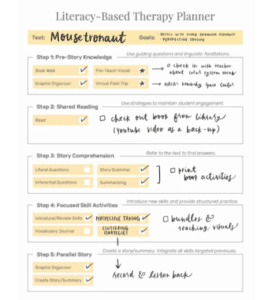
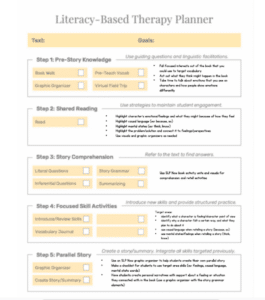
– The SLP Now One-Page Literacy-Based Therapy Unit Planner
– ReadWorks Article: Camping In Style
– SLP Now Membership – Our Book Activities include vocabulary cards, a story map, and WH question cards (literal and inferential) with multiple-choice picture cues!
– May Therapy Plans
– Targeting Grammar with Literacy-Based Therapy: Preschool, Early Elementary, Later Elementary, and Secondary
– Targeting Vocabulary with Literacy Based-Therapy Preschool, Early Elementary, Later Elementary, and Secondary

Subscribe & Review in iTunes

Are you subscribed to the podcast? If you’re not, subscribe today to get the latest episodes sent directly to you! Click here to make your listening experience auto-magic and as easy as possible.

Bonus points if you leave us a review over on iTunes → Those reviews help other SLPs find the podcast, and I love reading your feedback! Just click here to review, select “Ratings and Reviews,” “Write a Review,” and let me know what your favorite part of the podcast is.

Thanks so much!

Transcript

Transcript
Email Download New Tab

Speaker 1: Let's dive into some therapy plans for later elementary students. We are going to be using a fiction article from ReadWorks, and we're focusing on how to target narratives using a literacy based therapy framework. So some of the types of goals that we might target if we're focusing on narratives are answering questions about story grammar elements, retelling a story, of course, including story grammar elements, or generating a narrative. So we've got answering questions, story retells, story generation. Just a quick recap of some of the rationale behind using that. So explicit instruction of story grammar elements give students a meaningful framework and that's cited across the literature. There's plenty of support for using a story grammar elements and a really cool quote from Thomas Sello in 2003, indicates that using these story, grammar elements makes language learning tasks less demanding, more meaningful, and more authentic.
Paris and Paris in 2007, found that teaching story grammar enhances student comprehension, which is fascinating to me. There was a study that I came across, where they taught this framework to older students. And they taught story grammar elements, and they had a whole curriculum around it. And then they found that students comprehension of an actual lecture improved as well. So that kind of goes along with some of the citations I just shared, that it makes language learning tasks less demanding. It gives them a framework so they can hang these different pieces of information off of a more meaningful structure and make more sense of the input that they're getting. So I think that's really cool. I've been diving into a lot of narrative articles and the more and more I read about it, the more impressed I am. And it's such a cool way to target both lower and higher level language skills. So it's, we can target grammar and vocabulary, but then really focus on embedding those targets in a really meaningful context and targeting story grammar in the context of authentic stories. There's lots of evidence around that as well.
So without further ado, the article that we're talking about this week is called Camping in Style. You can access it for free on ReadWorks.org. You just have to sign up. As an educator, you get access to that for free. And it's just, they have beautiful articles and stories on there. Tons of search features. This article in particular is about Vivian and Kyle. So they are the main characters here. And Kyle loves camping, but none of his friends want to go. So he decides to create a camping experience that's quite glamorous. And it just tells the process of them building this campground. So nice seasonal kind of topic.
And yeah, so let's dive into the actual plans. So again, we're targeting answering questions about story grammar elements, story retell, story generation. Before we dive into the article, we'll look at the title. We'll look at a couple of like, just kind of glance at some of the texts to get an idea of what the story might be about. And this is where I kind of decide if the students have... I'll ask them some like pre-story knowledge questions. Have you ever been camping? Do you know what glamping is? And we'll just talk about some of those. Well start a discussion and then I'll determine if we need more background knowledge or not. And for this particular example, I think it'd be super fun to watch a YouTube video about glamping, for example. Or take a tour of a fancier camp ground or whatnot.
And I think that would be a really great way to fill in knowledge as needed. And then we would go ahead and fill in the graphic organizer and do some explicit teaching of the story grammar elements if needed. We would infer who the characters are, what the setting is, what the initiating event is, et cetera, et cetera, so that we can just get some meaningful exposure. And I think it's a fun inference activity and that can help us know if they really struggle with this, maybe we need to do a little bit more pre-story knowledge activation. Maybe there's vocabulary impacting their ability to fully participate in that. So we might do some pre-teaching, whatever they need. I will see the breadcrumbs and determine the best approach based on that.
Then for step two, we would read the article. I would read it or we could do round Robin reading, whatever makes the most sense for the group, whatever he keeps the most engaged. And then for step three, we would dive into some story comprehension. So this depends on the dynamics of the group, but we might have a combination of literal and or inferential questions. But I would ask them questions about story grammar. So like, who were the characters? What was the setting? And just go through the icons and fill in a fresh graphic organizer. Now that we've actually read the story.
And then that brings us to step four, the focus skill activities. So in step four, I always take some time to teach skills as needed. And if you want examples of what I do for grammar and vocabulary, head back to previous months episodes, because that'll give you more strategies. Today, we're just focusing in on narratives. So I would continue to include explicit teaching of story grammar elements, as much as students need with that. And I would continue to use graphic organizers and or visual cues as needed by the students.
I talked about the research behind that in last week's episode. But the citation for those specific strategies comes from Gillam at all of 2014, and then also from Paris and Paris, 2007. And some other strategies that we might use are to have students identify like, this is what we're using throughout the unit, but having them identify story grammar elements from within the article. But then I think it's also helpful to have them identify missing elements. So whether sometimes we have to infer elements in the story so we can use that.
But I also like to take this approach and as I often model the story retell first, and I might do a couple iterations where first I model it with the use of visuals. And then I say, okay, let me try this without the graphic organizer. Let's see if I can remember. And then I'll retell the story, but I'll purposefully leave off one or two of the elements. And then I have them identify those, the elements that I missed. And then I kind of model being a good sport about making a mistake and then we just make it a game. And the other students get to try to retell the story and we help each other and identify elements that we've missed. And this keeps everyone engaged throughout the whole unit. And it's just a really fun way to put things together.
So that wraps up step four. And then for step five, we get to dive into a parallel story, which brings us into story generation. So the students get to generate their own story at this point. And I typically like to have it be related to the topic that we've discussed. So we'll again, pull out another graphic organizer if needed. If the students are really getting the hang of the framework and they are able to just come up with a story, I'd like to see what they can generate on their own. So just go around the group and see, okay, so can you tell a story about a time that you went camping, or make up a story about a camping trip, or whatever prompt seems to resonate with the students. And then I think it'd be really cool to see what they can come up with without any support and see how they do in generating a story.
And then we can kind of go from there. And you'll be able to know if that's an appropriate step for your students or not. Do they need more support initially? You kind of want to find that sweet spot and not have huge levels of stress and frustration. So if you think that they really need that graphic organizer to get started, then you can definitely offer that. So, that's what we've got for our fiction article. And I think a really cool way to take this a step further if you're feeling like, okay, I've got this, I've implemented it with a couple of groups. I'm feeling really good. When I teach about literacy based therapy and the framework, and using all of these strategies, I think it makes sense to start with maybe a book for your K through two students. And then an article for your third through fifth graders. And just like using one text across grade levels.
But we've been talking about this for a while and if you've been listening to all of these episodes and you've been implementing it, I do have a little bit of a challenge. So I think that's a great, amazing, perfect way to get started. But if your anything like me, you're always trying to grow and learn. And so I think it could be really helpful to connect with the teachers in the classroom and pick something that is more curriculum based. So because once you get good at using this framework, once you get some good practice in, then it doesn't take as much planning time and you can easily throw together a unit with pretty much any texts, especially if you've been building out your visuals to teach these skills. You can take pretty much anything and run with it with very minimal prep time.
So I challenge you just for one of your groups, connect with a teacher and identify a theme that they're working on in the classroom and select a book that's related to that. Or just pick a book that they're actually reading in the classroom, or pick an article that they're actually reading. Or if you want to take it a step further next month, we're talking all about curriculum based therapy and selecting a bunch of different things, even math problems. So that's definitely something to stay tuned for. But I just wanted to give that a quick plug in case you're feeling like, okay, okay, I got this, this feels super easy. I'm ready for the next challenge. Definitely kind of take that on as you're ready. Or stay tuned for the curriculum based therapy content next month. And if this doesn't feel easy to you just yet, just keep chugging along. Take one piece a week, or a month, whatever you can handle, just take it slow. As long as you're taking steps forward, you're heading in the right direction. And I can't wait to see where you end up.

Scroll back to top

Sign up to receive email updates

Enter your name and email address below and I'll send you periodic updates about the podcast.

powered by

Filed Under: Podcast Tagged With: Evidence Based Therapy, Literacy-Based Therapy, Theme-Based Therapy, Therapy Plans

Free Speech Therapy Online Games and In-Person Activities

May 17, 2021 by Marisha 2 Comments

This is a guest blog post by Holly, a school-based SLP, she compiled a list of free online, print-and-go, and material-free games below.

How to Include Play Based Games Therapy into Your Speech Therapy Sessions! 

Embedding play into therapy can support engagement, make speech sessions more memorable, and provide opportunities to generalize communication skills to everyday contexts. 

It’s not hard to believe why games are such a hit with many of our students — in the age of virtual, in-person, and hybrid speech therapy sessions, we have some ideas to keep the fun going — all for free. Check out our round-up of online, printable, and material-free games below.

Free Speech Therapy Online Games and In Person Activities Online Games

Free Online Speech Therapy Games

There is emerging research to show that “serious games” (digital games intended to target skills) can improve communication skills in some student populations (Tsikinas & Xinogalos, 2019).

Luckily, there are a TON of educational sites that offer free games that you can use in your speech therapy sessions! You can use these games as a way to reinforce your teletherapy sessions. While you’re at it, check out these speech therapy apps for even more ideas for your speech therapy sessions.

Computer-based games can be used whether you’re sharing your screen during your speech teletherapy sessions, using a device with a student, or projecting for a group. Since there is no set-up or clean-up needed, this option is a breeze to add into speech sessions for some play-based reinforcement.

ABCYa – This site features educationally relevant games from Pre-K to 6th+ grade. Many of the games involve spatial concepts, customizing items, and curriculum-based learning. Some of my students’ favorites include Make a Skateboard, Pancake Panic, and Later Gator (full-access to all games without ads requires a subscription).

Backyard – This is an interactive game site that can be a lifesaver for your speech teletherapy sessions! Most of the games are recommended for ages 12 and up, so these can be a hit with older students. This platform is still in beta testing but my students have enjoyed it so far!

Brain POP – There are a ton of fun games on this site, many of which naturally tie into the curriculum. The Meaning of Beep is a fun game to work on vocabulary strategies (e.g., using synonyms and making inferences with context clues). For older students, Sortify takes a deep dive into category knowledge.

Disney LOL – This site features Coloring Pages, Arcade Games, Sticker Books, and more. Many of my students have a TV character or superhero, so these activities can be great reinforcers for participation.

Fun Brain – These digital games are quick and pretty intuitive for kids to pick up on. There’s a mix of educational activities and fun rewards — my students love When Pigs Fly and Penguin Drop as a brain break!

Go Noodle – This site is filled with movement breaks, dance choreography, and mindfulness exercises. Check out these Call & Response dances or the Blazer Fresh channel for language-related videos.

Guinness World Records | Kids – Not only is this site wonderful for working on superlatives — students can also enjoy the memory games and puzzles.

Highlights Kids – The Hidden Picture scenes on this site are a language gold mine. The Jokes section is also filled with multiple-meaning words!

I’m a Puzzle – Create a digital puzzle with pictures! This can come in handy if you’re looking to customize online games to students’ favorite interests or curriculum-based topics.

Language Playroom – This site has 20 free online games to target articulation, and they’re building their inventory of fluency, language, and social communication activities.

National Geographic Kids – Check out the Funny Fill-In stories, Just Joking’s laugh-o-meter, and Crack the Code activity. This site is also packed with photos, videos, and passages about animals.

PBS KIDS – These digital games focus on educational skills and social-emotional awareness, all while incorporating favorite PBS characters.

Picture Reveal – Upload your own image, set how many tiles you’d like to cover it with, and then get clicking!

Pink Cat Games – Build a monster, run a race, or spin a wheel while targeting speech and language goals. (Full access to all games requires a subscription.)

Poki & Poki Kids – This site includes digital versions of classic games like four in a row, yahtzee, and air hockey. Since there are countless other options, definitely preview games ahead of time!

Quia –  This is a database of online games, filled with content created by fellow educators. Students can play Jeopardy, Who Wants to be a Millionaire, Battleship, and more! Just filter the activities by the type of skill you’d like to target during your speech therapy sessions.

SLP Video Games – There’s a free “Get Rid of Red” game on Erik X. Raj’s site, which allows you to target speech/language skills within the game. (Full access to all online games requires a subscription).

Toy Theater – This site is filled with classic games (such as tic-tac-toe and pinball), plus language-related activities. The teacher tools also include dice, spinners, timers, an abacus, and more!

Free Speech Therapy Online Games and In Person Activities Printable Games

Printable Games

Next up, we have printable games and reinforcing activities that you and your speech students can try out during your speech therapy sessions. This ties into a previous post (A Year of Free Open-Ended Reinforcers), so check that out for even more options.

100 Trial Challenges – These sheets by Peachie Speechie cover themes and holidays, making it easy to tie into your speech therapy sessions.

Coloring Pages – Crayola has coloring sheets sorted by seasons, characters, places, and more!

Crafts – There are countless options here, whether you’re looking for kid-friendly tutorials for Origami, Paper Airplanes, or SLP Now Crafts that tie into our themed materials.

Free Printable Board Games – This site has a list of board games, bingo boards, and other entertaining activities.

Reinforcer Sheets – SLP Now members can check out the dozens of printable bingo boards, dice games, spinners, and coloring pages on our site!

Material-Free Games

This last list of games will just need you and your speech therapy students — these remind me of activities played at camp or on a road trip.

While the setup is simple, there may be some extra cognitive demands to follow directions and attend to these tasks! Feel free to augment with written/picture-based instructions and visual aids.

Name Game – Work on alliteration and adjectives all in one while helping students remember each others’ names!

Jedi Numbers – In this game, students try to count up to a number without interrupting one another. It’s great for reading nonverbal cues and sharing talk time with the rest of the speech therapy group.

Tall Tales – This student-favorite activity is all about generating stories filled with plot twists.

Fortunately, Unfortunately – This is another storytelling game that allows speech students to explore the benefits/consequences of situations with humor.

Word Chains / I’m Going on a Picnic – This game can be a fun challenge for speech students working on auditory memory skills.

Last Letter – Speech therapy students name items within a category that starts with the last letter of the previous word. Lots of language demands for this speech therapy activity!

Silent Interviews – Using nonverbal communication, pairs of speech students try to learn something about one another without talking.

Super Smile – Pass around contagious smiles as quickly as possible. 

Zip Zap Zop – This is a version of hot potato, but using words instead of a ball. Great for any speech therapy students with articulation goals targeting /z/!

Freeze Dance and Secret Dancer – These are great ways to get speech students moving!

Telephone – Of course, it’s a classic game built on communication skills!

Did we miss any of your go-to games? What’s your style — adding play throughout the speech therapy session or as a break at the end of therapy? We’d love to hear from you below.

How to Incorporate Games and Activities into Speech Therapy

Join our Free Literacy-Based Therapy Challenge and learn how to incorporate these wonderful online games and in-person actives into this evidence based framework! 

This 5 day Challenge will provide you with: 

-Daily, 5-minute tutorials to introduce you to the core steps in making literacy-based therapy a success with your caseload (no matter its size or diversity!)
-A robust workbook and templates to streamline your planning
-Free, tried-and-tested therapy materials that will make lesson prep a breeze

PLUS you’ll walk away with a month-long therapy plan, created in less than 10 minutes per day.

Click here to join today!

References

American Speech-Language-Hearing Association (n.d.). Telepractice. (Practice Portal). Retrieved April 15th, 2021, from www.asha.org/Practice-Portal/Professional-Issues/Telepractice/

Tsikinas, S., & Xinogalos, S. (2019). Studying the effects of computer serious games on people with intellectual disabilities or autism spectrum disorder: A systematic literature review. Journal of Computer Assisted Learning, 35(1), 61-73.

Filed Under: Therapy Ideas Tagged With: Apps, Freebies, Games, Teletherapy

#083: Targeting Narratives with Literacy-Based Therapy: Early Elementary

May 11, 2021 by Marisha Leave a Comment

Listen on Apple Podcasts Listen on Spotify

This Week’s Episode: How to Target Narrative Generation

Evidence shows that using literacy-based therapy to target narratives with preschoolers not only makes sense, but it really helps to set them up for literacy success in the future. Which brings us to this month’s focus: embedding narrative-based skills. Last week we focused on answering questions, sequencing, describing, and story retell with our preschoolers.  As I was digging through the research, I was more and more convinced that story retell is something that makes sense to work towards!

This week we’re going to use explicit instruction to target answering questions about story grammar elements, practice retelling the story, and then work on narrative generation with our early elementary students.  We are going to target those skills by reading A Camping Spree with Mr. McGee and provide visual support with our story grammar organizer. 🏕

Let’s get to it!

Strategies + Tips Discussed

Gillam et al. (2014) say that, “Narrative instruction should include explicit teaching of story grammar elements using graphic organizers and, or visual cues.”

– Book Walk: Use a story grammar organizer and Inferential questions about what may happen in the story
– Story Comprehension: Use Literal WH questions after the story is read. You can use that story grammar organizer again. It provides a clear framework for the student to follow!
– Focused Skill Activities: Retell the story by identifying the story grammar elements: “If students can identify story grammar elements in stories, that has been shown to yield improvements in complexity and content of oral narratives. ”  Hayward & Schneider in 2000
– Model the story grammar elements and use visual supports. Ask the student to help identify the story grammar element but purposefully leave out one of the elements.
– Parellel Story: Use a fresh graphic organizer and have the student create their own story

References

Adlof, S. M., McLeod, A., & Leftwich, B. (2014). Structured narrative retell instruction for young children from low socioeconomic backgrounds: A preliminary study of feasibility. Frontiers in Psychology, 5, 391.

Gillam, S. L., Olszewski, A., Fargo, J., & Gillam, R. B. (2014). Classroom-based narrative and vocabulary instruction: Results of an early-stage, nonrandomized comparison study. Language, Speech, and Hearing Services in Schools, 45, 204–219.

Hayward, D., & Schneider, P. (2000). Effectiveness of teaching story grammar knowledge to pre-school children with language impairment: An exploratory study. Child Language Teaching and Therapy, 16, 255–284.

Paris, A. H., & Paris, S. G. (2007). Teaching narrative comprehension strategies to first graders. Cognition and Instruction, 25(1), 1–44.

Swanson, L. A., Fey, M. E., Mills, C. E., & Hood, L. S. (2005). Use of narrative-based language intervention with children who have specific language impairment. American Journal of Speech-Language Pathology, 14, 131–143.

Here’s what we discussed:

[03:07] Therapy Ideas for Step 1 (Pre-Story Knowledge Activation)
[06:20] Therapy Ideas for Step 2 (Reading)
[06:35] Therapy Ideas for Step 3 (Post Story Comprehension)
[07:16] Therapy Ideas for Step 4 (Skill Practice)
[10:40] Therapy Ideas for Step 5 (Parallel Story)

Want to hear more about this topic? Click here to see this month’s content!

Links Mentioned

– The SLP Now One-Page Literacy-Based Therapy Unit Planner
– A Camping Spree with Mr. Magee
– SLP Now Membership – Our Book Activities include vocabulary cards, a story map, and WH question cards with multiple choice picture cues.
– May Therapy Plans

Subscribe & Review in iTunes

Are you subscribed to the podcast? If you’re not, subscribe today to get the latest episodes sent directly to you! Click here to make your listening experience auto-magic and as easy as possible.

Bonus points if you leave us a review over on iTunes → Those reviews help other SLPs find the podcast, and I love reading your feedback! Just click here to review, select “Ratings and Reviews,” “Write a Review,” and let me know what your favorite part of the podcast is.

Thanks so much!

Transcript

Transcript
Email Download New Tab

Let's dive into some therapy plans for our early elementary students. This week we're focusing on narratives. So, a little bit of background. Last week we talked about how it could be appropriate to target these skills with preschoolers, and it's especially, especially appropriate with our early elementary students. I wanted to share a little bit of the rationale and some of the evidence behind that. Explicit instruction on story grammar elements provides students with, or children, with a framework and it giving them that explicit instruction makes language learning tasks less demanding, more meaningful, more authentic. And the Paris & Paris article from 2007 shows that teaching story grammar enhances student comprehension, and it's a really meaningful context for therapy. So this comes from the Adlof et al. from 2014, but, "Focusing on narratives during oral language intervention provides a medium for clinicians to target both lower and higher-level language skills simultaneously."
So we've got lots of meaningful outcomes that we can generate when we're targeting narratives, and using story grammar, and all of those elements. And then to take it one step further, so this is from Swanson et al., 2005, but they said that teaching story grammar in the context of authentic stories, like books or fiction articles, which is what we're talking about this month, that yielded clinically significant improvements in students' oral narratives. So there's lots of benefits to using this approach. So hopefully you're convinced.
Some potential goals that we could be targeting throughout this unit related to narratives are answering questions about story grammar elements, retelling a story including story grammar elements, or generating a narrative. So we've got answering questions, story retell, narrative generation. So those are some of the different skills that we'll be talking about throughout the unit.
The book that we're using is, A Camping Spree with Mr. Mcgee. So this is a story about Mr. Mcgee and his dog and they go on a camping trip, but unfortunately they land their little camper ends up in the water and that's a problem that they get to solve. But it's a very sweet story. Perfect for this time of year. So, let's dive into the actual unit.
Our first step is pre-story knowledge. I like to start with a book walk. We would look at the cover, we would flip through some of the pages, and by doing that, I get a good idea of how much the students know about the topic. Have they ever been camping? Do they have trouble describing what's on the pages or, sorry, nice steady stream of language? That can give me an indication of whether we should do additional background like pre-story knowledge activities.
So if they're not familiar with camping, if they're struggling with that vocabulary, we might do a virtual field trip and watch a YouTube video about a kid who goes camping, or I'd take a tour of a camper, or whatever it may be. Whatever ... I just use my clinical judgment here to decide what areas students need additional exposure and information in. So once we do that or if they are all avid campers, they've got great vocabulary around it, then we can dive into the graphic organizer. So before we dive into that how to use ... Because this is the first super narrative-based activity that I'll be mentioning, I want to back up a second and talk about some of the research behind why I'm setting things up the way that I am.
The first thing is that I use visual supports. Gillum et al. in 2014, they indicate that, "Narrative instruction should include explicit teaching of story grammar elements using graphic organizers and, or visual cues." So we're going to include explicit instruction of the story grammar elements, and then we'll also use graphic organizers and visual cues. The use of the visuals and graphic organizers was also supported by Paris & Paris in 2007, and they indicate that that enhances student comprehension.
I have two other strategies, but I think we'll save those until we get to step four. But just to give students an opportunity to get explicit teaching of those story grammar elements and to include that graphic organizer in the visual cues, I have a story grammar poster and after we do the book walk and the pre-story knowledge activation activities, I like to have students take their best guess and try and fill in the story grammar organizer. And if they need explicit teaching of what the characters, and the setting, and all of that, if they need explicit teaching of those elements, then I will do that at that time, but we can fill in and make some inferences about the story.
So, after looking at the cover, we see Mr. Mcgee and his dog, so it's pretty easy to infer who the characters are by looking at a couple of pictures. We can infer the setting by looking at a couple of pictures. We can infer the initiating event, and the plan, and all of that. I think that's a really great opportunity to give students a little bit of a framework on what's happening and just to solidify all of the pre-story knowledge stuff that we talked about.
Then for step two, we'd go through and read the story. This is definitely the shortest and simplest step of the framework. It's pretty quick.
And then for step three, we would dive into some story comprehension. So typically, I include depending on the student's needs, we'll have just literal questions, maybe some inferential questions, but one other thing that I really like to do is ask questions about story grammar. So, I would pull out that framework again, that graphic organizer. I have lots of copies. I just have multiple copies running. I keep the pre-story one and then just grab a fresh one for the actual story, and then I'll ask them, "So who was it about?" and, "What was the setting?" We'll go through and answer that was comprehension questions related to story grammar.
Then when we get to step four for the focus skill activities, of course, this is also where we target grammar, and vocabulary, and all of that. If you're wondering about strategies for those units, check out past episodes where we shared tons of strategies just for the general literacy-based therapy framework, as well as grammar and vocabulary. But today, we'll just be talking about what we can do with narratives.
Some other strategies supported in the literature are identifying story grammar. "If students can identify story grammar elements in stories, that has been shown to yield improvements in complexity and content of oral narratives." That was from Hayward & Schneider in 2000. Hayward & Schneider also found that identifying missing elements in stories yielded improvements in student narratives.
So that gives us some ideas of what we could potentially try in our therapy session to help our students with narratives. As we're retelling the stories, and we talked about using visuals and the graphic organizer, so in step three they answered those questions and we probably filled them into the story grammar organizer.
And then in step four, we can work on retelling the story. I've done this a number of ways, but I typically do a model first, I point to the visuals and go through, and then I give the students an opportunity to practice retelling the story as well. If we were targeting grammar and vocabulary, we'd probably do those things first so they can embed those skills into their narratives.
But then we would ... I think this is a really cool way to identify missing elements. So I might do a model myself and I would have them check off and make sure that I'm including all of the elements that we need, and then I might do like the perfect version first and then, okay, let me try it again. And then I might go through and tell the story, but I might leave out one of the elements. Then they would have to ... Or maybe I'd try it with the visuals first and then I'd put the visuals away and like, "Okay, help me make sure that I include all the elements," and then I might leave out the setting, for example, and then the students can help me identify, "Oh, you left out the setting." And then that'll be a way to include them in it. Then the members in the group can take turns retelling the story and we would gradually fade the use of those visuals.
So, at this point they've gotten lots, and lots, and lots of exposure to the story and then I would obviously provide the visual support as needed, and then also verbal prompts and whatnot. But I would have the student retell the story and over multiple attempts, I would just decrease that support. So by the end, the students are all retelling the story on their own with as little support as possible. That might have to be adjusted for different students, but then they can listen to each other's stories and identify any missing elements and give each other feedback. Then it just becomes, it makes it fun, it keeps everyone engaged versus, "Oh, Johnny is telling his story now, so I'm not going to listen," but it keeps them engaged and it gives them more and more meaningful exposures.
So that's what we would do for step four. And then first step five, we get to jump into story generation. So we've done lots and lots of practice with story retell, but for step five, they get the opportunity to generate a parallel story. So we pull out a fresh graphic organizer. We can review all of the story grammar elements. If they don't need the visuals anymore, I'll just hide those, and then we can come up with our own story. And depending on the student's level, if they need a lot of support, we probably would just do one story as a group, come up with a story, fill in the organizer, and use the same kind of structure that I talked about in step four or if they're more independent, I might just do like round-robin where they can each tell their own story and just adjust the activity based on the level of support that they need.
So, yeah, that is our framework, and next week we will be talking about how to use a fiction article to work on narratives.

Scroll back to top

Sign up to receive email updates

Enter your name and email address below and I'll send you periodic updates about the podcast.

powered by

Filed Under: Podcast Tagged With: Books, Evidence Based Therapy, Literacy-Based Therapy, Theme-Based Therapy, Therapy Plans

29 Best Speech Therapy Apps for SLPs to Target Communication & Language Skills

May 4, 2021 by Marisha Leave a Comment

This is a guest blog post by Holly, a school-based SLP, on the top lists of go-to speech-language therapy apps and how they can be used for interactively targeting communication skills.

Let’s talk about how speech therapy apps can reinforce speech and language therapy! 

When it comes to supporting student engagement, smart devices can be a go-to tool in speech therapy. We’ll be taking a tour of our favorite apps and how they can be used for interactively targeting communication skills.

Using speech therapy apps in speech-language therapy has become more common over the last decade (see ASHA’s informational post). However, it can be challenging to evaluate the quality of speech therapy apps for clinical use (Furlong et al., 2018; see ASHA’s guidance on evaluating procedures, products, and programs). While there’s evidence to support the use of articulation-based apps in conjunction with trained clinician feedback (McLeod et al., 2020), further research is needed to explore the effects of interactive speech therapy apps on different skills, such as social communication (Griffith, Hagan, et al., 2020). As SLPs, we find ourselves in this scenario pretty often: technology is constantly developing, researchers are keeping up as best as they can — so in the meantime, evidence-based decision making largely depends on our clinical judgment and the needs of our students! 

There are thousands of speech therapy apps related to our scope of practice, so where do we begin? Before we dive in, here are 9 Tips for SLPs to Use an iPad Like a Pro — just in case you find yourself needing to organize any newly downloaded speech therapy apps from this list. (Note: for the majority of free apps included in this post, you’ll notice they come with a trial, a “lite” version, or frequent ads. While these speech therapy apps have been reviewed, the ads have not. For an extra charge, you can upgrade to get rid of the ads if that’s your preference!)

29 Best Speech Therapy Apps for SLPs to Target Communication Language Skills Articulation

1. Articulation Apps

Articulation Station – This is one of the most popular articulation apps in our field — and for good reason! Flashcards, memory, and slot machine-style spinners make this app interactive. You can take data on the app and encourage students to self-monitor as well. For language goals and mixed groups, check out this post on How to Use Articulation Station for Language Therapy! iOS. Price: Free for one sound, then $1.99-$7.99/additional sound or $59.99 for all sounds.

Erik X. Raj Articulation Apps – These articulation apps target later-developing sounds such as /s, z, r, l/ and “sh”/”ch”/”th” using play-based activities like charades, secret missions, and trivia. iOS. Price: $4.99/app.

SCIP (Sound Contrasts in Phonology) – If you’re treating phonological patterns, this app has 5 approaches to choose from (Multiple Oppositions, Minimal Pairs, Maximal Oppositions, Treatment of the Empty Set, and Vowel Contrasts). While there aren’t extra interactive features, students can be involved in collecting their own data to help with self-monitoring. iOS. Price: $59.99.

29 Best Speech Therapy Apps for SLPs to Target Communication Language Skills Speech Language

2. Speech-Language Apps

These speech therapy apps were designed for speech-language therapy, so you can directly target communication skills with your students. The apps you see in this list were designed by fellow speech-language pathologists!

Cough Drop – When it comes to augmentative and alternative communication (AAC), there are a lot of things for your team to consider when selecting a device and program. In this list, we’ve included a user-friendly and easy-to-try AAC program — check out our earlier post here: CoughDrop: An Innovative App that is Changing AAC. iOS, Google Play, Amazon, Windows, Web Browser. Price: Free publicly shared boards (example); free trial, then $6/month or $200/lifetime.

Little Stories – This is another speech therapy app by Little Bee Speech, filled with stories that can be used to target speech sounds, reading fluency/comprehension, sequencing, story retell, and conversation. Plus there are coloring pages and scavenger hunts built into the app! iOS. Price: Free lite version; $0.99/additional story or $59.99 for all stories.

Tactus Conversation Therapy – For older students, this speech therapy app can support generalizing speech goals, grammar targets, and language skills in conversation. Start by selecting relevant topics, then follow along with the guided questions and problem-solving scenarios. Tactus is known for creating speech-language therapy apps to support adults and stroke survivors, so I’ve found many of my high school students appreciate the complexity and design of the app. iOS & Google Play. Price: Free lite version; $24.99 for the full version.

Word Vault – This app offers stimuli for articulation, phonology, language, and social communication skills. Users can unlock more interactive features like pictures, games, and audio recordings with a subscription. iOS. Price: Free lite version; subscription for $5.99/month or $54.99/year.

World’s Worst Pet | Vocabulary – Offered through iReady, this interactive vocabulary app offers dynamic teaching and assessment of tier two vocabulary across different levels. iOS. Price: Free.

Your Face Learning – This is another speech therapy app by Erik X. Raj that creates customized worksheets for students. Targets include sounds, basic concepts, compare/contrast prompts, story starters, social skills, and more. You can print the worksheets out or annotate them in another app (like Notability!) iOS. Price: Free.

SLP Now – This web application is for speech-language pathologists who want literacy-based, evidence-based materials, and tried-and-true caseload management tools to systematize their speech therapy planning and streamline their paperwork. SLP Now offers over 6,000+ materials and recently introduced a new interactive material called Smart Decks. Price: Free for 14-days + 5 free PDF downloads and unlimited Smart Decks 

SLP Now Boom Cards GIF


3. Language Stimulation & Brain Break Activities

While these apps aren’t directly designed for use in speech therapy, they are great at eliciting language, indirectly targeting speech skills, or supporting engagement during speech therapy sessions. Sprinkle some interactive breaks throughout speech therapy or celebrate with a game at the end — whatever your style is!

ABCYa – This app features educationally relevant games from Pre-K to 6th grade. Many of the games involve spatial concepts, customizing items, and curriculum-based learning. iOS, Google Play, & Web Browser. Price: Free version; full version for $9.99/month or $69.99/year.

Breathe, Think, Do with Sesame – For younger children, this app is a great way to explore self-regulation strategies and problem-solving skills. There’s a bubble-popping activity that is a great way to unwind! iOS & Google Play. Price: Free.

ChatterPix Kids – This app is an SLP Now favorite! With it, your students can make anything talk — pictures of people/pets, favorite characters, doodles, and more. On Episode #80 of the podcast, you can hear more ideas about using ChatterPix to target vocabulary. The creator, Duck Duck Moose, also has apps that focus on nursery rhymes, puzzles, drawing, and more. iOS & Google Play. Price: Free.

Fantastic 4 In A Row Go – Games like Connect Four are great for maximizing speech trials (e.g., “say X words and then take a turn”). EnsenaSoft Games also has other digital board games. iOS, Google Play, & Amazon. Price: Free with ads, upgrade with in-app purchases.

GoNoodle & GoNoodle Games – This app is filled with movement breaks, dance choreography, and mindfulness exercises. Great for self-regulation and following directions! iOS, Google Play, & Web Browser. Price: Free.

Heads Up! & Heads Up! Kids – This barrier game puts describing and language skills to the test in a fun and competitive way. The original version includes written words and pop culture topics, while the kids’ version includes pictures of familiar animals, actions, and items. iOS & Google Play. Price: Free, in-app purchases available; $3.99 for the kids’ version.

PBS KIDS Games – These games focus on educational skills and social-emotional awareness while incorporating PBS characters. There are many related apps that we could rave about too, so feel free to browse through PBS KIDS Apps! iOS, Google Play, & Web Browser. Price: Free.

Shoe the Goose Apps – These hands-on apps give kids the opportunity to design their own treats, clothes, and trucks. They’re filled with lots of language-rich targets, such as describing and sequencing. iOS. Price: $0.99/app.

Toca Boca Apps – In the Toca world, students can pretend to be chefs, hairdressers, medics, performers, designers, and more. These play-based activities make it easy to target language skills such as basic concepts, directions, object functions, and description skills. iOS & Google Play.  Price: Free versions available, most full versions are $3.99/app, $19.99/bundle.

Toontastic 3D – Another SLP Now Favorite! This is a way for students to narrate their own stories and bring them to life. In  Episode #36 of the podcast, we discuss using literacy-based therapy and generating parallel stories using ToonTastic. This is also a functional way to target grammar skills (e.g., simple/compound/complex sentences and subject/verb agreement). iOS & Google Play. Price: Free, in-app purchases available.

29 Best Speech Therapy Apps for SLPs to Target Communication Language Skills Interactive Tools

4. Interactive Speech Therapy Tools

You may have heard about using these tools on the computer  — well, there’s an app for that, too! We’ve also included some apps that can be used to adapt materials into digital formats.

Epic – There’s a massive digital library of picture and chapter books on this platform, which makes literacy-based therapy even more accessible. iOS, Google Play, & Web Browser. Price: Free access at this time; option to upgrade for $9.99/month or $71.99/year.

Little Spinner – Spin a wheel full of category items (e.g., colors, shapes, vehicles, body parts) and follow along with the songs in the apps. There’s also an option to create your own spinner using text and photos! iOS. Price: Free, $0.99 for each additional spinner and the customization option.

Notability – This is another SLP Now favorite — it’s a super-powered annotation app that allows you to add pictures, audio, drawings, and text. I use this app for completing worksheets with my students, highlighting reading passages, digitizing their speech journals, etc. The possibilities are endless here, plus writing on a device with a stylus usually leads to instant engagement. Check out Marisha’s Notability Tutorial Part 1 & Tutorial Part 2. iOS. Price: $8.99. 

Vooks – This platform makes reading more engaging than ever, courtesy of its animated, captioned storybooks. Their collection includes books for young readers that span genres and encourage social-emotional development. iOS, Google Play, & Web Browser. Price: Free for educators at this time; $4.99/month for standard users.

Youtube Kids – When exploring a new concept or building background knowledge, Youtube always has something. The kids’ version of the app makes it easier to look things up on the fly with students. iOS, Google Play, & Web Browser. Price: Free with ads.

29 Best Speech Therapy Apps for SLPs to Target Communication Language Skills Family Communication

5. Family Communication

The last apps included here feature ways to connect with families and send speech and language homework. It can be really powerful to have students involved in this part! I try to make it a habit to send positive notes home to families, and this can reinforce participation in speech therapy for students.

Check out our previous post on this topic: Speech Therapy Homework: One Easy Solution. Many of these tools can be used at the end of a speech therapy session to help students connect the dots between what they’re working on in school and how they can apply these skills at home. For example, at one of my schools, I wrap up sessions by asking my students to summarize what we worked on, then I send a quick message to parents and provide participation points. If your school district uses one of these platforms, you can hop on board!

Class Dojo – With this app, you can share messages, photos, videos, and documents with families. It also has built-in language translation and reward features. iOS, Google Play, & Web Browser. Price: Free.

Edmodo – This is another platform that supports communication between teachers and students and can be used to send documents. iOS, Google Play, & Web Browser. Price: Free.

Remind – This messaging tool pairs with learning management systems such as Google Classroom, OneDrive, and Canvas. iOS, Google Play, & Web Browser. Price: Free, with upgraded features available.

SeeSaw – This app allows educators to connect with families and share students’ digital portfolios. iOS, Google Play, Amazon, & Web Browser. Price: Free.

Bonus: If students have a favorite character from a book, show, movie, or video game, there might be an app that’s related to their special interest. I find this can really help with buy-in during speech therapy sessions, too! 

Looking for more reinforcing activities for your speech therapy sessions? Here’s a post about the Best FREE Reinforcers for Teletherapy.

What other speech therapy apps do you use in therapy? Let us know in the comments below!

References

American Speech-Language-Hearing Association. (n.d.). Applications (Apps) for Speech-Language Pathology Practice. https://www.asha.org/slp/schools/applications-for-speech-language-pathology-practice

American Speech-Language-Hearing Association. (n.d.). What To Ask When Evaluating Any Procedure, Product, or Program. https://www.asha.org/slp/evaluate/

Furlong, L., Morris, M., Serry, T., & Erickson, S. (2018). Mobile apps for treatment of speech disorders in children: An evidence-based analysis of quality and efficacy. PloS one, 13(8), e0201513.

Griffith, S. F., Hagan, M. B., Heymann, P., Heflin, B. H., & Bagner, D. M. (2020). Apps as learning tools: a systematic review. Pediatrics, 145(1).

McLeod, S., Ballard, K. J., Ahmed, B., McGill, N., & Brown, M. I. (2020). Supporting children with speech sound disorders during COVID-19 restrictions: Technological solutions. Perspectives of the ASHA Special Interest Groups, 5(6), 1805-1808.

Filed Under: Therapy Ideas Tagged With: AAC, Apps, Articulation, Evidence Based Therapy, Freebies, Interactive Reinforcement, Parent Communication, Student Engagement, Teletherapy, Tools

#082: Targeting Narratives with Literacy-Based Therapy: Preschool

May 4, 2021 by Marisha Leave a Comment

Listen on Apple Podcasts Listen on Spotify

This Week’s Episode: How to Target Narratives with Preschoolers Using Literacy-Based Therapy

Evidence shows that using literacy-based therapy to target narratives with preschoolers not only makes sense, but it really helps to set them up for literacy success in the future.

That brings us to this month’s focus: embedding narrative-based skills. The focus of this unit with our Preschoolers will be— answering questions, sequencing, describing, and story retell. Are preschoolers ready to start telling stories? As I was digging through the research, I was more and more convinced that that is something that makes sense to work towards!

We’ll be doing that with the help of the book, Please, Puppy, Please, which is an adorable story about two kids who get a puppy.

Let’s dig into some tips that will make your therapy planning no so…RUFF! 🐶

References

Gillam, S. L., Olszewski, A., Squires, K., Wolfe, K., Slocum, T., & Gillam, R. B. (2018). Improving narrative production in children with language disorders: An early-stage efficacy study of a narrative intervention program. Language Speech and Hearing Services in Schools, 49, 197-212.

Petersen, D. B., & Spencer, T. D. (2016). Using narrative intervention to accelerate canonical story grammar and complex language growth in culturally diverse preschoolers. Topics in Language Disorders.

Nathanson, R., Crank, J. N., Saywitz, K. J., & Ruegg, E. (2007). Enhancing the oral narratives of children with learning disabilities. Reading & Writing Quarterly, 23(4), 315–331.

Here’s what we discussed:

[03:13] Therapy Ideas for Step 1 (Pre-Story Knowledge Activation)
[05:15] Therapy Ideas for Step 2 (Reading)
[05:44] Therapy Ideas for Step 3 (Post Story Comprehension)
[07:20] Therapy Ideas for Step 4 (Skill Practice)
[08:10] Therapy Ideas for Step 5 (Parallel Story)

Want to hear more about this topic? Click here to see this month’s content!

Links Mentioned

– The SLP Now One-Page Literacy-Based Therapy Unit Planner
– Please, Puppy, Please by Spike Lee & Tonya Lewis Lee
– Virtual Field Trip on YouTube
– The SLP Now Membership (The WH Question Cards + Graphic Organizer that we mentioned are included in the membership!)
– Play-Based Therapy Toy Suggestions

Subscribe & Review in iTunes

Are you subscribed to the podcast? If you’re not, subscribe today to get the latest episodes sent directly to you! Click here to make your listening experience auto-magic and as easy as possible.

Bonus points if you leave us a review over on iTunes → Those reviews help other SLPs find the podcast, and I love reading your feedback! Just click here to review, select “Ratings and Reviews,” “Write a Review,” and let me know what your favorite part of the podcast is.

Thanks so much!

Transcript

Transcript
Email Download New Tab

This week, we are diving into all things preschool and all things narratives. So before we dive into the actual therapy plans, I just wanted to share a couple of the goals that we might be targeting when we're working on narratives with preschoolers. So we might be working on answering questions about a story sequencing or describing picture cards, or to actually retell a story. I'm not going to lie. I was thinking about some of my groups, and I wasn't sure if it would make sense for them. Are they ready to start telling stories? But as I was digging through the research, I was more and more convinced that that is something that makes sense to work towards, and of course we consider each step each student's strengths and needs, and reverse engineer where they are, and where we want them to go, and come up with sub-goals that make sense towards that final action.

But it's definitely something that, there's tons and tons of research out there. There was one study featuring small group narrative intervention with Spanish-speaking preschoolers learning English and that was by Spencer et al in 2019 and 2020. They were absolutely working on narratives with these preschoolers who were just learning English. There was another study by Spencer, Peterson, Slocum and Allen in 2015. They did large group narrative intervention with preschoolers, and they used WH questions as prompts. So that's, again, something we're doing with our preschoolers.

There's tons and tons of studies out there. There's more and more, so those were just a couple that came up. It was also super interesting because Snow et al in 2007 report that the ability to produce a narrative and preschool predicts reading comprehension performance in fourth, seventh, and tenth grade, so this is an important skill that these younger students can be working towards. If we can help them, it is absolutely an inappropriate goal. But again, we get to use our clinical judgment, but I think this was a helpful perspective.

So the book that we're using this month is called Please, Puppy, Please. It's about two kiddos who get a puppy and their experience with that puppy. So let's just dive into the literacy based therapy framework. Well, again, we'll just be focusing primarily on embedding narrative based skills in this unit. So we are working on answering questions, sequencing, describing, and then actually story retell. So for pre-story knowledge, we'll do a book walk, and we'll look at the cover, and flip through some of the pages to see what ... just to get an idea of what kind of schema the students have, or what kind of background knowledge they have around a puppy because that will significantly impact their ability to retell the story.
Have they had a pet? What's their experience with having a pet? Do they not know about having pets as cats and dogs? Do they have that vocabulary in terms of how we take care of them and all of that? If some of the students in the group don't have experience with pets, there's a number of different activities that we could do. So we could take a virtual field trip and have someone ... I'm sure there's videos of kids on YouTube showing them what chores they do to take care of their dog or their cat, and all of the responsibilities that that entails.

I have a really fun little, it's supposed to be a vet kit, but it has a little dog, and a carrier for the dog, and a bowl, and all of the supplies that you use. I think it even has a little ball, so we could do some pretend play around that, and then again, modeling the vocabulary and the concepts that they'll really need to understand that story. So those are some ideas for step one, and then it might ... I sometimes do an inferencing activity, so this might be appropriate for students who already have good background knowledge. If they all have pets, and they're really familiar with that vocabulary, I might take this a step further and use my story grammar icons to guess what the story will be about. So after doing the book walk, we can infer who the characters are, where the story happens, what the problem is, et cetera, et cetera, so that's something we can do there.

Then for step two, we would just read the book, and I don't add a lot of fluff here. I just do whatever I can to maintain students' engagement. So whether that's, if we're in person, having sit spots, behavioral reinforcement for attending to the book, or if we're doing teletherapy, we get to get a little creative. I might pause the book at times to make sure that the students are engaging.

Then for step three, we would dive into story comprehension. So based on that one study that I shared where they use WH questions as a support to start working on story retell, that was the Spencer, Peterson, Slocum and Allen 2015 article. I think that would be a great approach, and then we can still work on just the actual comprehension questions, and then we can fill that into the story grammar organizer, if that makes sense. I would use visual supports as needed, so we do have question cards for this unit. So if they're not quite ready for the more complex story, grammar components, we have some question cards. I really like using these because they're leveled, and they include the different question types like who, what, when and where, and then their level too.

Speaker 1: So one of the levels for the who questions only has people, and then the next step up would be having a person, a location and a thing. So they have to really understand what the question word means to pick the appropriate answer. They have a field of three choices, which helps with that errorless learning too. So I think that would be my step-wise progression. If they're not, not quite ready to answer those more complex questions, we would build up their comprehension questions skillset and spend some time working on that.

Then when it comes to the focus skill activity, so step four of the framework, I would ... We're focusing on narratives here today, so I'm not going to dive into all of the strategies. But if you want to listen back to the previous episodes, if the students have any grammar goals, I share tons of ideas and the grammar episodes, and the same thing for vocabulary, as well as just general strategies way back in February when we were just talking about the framework as a whole. But I would just embed all of those activities as needed, and then the generating the story could happen in step ... Yeah, that would happen in step four too. We have the option, just looking ahead a little bit, if we want additional generalization, we can take it to step five and have the students generate a parallel story. So maybe they can tell a story about one of their pets, or they can make up that pet. They can a imaginary speech therapy pet and make a story about that.

But in terms of step four focus, skill activities for narratives, the evidence really supports the use of visual icons, so that's something ... That's what I mentioned from the Spencer et al 2019, and then the Spencer et al 2020 article. So one of the examples that they gave was using the visual icons. So we can use those as a support and one important thing that was noted in that article and also Spencer and Peterson 2020 is that we use those visual supports to make abstract concepts more concrete. So we have those visual icons to make it more approachable, but it's ... We don't want the students to be dependent on those icons, so just something to think about, is just that we want ...

In the Spencer et al studies, they showed them icons while the story was being modeled and while the first child was retelling the story. But then for the second child, they only gave the icons, and then when the third child retold the story, they didn't give any of the icons. So over consecutive attempts of the retell across the group, they decrease those visual supports just thinking about generalization from the very start, which I thought was super helpful.

So we have a lot more that we could dive into when it comes to narratives and strategies, but that's what we've got for preschool this week and next week, we'll be diving into more strategies and really talking about how to target narratives with early elementary students.

Scroll back to top

Sign up to receive email updates

Enter your name and email address below and I'll send you periodic updates about the podcast.

powered by


Filed Under: Podcast Tagged With: Books, Literacy-Based Therapy, Theme-Based Therapy, Therapy Plans

Vocabulary Approach: How to Use Semantic Mapping & the Research Behind it

April 27, 2021 by Marisha 1 Comment

This is a guest blog post by Monica, a school-based SLP, is all about how to use semantic mapping & the research behind it!

Do you have students with word-finding difficulties, but are not sure where to start?

Have you talked to their parents and teachers and they really want their student or child to be able to expand on their ideas, but they really struggle with vocabulary? Do you wish you could embed another vocabulary intervention into your existing narrative therapy? Semantic mapping is here to make your life easier!  Stay with me for how to follow EBP decision-making and to see if semantic mapping is a good fit for your students and their families. We’ll end with some therapy ideas for your sessions.

Thorneburg et al. (200)

Semantic Mapping

What is Semantic Mapping? How do you do it?

Semantic mapping is also called semantic feature analysis. We all know the term from grad school as a common form of therapy for aphasia. Semantic mapping is when you list out features related to a word. It is most commonly done using interconnected circles and charts. Using this strategy helps students/clients map out how words are related to each other and develop a deeper understanding beyond labeling (Alt et al 2004).  Semantic mapping can include any words related to the target word to expand on knowledge about the target word. Examples of ways to expand on a word are: categories, physical attributes, actions,  origin, emotions, and background knowledge.

What is Semantic Feature Analysis?

Semantic mapping has a lot of different names. In the research, it goes by semantic mapping and semantic feature analysis. We all know it from grad school because it’s a commonly used therapy approach for aphasia. What does the research look like for the preschool to adolescent population?

Preschool 

Alt M, Plante E, Creusere M. (2004). Semantic features in fast-mapping: performance of preschoolers with specific language impairment versus preschoolers with normal language. Journal of Speech Lang Hearing Research. 407-20.

Preschool research for semantic mapping isn’t as easy to find. The research that is available points to SLI students having a more difficult time with semantic mapping than their peers.

The researchers suggested that these students are not just having a hard time labeling, but a deeper understanding of vocabulary.

Preschool students with SLI in this study had a more difficult time with actions than nouns.

School-Aged 

Best W, Hughes LM, Masterson J, Thomas M, Fedor A, Roncoli S, Fern-Pollak L, Shepherd DL, Howard D, Shobbrook K, Kapikian A. (2018). Intervention for children with word-finding difficulties: a parallel-group randomised control trial. International Journal of Speech-Language Pathology. 20(7), 708-719.

“Combining semantic intervention with phonological intervention led to on average 4x growth in the experimental group than the control group” (Best et al. 2018).

A randomized control study looked at word-finding therapy for children with language difficulties in a school setting.

Treatment was done once a week for six weeks individually.

Note: The children in this study scored within the normal range for comprehension and did not have a diagnosis of dyspraxia, autism spectrum disorder, ADHD, or global delay.

Adolescents 

Lowe H, Henry L, Müller LM, Joffe VL (2018). Vocabulary intervention for adolescents with language disorder: a systematic review. Int Journal of Language and Communication Disorders. 199-217.

Meta-analysis research for the adolescent population showed mixed results, but higher efficacy when using a phonological-semantic approach, with “outcomes that are better when the intervention is embedded in a wider language context such as a narrative approach.”

Overall, it looks like the research supports using semantic mapping when used hand in hand with phonological mapping. Embedding semantic-phonological mapping into a narrative approach may also improve outcomes. 

Client/Student & Family Values

What are some things we can think about after we’ve selected a therapy approach to use?

Let’s look at how to incorporate the client/client’s family’s factors like values and cultural/socioeconomic factors. Consider the research when making a recommendation about service delivery to the family and making a team decision.

“Students who received services through a collaborative model had higher scores on curricular vocabulary tests than did students who received services through a classroom-based or pull-out model. Although all three services delivery models were effective for teaching vocabulary” (Thorneburg et al., 2000).

Clinical Judgement and Expertise

After you have decided that it is appropriate for your client and the client/family agrees that it is  the best approach (maybe at an IEP meeting?), it’s time to use clinical judgment and expertise to think of the ways to best use this approach in therapy. Hang on tight, right after this, we’ll go over some therapy ideas!

Lowe et al. (2018) said that combining this approach with a phonological one and incorporating it in a narrative intervention has the most evidence behind it. Do you have students that would benefit from this approach? Semantic mapping lends itself to using a  lot of visuals and is easy to adapt to different learning styles and support needs.

Set up a way to take baseline data and monitor progress (keep in touch with teacher/caregivers to see if it’s working).

We love working on areas that can give you more bang for your buck and have areas of overlap.

How is working on expanding vocabulary and strengthening this skill going to increase access to the curriculum and participation in the classroom for this student?

Will working on vocabulary and expanding those skills also help with socio-emotional skills for your student/client? Would this help conversational skills and general functional communication?

Last Stop: Therapy Ideas

Use your existing narrative lesson

Incorporate semantic mapping by doing a book walk and map out new words before you start reading the book. You can also stop on ages to describe objects, characters, and setting using semantic mapping (e.g., what they look like, how they feel, and what they’re doing).

Make it functional

Pick places on their school campus or from home. Add sentence frames for extra support. Ask caregivers for ideas of things that they have a difficult time expanding on or things that they frequently have a hard time naming.

Collaborate

Work with teachers to do phonological-semantic mapping for upcoming themes and activities to increase participation in class. This would be a great time to incorporate actions as target items.

Use high-interest targets

Introduce new adjectives to talk about high-interest shows or movie clips to expand language.

Make a story with new words

Make a narrative or story using new words that you have targeted to increase word exposure. The more exposures to a new word, the better!

Don’t forget to use phonological mapping

Spell out the word and sound it out to include phonological mapping to help students learn the word. You can clap out the syllables, include a word that rhymes, or other words that start with the same sound.

But how do I know if it’s working?

Last but not least! Don’t forget to take the time to review if this approach is working by comparing it to that baseline data that you took. Best et al. (2018) showed that 6 weeks of intervention was needed to show a positive effect for vocabulary intervention.

References

Alt, M., Plante, E., & Creusere, M. (2004). Semantic Features in Fast-Mapping: Performance of Preschoolers with  Specific Language Impairment Versus Preschoolers with Normal Language. Journal of Speech, Language, and  Hearing Research>, 47(2), 407-420.

Best, W., Hughes, L.M., Masterson, J., Thomas, M., Fedor, A., Roncoli, S., Fern-Pollak, L., Shepherd, D. L., Howard, D., Shobbrook, K., Kapikian, A. (2018). Intervention for children with word-finding difficulties: A parallel group randomised control trial. International Journal of Speech Lang Pathology. 20(7), 708-719.

Cirrin, F.M., & Gillam, R.B. (2008). Language intervention practices for school-age children with spoken language disorders: a systematic review. Language, speech, and hearing services in schools, 39(1), S110-37 . 

Hadley, E. B., Dickinson, D. K., Hirsch-Pasek, K., & Golinkoff, R. M. (2018). Building semantic networks: The impact of a vocabulary intervention on preschoolers’ depth of word knowledge. Reading Research Quarterly.

Lowe, H., Henry, L., Müller, L.‐M. and Joffe, V.L. (2018), Vocabulary intervention for adolescents with language disorder: a systematic review. International Journal of Language & Communication Disorders, 53, 199-217.

Marulis, L. M., & Neuman, S. B. (2013). How Vocabulary Interventions Affect Young Children at Risk: A Meta-Analytic  Review.Journal of Research on Educational Effectiveness, 3, 223-262.

Throneburg, Calvert, Sturm, Paramboukas, & Paul (2000). A comparison of service delivery models: Effects on curricular vocabulary skills in the school setting. American Journal of Speech-Language Pathology, 9, 10–20.

Filed Under: Therapy Ideas Tagged With: Evidence Based Therapy, Therapy Plans

#081: Targeting Vocabulary Goals with Literacy-Based Therapy: Secondary

April 27, 2021 by Marisha Leave a Comment

Listen on Apple Podcasts Listen on Spotify

This Week’s Episode: How to Target Prefixes and Suffixes

So far in this month’s podcast series we’ve targeted basic concepts, as well as some comparatives and superlatives with our preschool students. We tackled plans with our early elementary that focused on targeting object function, categories, antonyms + synonyms, and describing. Last week we targeted multiple meaning words with our later elementary students.

You’ll notice that our vocabulary goals for this week are similar to last week, with less of a focus on multiple meaning words and more time spent on prefixes and suffixes.

We’ve taken the vocabulary research and embedded it into the literacy-based framework, to create a super functional application that blends the best of both evidence-based worlds. You can find great visuals listed under strategies + tips! Don’t forget to save them for future references! 🤓 😍

P.S. For more on our vocabulary intervention framework, bop on over to this blog post: How to Teach Vocabulary: A Framework.

Strategies + Tips Discussed

– Literacy-Based Therapy Framework
– Vocabulary Intervention Framework

A Helpful Link

– SLP Now Evidence Table

Here’s what we discussed:

[2:15] Therapy Ideas for Step 1 (Pre-Story Knowledge Activation)
[5:15] Therapy Ideas for Step 2 (Reading)
[5:17] Therapy Ideas for Step 3 (Post Story Comprehension)
[6:05] Therapy Ideas for Step 4 (Skill Practice)
[7:42] Therapy Ideas for Step 5 (Parallel Story)

Want to hear more about this topic? Click here to see this month’s content!

Links Mentioned

– The SLP Now One-Page Literacy-Based Therapy Unit Planner
– ReadWorks Article: The First Earth Day
– EdPuzzle
– SLP Now Membership (You can find the KWL Chart, graphic organizers and WH questions that we talked about here!)
– Wheel Decide

Subscribe & Review in iTunes

Are you subscribed to the podcast? If you’re not, subscribe today to get the latest episodes sent directly to you! Click here to make your listening experience auto-magic and as easy as possible.

Bonus points if you leave us a review over on iTunes → Those reviews help other SLPs find the podcast, and I love reading your feedback! Just click here to review, select “Ratings and Reviews,” “Write a Review,” and let me know what your favorite part of the podcast is.

Thanks so much!

Transcript

Transcript
Email Download New Tab

Speaker 1: Okay. So let's dive into some secondary vocabulary plans. Our vocabulary goals for this week are the same as last week, and last week we focused primarily on multiple meaning words. So this week we're going to hone in a little bit more on affixes or prefixes and suffixes. And the article that we're using is a non-fiction text from ReadWorks called The First Earth Day. And if you want to plan along, head to slpnow.com/planner. You'll just enter your name and email, and we'll send you a interactive planner like editable planner. You can plug in the title of the texts that we're using. You can plug in your students' goals and then plan out the activities for each step of the literacy-based therapy framework. So without further ado, we'll dive into our plans.
So again, we're using Dr. Ukrainetz's five-step literacy-based therapy framework, and we're embedding all of the vocabulary research that I've come across into this framework. So there is a separate framework for vocabulary intervention and in these episodes, I'm just combining the two to put it into a super functional context. So just to recap the texts of The First Earth Day and the goals that we're focusing on are prefixes and suffixes, but we can target any number of goals. And if you want ideas for multiple meaning words, et cetera, et cetera, check out the previous section.
So for step one, we'll dive into pre-story knowledge. So with this, I like to do an article walk. We'll pull up the article, we'll look at the title, we'll look at any pictures, and we'll skim through the text. And I like to have students fill in a KWL chart. It's a graphic organizer where they fill in what they know about the topic, what they want to know and then afterwards, we can go back and fill in what they learned. And depending on how the article walk and the filling in the graphic organizer goes, I will use my clinical judgment to decide if we want to do a virtual field trip. So in this case, we might watch a video about the history of earth day, for example, if they end up needing additional background information.
Another activity that I like to do for this age group especially when it comes to prefixes and suffixes is to pre-teach the vocabulary. So assuming that the students have been introduced to prefixes and/or suffixes and that they know what they are that is definitely a precursor, I would identify the prefixes and suffixes that I want to target. And this is largely based on just the students' progress overall where we decided to focus on just which target makes the most sense. And then we can go through and introduce the prefix and or suffix. I have a bunch of affixes activity pages that I like to pull into their vocabulary journal so we can identify the prefix or suffix to find it. And then we can go through the article and identify the words that have that prefix and/or suffix, add it to their vocabulary journal page. And then by the time we dive into the article, they'll know a lot of the vocabulary that they need to access that article and just to have it makes sense.
And then after we do that, I might have them fill in a graphic organizer to infer what the main idea is and what the key details are. This is a really great language activity. It again gives them an opportunity to use some of their vocabulary words. And I get super, super excited and definitely reinforced when students use those words. Because as I've said a million times already, a lot of our students need upwards of 40 meaningful exposures to really integrate new words into their vocabulary. And so if they're motivated to really find ways to use those words and refer to their vocabulary journals and try to create sentences, I think that's really awesome. And sometimes I'll give them little tallies and we can see who gets the most exposures and they get a kick out of that.
But then, so we fill in that graphic organizer. Again, it's an opportunity for me either to model the use of the target words or an opportunity for the students to use them. And then for step two, we just read the article, keep that pretty simple, and that brings us to step three, where we do some story comprehension.
So at this point, I'll ask a combination of literal and/or inferential questions. One, because many students tend to have comprehension goals. And then it's also just another opportunity to embed the target vocabulary words, because that's what we're all about getting lots and lots and lots of exposures. And then for another activity is to actually fill in, like after we actually read the texts, we can fill in the summarizing graphic organizer. We can identify the actual main idea and compare it to the main idea that we thought. It would be like our inferred main idea and then also the key details. We can create sentences from that. We can use our key vocabulary words and then again, just more and more opportunities to use that word.
And then that brings us to step four, where we focus on focused-skill activities. So I would again review the skill as needed. So I have a visual that introduces each vocabulary skill. So we review that as needed and then we continue working on the vocabulary journal. So each like this particular unit has several vocabulary pages to go with it. And so we can pull all of the multiple meaning word pages. We can pull all of the prefixes and suffixes and pull those pages from the skill packs and add in the words that I identified for all of the prefixes and suffixes and we do just a number of activities. And because we're often targeting more than just vocabulary, we're often targeting grammar and language as well so we can embed this vocabulary in any number of activities. And if you need additional ideas, definitely go back and check out the previous podcast episodes.
But I shared this last week, one of my favorite activities. If I really just need, if everyone is working on vocabulary and we just need to get a lot of drill, I love creating little wheels like digital wheels and adding in the target, the vocabulary targets. And then I either have students to find the word using them in a sentence, acted out, dried out, any number of fun-engaging activities, just to give them more meaningful exposures to that vocabulary target, and then we just get in as much practice as we need.
And then we get to step five, which is the parallel story. And because this text is a non-fiction text, the activity looks a little bit different. If they haven't already written out sentences for the summary of the story, our summarizing skill pack has a graphic organizer that helps them write out a summary. So I'll have them do that and that's often not the most exciting activity. So I look at the dynamics of the group and decide what would be motivating for them, but a lot of students are aspiring YouTubers. So we either create a YouTube video and we don't actually post it on YouTube and I asked for parent permission. But we might record a video and pretend that we're creating a YouTube video or a newscast or just something related to the topic.
And sometimes we just read off the summary. Sometimes we do a spin off and create something else, which gives us even more exposure or more opportunities to create those sentences and embed those vocabulary words. So I just kind of follow the dynamics of the group and the level that they're at and what is appropriate to build that all in.
So that's a wrap on our secondary unit with a focus on vocabulary, and I hope that was super helpful.

Scroll back to top

Sign up to receive email updates

Enter your name and email address below and I'll send you periodic updates about the podcast.

powered by

Filed Under: Podcast Tagged With: Evidence Based Therapy, Literacy-Based Therapy, Theme-Based Therapy, Therapy Plans, Vocabulary

Summarizing and Main Idea Intervention: A Practical Review

April 22, 2021 by Marisha Leave a Comment

This is a guest blog post by Holly, a school-based SLP, all about summarizing and main idea intervention!

“Tell me about that movie you watched!”
“What are you learning about in social studies?”
“Let’s summarize what we learned from this article.”

These types of conversations can take a lot of effort for our students.To provide a summary, countless foundational language skills are involved: comprehending information, remembering details, categorizing based on topics and themes, sequencing, identifying story elements, filtering important and unimportant information, paraphrasing, formulating sentences — the list goes on! 

It’s no wonder this skill is so challenging and important. What makes summarizing such a powerful target for language intervention? It’s:

Relevant. Summarizing is a curriculum-based skill that shows up in Common Core standards all the way from kindergarten (retell familiar stories with support) to twelfth grade (provide an objective summary of the text). 

Functional. Students have opportunities to practice it across everyday conversations, language arts instruction, and nearly every other academic content area!

Strategic. Not only is summarizing a skill in itself — it’s a helpful tool to support memory, comprehension, and expression. We’re all for working smarter (not harder) and that counts for our students, too.

This is why we’re reviewing practical strategies for summarizing and main idea intervention. While this is an area that is well-researched in the field of education, our goal is to help you filter through the information to find high-quality, relevant external evidence and explore how it fits into your own decision-making.

Thanks to ASHA’s Evidence Maps, this post’s primary source is a systematic review and meta-analysis by Stevens, Park, & Vaughn (2019). The article investigated interventions for summarizing and main idea identification, which were provided to struggling readers from elementary school to high school. 

The Difference Between Retelling and Summarizing

When a student retells a story, they are using story grammar to recount a series of events.

When a student summarizes a text, they are identifying the main idea and key details. The text is expository in nature (versus a narrative).

Here are the highlights…

This systematic review included 30 experimental, quasi-experimental, or single-case design studies published between 1978 and 2016, with a population of students between third and twelfth grade who were identified as struggling readers.

The interventions included a range of summarizing and main idea instructional practices (using a mix of narrative and expository texts), administered across a range of service delivery models (1-4 students per group vs. 5+ students per group, 12 and fewer sessions vs. 13 and more sessions).

The outcomes of the group design studies “were indicated to have a positive effect on struggling readers with an effect size of 0.97” and the single-case design studies “demonstrated strong evidence favoring main idea and summarizing interventions on oral and written retell measures” (Stevens, Park, & Vaughn, 2019). There was no significant difference of intervention effectiveness on group size, frequency of sessions, or students’ ages/grades.

Now that we have an overview of the external evidence, let’s dig deeper and find out what intervention approaches were effective. While we walk through a framework for summarizing and main idea interventions, consider which strategies might be a good fit for your caseload.

1. Preview Text Structure

First things first: what kind of texts and materials will be the base of your intervention?

To generate a summary, students will first need a stimulus, such as a picture scene, passage, story, or video. It’s no secret that we love literacy-based therapy (see previous posts here), and there are endless ways to incorporate summarizing skills into this framework. Depending on your students’ ages and interests, you can incorporate photos and paragraphs, narrative texts such as picture books and fiction articles, nonfiction articles with a range of different text structures, or video clips.

Stevens, Park, & Vaughn (2019) suggest that there are benefits of explicitly teaching the text structure of what students are reading (Bakken, J. P., Mastropieri, M. A., & Scruggs, T. E., 1997; Dimino, J., Gersten, R., Carnine, D., & Blake, G., 1990; Weisberg, R., & Balajthy, E., 1990). When students know the context of a story (fiction or nonfiction) or an author’s purpose (to inform, persuade, entertain), it can serve as an effective foundation for summarizing. This can be incorporated during your “book walk” with students — review the type of text you’re reading or ask students to make a prediction. Another option: give students the ability to choose the structure of the text you’ll be targeting! Many of my high school students love the nonfiction units involving debates, so it’s a great chance to explore the structure and intent behind these persuasive texts.

2. Integrate Graphic Organizers

Which visual aids will you use to explicitly teach and practice summarizing skills?

Graphic organizers were observed to support students’ ability to identify main ideas and generate written summaries (Boyle, 1996; Boyle & Weishaar, 1997; Faggella-Luby & Wardwell, 2011).

In narrative texts, you may consider story grammar diagrams and sentence starters, which can be found here. Check out these summarizing visuals, which are also adapted for each nonfiction unit. Here are a few graphic organizers in action:

SLP Now Summarizing Graphic Organizers

3. Teach Summarizing Strategies

Now that students are primed on the type of text they’re reading and the summarizing tasks at hand, consider equipping them with strategies to use while listening and reading.

Here are a few strategies supported with research:

• Brown & Day’s (1983) Macrorules for Summarizing: Delete trivial information, delete redundant information, generalize information using a categorical name, and select the main idea topic sentence from the text (if it’s not explicitly stated, invent the main idea topic sentence!)

• Schunk & Rice’s (1992) 5-Step Comprehension Strategy: Read the comprehension questions, read the passage to find out what it’s mostly about, think about what the details have in common, imagine what would make a good title, and reread the story if you do not know the answer to a question.

4. Encourage Self-Monitoring

To support students’ progression towards independence, the following self-monitoring strategies were outlined:

• Self-questioning techniques (Graves, 1986): Prompt students to think of a question about the main idea and answer it. Let’s take an article all about sharks: What makes sharks special? How many kinds of sharks are there? Which ones are the most dangerous? Asking and answering these questions about the text can help students generate a summary with key details.

• Checking off completed strategy steps (Jitendra et al., 2000; Malone & Matropieri, 1993): After identifying “who” did “what”, working through a story element diagram, or incorporating summarizing strategies, students can check off each step as complete.

Wrapping it up with a recap!

Let’s recap these researched approaches to targeting summarizing skills:

1. Preview text structure. 

2. Integrate graphic organizers. 

3. Teach summarizing strategies. 

4. Encourage self-monitoring.

This is a snapshot of practical summarizing and main idea intervention strategies captured by the literature over the past few decades. Some of these may already be part of your arsenal and some may be unfamiliar. For what it’s worth, here’s a friendly reminder: none of the research studies tested all of these strategies simultaneously, so there’s no precedent to fit each intervention approach into one activity during your next session. Let us know what you think about the review and if you have any questions. Thanks for stopping by!

References

Bakken, J. P., Mastropieri, M. A., & Scruggs, T. E. (1997). Reading comprehension of expository science material and students with learning disabilities: A comparison of strategies. The Journal of Special Education, 31(3), 300-324.

Boyle, J. R. (1996). The effects of a cognitive mapping strategy on the literal and inferential comprehension of students with mild disabilities. Learning Disability Quarterly, 19(2), 86-98.

Boyle, J. R., & Weishaar, M. (1997). The effects of expert-generated versus student-generated cognitive organizers on the reading comprehension of students with learning disabilities. Learning Disabilities Research & Practice, 12(4), 228-235.

Brown, A. L., & Day, J. D. (1983). Macrorules for summarizing texts: The development of expertise. Journal of verbal learning and verbal behavior, 22(1), 1-14.

Dimino, J., Gersten, R., Carnine, D., & Blake, G. (1990). Story grammar: An approach for promoting at-risk secondary students’ comprehension of literature. The elementary school journal, 91(1), 19-32.

Faggella-Luby, M., & Wardwell, M. (2011). RTI in a middle school: Findings and practical implications of a tier 2 reading comprehension study. Learning Disability Quarterly, 34(1), 35-49.

Graves, A. W. (1986). Effects of direct instruction and metacomprehension training on finding main ideas. Learning Disabilities Research.

Jitendra, A. K., Kay Hoppes, M., & Xin, Y. P. (2000). Enhancing main idea comprehension for students with learning problems: The role of a summarization strategy and self-monitoring instruction. The Journal of Special Education, 34(3), 127-139.

Schunk, D. H., & Rice, J. M. (1992). Influence of reading-comprehension strategy information on children’s achievement outcomes. Learning Disability Quarterly, 15(1), 51-64.

Stevens, E. A., Park, S., & Vaughn, S. (2019). A review of summarizing and main idea interventions for struggling readers in grades 3 through 12: 1978–2016. Remedial and Special Education, 40(3), 131-149.

Weisberg, R., & Balajthy, E. (1990). Development of disabled readers’ metacomprehension ability through summarization training using expository text: Results of three studies. Journal of Reading, Writing, and Learning Disabilities International, 6(2), 117-136.

Perspective taking: “According to the author…”
WH questions: Who / did what / when / where / why
Conjunctions: Someone / Wanted / But / So / Then

Filed Under: Therapy Ideas Tagged With: Evidence Based Therapy, Literacy-Based Therapy, Therapy Plans

How to Use PICO Questions in Your SLP Evaluations

April 21, 2021 by Marisha Leave a Comment

This is a guest blog post by Monica, a school-based SLP, on how to streamline your speech and language evaluations by using the PICO question as an evidence-based strategy. 

We’ve all faced the same problem of wanting to get a lot done with our evaluations, but not having enough hours in the day. There are so many things to accomplish with an evaluation: addressing teacher and parent concerns, seeing where the student is developmentally, finding patterns of strengths, finding areas of needs, planning for new goals, thinking about what EBP interventions we’re going to use with the student, and considering influences like other languages and cultures (at the very least!). I think especially when we have a lot of evaluations going on at the same time, posing each evaluation as a PICO question could help to hone in on what you want to get out of the evaluation. I also tend to get stuck in a rut of doing the same type of evaluations, especially when there is a lot to juggle with my workload. I like to think of my end game first and then form a plan from there. 

Here is how to break down the PICO question according to ASHA.

P – Population/Problem, “What are the characteristics and/or condition of the group? This may include specific diagnoses, ages, or severity levels (e.g., autism spectrum disorder, mild hearing loss).”

I – Intervention/Indication, “What is the screening, assessment, treatment, or service delivery model that you are considering”

C – Comparison/Control, “What is the main alternative to the intervention, assessment, or screening approach (e.g., placebo, different technique, different amount of treatment)? Note: In some situations, you may not have a specific comparison in your PICO question.”

O – Outcome, “What do you want to accomplish, measure, or improve (e.g., upgraded diet level, more intelligible speech, better hearing in background noise)?”

PICO Question Example

For example, we have a kindergarten student with suspected autism. The student’s parent is going to seek an evaluation referral from their primary care physician, and the school team is going to start an evaluation. The teacher has concerns about social skills and language. 

When I think about what to fill out first, usually I’ll think about the population first. BUT, I will often think about what type of intervention I know to be evidence-based practice for that population and what information I will need to drive goals. For the autistic population, I know that I’ll need a good picture of how they are functioning in real life, not just what a standardized test can give me, and that I’ll need to do extensive interviewing with the teacher and caregivers. One type of intervention I will most likely want to use is to work on them having a foundation of perspective-taking skills to improve their comprehension and ability to interact with peers in a way that is comfortable for them. We often come across the problem of not being able to identify strengths with formalized assessment, so we’ll explore other ways to gain information. 

Start with the (O)utcome in the PICO question

To get a whole picture of the child/student. What their strengths and needs are, with a focus on perspective-taking and comprehension. 

P – Student in kindergarten, areas of concern: language, social skills (suspected autism)

I – 

C – 

O – To get a whole picture of the child/student. What their strengths and needs are, with a focus on perspective-taking and comprehension. 

Next (I)ntervention and (C)omparison

We typically have formal and informal assessments, so let’s compare the results of those two, and see what we would miss if we only did formal/standardized testing. The same PICO method could be used to think about which standardized tests to give, what would you be missing, or what to consider when deciding which test to administer. (Other things to consider are the norming population, the complexity of language used in the test, and if the test is really testing for what you are looking for).

What ways could you fill the gap left by formal testing? 

P – Student in kindergarten, areas of concern: language, social skills (suspected autism)

I – Formal and informal testing in all areas of concern

C – Only formal/standardized testing 

O – To get a whole picture of the child/student. What their strengths and needs are, with a focus on perspective-taking and comprehension. 

Informal Testing Tips

Use informal testing as a way to fill the gaps with formal standardized testing. In this case, I would do extensive interviews with the teacher/school staff/caregivers and observations. Narratives are an important area of intervention for the autistic population because it can target both language and perspective-taking skills (Gilliam, Hartzheim, Studenka, Simonsmeier, Gilliam, 2015). I usually start with informal assessments to build rapport, and it is often the most useful data. Next, I finish up with some quick informal assessment after formal standardized assessment if there was an identified area of need. Hadley & Dickinson (2018), showed that a language sample during storytelling is a better indicator of a child’s vocabulary skills. With the language sample, you could ask the child to describe their favorite foods or movie and get baseline data in describing.

An informal retell of a wordless picture book could give you information on perspective-taking skills and if they picked up on any emotions in the story.

Asking questions during and/or after the story could give you information on their comprehension skills, as well as classwork samples and teacher interview.

You could also use this time to assess overall intelligibility (and figure out what kind of speech sound disorder assessment you want to do if that’s an area of need).  

Use Visuals

Because it’s informal testing, you’re able to use any visuals and prompting you might need, which is also a great indicator of what type of supports the child might need in the classroom and with your intervention. I use my favorite materials during this portion of the informal assessment, and can get a lot of information that I might have missed with just a standardized assessment. Visuals like this Describing Helper makes your SLP life easier. This is also a great time to test out some speech sound interventions and different levels of prompting. (Were you able to get a sound with a quick phonological awareness task? Or with some very specific motor-based prompts?)

Check in with the teacher or caregiver. 

Do a quick check back with the parents and teachers to make sure what I’m seeing in the assessment sounds like their child and I’m set. We can now see that the (C)omparison: only using formal/standardized testing would have missed a lot of valuable information. Starting with identifying what strengths to build on, and what interventions might be appropriate, has really streamlined my assessments. This also helps when I have a complex case and it feels overwhelming to start. It’s cut down on the time I need to take to sit down and write goals and get baseline data because it’s an all-in-one process. 

Here’s a quick summary of the process:

1. Make a PICO question.
2. Get a language sample and check in with teachers and caregivers.
3. Do standardized/formal assessments.
4. Do follow-up informal assessments: embed getting baseline data and prompting.
5. Do a quick trial of interventions that may work with the strengths of the student.
6. Write goals and form a treatment plan from your data.
7. Check back in with teachers and caregivers, if needed.

Looking for more resources to test a student with a culturally diverse background? Dynamic assessment is also another informal measure that will give a better indicator of their skills. The Leader’s Project has a great explanation of the test-teach-retest model of dynamic assessment here.

References

American Speech-Language-Hearing Association. (n.d.). EBP Process – Step 1: Frame Your Clinical Question. https://www.asha.org/research/ebp/frame-your-clinical-question/

Gillam, S. L., Hartzheim, D., Studenka, B., Simonsmeier, V., & Gillam, R. (2015). Narrative Intervention for Children With Autism Spectrum Disorder (ASD). Journal of Speech, Language, and Hearing Research, 58(3), 920–933.

Hadley, E. B., & Dickinson, D. K. (2020). Measuring young children’s word knowledge: A conceptual review. Journal of Early Childhood Literacy, 20(2), 223–251.

Filed Under: Evidence-Based Strategies Tagged With: Assessment, Therapy Plans

The SLP’s Guide to Virtual Speech Teletherapy & Language Assessments

April 21, 2021 by Marisha Leave a Comment

Back in 2005, ASHA first recognized teletherapy as a delivery model for speech-language pathologists and audiologists. It has since been an area of study, practice, and special interest for a growing number of clinicians. Over the years, we’ve heard from Tracy Sippl on our blog (Getting Started with Teletherapy) and Sarah Lockhart on our SLP Now Podcast (A Crash Course in Telepractice for SLPs) as they’ve discussed their day-to-day jobs.

Now, we know that speech-language teletherapy services are more widespread than ever — largely due to virtual pivots SLPs made out of necessity in 2020. Whether you’re a clinician just branching out into virtual services, an SLP who learned all of the basics on the fly, or an experienced teletherapist, we have put together a definitive guide for providing speech-language teletherapy. 

This post includes an overview of your teletherapy setup (e.g., technology, environmental supports) in addition to virtual assessment and intervention considerations. We’ve incorporated highlights from ASHA’s Evidence Maps in the area of Telepractice, using a range of systematic reviews from the last decade! Let’s get started.

1. Technology Essentials for Teletherapy

Confirm which video conferencing platform you will be using with students.

Camden et al. (2019) conducted a systematic review of teletherapy modalities used for pediatric teletherapy, finding that “the type of technology used did not influence outcomes, indicating a multimodal approach can be adapted to fit the needs of the children and their families.” There’s no one-size-fits-all option, so consider the factors that will affect your students. Here’s a snapshot of a few popular options and what sets them apart! Once you have a platform in mind, you’ll want to review relevant tutorials so you and your students can become familiar with navigating its features.

Platform Price Range Screen Sharing Screen Control HIPAA Compliant Version
Zoom Free – $200/mo Yes Yes Yes (paid version)
Doxy.Me Free – $50/mo Yes No Yes (free and paid)
Google Meet Free Yes No Yes (here)
VSee Free – $50/mo Yes Yes Yes (free and paid)

Consider which devices and accessories you and your students will be using.

You’ll each need a desktop or laptop computer (preferred) with either a built-in webcam or an external webcam, or a smart device such as a tablet (if needed) with a built-in camera. Headsets or headphones with a built-in mic will also make a positive difference for you and your students — this way, you and your students can hear each other as clearly as possible. Both you and your students will need access to the internet, either through wifi or an ethernet connection (this will often determine the quality of your audio/video connection). Lastly, a power cord and outlet should be accessible to keep the device charged throughout the session.

Provide scheduling reminders.

While in-person services often allow you to physically pop by a class or provide a hall pass to a student, scheduling looks different for virtual services. How will you invite students and families to join your session on the right day, time, and platform? You can individually send reminders via phone calls, texts, emails, or announcements on student homepages (e.g., Google Classroom). You can also use an email/calendar system (e.g., Google, Outlook) or another program (e.g., Calendly) to schedule events and send auto-reminders to students, families, or teachers. Either way, consistent scheduling has its benefits. According to Camden et al., “scheduled online intervention sessions as compared to a needs-based approach (e.g., family contacts the provider on an as-needed basis) were found to be more effective” (2019).

2. Environmental Supports for Teletherapy

Connect with students’ caregivers.

When you’re not in the same room as your students, an adult on their side of the screen can make a world of difference. Depending on a student’s age and support needs, start a dialogue with family members or educators around expectations: when caregivers are available and what their role may look like (e.g., setting up the technology, supporting participation, on standby for troubleshooting if needed). This is also an opportunity to incorporate parent-implemented home programs, since teletherapy studies “using a coaching approach [were] identified as being more frequently associated with outcome improvement” (Camden et al., 2019). For more on this topic, check out The Importance of Parent Involvement (And How Teletherapy Can Help) on parent involvement and an interview with Leanne Sherred about fostering parent engagement in telepractice.

Reduce background noise and distractions.

There’s no surprise here — we’ve all seen how distraction-rich environments impact focus and comprehension. Consider who else is around the student or if there are any TVs within earshot. If distractions can’t be totally eliminated, can the student face another direction or use headphones? Since we can’t control what is happening on a student’s side of the screen, this is another reason to partner with caregivers as much as possible. Lastly, tweak your webcam setup so you have an accessible camera angle and light source (reduce extra glare by facing towards a light source or window, rather than having the light shine from behind you).

3. Virtual Assessments in Teletherapy

Discuss expectations for virtual evaluations.

Check in with students’ families and educational teams in advance of the evaluation to gather input and review testing plans (e.g., technology support, interpreters). You may opt to use informal and/or formal methods of virtual assessment, depending on many factors.

Use informal assessment measures.

One example of this includes language sampling — check out this 6-step process for collecting language samples! Here is an example of how to adapt this task for teletherapy:

Step 1: Select an elicitation task (e.g., conversation starters, narrative retell, expository/persuasive prompt). If using a narrative retell activity, you can either physically review the book with the student (e.g., hold it up to the webcam, use a document camera) or you can screen share a digital version of the story (e.g., a scanned/PDF copy, youtube video without audio). 

Step 2: Set up the teletherapy session and select the “recording” feature so you can review a video of the sample afterward. Complete the task with the student, providing opportunities for the student to repeat utterances if audio/video temporarily cuts out.

Step 3: Transcribe and analyze the sample, noting situational limitations if present. For further analysis and comparison of scores to same-aged peers, SUGAR and SALT Software programs may also be considered.

Administer validated formal assessments virtually, as appropriate.

Visit ASHA’s Considerations for Speech, Language, and Cognitive Assessment via Telepractice, which reviews general guidelines for standardization and modification of telehealth assessment materials. 

Speech: With a high-quality audio/video connection, virtual assessments of speech-sound production are shown to be valid (Wales et al., 2017).

Language: Because many in-person standardized tests require the use of pointing or following directions, adapting virtual receptive language assessments is not quite as straightforward. There are some digital evaluation materials that have been published (e.g., Q-global and Q-interactive by Pearson). Previous studies have demonstrated the potential of telehealth for school-age language assessments on a small scale, though further research would be beneficial to measure validity across age ranges, populations, and settings (Sutherland et al., 2016).

4. Teletherapy Intervention Tips

Incorporate your EBP framework for making decisions.

When summarizing their systematic review, Wales et al. stated that the “findings from the seven reviewed studies revealed that telehealth is a promising method for treating children with speech and/or language difficulties”, though results are limited at this time (2017). While external evidence related to teletherapy continues to grow, your clinical expertise and responsiveness to student perspectives are equally vital.

Use, adapt, and explore teletherapy materials.

There are countless ways to effectively target communication goals with standard therapy materials without reinventing the wheel. However, if you are new to digitally interactive and looking to give it a try, there are many options to explore! Here’s a quick guide to the different formats teletherapy materials may come in:

Physical books, manipulatives: Use in-person therapy materials by holding items up to the webcam or a document camera. Physical items can also be combined with green screen virtual backgrounds.

Traditional PDFs: Use static PDF documents by screen sharing and annotating (e.g., Zoom annotation, Adobe, Kami, Paint Tool extension).

Boom Cards: Use Boom Cards by screen sharing, selecting responses, typing into text boxes, dragging/ dropping items, and showing corrective feedback.

Online Materials: Use other online materials (e.g., videos from YouTube, EdPuzzle, Epic) by sharing your screen and computer sound.

SLP Now Membership: We have been busy creating evidence-based therapy materials that can be used to help make your life easier for digital teletherapy. Listed below are some of the options that our members have been utilizing. They are feeling more confident and less stressed.  You can have access to them for free if you sign up for a free 14-day trail!  We’d love to hear what you think!

SLP Now No Print PDFs: Use interactive PDFs by screen sharing, annotating, and directly clicking on words/images to navigate through the document.

SLP Now Google Slides: Use interactive powerpoints by screen sharing while in editing mode, dragging/dropping items, or typing into text boxes.

SLP Now Smart Decks: Use Smart Decks by screen sharing, selecting responses, typing into text boxes, and showing/hiding corrective feedback.

SLP Now Boom Cards GIF


Support virtual engagement.

Even if every previous step is planned out flawlessly… is the student tuned in and actively participating? If you’re looking to add naturally motivating activities into teletherapy, here’s a previous post on Free Reinforcers for Teletherapy!

Here’s a recap of this guide:

1. Technology Essentials: Consider which video conferencing platform, devices, and accessories you and your students will be using. Provide scheduling reminders as well!

2. Environmental Supports: Connect with students’ caregivers and work together to reduce distractions.

3. Virtual Assessments: Determine expectations for virtual evaluations, including informally and formal assessments, as needed.

4. Teletherapy Intervention Tips: Incorporate your EBP framework for making decisions. You can do this by exploring relevant teletherapy materials and supporting virtual engagement!

Clearly, there’s a lot to explore in the world of teletherapy — thanks for stopping by! Is there anything you’d like us to unpack further? Let us know if you have any questions or virtual wisdom to share with others below.

References

American Speech-Language-Hearing Association (n.d.). Telepractice. (Practice Portal). Retrieved April 15th, 2021, from www.asha.org/Practice-Portal/Professional-Issues/Telepractice/

American Speech-Language-Hearing Association (n.d.). Considerations for Speech, Language, and Cognitive Assessment via Telepractice. (Clinical) Retrieved April 15th, 2021, from https://www.asha.org/slp/clinical/considerations-for-speech-language-and-cognitive-assessment-via-telepractice/

Camden, C., Pratte, G., Fallon, F., Couture, M., Berbari, J., & Tousignant, M. (2020). Diversity of practices in telerehabilitation for children with disabilities and effective intervention characteristics: results from a systematic review. Disability and rehabilitation, 42(24), 3424-3436.

Eichstadt, T. J., Castilleja, N., Jakubowitz, M., & Wallace, A. (2013, November). Standardized assessment via telepractice: qualitative review and survey data. Paper presented at the annual meeting of the American-Speech-Language-Hearing Association, Chicago.

Kester, E. (2020, June 12). Conducting student speech-language evaluations via telepractice. Retrieved April 15, 2021, from https://leader.pubs.asha.org/do/10.1044/leader.SCM.25062020.36/full/

Sanchez, D., Reiner, J. F., Sadlon, R., Price, O. A., & Long, M. W. (2019). Systematic review of school telehealth evaluations. The Journal of School Nursing, 35(1), 61-76.

Sutherland, R., Hodge, A., Trembath, D., Drevensek, S., & Roberts, J. (2016, September). Overcoming barriers to using telehealth for standardized language assessments. Perspectives of the ASHA Special Interest Groups, 1(SIG 18), 41–50.

Taylor, O.D, Armfield, N.R, Dodrill, P., & Smith, A.C. (2014). A review of the efficacy and effectiveness of using telehealth for paediatric speech and language assessment. Journal of Telemedicine and Telecare, 20(7), 405–412. doi:10.1177/1357633X14552388

Wales, D., Skinner, L., & Hayman, M. (2017). The efficacy of telehealth-delivered speech and language intervention for primary school-age children: a systematic review. International Journal of Telerehabilitation, 9(1), 55.

Filed Under: Therapy Ideas Tagged With: Evidence Based Therapy, Teletherapy

#080: Targeting Vocabulary Goals with Literacy-Based Therapy: Later Elementary

April 20, 2021 by Marisha Leave a Comment

Listen on Apple Podcasts Listen on Spotify

This Week’s Episode: How to Target Idioms, Multiple Meaning Words, and Context Clues

So far in this month’s podcast series we’ve targeted basic concepts, as well as some comparatives and superlatives with our preschool students. Last week, our early elementary plans focused on targeting object function, categories, antonyms + synonyms and describing.

We’re going to focus on multiple meaning words with our later elementary students because the research that I’ve done lately indicates that teaching idioms and context clues don’t deliver the same evidence-based bang for your buck as multiple meaning words.

Let’s get to integrating our vocabulary intervention framework with *my favorite* Literacy-based therapy framework!

P.S. For more on our vocabulary intervention framework, bop on over to this blog post: How to Teach Vocabulary: A Framework.

Strategies + Tips Discussed:

– Literacy-Based Therapy Framework 
– Vocabulary Intervention Framework

Here’s what we discussed:

[2:35] Therapy Ideas for Step 1 (Pre-Story Knowledge Activation)
[5:35] Therapy Ideas for Step 2 (Reading)
[5:44] Therapy Ideas for Step 3 (Post Story Comprehension)
[6:55] Therapy Ideas for Step 4 (Skill Practice)
[10:05] Therapy Ideas for Step 5 (Parallel Story)

Want to hear more about this topic? Click here to see this month’s content!

Reference

SLP Now Evidence Based Table

Links Mentioned

– The SLP Now One-Page Literacy-Based Therapy Unit Planner
– ReadWorks Article: Miss Johnson’s Plant Experiment
– Virtual Field Trip on EdPuzzle
– ChatterPix
– Wheel Decide

Subscribe & Review in iTunes

Are you subscribed to the podcast? If you’re not, subscribe today to get the latest episodes sent directly to you! Click here to make your listening experience auto-magic and as easy as possible.

Bonus points if you leave us a review over on iTunes → Those reviews help other SLPs find the podcast, and I love reading your feedback! Just click here to review, select “Ratings and Reviews,” “Write a Review,” and let me know what your favorite part of the podcast is.

Thanks so much!

Transcript

Transcript
Email Download New Tab

Speaker 1: Let's dive into some plans for later elementary. As always, we're going through our vocabulary goals. This month we are focusing on vocabulary. We split up... We made a list of vocabulary goals that we tend to see, and goals that we thought were appropriate for this age group included non-literal language or idioms, multiple meaning words, context clues, and affixes. We'll be focusing primarily on multiple meaning words throughout this unit. If you are wondering about some of the other skills, we'll really be diving into affixes next week. And then we targeted a variety of other goals in the last two weeks, as well.
The article that we're using is Ms. Johnson's Plant Experiment, and that can be found on ReadWorks. Let's dive into a plan and be sure to head to slpnow.com/planner, if you want to follow along and fill in your own therapy plan. This plan typically is good for a whole month of therapy and then typically the students who need more therapy or who need more time with a unit, they are typically seen more times a week than the students who need less support. And so it ends up evening out, at least in my experience. So that's what we've got and we'll just dive into those plans.
So again, this is based off of Dr. Ukrainetz's five step literacy-based therapy framework. I dug through a bunch of the research to learn more about vocabulary intervention, and I worked hard to marry the two and figure out how to integrate all of these vocabulary strategies and implement them in a literacy-based therapy framework.
So let's start with step one, which is pre-story knowledge. We start off with a book walk or in this case, an article walk. We'll look at the article or the article title. This particular article has a picture to go with it. And we might just browse through the article a little bit, skim the passage to see what we can find. A lot of times students will, if they have some pre-story knowledge, they'll be able to share some of their experience. I really like using a KWL chart in this situation. So we'll do the book walk and then I'll see what they know about the topic and then what they want to know, and then at the end, we can fill in what they learned. But if they really struggle to fill in this chart, I will... and I'll use my clinical judgment to decide what type of virtual field trip we want to do, and if it's even appropriate, but I love searching for videos on Edpuzzle. I'll just look up a video that I think would be relevant.
So this is about a plant experiment, so I might have them watch a video about a plant experiment, because that would be super relevant and then they can see it in action and we can dig deeper into any concepts that they struggle with. This might be where we identify vocabulary that is particularly challenging, especially vocabulary that they need. So we might also pre-teach some vocabulary. And then I identify the key vocabulary words. I'll identify anything that's tricky as we work through the passage, but typically I do a pretty good job of predicting what they need support with.
I analyze all of my reading passages and pull out the multiple meaning words, and I pull out the relevant prefixes and suffixes. I can typically guess based on that list, what they'll need support on. And so I can take some time to pre-teach that. We can define the word, which is especially important for our students at this point. So we'll define it, we'll fill it in. At this age group pre-teaching makes sense. For our younger students they don't have as much of that basic vocabulary yet, and they really need exposure to the book before that really makes sense. That's typically what I try to do based on my own experience and what I read in the research.
Once we've done all of those activities, we can go ahead and fill in a graphic organizer. I pull up my story grammar organizer, and it includes icons and definitions of all of the story grammar elements. And then we identify who the story is about, when and where it happens, et cetera, et cetera. And we just fill that in. And it's an influencing activity because we've only glanced at the article. And so we make our best guess based on what we learned about the vocabulary and what we learned in our virtual field trip and our KWL chart and then we infer what happens in the story.
Then for step two, we actually read the article. We keep this really short and simple. We just read through it and we're good to go. Then for step three, we dive into story comprehension. You might be thinking, "What does this have to do with vocabulary?" So in step one, I modeled the target vocabulary words. I gave the students the definition. And then when we read the story, they had additional exposures to the target vocabulary words because they appear in the text. So then by step three, we would have gotten a decent amount of exposure. They should be familiar with the words. And so I want to ask questions, and this is a great activity because oftentimes the students in my group also have comprehension goals, but it's another opportunity to embed these vocabulary words.
I'll strategically split up the questions. I have lists of questions that I like to ask. I can find those in my cheat sheet. And I have a list of literal and inferential questions. I also have some worksheets with questions and I can pick the one or ones that make the most sense for the group. And we just go through that. And then when we get to step four, because in step three, we did the comprehension activities. They had a couple of opportunities to use their word in a meaningful context or their words. And then in step four, I do the focus skill activity.
This, especially in terms of vocabulary, I think if we're working on multiple meaning words or context clues or affixes, I would like to introduce the skill before I expect them to define it. So this framework doesn't necessarily have to go in order. So step four is something that I would probably... I would teach the skill as soon as we write that IEP goal, the first session after that I'd review their goals and introduce that. I think that progression just makes more sense. But when we get to step four, I would just review that skill. And then we would work on building the vocabulary journal.
For multiple meaning words, each unit includes several pages that I either print out and put into a physical journal, or I copy and put into a virtual journal in Google Slides and then I have the student do a bunch of exercises with the target vocabulary words. So whether we're working on multiple meaning words, context clues, affixes, or non-literal language, we'll do different activities with those targets. And then if we need additional... Because a lot of times students need 40 plus exposures. So the vocabulary journal will give us multiple exposures of each word and they've had exposures to the word throughout the unit, but if we need more than that, I might do different activities.
I like creating digital wheels where we add their words and then we spin the wheel and then they have to come up, they have to define the word, use it in a sentence, whatever activity makes sense or we do a combination of those. As always, all of these activities can be used. They're rich language activities, so if one student is working on defining the words that if another student has a grammar goal, they can create a compound sentence about the word. So we can be strategic in how we set these up. But digital wheels are really fun activities to get multiple exposures ChatterPix is a really fun activity, so we might take a picture of the teacher, for example, and we might have her... ChatterPix is... I used to use it with my preschoolers, but the older kids love it, too.
So you take a screenshot of a face, you draw a line for the mouth, and then you hold down the record button and you speak in a sentence. And then when you're done recording, it plays it back and then the mouth moves. The kids think it's hilarious. And it's very motivating. So what I have them do is, if we did their vocabulary journal, as a reinforcer, I can have them read their sentences and record them on ChatterPix and then they listen back to them and they think it's hilarious, so they're super engaged in that. That's a really great way to get multiple exposures and we're building on all of the activities throughout the unit. We can do the same thing with responding to questions. If we catch them using their vocabulary word, then maybe they get to record it in ChatterPix. And if multiple students are working on similar goals, they all get meaningful exposures that way, and it keeps them all engaged.
So that brings us to step five, the parallel story, where we fill in the graphic organizer and we create a story related to the story that we just read. So they come up with their own character, setting, et cetera, et cetera. We do our best to incorporate their vocabulary words, and then they can record themselves reading that. They can reenact the story. There's lots of different options to facilitate engagement and make it super fun for our students. And then that brings us to the end of the unit.
I just wanted to point out, I go into a lot more detail and dive into all of the research on the different vocabulary goals, but I just wanted to share what I found in my research. And this could be different, but when it comes to idioms, there is some evidence, but there isn't much to show that teaching idioms is effective. Idioms are used all the time in conversational speech and all of that. They don't show up a ton in a lot of our articles. So I tend to teach those more incidentally and I'm absolutely, I'm always looking in the literature because things always change and maybe since I did that research, there's been more evidence, but that's just what I found in my last round of research.
And the same thing is true for context clues. I have been able to teach context clues strategies that did have a significant impact on my students. So I'm not saying that we can never write goals for figurative language or context clues, but there is a lot more research for targeting multiple meaning words, which we focused a lot on and we have a lot of activities in our monthly units for those.
And then as promised next week, we'll really focus in on prefixes and suffixes. And again, if you want more detail on all of the strategies and ways to structure vocabulary intervention, I embedded pretty much everything I know about multiple meaning words in this snippet here, but do check out the vocabulary course if you'd like more detail.
That's a wrap. We'll see you next week.

Scroll back to top

Sign up to receive email updates

Enter your name and email address below and I'll send you periodic updates about the podcast.

powered by

Filed Under: Podcast Tagged With: Evidence Based Therapy, Literacy-Based Therapy, Theme-Based Therapy, Vocabulary

Evidence-Backed Strategies for Complex Syntax Intervention with Younger Students

April 19, 2021 by Marisha Leave a Comment

This is a guest blog post from Rebecca, another SLP, all about complex syntax intervention with younger students!

How I Approached Syntax Intervention with Younger Students

While working with younger children with language impairment, I typically utilize my previous grad school instruction and SLP supervisor training. I tend to approach my therapy sessions by using simple sentence structures that target morphosyntactic (grammar and sentence structure) forms and increasing utterance length. Targeting complex syntax with younger students wasn’t at the top of my radar!

So, after collecting a thorough language sample from my student and analyzing it for morphological and syntactic errors, I would determine what skills to target first. Traditionally, I would target morphosyntactic forms including markers of tense and/or agreement, such as past tense –ed, third person singular –s, auxiliary be, and copula be) in a simple sentence frame (e.g., The girl pets the puppy).

My therapy goal may look something like this:  By June 2022, when participating in story retell, Johnny will independently use regular and irregular past tense verb forms, improving from 50% to 80% accuracy, as measured by SLP data.

Sound familiar?

Additionally, I would target increased sentence length by teaching students to add more descriptive words (adjectives and adverbs) to their utterances. But how can I target expanding sentence length beyond the simple sentence framework? Don’t my students need to master their morphosyntactic forms in simple sentences before I can move on?

If, like me, you thought you needed to wait until students entered the 3rd-grade to incorporate complex syntax forms in your therapy intervention, think again!

Typical Language Development and Complex Syntax with Younger Students

In typical language development, children begin to use complex sentence forms soon after they combine words into sentences, usually by age 2-3 years (Arndt & Schuele, 2013; Bloom, Tackeff & Lahey, 1984; Limber, 1973).

Reduced infinitives (e.g., I wanna sleep) and simple infinitives (e.g., Everyone wants to go) are two of the earliest forms of complex syntax produced by young children with a Mean Length of Utterance (MLU) below 3.0.

Beyond an MLU of 3.0, children start to produce a wide range of complex syntax forms. For a comprehensive view of complex syntax forms see Schuele & Dykes, 2005.

Why Target Complex Syntax in Therapy with Younger Students?

So why is this important to remember? For many of the students with language impairments on our caseloads, their development in use and mastery of complex syntax forms is often delayed by as many as two years behind their age-matched peers (Eisenber, 2003; Fletcher, 1992; Marinellie, 2004; Schuele & Dykes, 2005).

Moreover, complex syntax is needed to meet the academic demands of the classroom curriculum and common core standards.

Reviewing the Evidence for Complex Syntax

You might be asking yourself at this point, “Okay, I’m willing to give complex syntax a try with my younger students, but how?”

We will begin by reviewing a series of three studies by Nelson, Camarata, and colleagues (Camarata & Nelson, 1992; Camarata, Nelson, & Camarata, 1994; Nelson, Camarata, Welsh, Butkovsky, & Camarata, 1996), that compared two approaches to complex syntax, direct imitation and conversational recast.

But first, disclaimer alert! There is limited research available targeting complex syntax interventions for young children with language impairment, so as in all situations of determining the best approach for your students, it is important to consider the three pillars of Evidence-Based Practice–scientific evidence, clinical expertise, and client perspectives.

Okay, let’s dive in! A within-subject design was used to monitor progress of individual targets including morphosyntax, simple syntax, and/or complex syntax. Children aged 4-7 years participated in 1:1 direct intervention for 30-60 minutes per week for a range of 3-5 months of treatment.

Researchers found that young children with and without language impairments learned their syntax targets in a spontaneous context much faster during the conversational recast condition (fewer sessions and fewer therapist recasts).

Conversely, when engaging in the direct imitation condition for elicited productions of the syntax targets, young children initially learned faster, but did not carry over the skill to spontaneous contexts as quickly.

All signs point to the conversational recast approach when learning and retaining new syntactic structures. Okay, but how can I start using this approach in therapy?

Recasting in Speech Therapy

Let’s define it first! Sentence recasts are the immediate therapist response to a child’s utterance that repeats some of the child’s words and corrects or modifies the morphological or syntactic form of the utterance.

Key Points When Targeting Complex Syntax with Younger Students

– Recasts are a way to add or correct information without disrupting the flow of the conversation.
– Recasting is another form of modeling.
– Recasts occur when the therapist repeats the correct or modified syntactic structure.

Example

The therapist shows the child a picture of a puppy with a ball.
– Child: “The ball is red.”
– Therapist: “Who is playing with the ball?”
– Child: “The puppy.”
– Therapist: “The ball that the puppy plays with is red.”

Added Benefits

– Therapy can be addressed in a structured or naturalistic setting
– The therapist can engage in the child’s interest and language level
– The child does not receive negative or corrective criticism
– The child does not have to repeat anything
– Parents, teachers, and peers can be trained to support this intervention

I hope you’ve enjoyed this overview on using conversational recasts to improve complex syntax for younger children!

Don’t forget to check out the blog next time when we discuss another approach to addressing complex syntax, repeated storybook reading within a scaffolded-language structure (RSR-SLS; Bellon-Harn, Byers, & Lappi, 2014).


References

Arndt, K. B., & Schuele, C. M. (2013). Multiclausal utterances aren’t just for big kids: A framework for analysis of complex syntax production in spoken language of preschool- and early school-age children. Topics in Language Disorders, 33(2), 125–139.

Bellon-Harn, M. L., Byers, B. A., & Lappi, J. (2014). Treatment intensity: Effects of interactive book reading on narrative abilities in preschool children with SLI. Communication Disorders Quarterly, 35(4), 226–236.

Bloom, L., Tackeff, J., & Lahey, M. (1984). Learning to in complement constructions. Journal of Child Language, 11(2), 391–406.

Camarata, S. M., & Nelson, K. E. (1992). Treatment efficiency as a function of target selection in the remediation of child language disorders. Clinical Linguistics & Phonetics, 6(3), 167–178.

Camarata, S. M., Nelson, K. E., & Camarata, M. N. (1994). Comparison of conversational-recasting and imitative procedures for training grammatical structures in children with specific language impairment. Journal of Speech, Language, and Hearing Research, 37(6), 1414–1423.

Eisenberg, S. (2003). Production of infinitival object complements in the conversational speech of 5-year-old children with language impairment. First Language, 23(3), 327–341.

Fletcher, P. (1992). Subgroups in school-age language impaired children. In P. Fletcher & D. Hall (Eds.), Specific speech & language disorders in children (pp. 152–165). London, England: Whurr.

Limber, J. (1973). The genesis of complex sentences. In T. E. Moore (Ed.), Cognitive development and acquisition of language (pp. 169–185). New York, NY: Academic Press.

Marinellie, S. A. (2004). Complex syntax used by school-age children with specific language impairment (SLI) in child–adult conversation. Journal of Communication Disorders, 37(6), 517–533.

Nelson, K. E., Camarata, S. M., Welsh, J., Butkovsky, L., & Camarata, M. (1996). Effects of imitative and conversational recasting treatment on the acquisition of grammar in children with specific language impairment and younger language-normal children. Journal of Speech, Language, and Hearing Research, 39(4), 850– 859.

Stoeckel, R. [MedBridge]. (2020, July 7). Demonstration of Recasting [Video].  https://youtu.be/WqT0Lzb_yts

Schuele, C. M., & Dykes, J. C. (2005). Complex syntax acquisition: A longitudinal case study of a child with specific language impairment. Clinical Linguistics & Phonetics, 19(4), 295–318.

Schuele, C. M., & Wisman Weil, L. (2004). Complex syntax productions of children with specific language impairment and MLU-matched peers. Poster session presented at the Symposium on Research in Child Language Disorders, Madison, WI.

Filed Under: Therapy Ideas Tagged With: Evidence Based Therapy, Grammar, Therapy Plans

  • « Go to Previous Page
  • Page 1
  • Interim pages omitted …
  • Page 14
  • Page 15
  • Page 16
  • Page 17
  • Page 18
  • Interim pages omitted …
  • Page 38
  • Go to Next Page »

Platform

  • For SLPs
  • For Districts
  • Pricing
  • Contact

Resources

  • Success Stories
  • SLP Now Blog
  • Podcasts
  • Speech Therapy Tools
  • Reviews

Policies

    • Cookie Policy
    • Privacy Policy
    • Terms of Service
    • Trust Center


social links

youtube

Youtube

instagram

Instagram

facebook

Facebook

© 2026 | All Rights Reserved | SLP Now®