• Skip to primary navigation
  • Skip to main content
SLPNOW_Logo_Color
  • For SLPs
  • For Districts
  • Success Stories
  • Resources
    • Blog
    • Podcasts
    • SLP Goal Bank
    • Speech Therapy Tools
    • Contact
  • Pricing
Login
Free Trial

Marisha

CF Supervision: What Your Supervisor Can Do to Support You

July 6, 2021 by Marisha Leave a Comment

Every supervision relationship is different, but here are some examples of how your clinical fellowship year supervisor might support you:

1. Brief you on district policies and guidelines.

2. Train you (or tell you who will train you) on the websites/systems you will be using for paperwork, caseload management, and billing.

3. Give you a rundown of who is in the district and who to ask for help.

4. Share templates for report writing.

5. Review your district’s IEP standards/expectations.

6. Proofread reports/IEPs.

7. Arrange for you to observe an IEP meeting with parent permission.

8. Attend your first IEP meeting.

9. Share a checklist and/or scripts for IEP meetings.

10. Help you troubleshoot difficult cases.

11. Help you troubleshoot difficult situations with coworkers or families.

12. Give you ideas for lesson plans when you get stuck.

13. Give you tips on how to make your schedule. Your supervisor will also be setting up their caseload, so you might be able to observe how they do it.

14. Help you troubleshoot ways to get support if you get overwhelmed or if your caseload numbers get really high.

If your supervisor doesn’t offer a type of support that you’d really like to receive, you can always ask!

Filed Under: CFY Resources Tagged With: CFY, CFY Resources

CF Supervision: Fostering the Relationship

July 6, 2021 by Marisha 1 Comment

Your relationship with your supervisor can make or break your clinical fellowship year (CFY). Here are some questions to consider as you foster that relationship and start off on the right foot:

1. What type of support do you need?

Do you like to be more independent and ask questions when needed, or do you want a lot of support?

Be honest! Supervision style is a two-way street and your opinion matters!

2. How do you like to communicate?

Do you prefer e-mail, text, or in-person meetings?

3. What type of weekly support do you need?

Schedule check-ins at least once a week.

Remember, supervision during your CF year is very different from internship supervision. You will get basic job training and then be able to use your supervisor as a resource and mentor.

Filed Under: CFY Resources Tagged With: CFY, CFY Resources

A Checklist for Week 1 of Your Clinical Fellowship (CF)

July 6, 2021 by Marisha Leave a Comment

Ready to dive into the first week of your clinical fellowship (CF)? We put our heads together and came up with a list of essential tasks to prepare for the school year. There are 35 items on this list, which can definitely feel a little overwhelming! Set a goal to tackle 5-7 items a day. You may not be able to complete all of the items within the first week, and that’s okay! Just do your best!

Print this list (or download our free CF binder at the bottom of this post) to keep track of your progress. There’s nothing more rewarding than seeing your progress as you highlight/cross off completed items!

The Basics

1. Introduce yourself to school staff (principal, assistant principal, secretaries, custodian).

2. Find out when your first meetings are and add them to your calendar.

3. Look at a staff directory (on the school website or an old yearbook).

4. Make a list of your district contacts (e.g., program coordinator/director, department secretary).

Getting Set Up

1. Get a key to your space.

2. Pick up your work computer.

3. Get access to your work email.

4. Get access to your caseload/IEP management system (e.g., SEIS).

5. Get access to your billing setup. (Your district should provide training for this.) 

6. Get access to your attendance/student information system.

7. Get your caseload list. (This can sometimes involve quite a bit of sleuthing. You can typically request a list from the special education secretary. Ask your supervisor and/or lead SLP for help, if needed!)

Finding Your Way

1. Get a map of the school.

2. Find the copy machine.

3. Find your mailbox.

4. Figure out where to find school supplies (or how to request items).

Your Speech Space

1. Take an inventory of what materials you have.

2. Make a note of basic school supplies that are needed. (Your school/district may provide these!)

3. Note what tests you have and where your protocols are. Make a note to request more if you are low. 

4. Ask about rearranging your room. (Some schools don’t want you to move furniture yourself.) Request new furniture if needed.

5. If you do not have an adequate space, see if you can work with your supervisor on advocating for a more appropriate space that is FERPA compliant. 

When You Have Your Caseload

1. Find out how to cross-check your caseload to make sure that no one is missing. (You can ask your supervisor or SLP lead for support.) 

2. If you have SLP Now, follow these steps to set up your caseload. 

3. Send out “IEP at a Glance” printouts to teachers.

Scheduling

1. Write down which teachers you are going to be working with. 

2. Ask your school psychologist or educational specialist for advice about your school’s culture. 

3. Choose how you want to make your schedule (Maybe a scheduling party? Or Calendly or Doodle for digital scheduling?). Give yourself a deadline. Your supervisor will be able to help you.

4. Make note of other providers that you will have to schedule with. Introduce yourself to them as well, and ask them when they typically have their schedule ready.

5. Get a master school schedule with recess, specials (e.g., PE, art), and regularly occurring assemblies (e.g., morning assemblies).

6. Once your schedule is complete, send out teacher (and student) session time reminders. (Even though you will make many adjustments to your schedule!) You can use paper, send an e-mail, create a calendar invite, or use a digital communication system–like Google Voice or Seesaw. Whatever you do, make a template and save it.

Supporting Students

1. If one teacher has a lot of your students, meet with them and ask if they have any information to share about students. This could include what will help them succeed and help you support them. For example, ask about special interests, sensory preferences, or how you could set up the environment for a successful and fun session. 

2. Take an inventory of your students’ goals and find patterns so that you can start to make a game plan for what type of therapy will be the most efficient. 

3. Take note of what population you will be serving and how you will need to support them. Will you need to provide extra support for sensory regulation? All kids benefit from emotional/sensory regulation, so it’s something that you can integrate into your sessions. Does your school have translators? Social workers? Community resources? Counselors? Trauma-informed resources? 

Other Things to Consider

1. Find out how to send paperwork to the district.

2. Find out what the session makeup policy is in your district.

ASHA’s stance is that there should not be a blanket policy from districts. Decisions should be made on an individual basis whether missed sessions are a denial of FAPE for that particular student.

3. If you are a part of the union, you can ask your supervisor about what support is available.

Filed Under: CFY Resources Tagged With: CFY, CFY Resources, Productivity, Scheduling

What We Wish We Knew Before Our Clinical Fellowship (CF)

July 6, 2021 by Marisha Leave a Comment

We asked hundreds of SLPs what they wish they knew before their clinical fellowship (CF). Here are the common threads:

Relationships

1. Focus on building relationships with your staff, parents, and students.

2. The secretaries and custodians are going to be your best friends.

3. One of the hardest things to learn on the job is how to navigate difficult relationships with parents. It’s hard not to take things personally when things don’t go as expected, and also difficult to help counsel parents through tough situations. If you didn’t have a counseling class during your program, check out this blog post.

4. Your relationship with your students is what makes progress happen.

5. Be careful about who you talk to, what you say, and WHERE you are. You never know who is listening. Keep FERPA in mind at all times. 

Learning

1. It’s okay to not know. No one expects you to know everything.

2. Don’t be afraid to ask questions.

3. Use this phrase when needed: “That’s a great question. I want to take some time to think about it and get back to you.” This is much better than giving a wrong answer and have to correct it later. 

4. It’s a lot at first, but you will learn.

5. You’re gonna make mistakes. You know a lot, but–at the same time–not a lot. 

6. You will write cringe-worthy goals. That’s okay.

7. You will have cringe-worthy IEP meetings. That’s okay.

8. You will have cringe-worthy therapy sessions. That’s okay.

9. Give yourself grace.

10. Do the CEUs even though they don’t count yet. They are an incredible confidence booster! The SLP Summit is free, and they offer 8 hours of courses every July and January!

Supervision

1. Utilize your supervisor as much as possible. They are there for you!

2. Ask your supervisor for feedback if you aren’t getting support.

3. You can respectfully disagree with your supervisor when they have a different perspective on best practices.

4. If your supervisor doesn’t work with students like your caseload, ask if any other district SLPs would be open to answering caseload-specific questions for advice.

5. You can get a mentor other than your supervisor. ASHA STEPS is a great way to find a mentor. They are open in February. An ASHA STEPS mentor may not be able to guide you through your CF, but they would be able to talk to you about the next steps in your career. 

Your Speech Room (or Closet)

1. You do not need to have picture-perfect, laminated materials and detailed therapy plans to see your students make progress.

2. Don’t compare yourself to others when setting up your workspace. Less distraction is generally better, especially for neurodiverse students. 

3. Do what’s best for YOUR students, not what other people are doing on the internet.

Paperwork and Productivity

1. The district will keep track of you by your paperwork and if you meet timelines. Focus on getting them done according to your district/state/federal guidelines. 

2. Find shortcuts for productivity where you can. Here are some tips to get started.

3. Ask for templates that are available. You might have access to report templates, progress report templates, or goal banks. You most likely don’t have to write reports from scratch! Plug these into a text expander to save time.

4. Schedule time to write reports and protect that time so you can keep work at work.

5. Buy noise-canceling headphones for paperwork time. 

Self Care

1. Build in self-care routines (e.g., prep meals, schedule exercise/time for hobbies, meet up with friends).

2. Take breaks at work.

Advocacy

Learning to advocate for yourself is a process. Phuong Lien Palafox is my absolute favorite. I watch her video “SLP, Hear Me Roar” when I need a reminder of why I do what I do. 


And that’s a wrap! What stood out to you? Would you add anything else? Let us know in the comments below!

Filed Under: CFY Resources Tagged With: CFY, CFY Resources, Paperwork, Parent Communication, Productivity, Teacher Communication

The Summer Before Your Clinical Fellowship Year (CF): 8 Tips for the Overachiever

July 6, 2021 by Marisha Leave a Comment

All you really need to do before starting your clinical fellowship is complete the necessary paperwork.

If you are anxious and would like to get a head start, here are some things that you can think about and get ready before you know your caseload.

1. Keep track of your start date and any important onboarding training dates.

You can also ask about specific trainings for new district SLPs. Don’t forget to add them to your calendar!

2. Check in with your supervisor.

You can ask them what the beginning of the school year will look like (e.g., time for planning, setting up, and caseload management).

Your supervisor might be able to tell you your school placement and what your caseload might look like. This can always change so take this with a grain of salt! I wouldn’t recommend buying and prepping tons of materials ahead of time.

3. Reflect on your strengths and needs as a new clinician.

What areas of the job will you need the most support with? Be honest, it’s easier to ask than to fix a mistake.

4. Explore self-care strategies.

This is KEY! It’s so easy to lose yourself in a new job. You can start by building healthy habits now (e.g., meal prepping, working out, hobbies). You can also plan vacations or mental health days. Think about what you need to take care of yourself and recharge your battery throughout the school year.

5. Explore organization strategies.

This is my favorite thing to talk about, and I have lots of ideas for you here. You can think about which planner to use, how to keep track of evaluations/IEPs, how to organize your therapy planning, etc etc.

6. Learn about behavior management strategies.

Here are some resources for a neurodiversity-affirming mindset.

– ASHA Voices: Two SLPs Talk Autism and Positive Self-Concept
– Autism and Neurodiversity: Addressing Concerns and Offering Implications for the School-Based Speech-Language Pathologist

7. Learn about cultural competency and trauma-informed care.

Check out ASHA’s practice portal for cultural competency tips.

Last but not least…

8. Take a break!

You just graduated! Know that you have the most recent, up-t0-date knowledge. You have a huge advantage here when it comes to making evidence-based decisions. Let your brain rest so you can start your CF with tons of energy!

Filed Under: CFY Resources Tagged With: CFY, CFY Resources, Organizing Therapy Materials, Paperwork

All You Need to Know About Paperwork for Your Clinical Fellowship (CF)

July 6, 2021 by Marisha Leave a Comment

Getting the paperwork sorted might have been the most stressful part of starting my clinical fellowship, but I made it a lot more complicated than it had to be!

Biggest Takeaway: Don’t be afraid to ask for help! You’re not the only one going through this process, and you have tons of resources (i.e., your graduate program, your supervisor, your fellow graduates).

Here’s a quick overview of the paperwork that will be required to start (and complete!) your CF:

State Paperwork

There are one (or possible two) things that you’ll need for your state:

1. You’ll want to submit the required paperwork to your state for your temporary license if that is a requirement. Your supervisor can help you with your licensing paperwork.

2. You’ll also want to get your teaching credential. Your university should be helping you with this.

Every state is different, so check with your graduate program and look up your state requirements.

If you are starting a job in a different state than your graduate program, allow extra time for the process. Licensing paperwork usually takes around four to six weeks to process in my state.

ASHA’s Paperwork

Good news! Your ASHA paperwork doesn’t need to be turned in until the end of your CF, but you should know what ASHA’s requirements are. (It’s your job to do this! Don’t rely on your supervisor.)

Once you are ready to submit your paperwork, it’s a pretty simple online process! You can click here to fill out the form online.

You’ll also need these additional documents:

– Passing Praxis exam scores (sent directly to ASHA from ETS)
– Official graduate transcript which verifies the date and degree awarded (may arrive directly from institution)
– Speech-Language Pathology Clinical Fellowship (SLPCF) Report and Rating Form report through your online application portal
– Disclosure documents (if applicable)

Bonus Tips

If you were a member of NSSLHA for two years during graduate school, you are eligible for a “gift to the grad” discount that includes 20 months of membership for the price of 12.

ASHA states that it is the responsibility of the CF to verify that your supervisor is certificated. You can do a quick check online and should do so periodically throughout your CF. If your supervisor is not certificated, you will have to redo the portion for when their certification lapsed.

Filed Under: CFY Resources Tagged With: CFY, CFY Resources, Paperwork

Planning Your First Week of Therapy

July 5, 2021 by Marisha Leave a Comment

Here are two questions to ask yourself when you are planning your first week of therapy:

How are you going to introduce yourself to families/parents? 

Here are some options:

1. Send out a letter introducing yourself to send home with students or via e-mail.

2. Connect with parents by calling or texting. (You can use your school phone or Google Voice.)

3. If your school has Seesaw (or a similar parent communication website), connect on that platform.

What will be your “first day” activity?

I always love a “getting to know you” activity!

Be sensitive when asking about family members and vacations.

1. Consider using language like “who lives at home with you” or “who takes care of you.”
Instead of “What did you do on summer vacation?”, try “What’s something you love to do or are interested in?”

2. Make a note of their responses. This can be therapy gold!

3. For any questions/activities, I usually model it and start with myself.

Here are some other ideas:

1. Ask what they liked (and didn’t like) about speech last year.

2. Review their goals.

3. Talk about why they go to speech and what we can accomplish together.

What about older students?

With older students, have a conversation on what they struggle with at school and let them know that we’re going to work on making goals together.

Consider asking them what their favorite candy and snacks are. If this is allowed, keep a stash for when they have a bad day or to increase buy-in.

Filed Under: CFY Resources Tagged With: CFY, CFY Resources, Productivity, Therapy Plans

#089: Curriculum-Based Therapy Plans for Secondary

June 22, 2021 by Marisha Leave a Comment

Listen on Apple Podcasts Listen on Spotify

This Week’s Episode: How to Integrate Curriculum into Therapy with Our Secondary Learners

I cannot believe we’re already wrapping up this month of curriculum-based therapy content! I don’t know about you, but I had a *lot* of fun with this one.

There is so much to learn about alternative service delivery models and creating the least restrictive environment for learning, so trust me when I say that this is definitely *not* the last time we’ll be making beautiful contextualized learning magic happen by blending literacy + curriculum-based therapy!

So far this month we’ve planned for our preschoolers, early elementary learners, and later elementary learners. This week we are going to focus on our secondary learners.

With this group of secondary students, we’re going to talk about identifying facts versus opinions, identifying the main idea and key details, summarizing and producing sentences with three or more clauses, and determining the meaning of words using affixes — and the curriculum-based activity we’re going to work on is writing a persuasive essay! 🙌

One of the struggles that our secondary students can come up against with this kind of work is pulling together different texts to support the arguments in their essay. It can be a challenge to break down the texts, which makes writing the actual essay feel impossible…but we can help to make that more manageable for them!

Oh and one quick reminder: Our job here is not to help the students complete the assignment, it’s to support the language underpinnings that they need in order to write the essay. What we really want to do is help our students foster independence by teaching them the tools and skills that they need to succeed! 💪

Let’s get to it, shall we?

Strategies + Tips Discussed:

– Summarize the Text
– Identify Key Details
– Identify Facts and Opinions
– Use a Graphic Organizer

Here’s what we discussed:

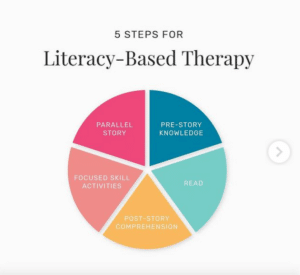
[4:30] Therapy Ideas for Step 1 (Pre-Story Knowledge Activation)
[5:36] Therapy Ideas for Step 2 (Reading)
[5:40] Therapy Ideas for Step 3 (Post Story Comprehension)
[6:35] Therapy Ideas for Step 4 (Skill Practice)
[8:16] Therapy Ideas for Step 5 (Parallel Story)

Links Mentioned

– ProCon Article: Paying College Athletes – Top 3 Pros and Cons
– The SLP Now One-Page Literacy-Based Therapy Unit Planner
– KWL Chart (In the SLP Now Membership)
– Summarizing Graphic Organizer (In the SLP Now Membership)

Subscribe & Review in iTunes

Are you subscribed to the podcast? If you’re not, subscribe today to get the latest episodes sent directly to you! Click here to make your listening experience auto-magic and as easy as possible.

Bonus points if you leave us a review over on iTunes → Those reviews help other SLPs find the podcast, and I love reading your feedback! Just click here to review, select “Ratings and Reviews,” “Write a Review,” and let me know what your favorite part of the podcast is.

Thanks so much!

Transcript

Transcript
Email Download New Tab

Wow. I cannot believe we are already wrapping up this month of curriculum-based therapy content. It's been really fun to dive into all of the things. This is definitely not the last time we'll talk about curriculum-based therapy and how we can use it with literacy-based therapy and all of that good stuff. Like I've been saying throughout all of these episodes, this is something that I think is incredibly important and I'm consistently trying to learn more and grow more in this area when it comes to like least restrictive environment, providing services in the classroom, alternative service delivery models. There is so much to dive into, but it's been a journey for me and I'm sure you're on a journey too. So I think it's still helpful to share, in of where I am at this point. And I'll continue to share what I'm learning and we have some exciting stuff coming up.
So it won't just be my perspective. So super, super excited about all of that. But this week we are working with some secondary students and the sample goals that I pulled for this group are, identifying facts versus opinions, identifying the main idea and key details, summarizing and producing sentences with three or more clauses, and then determining the meaning of words using affixes. So lots of good stuff here. And the curriculum-based activity that I chose to support was writing a persuasive essay. So this is something that I know I had to do as a freshman in high school. And it continued on throughout high school. And I remember doing all of these activities where we had to identify what was a fact and what was an opinion. I had ... I remember my sophomore year, one of my English teachers completely tore apart my essay and made me highlight all the parts.
So I've had a lot of practice with this and I've seen students work on this as well. So I thought it would be a really nice way, and I've done this with like one group in particular comes to mind. They had to write an essay and when they're writing these essays, they have to pull a lot of different texts to support their arguments. And a lot of our students have a hard time breaking down the texts, which makes writing the essay feel nearly impossible. So for this example, they, the students had to write an essay, a persuasive essay, and they got to pick the topic. So for this hypothetical group, they're writing an essay about whether college athletes should be paid and there are some really cool sites out there. One example is ProCon and so that's the example that I'm using today. So there's an article called, Paying College Athletes – Top 3 Pros and Cons.
And so that'll give us a really, it'll just be, like I'm not teaching the students how to write the persuasive essay, but I'm helping them. I'm implementing literacy-based therapy and giving them the strategies that they need while supporting their speech and language goals so that they can learn how to break apart the article, identify the information that they need, and then that'll get them closer to being able to write that essay. And just given our limited time with the students, this is just one example. And then I would try and coordinate with the other teachers and everything to make sure that all of the aspects are being covered. But I think this is where I felt like I was uniquely skilled and able to really support students. And it ended up working out really well with their goals. So, that's just how I decided to approach this.
So, diving into Ukranatist literacy-based therapy framework. If you want to follow along and jot down any notes or ideas, or if you want to start kind of planning your own unit, using this as some inspiration, you can head to slpnow.com/planner. But for step one, we can take an article walk in that we look at the article, we look at the title, we look at the picture, we look at the headings to get an idea of what it'll be about. And typically like with these persuasive essay topics, the students pick something that they are familiar with and that they already have an opinion on.
So hopefully we don't need to do a bunch of pre-story knowledge activation activities, but I think a KWL chart would be super interesting because the students likely know a lot about the topic, because they are likely very excited about sports and college sports and maybe they want to be a college athlete. Maybe they have an older sibling, who knows. So, they probably have a lot that they know, and they likely, because they know a lot, they probably have a lot of questions about the topic too, so we can fill in that KWL chart. And then as we read through the article, we can add in additional things that we've learned.
So I think that's a really great way to work through that. And then for step two, we'll just read through the article. And again, just my main goal is to make sure that students are engaged in attending to the article. And then for step three, we'll do some comprehension. So, because the students that I ... like in the hypothetical group don't have explicit comprehension goals. I assume that this is a relative strength for them. So I would just go through some literal and inferential questions to make sure that they're comprehending the text, but we would probably pretty quickly jump into summarizing.
So we would identify ... we would use the same strategies that we talked about last week and then also last month to help them summarize the text. And so we would identify who, where, what it's about and what's most important. And then we would identify the key details. This is also a great opportunity, because I feel like summarizing helps us move from step three to step four. So typically we would start filling in the summarizing graphic organizer and then we would transition to step four and we would do some practice. Maybe because the students are working on clauses, we would do some teaching of that, do some structured practice and then move into some like expanding sentences drill. And then we could use that to expand our summary, potentially, or just have some discussion around the article and practice expanding our sentences in that discussion. We could also do some teaching around fact versus opinion.
And if students are still struggling with that, we can back things up and take some very personal facts and opinions related to the group and do some practice there. And they could even play a little game like, is it fact or opinion, and they can make a statement and then the other members in the group have to determine whether that's a fact or an opinion, and they have to tell why. We could use a visual to support that, all of that good stuff. And then yeah. So, and then we would work through, once they get a good grasp of that, we can work on identifying the facts and opinions in the article. And this is a really important skill if they're being required to write a persuasive essay. A lot ... when I had to write them and when I've worked with students, they typically require them to like state an opinion and then support that with evidence.
So state their opinion and then list different facts. And if they have a really hard time differentiating, what's a fact versus an opinion. That is a very, very challenging exercise. And I found that taking some time to break that down makes that task much easier for our students. And then we would kind of continue working on their summary. And if they have the graphic organizer, they could pretty easily use that when it comes to writing their paper, I could give them ... if we don't have time to go through all of their articles, I could give them the graphic organizer and teach them how to do it. Maybe they could fill that in for homework and then they could use that. They could bring that to, like if they are working with a special education teacher, or whatnot, we could collaborate to make sure that they're continuing to use those strategies as they work through and start putting together their final persuasive essay.
So those are just some activity ideas to break that down. And I hope this is a helpful example, because our goal is not to complete the assignment. Just because I'm helping the ELA teacher and supporting that with the use of the persuasive essay, I'm not teaching them how to write a persuasive essay. I'm supporting the language underpinnings that they need to do that successfully. So I'm still very much staying in the speech and language zone and using my unique skills and perspective to set students up for success. And ultimately the goal is to have the students be independent with these underpinnings so that they have the tools and skills that they need to do this on their own. So, that's what that would look like. Hopefully that gives you lots of ideas and inspiration. I would absolutely love to see how you're applying this, where, what your journey is like with the framework. And yeah, I think that's a wrap. We'll see you next time.

Scroll back to top

Sign up to receive email updates

Enter your name and email address below and I'll send you periodic updates about the podcast.
powered by

Filed Under: Podcast Tagged With: Curriculum-Based Therapy, Literacy-Based Therapy, Therapy Plans

#088: Curriculum-Based Therapy Plans for Later Elementary

June 15, 2021 by Marisha Leave a Comment

Listen on Apple Podcasts Listen on Spotify

This Week’s Episode: How to Integrate Curriculum into Therapy with Later Elementary Students

If you’ve been a part of the SLP Now community for a while, you’ve probably heard me talk about the importance of meaningful, contextualized intervention once or twice. 😂

It’s part of why I’m such a fan of literacy-based therapy — and when you can pull materials from the curriculum, even better!

With this month’s learning series, our aim is to take those literacy-based therapy strategies that we’ve been discussing and embed the strategy into the classroom by applying it to materials from the curriculum. So far this month, we shared plans for our preschoolers and early elementary learners.

This week we’re going to tackle therapy plans for later elementary learners, and we’re going to do that with a group of hypothetical sixth graders who are working on answering questions, defining multiple meaning words, and summarizing texts.

Once we get the hang of these curriculum-based strategies, it becomes easier and easier to find ways to connect to the curriculum because it is so contextualized. You can pull pretty much any texts from the classroom and provide support in or outside of the classroom. 😍

Let’s dive in with a science expository text: A to Z article called Seeing the Evidence: Forensic Scientists at Work!

Strategies + Tips Discussed:

– The Literacy-Based Therapy Framework
– Pre-teach the  vocabulary
– Scaffold the text
– Model how to summarize the text

Here’s what we discussed:

[4:30] Therapy Ideas for Step 1 (Pre-Story Knowledge Activation)
[6:50] Therapy Ideas for Step 2 (Reading)
[7:08] Therapy Ideas for Step 3 (Post Story Comprehension)
[9:20] Therapy Ideas for Step 4 (Skill Practice)
[10:45] Therapy Ideas for Step 5 (Parallel Story)

Want to hear more about this topic? Click here to see this month’s content!

Links Mentioned

– A to Z Article: Seeing the Evidence: Forensic Scientists at Work
– The SLP Now One-Page Literacy-Based Therapy Unit Planner
– KWL Chart (You can find this in our SLP Now Membership!)

Subscribe & Review in iTunes

Are you subscribed to the podcast? If you’re not, subscribe today to get the latest episodes sent directly to you! Click here to make your listening experience auto-magic and as easy as possible.

Bonus points if you leave us a review over on iTunes → Those reviews help other SLPs find the podcast, and I love reading your feedback! Just click here to review, select “Ratings and Reviews,” “Write a Review,” and let me know what your favorite part of the podcast is.

Thanks so much!

Transcript

Transcript
Email Download New Tab

I have a group of sixth graders, hypothetically, who are working on answering questions, defining multiple meaning words, and summarizing texts. And we're continuing to follow the curriculum-based therapy theme and using content from the curriculum, or just chatting about ways to be more curriculum-based using a literacy-based therapy framework.
And I absolutely love the literacy-based therapy framework because it makes it really easy to implement contextualized intervention in a very meaningful way. And once we get the hang of the strategies, it's really easy to find ways to connect to the curriculum because it is so contextualized. It makes it really easy to pull pretty much any texts from the classroom and provide support in or outside of the classroom. I will admit that I have a little bit of experience providing intervention in the classroom, so a lot of the examples that I've been giving this month include work kind of outside of the classroom, and that's definitely something that I'm challenging myself with to figure out ways to work a little bit smarter there.
But this is my step in the journey of implementing, just connecting with the curriculum, collaborating with teachers, and pulling meaningful content, and then also sharing strategies and doing some lessons here and there. But I've been seeing some really, really cool articles about complete interventions in the classroom. That's something we're diving into and we'll have more content on soon. But this, I thought, it would still be helpful to share my journey and my progression towards curriculum-based therapy and the LRE and all of that.
For this particular group of students, they were doing a reading A to Z article in the classroom, and it was called Seeing the Evidence: Forensic Scientists at Work. Such a cool text. It was so much fun. I'm really excited to dive into this. And then if you want to follow along, and if you have a group that might be learning about forensic science in the classroom, or if you're wanting to use another text for a group of students using similar strategies, then head to SLPnow.com/planner, and you'll get a free copy of my one-page planner, so you can fill in your own text and goals as we go along. And hopefully these ideas will give you some strategies.
The forensic science article is an expository text. It's not story grammar, which is what I typically use with my younger students. And I find that a lot of times students still benefit from... They don't quite have a strong grasp of narratives in the very beginning, but this particular group of students was... it made sense to dive into the expository text at this point.
Yeah, so this gives us an opportunity to really focus in on summarizing and finding the main idea. And again, there's external evidence to support this as a strategy to improve comprehension. And last month we talked about a variety of strategies to work on summarizing and identifying the main idea. It was in the secondary episode. So, it was the fourth episode posted, but that will give you some... If you're wanting a refresher on some of those ideas, I'd really recommend checking out that episode. But it's basically just giving the students different self-monitoring tools, providing explicit instruction as always, and some scaffolding strategies.
Then, in terms of what we're actually going to do, I'll pull up my planner now, too. And then just to recap, we're using the article Forensic Scientists at Work. This is from reading A to Z. It is a paid subscription, but the goal of this is to use something from the classroom. So, if your teacher is using a Reading A to Z article, or you could apply this to any texts that they're using in the classroom. And the goals were targeting or answering questions, multiple meaning words, and summarizing.
For step one, our pre-story knowledge, we'd start off with an article walk and I would likely pull out a KWL chart as well. So, what they know about the topic already, what they want to know, and then later on, we can fill in what they learned.
With one particular group that I'm thinking about, they didn't have any background knowledge about forensic science, and it seemed like vocabulary was the biggest barrier for them. So, I did some pre-teaching where we identified some of the most important words, and we broke them down and we did a variety of activities. And if I'm being honest, when I used this text, I wasn't as familiar with the framework, and I actually just dove into reading the article. I completely skipped step one. Then we started doing story comprehension, and they weren't able to answer any of the questions.
So, that made me pause, and I realized that I actually needed to do the pre-teaching. I've definitely had my own literacy-based therapy and curriculum-based therapy fails. So, hopefully these podcasts episodes can help you learn from my mistakes. But I definitely had some internal evidence there that what I was doing was not working. That's why I'm super grateful for this framework, because I see my students making much more progress. And of course, that's just my internal evidence, but we also have... I do my best to share the external evidence, like data from the research that supports the use of these various approaches as well.
Back to the plan. We just did some pre-teaching of the vocabulary targets. They've got a good idea, a good grasp on what a victim and a suspect and all of that. And we've used our different vocabulary strategies to work on that. And then the next step we would dive into is shared reading. We would read through the text, and I keep this pretty simple. We just read through and make sure that students are staying engaged, but I don't do a lot beyond that. Like I said, I keep it pretty simple.
And that leads us to step three, where we dive into the story comprehension. This particular group was working on literal and inferential questions. So, I just started with the literal questions, and we did some comprehension there. That went well, which was exciting, so we continue to work on inferential questions. And then we started diving into summarizing as well, because that was one of their goals.
We used the strategies that I mentioned in the last episode from the Stevens et al. Articles, just different ways to scaffold. And some of the highlights were identifying sections of the text and then asking, "Who or what is the section about?" And then, "What is the most important idea about the who or what?" And then I would scaffold and support to students to write the gist.
Another way to do that is just make it shorter. Express it in a shorter form. If they struggle with that, we can, again, refer back to the text, or if we've done teaching of text structure, we can have them look at the text structure. And then of course, I want to make sure that I actually taught them how to do that, initially. So, sometimes I just dive into those strategies, but it's also really important to give them some explicit instruction before we expect them to start summarizing.
So, some ways to do that are to provide models of generating a summary. Maybe I would identify the main idea and just have a small section, and I would kind of talk through asking myself those questions. And then I would just kind of model my thinking out loud. Then I would give that students opportunities to practice and give them very specific feedback. Like, "Oh, I loved how you asked yourself the question about who or what is this section about. You did a great job identifying that, but you forgot to ask yourself what's the most important idea?" Or, "You just copied the text. Can you tell it in your own words? Write the gist. Make it in a shortened form, whatever makes the most sense." Hopefully those are some helpful examples in how to navigate that when it comes to summarizing.
And then we're at step four now. In this unit, we've already gotten to work on answering questions and summarizing and multiple meaning words, so we would just continue those in step four. I would take additional time to teach, as needed. I would have the students work on a vocabulary journal, and then this would be an opportunity to work on the other language skills as well. So, if they're working on answering questions, we can fill in the vocabulary journal, have discussion around that.
That benefits all of the students. It gives the students who have vocabulary goals, an opportunity to get more meaningful exposures. And it gives the students who are working on questions, also a meaningful... an opportunity to get more meaningful practice with those questions. And so, it just is a win-win all around. As long as we're choosing language, rich activities, we are golden and we can provide really amazing therapy.
Then I would also take some time to continue refining the students' summary. After we work on the comprehension and the vocabulary, we would revisit that summary and see if we can incorporate some of that vocabulary, and practice generating that summary. And that would give them, again, more meaningful opportunities to use their vocabulary in a meaningful context, all of that good stuff.
And then, step five of the framework is a parallel story. This is a little bit different if we're using a non-fiction text. I might have the students, maybe if we still need to work on narratives, if that's still one of the goals, they can make up a story and generate a story related to forensic science, or they can convince... Maybe they decide they want to become a forensic scientist. So, they write a persuasive, like a mini-persuasive essay about why they should be admitted to the forensic science program, or why it's important for us to have forensic scientists that can...
There's different ways to get creative and give students additional opportunities to use their target structures to embed their goals in meaningful contexts. Those are just some ideas. Hopefully that was a helpful framework. And then, next week we are diving into a curriculum-based therapy activity for our secondary students.

Scroll back to top

Sign up to receive email updates

Enter your name and email address below and I'll send you periodic updates about the podcast.
powered by

Filed Under: Podcast Tagged With: Curriculum-Based Therapy, Literacy-Based Therapy, Therapy Plans

#087: Curriculum-Based Therapy Plans for Early Elementary

June 8, 2021 by Marisha 2 Comments

Listen on Apple Podcasts Listen on Spotify

This Week’s Episode: How to Integrate Curriculum into Therapy with Our Early Elementary Students

Let’s continue our trip on the curriculum-based therapy train and talk about some ideas for our early elementary learners! 🚂

With this month’s learning series, our aim is to take those literacy-based therapy strategies that we’ve been talking about, and embed the strategy into the classroom by applying it to materials from the curriculum.

Last week we targeted some language comprehension, vocabulary and grammar with our preschoolers. The specific targets were answering questions about a story, identifying basic concepts, and producing three-word sentences that are grammatically correct.

This week I share an example of how I was able to collaborate with a teacher to help a student that was struggling with math word problems!

When I first heard this, I was a little bit unsure…speech language pathology and math aren’t exactly known for going hand-in-hand. 🤣

But as I thought about it and looked at the student’s goals, I became convinced that this was a really great area for me to support!

Let’s dive in and focus on how to target answering questions, identifying key details, defining tier two vocabulary words, and producing compound or compound complex sentences with our later elementary students.

Strategies + Tips Discussed:

– Collaborate with the teacher to target goals
– Observe the teacher to see what kind of language is being used in class
– Pre-teach instructional verbs and unknown words that are being used in class
– Act out the word problem
– Create vocabulary journal

Reference

– Lowman et al. from 2018 that talks about teaching kindergartners instructional verbs, and I really loved their approach. In this study they recognize the importance of instructional verbs and they wanted to see if they could teach these kindergartners 12 words that they thought were really important.

Here’s what we discussed:

[3:50] Therapy Ideas for Step 1 (Pre-Story Knowledge Activation)
[6:50] Therapy Ideas for Step 2 (Reading)
[6:55] Therapy Ideas for Step 3 (Post Story Comprehension)
[7:09] Therapy Ideas for Step 4 (Skill Practice)

Want to hear more about this topic? Click here to see this month’s content!

Links Mentioned

– June Therapy Materials
– The SLP Now One-Page Literacy-Based Therapy Unit Planner

Subscribe & Review in iTunes

Are you subscribed to the podcast? If you’re not, subscribe today to get the latest episodes sent directly to you! Click here to make your listening experience auto-magic and as easy as possible.

Bonus points if you leave us a review over on iTunes → Those reviews help other SLPs find the podcast, and I love reading your feedback! Just click here to review, select “Ratings and Reviews,” “Write a Review,” and let me know what your favorite part of the podcast is.

Thanks so much!

Transcript

Transcript
Email Download New Tab

Here we go. Let's continue on the curriculum based therapy train and talk about some ideas for early elementary. So some of the goals that I'm targeting with this hypothetical group include answering questions, identifying key details, defining tier two vocabulary words, and producing compound or compound complex sentences. And so in this hypothetical, but also kind of similar to a real group that I've had, when I started implementing curriculum based therapy I went to the teacher of these students and I reviewed the student's goals with her.
So this is what Johnny and Anita and Juan are working on. So I reviewed the student's goals and I asked the teacher about her goals, like, "Where do you see them struggling?" And this particular teacher happened to have a professional ... or actually all of the second grade teachers had a professional learning goal to reach a certain benchmark for math word problems.
So when I first heard this, I was a little bit unsure, but the more I thought about it and the more that I'd looked at the student's goals, the more that I was convinced that this was a really great area for me to support, because math is way more than just numbers and operations. Math is incredibly rich with concepts in terminology, and the math isn't what was hard about the math word problems. It was understanding what was written, understanding the vocabulary. And then also the students were required to explain how they got to the correct answer.
So by pulling in these math board problems, it was a perfect way to target answering questions, identifying key details, defining tier two vocabulary words, and producing compound and complex sentences. I could not have thought of a better activity. So I got really excited as we started diving into these units and it ended up working out really well.
So I thought it would be fun to share something a little bit out of the box. And so just an example of a word problem that they might have been working on was, Joe had 40 marbles. Marlin gave Joe some more marbles. Now he has 65 in all. How many marbles did Marley give Joe? So if your brain is spinning already, my students' brains were absolutely spinning. So it's really a simple equation. It's just 65 minus 40 equals 25. So Marley gave Joe 25 marbles, but the students were really overwhelmed with language side of things, for a variety of reasons.
Then they were also required to produce some pretty complex language to explain their thinking as well. I hope your wheels are already turning too, because there's so, so much that we can do with this. So if you want to follow along with the literacy based therapy planner, this'll be a little bit different. And if you want to follow along, you can head to SLPnow.com/planner.
When we're working with a word problem, we can still take some of the steps. So we can take a word problem walk instead of a book walk for the first step of pre-story knowledge. So we'll look at the word problem and just see what we notice. A lot of times there's vocabulary that is challenging. When I was working on the word problems with these students this was kind of part way through the year. They had already been doing these word problems for a while. So I asked to get a stack of just the past word problems, and I went through and identified the vocabulary words that might be tricky for my students. And so I worked on making a list of ones that we might need to target.
This was inspired by, there's a really cool article by Lowman et al. from 2018 that talks about teaching kindergartners instructional verbs, and I really loved their approach. So in this study they recognize the importance of instructional verbs and they wanted to see if they could teach these kindergartners 12 words that they thought were really important. So, I worked with the teacher to identify the most important instructional words, and then they taught them and they taught them to preschool years before they went into kindergarten.
I thought that was a really cool well approach. And so I was like, "Can I use this? Can we identify vocabulary that students need within the word problems?" And then also there are some tier two words that they would need to use to explain their reasoning. So more of the thinking words, so that, I thought that was a really cool opportunity.
Then I observed the teacher giving a lesson or two just to see what her language was around it, and that could also be a good way to identify key vocabulary words to target, and then we could kind of work from there and prioritize the different targets. I could check in and do like a quick probe with the students to see for the students who have vocabulary goals to see which words we need to teach and all of that good stuff.
So we might do some pre-teaching of vocabulary. That was a very long tangent to say that we can pre-teach vocabulary too. We could identify unknown words in the word problem, or we could do like a little bit of a unit really honing in on the words that they need to explain their thinking and have some different practice around that. So that's what we've got for step one. And we might kind of act out some stuff if they're having ...
Because I think a lot of times the students seem to get overwhelmed with the language, so just acting out the word problem was a helpful strategy. It made it feel a little bit more approachable and that made the math part easier, but then it also made it a lot easier to actually solve the problem. So for step two, we would just read the problem. And then for step three, the comprehension, we would break it down and identify the most important parts. I might ask some basic questions just to make sure they understood it.
Then we would go into step four where we really work on our skills. So this is where we would work on identifying the key details, using that tier two vocabulary, producing those compound and complex sentences. I can take some time for teaching here, and if you want specific strategies for how to teach vocabulary, like I love a good vocabulary journal. I think that would be very appropriate here, especially since we would be coming back to these word problems.
Then I would also refer back to the grammar episodes for strategies for compound and complex sentences. But yeah, that's how it's definitely not a clear fit into literacy based therapy framework, but I think we can use some of the strategies that we've learned. And I think it's just a good example of how we can take something that we might not always consider as a good language target, but this ended up being really effective. The teachers were incredibly motivated to work with me. I got one of those word problems in my box multiple times a week, whereas before I implemented this, I was just, it was really hard to get anything from them. And it was something that the teachers were very motivated to collaborate on this. They were able to use some of the strategies. We worked together on some of the strategies.
So they were able to implement that, and it benefited students that weren't even on my caseload. So it's just a really cool way to get teacher buy-in, but also have a significant impact on our students and students that aren't in our groups or that aren't on our caseload. So just a really cool way to have an impact and all of that good stuff. So hopefully that gave you a good overview. I'd love to hear how like a unique therapy target that you might be inspired to use, and if you have any questions on how to implement some different strategies, I would absolutely love to chat and brainstorm. So next step is later elementary.

Scroll back to top

Sign up to receive email updates

Enter your name and email address below and I'll send you periodic updates about the podcast.
powered by

Filed Under: Podcast Tagged With: Curriculum-Based Therapy, Literacy-Based Therapy, Theme-Based Therapy, Therapy Plans

#086: Curriculum-Based Therapy Plans for Preschool

June 1, 2021 by Marisha Leave a Comment

Listen on Apple Podcasts Listen on Spotify

This Week’s Episode: How to Use Curriculum in Literacy-Based Therapy

I cannot tell you how much I’ve been looking forward to this month of content, because we’re diving into all things curriculum-based therapy! 🤓

The goals we’re going to target in this unit with our preschoolers are: answering questions about a story, identifying basic concepts, and producing three-word sentences that are grammatically correct. We’ve got a good mix of targets with some language comprehension, some vocabulary, and some grammar. 💪

What we’re really aiming to do with this month’s learning series is take those literacy-based therapy strategies that we’ve been talking about, and embed the strategy into the classroom by applying it to materials from the curriculum.

The more that I read the research, the more that I see the importance of contextualized intervention.

Let’s get to it!

Strategies + Tips Discussed

– Contrastive Imitation + Drill-Based Activities
– Focused Stimulation + Frequent Modeling/Recasting

Reference

– Fey, Cleave, & Long (1997) describe a treatment approach in a preschool classroom. The therapists selected several grammar targets and cycled through the targets (a week for each). They used contrastive imitation and focused stimulation. Contrastive imitation was a drill-based activity, while focused stimulation included frequent models and recasts in a variety of activities (e.g., play, snack, and other common preschool activities).

Here’s what we discussed:

[7:30] Therapy Ideas for Step 1 (Pre-Story Knowledge Activation)
[8:53] Therapy Ideas for Step 2 (Reading)
[10:00] Therapy Ideas for Step 3 (Post Story Comprehension)
[11:24] Therapy Ideas for Step 4 (Skill Practice)

Want to hear more about this topic? Click here to see this month’s content!

Links Mentioned

– June Therapy Materials
– The SLP Now One-Page Literacy-Based Therapy Unit Planner
– Wheels on The Bus by Anthony Lewis
– SLP Now Membership (WH Questions activities are included in the membership!)

Subscribe & Review in iTunes

Are you subscribed to the podcast? If you’re not, subscribe today to get the latest episodes sent directly to you! Click here to make your listening experience auto-magic and as easy as possible.

Bonus points if you leave us a review over on iTunes → Those reviews help other SLPs find the podcast, and I love reading your feedback! Just click here to review, select “Ratings and Reviews,” “Write a Review,” and let me know what your favorite part of the podcast is.

Thanks so much!

Transcript

Transcript
Email Download New Tab

Speaker 1: Hey there, SLP. I cannot tell you how much I've been looking forward to this month of content. We are diving into all things curriculum-based therapy, and we're getting started with a group of preschoolers. So the goals that we are going to be targeting in this unit are answering questions about a story, identifying basic concepts. So spatial temporal, qualitative, quantitative, and we'll also be chatting about producing three-word sentences that are grammatically correct. So I wanted to include a combination of different goals. So we've got some language comprehension, some vocabulary and some grammar. So hopefully that's a good mix. And hopefully it'll be a really good way to give you some ideas to step up all of the literacy-based therapy strategies that we've been talking about, but starting to embed them into the classroom and, or like pulling more from the curriculum. And I think this is especially important because the more that I read the research, the more that I see the importance of contextualize intervention. There's also a lot of talk about least restrictive environment and just getting creative with service delivery.
There's some really cool studies out there. I just read one about narrative intervention and they talked about having a whole unit in the classroom, a nine week structured unit, and this was one of the ASHA EBP briefs articles. So it was just kind of integrating a bunch of different articles to try and solve a clinical problem. And then the speech therapist ended up deciding, she decided to put together a nine week narrative instruction unit within the classroom. So she did it twice a week for 30 minutes and I've just been reading more of this kind of staff and it's just really interesting to think about how we can change up what we're doing and move away from sticking with 30 minutes once or twice a week in the speech room. That's our default, that's what we kind of stick with and having very little variation.
And I think the more that we learn, the better that we can kind of customize each student's service delivery and just how we put together their IEP and have it truly be individualized. So I'm really excited to start exploring this topic. This is something that I definitely still have room for growth in. I did a little bit of intervention in the classrooms and I have implemented some alternative service delivery in terms of like getting creative with the minutes and just moving away from the 30 minutes once or twice a week model. But I definitely still have room for growth. So I'm excited to continue diving into the research and experimenting as I figure things out. But with my preschoolers, I've actually done a lot in the classroom. And so that's what I'll focus on today. So the book that we're using is Wheels On The Bus, and it's a song that...
This is something that they use, I think pretty much every preschool classroom that I've been in sings Wheels On The Bus. They watched the YouTube video for it. And so I thought it would be a fun way to target some of our speech and language goals, provide some visual supports and then just target our skills in a meaningful way. And if I'm able to do this in the classroom, model it for the teachers and the assistants. It's also a really meaningful context for the students, because if I teach them some strategies or whatnot, they'll be able to... It'll be really easy for them to generalize because I taught them in that original context. So it's just really cool. I've been able to take books into the classroom, and then I've found that the teachers end up using them, especially if we collaborate on the book selection.
And then it just really benefits everyone because I teach them some new strategies and we really get to collaborate and find ways to really impact our students. So let's figure out what this would look like using a literacy-based therapy framework. And I use a planner to map out my units, it's just a one-page sheet. So I just put in the texts, so we're using Wheels On The Bus and I write the goals at the top of the page. So that for this hypothetical group, we're working on answering questions, identifying basic concepts, and then producing three-word sentences or three-word utterances that are grammatically correct. And yeah, so we're going to be... Oh, and if you want a copy of this planner, you can head to SLPnow.com/planner to fill this in, just like put in the ideas that I have share or think of your own group and jot down some of their goals and see how you can implement this, and just adjust my ideas to make it work for your students' goals.
But when I think of a preschool classroom, I think of their day usually consists of play centers, having rotations, they have snack, they have circle time where they sing music. So these are all different types of activities that we can support and help students use their language. And one study, Fey, Cleave, Long in 1997 describes the treatment approach in a preschool classroom, which I think is a really good example to pull from. But the therapist in the study selected, and this was focused on grammar. So we have one grammar goal, but I think we can look at some other options and get creative and use this kind of model and implement all of the other evidence back strategies that we've used and that we've discussed over the last several months on the podcast and we can kind of integrate all of that together.
But in this particular study, they selected several grammar targets that their students needed to work on and they cycled through the targets. So they spent one week on each of the targets and they use contrast of imitation and focus stimulation. So definitely head back to the preschool grammar episode, if you want a refresher on that. But they did contrast of imitation as a drill based activity. And then they use focused stimulation in all of the different types of activities that I listed like play, snack, circle time, all of that good stuff. So this is something that we could easily embed within the classroom. And when we talked about vocabulary, there's another similar study that describes a treatment approach used in a preschool classroom and it has like a very structured example of how they implemented it.
So I think we can draw some really cool ideas from both of those studies. So when it comes to pre-story knowledge, so step one of Dr. [Yukarance's 00:08:50] framework. We can do a book walk and we can look at the pictures and we can see if the students are able to identify the bus or the people or the different actions. And this is a little different where this is not of the most developed story in the world. We're focusing more on basic grammar and vocabulary than story retell and all of that. But I think this is a great introductory activity, especially if it's a song that they're going to use throughout the year. And then we can talk about like if the students ride the bus to school, we can talk about what they do with that.
And maybe I could even meet them at the bus and we could talk about like the wheels and "Oh, here's the driver and here are the people," and just kind of connect what we're reading in the book to what we're doing there. If we could actually listen to the song on the bus, that would be pretty epic. So I don't know. We could get creative here, but those are just some options. If we want to like take a field trip or I think a play-based activity would be super fun. I feel like every preschool classroom has one of those play buses. And so as they're playing with the bus, we can do some different language activities, as like a pre-story knowledge activity or later in the unit. So those are just some ideas for what we would do for step one. For step two, we would read the text.
And I've worked in a variety of preschools, so for some of the classrooms, the students really benefited. It was difficult just to get them to attend to the story, but as they got familiar with it, they were much more willing to participate. So the first time we did a reading was always a little bit rough and we would just work really hard to keep them engaged in the story, but then over... I would read on Monday and then the teacher during circle time, she would continue to read the story. And so I would just have to be there on Monday during circle time, and then I could come in during other parts of the days, once she had like seen me read, saw of my different models, and we discussed the strategies that we want to use. Then she continued it for me so I could jump in at different points in the school day to help with the more of that contrast of imitation, like doing that drill based activity as well as focused stimulation during different activities as well.
So then for story comprehension, we have some very simple WH question cards. So I think those are a great approach for the types of students we would be working on this with. So it has simple like who and what questions, for example, and they're leveled as well. And I would use different cards depending on the study students' needs, but some of them they're just learning the meaning of the different question words. So we might just, if I ask them a who question, the visual choices might only include people and that's a way to include some of that errorless learning. But then if they're starting to understand the meaning of the different question words, I might give them a question with like a who question with a person, a location, and another answer as well, so that they actually have to understand.
So that's a good way to scaffold the comprehension piece. And we have visual choices, so it's easy to... Even if a student isn't at the level of producing a response independently, we can scaffold them and maybe we can even make it a field of two choices, or we can make it errorless and help them identify it. And if they're using an AAC device, we can help them find the answer on their device and so on and so forth. So there's lots of ways to scaffold that and set students up for success there. Then when we dive into step four for the focus skill activities, this would be like following Fey et al. model. It would just be jumping in with the students in the classroom in a variety of activities, whether they're doing play centers, or during snack time, or whatever it may be, I would embed the different skills that we've been working on in those meaningful contexts.
And so maybe we can do like a best craft, or maybe we can play with the toy bus, or maybe we can take a cardboard box and pretend we're going on the bus. Then we can use that as an opportunity to use our basic concepts because that's one of the goals that we had or to produce a three-word utterances. I would be modeling that and recasting and using all of those in a meaningful context. And so, hopefully that's a helpful recap of some of the different strategies that we can use for the students. And then next up is early elementary.

Scroll back to top

Sign up to receive email updates

Enter your name and email address below and I'll send you periodic updates about the podcast.
powered by

Filed Under: Podcast Tagged With: Books, Curriculum-Based Therapy, Evidence Based Therapy, Literacy-Based Therapy, Therapy Plans

#085: Targeting Narratives with Literacy-Based Therapy: Secondary

May 25, 2021 by Marisha Leave a Comment

Listen on Apple Podcasts Listen on Spotify

This Week’s Episode: How to Identify the Main Idea, Key Details and Summarizing

So far in this series we have focused on answering questions, sequencing, describing, and story retell with our preschoolers. We continued to build on these skills and focused on how to use explicit instruction to target narrative generation with our early elementary students and our later elementary students. 

This week we’re going to wrap up our series on narratives with a unit for our older students, and this differs from what we’ve done in the last few weeks because we tend to shift more towards expository text — especially if they have a solid understanding of the story grammar framework.

This age group spends less time with narratives and more with those expository texts, so we really want to work on: identifying the main idea, key details, and learning how to summarize.

Solis et al. (2011) indicate that teaching sixth through eighth-graders with LD, how to summarize and find the main idea is an effective strategy to help improve understanding of the text.

These skills are really important not only for school work or studying to pass exams — but for real-world milestones like passing a driver’s test, understanding directions in a manual, or onboarding at a new job.

Setting them up for success starts now. Let’s get to planning, shall we? 

Strategies

Scaffold instruction, model use of strategy, use graphic organizers, and give students ownership (Pyle et al., 2017).
Read the text, use self -monitoring tools, and use explicit instruction (Solis et al,. 2011).
Scaffold finding the main idea of a text (Stevens et al., 2019).

Here’s what we discussed:

[8:35] Therapy Ideas for Step 1 (Pre-Story Knowledge Activation)
[9:19] Therapy Ideas for Step 2 (Reading)
[9:30] Therapy Ideas for Step 3 (Post Story Comprehension)
[10:10] Therapy Ideas for Step 4 (Skill Practice)
[11:25] Therapy Ideas for Step 5 (Parallel Story)

Want to hear more about this topic? Click here to see this month’s content!

Links Mentioned

– The SLP Now One-Page Literacy-Based Therapy Unit Planner
– ReadWorks Article: Vitamin G for Your Mind
– SLP Now Membership
– May Therapy Plans
– Targeting Grammar with Literacy-Based Therapy: Preschool, Early Elementary, Later Elementary, and Secondary
– Targeting Vocabulary with Literacy Based-Therapy Preschool, Early Elementary, Later Elementary, and Secondary

Subscribe & Review in iTunes

Are you subscribed to the podcast? If you’re not, subscribe today to get the latest episodes sent directly to you! Click here to make your listening experience auto-magic and as easy as possible.

Bonus points if you leave us a review over on iTunes → Those reviews help other SLPs find the podcast, and I love reading your feedback! Just click here to review, select “Ratings and Reviews,” “Write a Review,” and let me know what your favorite part of the podcast is.

Thanks so much!

Transcript

Transcript
Email Download New Tab

Now we get to dive into something a little bit different for our older students, because with our older students, we tend to shift more towards expository texts, especially if they have a good understanding of the story grammar framework. They're really bombarded with expository texts throughout the school day and less so with narratives. So by teaching them how to identify the main idea, how to identify key details, teaching them how to summarize, those are skills that will be incredibly important as they move forward. Whether they're trying to pass their driver's test, or pass a social studies exam, or understand directions in a manual, or when they're starting a new job, these are skills that are incredibly important.
So instead of narratives, we're going to be focusing on summarizing for these students. And as I already alluded to, identifying the main idea and key details is one example of a goal. Another goal is to summarize the text. And Solis et al. from 2011 indicate that teaching sixth through eighth graders with LD, how to summarize and find the main idea is an effective strategy to help improve understanding of the text. And if they can learn to summarize and find the main idea of any given text, that could potentially have a very significant impact.
So what we're talking about today, we're discussing how to start targeting these skills using another ReadWorks article. Again, this is available for free at readworks.org. And the title of this article is Vitamin G For Your Mind, and just about the need for vitamin G. It's a little bit of a sciency article. So let's just dive in to our plans and I have a couple strategies that we can use. So Stevens et al., 2019, share a way to help us scaffold finding the main idea of a text.
So the question that I can ask is who or what is this section about and what is the most important idea about the who or what. And then I'm teaching the students to write the gist of the answers to those questions. So I thought that was a really helpful way because when I'm talking to students about identifying the main idea, a lot of times they'll say, "Well, the main idea is the first sentence in the paragraph." And then they just recite that. So I think these questions are super helpful in breaking that down. And being able to identify the main idea and really understand the main idea, I think is a huge step in the right direction. So just to recap, we want to know who or what the section is about and the most important idea about the who or what.
So that's how we can scaffold finding the main idea. And then just like who or what, and then the most important idea, and then kind of synthesizing that and finding the gist of that. And if our students struggle with this, we can remind them to go back to the text, especially if we start with an article that's a little bit more understandable and simple, that might be a good way to scaffold it as well. But just to have them go back to the texts, identify the who or what and the most important idea. And then there's also some cool research on reminding them to look at the text structure and teaching them the structure of the text. There's some really cool research out there. And like, for example, if it's a problem solving passage, the main idea will tell us the problem and the solution for that problem.
So if we can say, "Oh, this is a problem solution passage." So I need to know what the problem is and the most important thing about that problem is the solution. So I need to know the problem and the solution, and that'll give us the main idea. So I think that's a really cool way, like by teaching the text structures, we can set them up for success and give them additional strategies. And yeah, this study found by using this approach students were better at stating the main idea and understanding different text structures. So some other strategies that we can use. So when we're reading the text, and this kind of like goes along with what Stevens et al., 2019, what that article said, but we can highlight what's most important and then just work on expressing that in a shorter form.
So that's, instead of writing the gist, like expressing it in a shorter form might be another to say that, if students don't understand writing that gist. We can also help students use self-monitoring tools. So maybe after they read a paragraph, can they check-in with themselves to make sure that they understood it? And we also want to make sure that we're using explicit instruction. So I think the Stevens et al. article gives a really nice way to set that up. So we can model asking ourselves these questions, like who or what was this about? What was most important about that who or what? And so we'll model that and think out loud and model our thinking as we're identifying the main idea of a section or a paragraph or an article. And then we want to give students feedback as they're doing this on their own.
So have them read a section and ask them to kind of talk about what they think the main idea is, and if they need support with that we can kind of give feedback on, "Oh, so it sounds like you identify the who, but what's most important about that?" So just giving them feedback, really specific feedback to help guide them towards the main idea. Or if they did it perfectly, we can give them specific feedback there like, "Great job. You identified the what of that section and what's most important about that." And so we can just identify what they've done and what they need more support with. And then just providing them with tons of opportunities for guided and independent practice. And next month, we'll be talking all about curriculum-based therapy and how to kind of start, because when I teach about this, I think it's really helpful just to take one text and use it across multiple groups.
It helps you learn the strategies very quickly and it gives you some confidence in the different evidence-based strategies. But once you get comfortable with this, I like to challenge SLPs to incorporate different elements of the curriculum. So whether you're just simply selecting articles that are related to what they're discussing in the classroom, or if you want to take it a step further and really can set up strong communication with your teachers and pull in articles that they're actually using in the classroom, or even just using their textbook, whatever they happen to be like, "What are you reading in science today?" It can be as simple as that. But I think starting with like when you're first implementing this, you want to be able to put together some ideas. You want to read the texts before, so you can come up with some strategies. But once you get really comfortable with this, you can pull pretty much any text and implement these strategies.
And at that point, you would have gotten lots and lots of practice. And so it's easy to adjust and implement these strategies with pretty much any text. But anyway, that was a little bit of a tangent, let's get back to Vitamin G For Your Mind, this article that we're using. So again, to recap we're targeting identifying the main idea, identifying key details, and then summarizing the text. So for step one of the framework, we'll do some pre-story knowledge. We might just walk through the article. This one has nice headings and we might say, "Okay, so what is vitamin G?" What do the headings tell us? What do we think this will be about?" And we might just take a guess at what the main idea is and what we think will be most important. And maybe it's just questions at this point like "What questions do we think this article will answer?"
And we can do a KWL chart too, what we know, what we want to know, and then as we read, we can fill out the L like what we learned, but that can be a great pre-story knowledge activity, because then we can figure out if we need to do any additional pre-teaching. And then first step two, we would dive into actually reading the text. And then for step three, we would dive into some comprehension activities. So this really depends on where the students are, but we might ask literal and or inferential questions. And then we would also start diving, like we would start diving into all of the summarizing skills. And again, using that scaffolding procedure if needed, to help the students identify the main idea and to identify the key details. I really like using a graphic organizer, that makes it easier to kind of process all of the elements.
And, yeah, so that's what we would do for step three. And then for step four, we would be able to work on all of their other skills. And maybe in step three, we just focus on filling out the summary. And then after we've done all of our grammar and vocabulary practice, we can revisit the summary and make sure that we're including our new vocabulary and our new grammar. If we're working on compound and complex sentences or sentences with multiple clauses, we can expand that and include what we've learned. And then give the students the opportunity to practice like actually telling that summary and summarizing out loud. I think that's a great way to continue developing those skills. So for this example, we would just simply summarize the article. We could create a little video or create an animation to help us remember what the article was about.
And then again, still practicing our summarizing skills, integrating all of the grammar and vocabulary skills that we've targeted throughout the unit. And if you want more ideas for grammar or vocabulary, head back to previous months episodes for more details. And so that's what we would do for step four. And then for step five, this is typically the parallel story section, but I think it's a really great opportunity to take things a step further. So if we read an expository text and assuming it's something that's just largely informational, I think it's fun to explore different text structures.
So maybe we read this article about vitamin G and then the students can work on creating like a persuasive text or maybe we can read two articles about the same topic and then compare and contrast, but just diving into some of the different structures that they're using in the classroom. And that can be a cool way to talk about the different structures that they might encounter throughout their time in school and just give them additional strategies to navigate that. So, yeah, that's what we've got for this unit. And that's a wrap for all things narratives and summarizing, and we'll see you next month when we start sharing ideas for curriculum based therapy and really taking all of the things that we've learned over the past several months and taking it to the next level.

Scroll back to top

Sign up to receive email updates

Enter your name and email address below and I'll send you periodic updates about the podcast.
powered by

Filed Under: Podcast Tagged With: Literacy-Based Therapy, Therapy Plans

  • « Go to Previous Page
  • Page 1
  • Interim pages omitted …
  • Page 13
  • Page 14
  • Page 15
  • Page 16
  • Page 17
  • Interim pages omitted …
  • Page 38
  • Go to Next Page »

Platform

  • For SLPs
  • For Districts
  • Pricing
  • Contact

Resources

  • Success Stories
  • SLP Now Blog
  • Podcasts
  • Speech Therapy Tools
  • Reviews

Policies

    • Cookie Policy
    • Privacy Policy
    • Terms of Service
    • Trust Center


social links

youtube

Youtube

instagram

Instagram

facebook

Facebook

© 2026 | All Rights Reserved | SLP Now®