• Skip to primary navigation
  • Skip to main content
SLPNOW_Logo_Color
  • For SLPs
  • For Districts
  • Success Stories
  • Resources
    • Blog
    • Podcasts
    • SLP Goal Bank
    • Speech Therapy Tools
    • Contact
  • Pricing
Login
Free Trial

Marisha

#036: Tips for Success with Literacy-Based Therapy: Parallel Stories

February 5, 2020 by Marisha Leave a Comment

Listen on Apple Podcasts Listen on Spotify

We’ve officially wrapped our three-part series all about grammar over here at the podcast, and we are moving on to strategies for implementing the fifth step of the literacy-based therapy framework: Creating a parallel story!

If you haven’t heard of parallel stories before, this is always the last thing that I do in my literacy-based therapy units because it really allows students to integrate skills and apply what we’ve learned throughout the entire unit.

A quick note — before diving into all this episode’s goodness, make sure that you’re familiar with the basics of literacy-based therapy. If you’re not super confident, I recommend going back to episode four, which breaks down the five-step approach I’ll be talking about today.

When you’re clear on the basics, listen to this week’s episode where I share more about creating parallel stories — what they are and why they can be so beneficial, and then we’ll dive into some practical examples to implement this with your caseload.

A lot of you have written in to me saying that you’re looking for a little bit of inspiration on what could happen with the parallel stories, so I’ll share a few ideas about how to work with picture books, a couple of fiction articles, and some ideas for nonfiction articles to round out those various stages of learning.

So, grab your beverage of choice (I’ll have a chai latte!), put your feet up, and listen in.

Key Takeaways + Topics Covered

– Quick review of literacy-based therapy framework
– Using a story grammar organizer
– Examples in practice
– Creating stories on paper vs. digitally
– Parallel stories in fiction vs. non-fiction
– Using pre-story activation to influence the parallel story
– Ideas for parallel stories based on February’s Therapy Bundle
– A sneak peek at March’s therapy materials!

Links Mentioned in the Podcast

– ChatterPix
– Toontastic
– ReadWorks.org

Subscribe & Review in iTunes

Are you subscribed to the podcast? If you’re not, subscribe today to get the latest episodes sent directly to you! Click here to make your listening experience auto-magic and as easy as possible.

Bonus points if you leave us a review over on iTunes → Those reviews help other SLPs find the podcast, and I love reading your feedback! Just click here to review, select “Ratings and Reviews,” “Write a Review,” and let me know what your favorite part of the podcast is.

Thanks so much!

Transcript

Transcript
Email Download New Tab

Hello there, and welcome to the SLP Now podcast. Today, we are going to be talking about all things parallel stories. If you haven't heard of parallel stories before, this is always the last thing that I do in my literacy based therapy units for a number of reasons. It really allows students to integrate skills, and just really apply what we've learned throughout the entire unit.

If you're not familiar with literacy based therapy and how to make that work, all of that good stuff, I'd highly recommend going back to episode four which talks about the five step approach. It breaks it down and makes it super easy to approach. Just pause this and head back to episode four if you're not as familiar with the literacy based therapy framework.

But a lot of people who listened to that episode, or who are in the SLP Now membership, or who follow me on social media have asked for more information about those parallel stories, so that's what we're doing today. I'll just tell you a little bit more about what they are, and what the benefits are, and then we'll dive into some practical examples to implement this with your caseload.

I'm going to be sharing some different ideas on what we can do with a couple of different picture books, a couple of different fiction articles, and then I'll just give some different ideas for nonfiction articles as well. And then we'll see what else comes up, but that's the plan.

A parallel story, just backing up to step one, is when we read a story, for example, we read The Mitten, and we went through the whole literacy based therapy framework. We did our pre-story knowledge activation. We have a lot of great background knowledge. We read the story. We did comprehension activities. We worked on all of our vocabulary, and grammar, and just all the different goals that we have.

Then it's time to get some embedded practice and to really put those skills to the test. We always try to embed the skills throughout the skill practice and make it as relevant as possible, but the parallel story is the opportunity to take it to the next level.

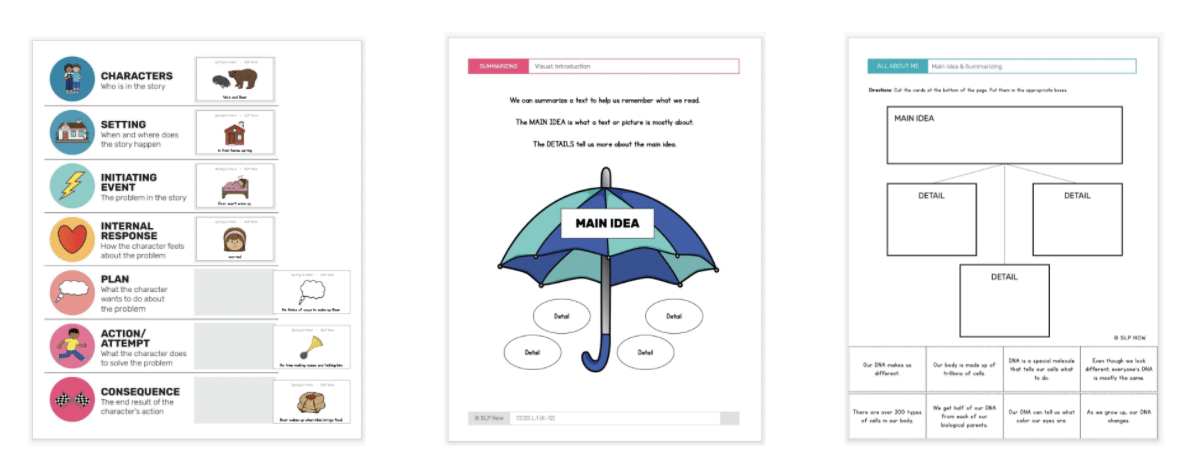
So what we do is we take the storyline, and I typically do ... In step three or four of the literacy based therapy unit, I have students fill in either a story grammar organizer, if it is a picture book or a fiction text or a summarizing sheet. I just make these little interactive activities for my nonfiction articles. We do that if we are working on those narratives or ... We do that throughout the unit for the story that we read, and that really helps with comprehension. It's an opportunity to embed our language skills in the retell. But creating a parallel story is just another opportunity to practice these skills in an embedded way, in a very meaningful way because the story ends up being very meaningful to the student. They take ownership of it.

For example, if we read Snowman at Night, it's a story about what snowmen do at night, or it's what this boy imagines that snowmen do at night. And then we can ... One of my groups ended up making a story about what cacti do at night. And so that is a way to take the storyline ... We'll take that story grammar organizer, we'll look at how it worked for Snowman at Night, then we'll take another copy and we'll start filling it in. We will look at Snowmen at Night for inspiration, but we might change the characters, or we might change the problem, or whatever draws a student's attention, that's what we'll do. And they get to take creative license here, and work to create their own story.

There's a couple of different ways that I like to put these together. A lot of my students will ... I love a good, old-fashioned book. So they'll just take some printer paper and, depending on how big we have to write, I'll either just get a stack of paper and put two colored pieces of paper on the front and the back and staple those together, and then we have a book, or I'll fold the paper in half and then create just a smaller book. So that's what we do if we are hand writing and hand illustrating the story.

I worked in a clinic for a while, and I loved doing this in the clinic because those were one-on-one sessions and that worked really well. This can work if you have students who can write independently, or if your students don't mind sharing one book. But I find that it gets a little bit trickier when we have more students in a group. I've definitely been able to make it work, but if I have a mixed group or multiple students in a group, I really like to project what I'm working on, or at least use like a screen that we can all look at.

My favorite thing to use is my laptop when we're doing these, because then I do have the option to project or we can just look at the same screen and work on it together. I love using PowerPoint because I can type really fast, so the students can come up with ... We'll fill in the graphic organizer and then we'll start creating some sentences around what we put in the graphic organizer. So it's like an expanded version of the retell. Then I'll just type up whatever we come up with in the session.

We might pull in, depending on time, we might pull in some Google images, too, so the students don't have to illustrate. And then I just print off multiple copies, so each student has one. It just saves a little bit of time and get to focus on the actual therapeutic elements, and not as many of the elements that take a lot of time.

If it makes sense with the students' goals, I might have them spend some time illustrating the stories, and taking time in those steps. But if it doesn't make sense, then that's the route that I like to go because I like to be efficient and get things done. The students love seeing their finalized books, pulling them off. I usually just will print them and staple them, which I call binding, which is super easy binding, and then they just get to ... They are so excited to see the final product and the thing that we've worked on for so long.

Then all of the students get to practice telling their story or telling their retell. It's a great opportunity because each student gets to practice producing the parallel story, and use their different grammar and vocabulary targets and all of that, but then they get to hear other students tell the story, as well. And then they have this beautiful book that they get to take home and share with their parents, or share with their friends, or their classmates, or their siblings, and then we just get additional practice with all of those targets.

So it ends up being a really fun activity. Yeah. That's the traditional, my go to option. That's what I typically do, definitely if we're using a picture book or a fiction article, and especially for younger students, that's one of my favorite things to do. For older students, sometimes we have to up the ante a little bit and change things up. Then we'll talk about lots of different things when it comes to the nonfiction texts. But if we're looking at picture books and fiction articles, the PowerPoint option, printed off multiple copies for each student, that's my favorite.

Some other things that we can do instead of that printed book, or as an alternative, or as an additional opportunity to practice, I always mention this app, but I love ChatterPix. So if we were telling the story of Cacti at Night, we might take a picture of a cactus, draw a little mouth on the cactus using the ChatterPix app, and then record the retell of the parallel story. It's just a fun way the students get to practice producing their narrative, and they get to hear it back, and have it be told from the perspective of the cactus. You can even pick whatever character you want. So there's some good opportunities for perspective taking, and we can get so incredibly creative, so many opportunities. So, yeah, that's one thing that's very fun. Students love it.

There's also another app called Toontastic, which allows us to create animations. This doesn't always work when we're doing ... I will use ChatterPix if we're just retelling this story, too. We'll take a picture of a character in the story and tell the story that way. Toontastic is amazing, but it doesn't always work because the settings aren't always a match. But if we're telling a parallel story, we can choose whichever setting we want. So Toontastic is really great for that. These are both iPad apps. I'm not sure if they are available on other platforms, but that's one that is very fun.

And then, just the simple activity that students really enjoy ... I feel like all students, or so many of my students, say that they want to become YouTubers. I guess that's the thing these days. And so just being able to record videos of the students is really fun. They can practice retelling their story. It's probably a good idea to get parent permission, but we sometimes just record the video and then just delete it right as the students are leaving. I just want them to be able to see themselves producing their narrative, and get to hear it back. They're just really excited to be able to see that.

We can even create different animations. We can grab just some different props or even print out different pictures and create our own low key animation using printed pieces or whatever toys we have in the speech room to retell a story, just using whatever props we have. You don't need anything super fancy. If you've got a phone or anything that has the ability to record video, there are so many different options and it's super fun.

Hopefully that gives you a good overview, lots of different ideas on things that you can do for fiction texts. Before we dive into nonfiction, I wanted to ... With nonfiction, it's not technically a parallel story, but I find that the principle works really well even using that concept. We're just working on summarizing instead of retelling, but it's still a very relevant skill, and a lot of the same types of things work when we're working on summarizing versus retelling. We're still embedding the concepts. We're still being communicators, all of that good stuff.

But before we do that, I wanted to dive into a couple of different examples of what this looks like for a couple of different texts. We will start, because I just pulled out my cheat sheets for the different units. I create them for every month of the year. Every month has a book, a picture book, a fiction article, and a nonfiction text that we focus on. And so you're getting a sneak peek of the books and fiction articles that are going to be coming out for the next couple of months inside the SLP Now membership. You don't need the membership to make this happen. That's just where I'm getting the inspiration from, and just from what I've done with previous students as well.

The first book that we'll dive into is The Mitten. This is a story about a boy who asks for white mittens from his grandmother. She knits them. She's hesitant to make them, though, because they're white and they get lost in the snow. And then the boy ends up going out to play. He loses one of the mittens. A bunch of stuff happens to the mitten while it's out in the forest, and then you'll just have to read the story to see what happens to the boy at the end of the story. That's just a recap of that story.

There are unlimited options that we could ... Your students will surprise you. They'll have so many different ideas on parallel stories based on their experiences. You'll do the pre-story knowledge activation, you'll be able to ... Some of those experiences will start to come up, and you'll be able to pull from those as you're working on the parallel story. It's a nice way to wrap everything up, because you're pulling all of the elements from the entire unit, even the pre-story. It's beautiful. I love it. For The Mitten, the students could tell ... Everyone has lost something at some point, so they could tell a story about something they lost. They could tell a story about a gift that they got from their grandmother or from their grandfather, or just any gift that they got. They could tell a story about the last time they were in the snow, the last time they were in the forest. As long as it follows the storyline and it has those story grammar elements, anything is fair game.

And sometimes we might want to steer the direction. Like if we really want to have a repetitive element with animals, like The Mitten does, we might want to steer students in that direction. You can steer the ship in the way that you want to get whatever grammar targets are, not grammar necessarily, but whatever targets you want to elicit, you can steer it that way.

If we really want to focus on animal vocabulary, I'll encourage the students to come up with a story about animals. So we can tell a story about a boy who wants a sand colored hat, and he lives in the desert and he loses his hat, and all of the animals crawl into his hat. That's an example that really closely follows the storyline, but it's in a different setting.

Or if you want to work on seasons, this story happens in the winter. You can tell the story about the spring or the summer, and what that would look like in the forest, or what would the boy want in the summertime? What would he be wearing in the summertime? So there's lots and lots of options. They are absolutely endless.

If you use the story grammar organizer, I have one in the SLP Now membership, but there are ... I'll link to some, but there are hundreds of research articles that outline these different elements. They give you different ideas for icons to use. There are so many options. I just pulled together what made sense for me. If you have that, you can't go wrong. You just ask the students, who is the parallel story about? Where did the parallel story happen? What was the problem? And you just work through that.

If you have their original graphic organizer to reference, the students will use that for inspiration. It works out beautifully, and it's so incredibly interesting to see what the students come up with. So those are some ideas for The Mitten. That's what I have planned for January.

As for some ideas for February, The Day it Rained Hearts is the book that I have planned for the February unit. The Day it Rained Hearts is a story about a girl who catches hearts on a rainy day. It's close to Valentine's Day, and she needs to figure out what to get her friends, so she uses the hearts to create valentines for her friends.

Again, tons and tons of story options here. Maybe you can create a similar story, like it's Halloween and it's raining pumpkins, or leaves are falling, or it's raining ... I don't know what it can rain, all of this sorts of things. It's raining paper and it's Christmas time. What can she make out of paper for Christmas presents? You can follow that main storyline. You can tell a story about Valentine's Day, maybe what they're doing for their valentines, or they had to go to the store with their mom and they couldn't find valentines, because they waited too long, or they forgot their valentines or ... There's so many things that can come up.

Again, just really thinking back, what came up during the pre-story knowledge activation? What did the students share and how can we integrate that experience and put it together? Maybe all of the students love dinosaurs, or they love a certain TV show, or it's a group of girls and they're really interested in Zac Efron or ... You can make it fun and engaging. They can choose the character. They can pick whichever celebrities or movie characters or whatever they want. And the nice thing is if you use Google images, you can easily grab those, and create the most engaging parallel story in the world. So those are just some ideas for February.

And then March, we've got another story. My cards are out of order here. For March, we have Spring is Here. It's a bear and mole story. This is a story about a mole who wakes up and realizes that it's spring, because bears and moles hibernate. I don't know how this works out, but he lives with a bear, and bear is still sleeping, and the mole really wants to wake up the bear, but he won't wake up. So then he comes up with a creative way to wake up his sleepy friend.

So lots and lots of options here. Again, use the pre-story knowledge questions to guide the decision making. You can choose, and it really depends on what you want to focus on. Do you want to focus on different times of year? Do you want to talk about different seasons? Maybe it's about to be winter and they have to get ready to hibernate. What's happening then? Or did they ever have a hard time waking any one up? What did they do to wake up? Like, if they were going to be late for school and they had to wake up their brother or their mom couldn't wake them up.

Or maybe there's different animals. Maybe we talk about, I don't know, just different characters, different setting, different time of year, place, time of year. Maybe we reverse the roles. Maybe the mole won't wake up. What would the bear do to wake up the mole? Or what would happen if the bear didn't wake up? Just all sorts of different things, lots and lots of options.

Hopefully those types of questions and ideas help you because I know a lot of you were just looking for a little bit of inspiration on what could happen with the parallel stories. Hopefully those three give you some different ideas. I have all of this sheets through May, but I think you get the idea. I think you have some good ideas on how to put this together for a parallel story.

I want to give some examples for fiction articles, too. I love using picture books for my preschool, early elementary students. But as they get a little bit older, it's just not quite as age appropriate, and the teachers are switching to more text-based materials so it makes sense that we make that switch, too. A fifth grader won't appreciate a picture book quite as much, and we want to give materials that are age appropriate.

So as students get older, I like to move towards those fiction articles because they still have ... The syntax is usually pretty doable. They've got a nice variety of vocabulary. It's a little bit of a step up from several picture books, which is nice. It's a little bit more challenging in terms of reading level. You can find articles that are at the same reading level as the picture books, too, but we just have more options and it's easier to find things that are educationally relevant.

Like I said, I love using ReadWorks.org. I can just match up with what they're talking about in the classroom, and that makes it really easy to put together. So that's what I like to do. I use those fiction articles until the students have a firm grasp of story, grammar, and all of the things that that entails, because story grammar is important for them to be able to tell their own narratives and story retell, and just in the expression components.

But it's also incredibly powerful. We won't dive into all of it today, but there's some really cool research out there about how teaching story grammar elements helps improve comprehension. They did a study with older students, and it helped. I think it gives students a framework, and it even helped improve comprehension of a classroom lecture, which is so incredibly interesting to me.

If you're interested in that, definitely check out our other narrative presentations. I think there's so much utility in targeting narratives in therapy, and I want to stick with that as long as possible. It's not something that they're being introduced to in the classroom, at least not in the way that we're teaching it. So I think it's incredibly powerful to stick with it, even if the students are older.

Now, if they have a really firm grasp of story grammar, they can tell nice narratives and all of that, it makes sense to move to a nonfiction text, which we'll touch on towards the end of this presentation. I like nonfiction texts, because the syntax gets a little more challenging and so that's more in line with the rigor of what they'll be seeing in the classroom.

It also is helpful because they're reading to learn at this point, and they're having to extract a lot of information out of their textbooks and all of that. So by reading nonfiction texts and summarizing them, it's just a really helpful study tool. And if they've already got the narrative skills down, like they've got a solid foundation, then it makes a lot of sense to continue on that.

But I would not be opposed to using a fiction article with secondary students, even later secondary, if that's what they need. Fiction articles can work for a wide range of students, and it's just really based on their needs. There's not a specific grade assigned to that.

The first fiction text that I have planned for January is called Snow Day Fever. This is a fiction article about a boy who has a fever on a snow day. He really wants to play outside, and he tricks his mom so that she'll let him play in the snow.

Again, it follows the same kind of thing. I fill out that graphic organizer, or my students and I fill out that graphic organizer, to map out the story grammar elements in this particular story. Then, based on the pre-story knowledge activation discussion, based on their additional experiences, whatever came up during the story, the students can then create a story maybe about the last time they were sick, the last time they had a snow day, the last time they tried to trick their mom. There's lots of fun ones that can come out of that. There's tons and tons of options. Again, changing out any of the elements, change the character, or the setting, or the problem. Maybe there's a kid who's afraid of the snow and he really doesn't want to go out, but his brothers keep teasing him or whatnot. There's so many different options, and we just let the students guide that discussion and steer the ship and we just guide.

For February, the next thing is How to Say I [Ref 00:29:21] You. This is for February, so it's with the Valentine's theme. There's a boy who didn't get any valentines at school, but someone in his family is very sweet and ended up taking care of him. It's a really sweet story about Valentine's Day.

The students, especially the older students, they will have lots of stories and emotions around Valentine's Day. So we can talk about, like, maybe they didn't get any valentines. Or maybe sometimes they send out cards for different occasions at school, so maybe they had an experience like they didn't get something that everyone else did. Or maybe they can talk about like figuring out the perfect valentine for someone they like or for a special friend or whatever it may be. Again, lots of options for that as well. And then, just thinking again about how can we change the characters, the setting, same thing. So nothing super unique here.

And then, the third article that I have planned, this one is from March and it's called The Hiking Trip. This is a fiction article about a hiking trip that a boy goes on with his dad. This is the March one, so it's almost spring and they couldn't go all winter because it was snowing, and so now that spring had arrived, they were able to go on a hike. His dad was hesitant to go, and it was an experience. So this is a story that involves waiting for things.

So maybe they're waiting all fall, they're just waiting for the snow. They're waiting for winter so they could go snowboarding. Maybe they tell a story about that. Maybe they tell a story about a time that they got lost, which happens in this story. Or maybe they tell about a time that they really wanted to do something and their parents wouldn't let them, or they had to wait for something.

The students will bring so many experiences to the table. If anything, you'll have a hard time just picking something because they're all such fun, good, unique ideas and so it's just a matter of navigating that, because not everyone will get to have their topic every time. You can take turns in being the storyteller.

If you're using the PowerPoint example, you can create multiple parallel stories and just have additional opportunities to practice, and that will extend the unit out a little bit longer. It gives the students more opportunities to really implement those. They'll get exposure to different vocabulary because you'll be changing up things in the story, and then they'll get to use their vocabulary, their grammar, all of the different skills. They'll be able to embed that into their retell of the story in a really meaningful way. I love being able to put those together, and it just really helps solidify all of those different skills. And it is super fun.

Then for the nonfiction articles, we have a lot of different options here, as well. I love the new newscast format. Like I said, a lot of the students want to be YouTubers, so creating a video is really exciting to them. And then I'll still use ChatterPix for these kids, too.

One example that I always give, it's an article about a futurologist who talks about his opinions about what he thinks traffic will look like in the future. I love having students ... Like, will you take a picture of whatever we think the futurologist looks like, and then we have him share his opinion. Then we can take pictures of different characters. We can have a picture of a teenager, or a mom or whatever, and we can have them share their opinions, too. So there's some opportunities to get a little bit creative here and not just summarizing this story, but then sharing opinions, working on fact versus opinion. Because I remember even in my essays as a high school/college student, they would have me highlight ... It was an activity that came up multiple times where in class we were working on highlighting things that were facts and things that were opinions. That's something that a lot of our students struggle with, and they will really struggle with a persuasive essay if they struggle, too, with perspective taking, and identifying the facts, and identifying the opinions, and finding out how to weave them together.

So these types of activities are incredibly relevant, especially if we're selecting articles that relate to what they're discussing in the classroom. It can just really make that experience that much easier. So yeah, that's what we've got.

If you tune into the live course, I will walk through some examples of stories that we put together. I can share, and these are ... Because I wasn't able to share the student work, they're examples that I created. But I'll show you the different examples of the written book, the PowerPoint book, the ChatterPix story, and the Toontastic. I'll just put together a bunch of different finalized products.

If you're not joining the live course, hopefully you have enough to go off of and have some ideas and inspiration on how to put this together. But, yeah, I'm excited to share that little extra bonus if you are joining us for the live speech therapy PD course.

You can find all of the info for this episode, all the links and citations that I mentioned at SlpNow.com/36. And then if you're here live, stay tuned for those little videos as promised, and we will see you next time. Thank you!

Scroll back to top

Sign up to receive email updates

Enter your name and email address below and I'll send you periodic updates about the podcast.

powered by


Filed Under: Podcast

#035: How to Target Later Grammar Goals in Therapy

January 29, 2020 by Marisha Leave a Comment

Listen on Apple Podcasts Listen on Spotify

In this episode, we’re continuing on with part three of our discussion grammar — a super exhilarating topic! Especially when it’s in conjunction with literacy-based therapy.

…See what I did there?

(FYI: Here are episodes one and two of this grammar series if you want to catch up.)

This week we’re talking about grammar for older students, which is even more exhilarating than usual because we’re moving beyond the typical pronouns, verbs, and irregular pronouns, and we’re jumping right into more complex syntax.

After all, who doesn’t love complex syntax?!

Go on and grab your beverage of choice, put your feet up, and get ready to get your nerd on. 🤓

Key Takeaways + Topics Covered

– Review of fundamentals for later grammar goals:
– The five-step framework we’re using for grammar intervention
– The literacy-based therapy framework
– How to target grammar goals using the literacy-based therapy framework

Links Mentioned in the Podcast

– Evidence-based strategies for grammar intervention
– How to target early grammar goals in therapy
– Visuals for complex sentences in the SLP Now Membership
– Connell (1982) article
– Apps that can be used in therapy
– ChatterPix
– Digital therapy planner
– Snow Day Fever from ReadWorks

Subscribe & Review in iTunes

Are you subscribed to the podcast? If you’re not, subscribe today to get the latest episodes sent directly to you! Click here to make your listening experience auto-magic and as easy as possible.

Bonus points if you leave us a review over on iTunes → Those reviews help other SLPs find the podcast, and I love reading your feedback! Just click here to review, select “Ratings and Reviews,” “Write a Review,” and let me know what your favorite part of the podcast is.

Thanks so much!

Transcript

Transcript
Email Download New Tab

Hey there, it's Marisha from SLP Now, and welcome to the SLP Now podcast. Today, we are continuing the discussion about literacy-based therapy. Today, we're focusing on grammar, which is a super exhilarating topic. We all love grammar. We're talking about grammar for older students, which is even more exhilarating, because we're moving beyond the typical pronouns, verbs, irregular pronouns, those kinds of things, and jumping into more complex syntax and all of the things related to that.

I cannot wait to dive in. What we're going to do today is, we'll talk about the different types of targets that we might look at, when we're working with older students. We'll map that onto the framework that I presented two episodes ago. We're going to move through things in the same way as we did in the last episode, 34, except last time was for earlier goals, like the things that I just mentioned, those plural nouns, past tense verbs, pronouns, all that good stuff, and we're diving into how to do these with older students.

If you want a refresher, definitely head to episode 33 for an overview of all things grammar. Head to episode 34 if you want the nitty-gritty specifics for those earlier goals, and stay tuned if you're feeling good about the basics of grammar intervention, and you just want to dive into all things grammar and syntax. Super fun.

Before we dive into all of the strategies, I just wanted to make sure that we're on the same page in terms of some of the things we could potentially target and what those things are. I enjoy grammar and learning about it. I had a English teacher in high school who had us diagram all the sentences. I got pretty good at it. I understand all of those different elements, but I know that's not everyone's cup of tea. I'll just share what we would need to know to be able to help our students. Then, you're aware of what types of targets make sense.

One that I think we're all pretty comfortable with is just compound and complex sentences. Just a quick recap of a compound sentence. A compound sentence just contains two sentences. We join them together with a coordinating conjunction. Then, there's a nice little acronym that we can use. It's FANBOYS, so F-A-N-B-O-Y-S. That helps us remember all the different coordinating conjunctions, so for, and, nor, but, or, yet, so.

That one's pretty simple. Compound sentence, check. We've got that down. Complex sentences are a little bit more complicated. We have an independent clause, which includes a subject and a verb, and then we also have a dependent clause, which includes a subordinating conjunction, the subject, and a verb. It's just a little bit more ... I mean, the sentence can be the same length, but it's just a little bit more complex in terms of understanding it. There we go.

We've got compound sentences, which just combine two sentence with a coordinating conjunction, and then complex sentences include an independent and a dependent clause that are put together. The dependent clause has a subordinating conjunction. There's a handful of subordinating conjunctions, but some examples are after, since, that, until, when, which, where, while, if, before, because, all of those good ones.

That's what we've got for our complex sentences. Those are pretty simple. When I'm introducing these to students, I always use a visual. My visuals are in the SLP Now membership, but you can find lots of ideas and inspiration online.

I like using paperclips to help students put together sentences. We might just rip up some pieces of papers, or use some note cards, or whatnot. Then, you can even get fancy, and color code them, and add different labels to the paperclips. I usually just have, if I have colored paperclips, or I'll just grab a regular one and draw on it with markers, so that it's "color-coded". Then, we'll use that to start putting those sentences together.

The visuals that I created make that really easy. That ends up working really well. Those are pretty simple to introduce to students and to start practicing. We'll talk about more of the nitty-gritty, in terms of all five steps of the framework and what we would do within each of the steps, but hopefully we're on the same page with compound and complex sentences.

The next thing that we might target is the passive voice. This is a little bit funky. I know that all of my teachers would say not to write in the passive voice, but a lot of texts use the passive voice. It can be tricky for our students to understand that, because it's just a little bit of a different sentence structure, and one that we don't always use in conversation. I think it's helpful to break that down and have that be a little bit clearer for our students.

What is the passive voice? It's when the object becomes the subject of the sentence. I could say, "Someone stole my laptop." That's how we would typically say it. That is the active voice. We don't know who that someone is, so we could flip it and make my laptop the subject of the sentence. We could say, "My laptop was stolen." The subject of the original sentence is just left off.

It makes sense that that can get a little confusing for our students, like I said, because it switches things up. We can use it to emphasize the action, or the verb, or if we don't know who or what the subject is, and it's in a lot of different texts. That's just something that we might want to break down for our students, because it shows up a lot, especially when it comes to textbooks and nonfiction texts. That can trip them up. That'll be something that we can address with our students.

The next thing that we're going to talk about, so, we've got compound, complex sentences, check. Passive voice, check. Next on the list is adverbial clauses. With adverbial clauses, it's, again, a clause is a group of words, and an adverbial clause, no surprise, it plays the role of an adverb.

Instead of, like, I go to the store daily, that daily is just a regular adverb. If we want to change daily into an adverbial clause, we can say, I go to the store when my mom tells me to. When my mom tells me to becomes that adverbial clause. That's something that we can help teach our students, because our students will tend to create simpler sentences. That can also, again, like we talked about before, that can also impact their comprehension.

By teaching them these structures, and modeling them to the students, having them create sentences, and experimenting with these different structures, and then, also, when we come across them in a text, breaking them down, and understanding them, those can help students. It'll enrich their writing, their ability to describe and explain, because if we have very limited syntax, and if we're only creating those very simple sentences, it definitely does impact our ability to explain things that are a little bit more complex, potentially.

That's why, because you might be thinking, why in the world? I don't even know what an adverbial clause is. Why in the world would I target that? That's why. You definitely do know what an adverbial clause is. You use that all the time. It's just something that we just can break down a little bit for our students.

We've got that one down. We are on the last one. We've got a relative clause. This is sometimes, this is called an adjective or adjectival, I think is how you say that, clause. That's in contrast to the adverbial clause. It makes sense that a relative or adjective clause functions as the adjective. An adverbial clause functions as the adverb. The relative/adjective clause functions as the adjective in a sentence.

Just backing up a second, too, with clauses, all clauses contain a subject and a verb. The relative clause begins with a relative pronoun, so who, whom, whose, that, which, or a relative adverb, when, where, why. While a relative clause typically starts with a relative pronoun or a relative adverb, an adverbial clause typically starts with a subordinating conjunction. There is some overlap here between the relative pronoun and relative adverb, as well as subordinating conjunctions. Some fit into both categories, there.

What we want to do is really look at the function of the clause. The relative clause functions as the adjective. The adverbial clause functions as the adverb. That is the main difference there, because they're both clauses. They both have subjects and verbs. There might be some overlap in the pronouns conjunctions that we see popping up there. That's really what we want to be looking at when we are distinguishing those different types of clauses.

Targeting either of them will help our students, again, like I said before, increase the complexity of their own language, but then, also being able to understand, because if there's ... There can be sentences with multiple clauses in them. This is often, we see this. We might have a sentence with passive voice and multiple clauses embedded. It can get really tricky to understand.

It'd be a shame if it's just syntax holding back our students. If they're building that vocabulary and getting all of those skills, we don't want syntax to be that barrier. It's something that we can do to support our students, and help improve their writing, and all of that good stuff.

That was our quick recap. That wasn't too painful. We got to go through all of this different structures. Compound, complex sentences, passive voice, adverbial clauses, and relative clauses. Those are the five things that I typically focus on when I'm working on more later grammar goals with older students or students ...

This can even start earlier in elementary school, depending on where the students are. If we're working on describing, it might make sense to work on some relative clauses, because then they'll be able to use their describing words and all of that. There are different examples on how to make that work. Also, compound, complex sentences, that's something that we can often work on.

That's what we've got. I want to jump back into the framework that we talked about in episode 35, or episode 33. Like I said before, definitely revisit that episode if you want a more thorough overview of why we even want to target grammar goals in context, and why even target these types of skills. We did touch on that a little bit, today. Then, if you want a more thorough overview of the framework and kind of stepping back into the research and theory behind it, definitely check out episode 33. Today, we'll do a quicker run-through of the different steps of the framework and just talk about how we can make that happen.

Just to recap those five steps, so you have an idea of what we're working through, the first step is assessment. Again, I would recommend going to episode 33 for a more thorough overview of that. A lot of the things that we talked about will apply, and you can use those. Just the quick recap, you'll want to use language samples, writing samples, whatever you can get from the classroom. You could potentially look at their comprehension, and seeing if the syntax helps with that, all that good stuff.

Then, step two is teaching. Step three is focused stimulation. Step four is structured practice. Step five is embedded practice. Since we did a lot on step one, assessment, in episode 33, we are going to jump into step two.

This will really depend on the skill that we're talking about. I always, especially when we're talking about grammar, it can get a little bit confusing if we're trying to describe all of these things to students. I think pairing this with visuals is incredibly helpful.

The example that I gave for compound and complex sentences, like using those different note cards, color coded paper clips, that kind of stuff, having that matchup with a visual is really helpful. For me, I make compound sentences green. Complex sentences are red. The conjunctions are those colors. Then, that just helps us make those sentences.

Then, I do the same thing for just to introduce the relative, and adverbial clause, and the passive voice. I just have a visual that shows how the different pieces move and what they mean. That makes a world of a difference. I love using a visual because, one, it makes it less confusing. We're not doing quite as much talking around things, and just talking about grammar can be very confusing.

Then, having that visual, it allows us to do less talking. It makes it easier for the student to process. Then, it's also really easy to refer to when we're doing different activities. The cool thing is, too, a visual can go with a student. They can take it to class with them, like if they're going to resource room, as well, and they're writing a paper, they can use those visuals when they're writing their essays, or whatever it may be.

It just increases ... We can give the student independence a little bit more quickly by giving them those visuals. That's a huge component of my teaching. I keep it as simple as possible. I just work ... My strategy is to give a simple explanation, kind of like I did when I was recapping the different grammar structures with you. I just keep it as simple as that, and even simpler, if I can, and just give them the nitty-gritty of what they need to know. Then, I just make sure that they can see all the different examples of relative pronouns and adverbs.

I don't focus too, too much on the terminology around it. I just give them that recipe. They don't have to know that it's a relative pronoun, per se. I give them the recipe, so that, the visual recipe of what the different conjunctions are or whatnot. Then, we work to create those sentences.

Not a whole lot of terminology around that. It's just a lot of functional practice with it. We'll get the recipe, and then we'll start making sentences. We'll start with things that are really relevant to them, like talking about the cafeteria, or their classes, or whatever movie they're excited about, or TV show, or game, or just whatever will capture their interest, something that they really understand well, so that they can wrap their head around those structures.

Then, once we get some good introductions there, that's when we can dive into the next steps. I always take some time to just introduce that concept, give them just a little primer, and just highlight the grammatical forms that we're going to be working on. Yeah. That ends up just being 5 to 10 minutes before we dive into an activity. Then, just focusing on the, and I like to just focus on one form at a time. I think that's a little easier. Then, we just learn by doing, like I said, following that recipe and putting that together.

That is step two. Then, for step three, we'll do some focused stimulation. Then, one caveat here, too, you know your students best. Some students might benefit just from some focused stimulation before you even try to explain it. Some students, it makes sense to teach it before you do the focused stimulation. I feel like these two go hand-in-hand at some times. Yeah. It doesn't have to be a linear process. You can use your clinical judgment to see what makes sense.

Quick recap of what focused stimulation is. It's when we provide frequent models and recasts in a variety of activities. When we model something, we highlight the feature naturally in conversation, when we provide a recast, it's when we correct or modify what the child says. If the student produces just a simple sentence, or maybe two simple sentences, we can connect those with a subordinating conjunction. We can recast it, add a subordinating conjunction, and recast that into a complex sentence.

Then, just continuing to do that, giving them examples of what they're saying in conversation, as they're talking about the weekend, as they're talking about a class that they're frustrated with, whatever it may be. We can embed that in our conversation, or when we're talking about a text, or doing any other therapy activity.

If we're reading a fiction text, or a nonfiction article, I can dive into some of those examples. As they're answering comprehension questions, I'll model. When I'm talking about the text, I'll model those whatever target structures we're focusing on. Then, I can also recast their answers to whatever structure we're focusing on.

This sounds super similar to last week, because it's the exact same thing. That strategy can still be incredibly helpful. Then, we want to give students enough exposure to the targets before we start expecting them to produce those sentences on their own. It's really a matter of clinical judgment, in terms of how much time we spend on that teaching and the focused stimulation. Some students are going to need more of that structured practice than others. We want to always be thinking about moving on to step five. We're talking about some really specific, drill-based things that we can do, but we want to move into the embedded practice as quickly as possible.

Three things that we can do there are, one, modeling combined with production. Two is imitating contrasting sentences. Three is combining sentences. With the first step, modeling combined with production, this is when we ... It's just taking that focused stimulation to the next level. We model a structure and then prompt the student to produce, or repeat it after us, or imitate.

Then, this can be helpful, but there is limited evidence for generalization. It might be a good first step, just to move a little bit away from just the focused stimulation and get them to talk through it a little bit more. I find that a lot of my students end up automatically imitating my recasts and my models, because they know what we're doing. Sometimes, it even works with younger students. They just naturally recast my recast or recast my model. That is super interesting to see how that works.

Then, the next thing that we can do is imitate contrasting sentences. This can be interesting, because I most often use this for the simpler structures, but you can check out the Connell 1982 article that works through a step-by-step training procedure. You can also use this if you're working on, like, you could have ... I mean, there's unlimited options. You could have contrasting sentences with different conjunctions and changing the meaning of what the sentence means. Yeah, so many different ideas, there. I believe that Connell 1982 gives some different examples of the more complex things that we can do with that.

Yeah. That's a really fun strategy that we can use, there. Then, another thing that we can do is combining sentences, which is really helpful when we're talking about compound, complex sentences, relative clauses, and adverbial clauses, because by combining sentences, we are using clauses, which is what all of those things are. We can give students two or more sentences.

Sometimes, we can even cut up an article and have them combine the sentences in the article. Sometimes, we'll just copy and paste it into a Word document and find ways to put them together. That's a way to connect with what we're reading in the text, or we can take the student responses and go from there.

There's two types of combining. We can do cued combining, where we provide the ... We underline the components that the student needs to combine and give them whatever they need to combine that sentence, whether it's the conjunction, the relative pronoun, whatnot. That is a step, like a scaffolded step.

Then, we can also do open combining, where we don't give them specific instructions. We just give them two sentences and prompt the student to combine them. Those are some fun strategies that we can use to work on some of those different skills.

Another bonus activity that I think is really fun when we're working on these different types of clauses is sentence expansion. We can just prompt students, like, we can take a sentence out of a text and expand it. Students can have a lot of fun. Sometimes, they'll do challenges to see who can come up with the longest sentence that's still grammatically correct and makes sense. We can just do different games with that.

Yeah. We can just pull a simple sentence from the article. Then, you add whatever types of clauses that we're using to increase the complexity and the length of that sentence. If we're working on adverbial clauses, we can say, "I saw the dog run," and then we can add different adverbial clauses to help clarify that picture of what the dog looks like when he's running, or how the dog is running, rather.

Those are just some fun activities that we can do when it comes to the drill practice. You don't really need a ton of materials. Once you have those visuals, it's really easy for students to understand what they're supposed to be doing. We can make it fun by just grabbing a dry erase marker and writing the sentence on the table, or letting them draw on the white board, or letting them type on the tablet, or letting them write the sentence in smelly marker, or whatever it may be.

There's a lot of different ways that we can make this more fun and interesting. I also, like, I mentioned this a lot, but there is some iPad apps that I really enjoy, too. This even works with older students. We can take pictures, or we can grab pictures from Google of their favorite celebrities, or TV show characters, or whatever it may be. As a reward for writing their complex sentence, or whatever structure we're targeting, they get to read that sentence out loud.

With ChatterPix, when you record someone's voice, it plays it back to you, and it looks like, it moves the mouth of the image that you imported, so it looks like your favorite movie character is saying that sentence. They get a big kick out of that. It keeps them engaged. Then, they're getting more exposure to those structures. That's a really fun way to get in that practice in a fun and engaging way. Then, you could even switch between characters. There are so many options. It's so fun.

That's what we do for step four, when we're doing more of that structured practice. Like I said, it can make a lot of sense to just pull sentences from the article. If that's still too confusing, we can just create sentences based on what they know, what their responses to questions, whatever it may be.

Then, once we give them enough exposure, and the purpose of the drill-based practice is just to highlight and prime those linguistic features. Then, we want to immediately incorporate them into the embedded activities, which we will dive into now. By using sentences from a reading passage, we can still do drill-based practice, but we're moving towards more embedded, because once we do that, we can have students respond to questions using their clauses. We can have them retell the story or summarize the article using their target structures. That helps us get towards that more embedded practice.

Yeah. Comprehension activities are a huge one. The retell, and any discussion around the story, any communication that we're doing, we get to embed the skills that we've been targeting throughout the entire unit. Like I said, that retell, summarizing component is one of my favorites. I like to have, with older students, we don't do quite as many traditional parallel stories where we're creating a book. Some students are very interested with that.

With them, I like to do some things that involve more media, because that gets them very excited. We can write a newscast and record that. That's a very, like, they'll be giving presentations in their classes, so that's a worthwhile skill to practice. We can generate that summary and then deliver the summary pretending to be a newscaster.

A lot of them want to be YouTubers. We can look at their favorite styles and incorporate some of that while using their sentence structures related to what the text that we're talking about. We're probably not going to ... I want it to be educationally relevant, so we might not be talking about the coolest new clothes or whatever those YouTubers talk about, or whatever stunts they're playing, but if it's related to the article that we're discussing, and if it's related to what they're working on in the classroom, then we're golden, and we're good to go.

That's how we do that. Then, just a recap, these steps are not linear. We'll move back and forth between these steps. It's not always one, two, three, four, five. Sometimes it's like, one, two, four, three, five, six, or not six, because that's not a step.

You get the idea. You use your clinical judgment to get a feel for where the students are. Don't forget to teach, because otherwise, this will be incredibly frustrating. Visuals are huge and so incredibly helpful. Definitely check out the, I'll put the citations in the show notes at SLPNow.com/35. Do check out those articles, because they help map out these things in such a detailed way. It gives you a protocol on how to implement this.

I will work on putting together some more specific examples, but if you're wanting to apply this to your caseload, definitely check out those articles. Double-check me on the research, too. Maybe there's something different out there or just a different interpretation. I just think going to the source is incredibly helpful.

A quick recap of the steps that we talked about. We start with assessment, and again, head to episode 33 to see more of the specifics. Step two is teaching. Step three is focused stimulation. Step four is structured practice. Step five is embedded practice. That's what we've got going on. I'll just give some examples of how we can apply this to an example unit.

I make, because I don't always have time to dive into all of the articles that our students are using. We can pull from just about anything when we're looking for materials within these literacy-based therapy units. We can use a social studies textbook, a science textbook. We can use whatever. We can use excerpts from books they're reading in English, or yeah, any literature is fair game.

One of my favorite time-saving strategies, because it is challenging, especially in a secondary setting, to connect with all of the teachers, and to know what they're doing at all times, and to figure out where they are in a text, because if they're reading a book as a unit, it can be a little bit frustrating, because it takes us several sessions to work through even just a couple paragraphs in the book. The book is not to keep up with what the teachers are doing in the classroom. The goal is to go beyond that, because we are speech language pathologists, and not tutors. We're really diving into a text to help give a student more exposure.

Personally, I've found that to be a little tricky, because the students get frustrated, like, "Why are we working on this small part of chapter one? We're already on chapter five. Why are we going ..." It just gets a little bit frustrating.

I like to try, if I'm working with the English teacher, I might just find out what they're book they're reading and find articles related to that, to help build their background knowledge and schema around those things. If they're reading articles, I'll definitely use those, if I can grab them. I find that sometimes it makes it easier to implement if we can just ... The teacher can easily tell us, "We're learning about X, Y, and Z this semester," and we can just find things to support that. I mean, we can always use what they're using in the classroom, as well.

What I ended up doing, for my own sanity, was I grabbed a bunch of articles. I love using ReadWorks, personally, so I grabbed a bunch of articles from there. I tried to grab the articles that I knew included topics that a lot of my students would be covering in their classrooms. Then, I made cheat sheets and activities to go with those articles.

It's been absolutely amazing. I just have, like, I keep the unit in ... I mean, it's all on my digital therapy planner in SLP Now. I started just printing out some of the materials to prep for the week, and then I just ended up keeping the folders. It's amazing, because I have a little cheat sheet that I use. Then, I put some different activities in there. It's just in a poly folder. I use paperclips to organize the different sets of papers.

Then, a quick cheat, I always mention this. If you want to make sure you don't use up your original, you can mark a big X in yellow highlighter. Then, you'll know not to give that one away. If you run it to the copy machine, it won't pick up the yellow highlighter, which is super cool.

Yeah. I just keep that bundle. Then, I've found myself, like, "Man, I need a therapy activity." Then, I can just grab that. It gives me everything that I need for that unit, in addition to the grammar visuals that I have ready to go, as well as vocabulary and whatever else I might need to teach the concepts. I have everything that I need for the structured practice and the embedded practice within that little folder.

The cheat sheets really help, because I pull all of the different grammar structures out. It can be a little bit overwhelming to try and find all of the, like, is this a good ... Will this article give us enough examples of adverbial clauses that we can pull apart and start to understand? Whatever structure we're working on. This can help us. What coordinating conjunctions does this article have? Which subordinating conjunctions? It just gives me a quick memory jog, too, on what I might want to do.

That's what we do. Then, I just grab the cheat sheet. It helps me figure out which targets we want to focus on, based on the students' goals. Then, we follow that framework that we talked about, like the one, two, three, four, five for grammar and embed that into the whole unit.

One example, I just pulled up the cheat sheet for an article called Snow Day Fever. This is from ReadWorks, as well. It's a fiction article about a boy who has a fever on a snow day. He really wants to play outside, so he tricks his mom, so that, like, he puts the thermometer in a glass of ice to get his temperature to go down. Obviously, that didn't work out so well.

It's a really nice article. It's relevant if we're having lots of snow days, or the students are learning about weather, or whatever it may be. This is one that I typically use, like, I think it was written at a third grade reading level, so it can be used with later elementary, secondary students. It's a fiction article, so it's great for story grammar and all of those other types of things. Lots and lots of vocabulary.

Because we're focusing on grammar, when I look at the cheat sheet for Snow Day Fever, I can quickly see which pronouns we have. There's one example of an irregular plural noun, tons and tons of irregular past tense verbs. Then, we have a couple of conjunctions, a handful of subordinating conjunctions. We've got some adverbial clauses, relative clauses.

Having this at a glance, I can just quickly look at my students' goals and figure out which targets I want to focus on, given what's in the text. Then, we may target all of them, throughout the unit. It just helps me prioritize for that session.

Then, when we're in the ... It depends on which stage of the literacy-based therapy framework we're in. If we're doing the pre-story knowledge activation, that's step one, I'm primarily focusing on ... We'll be discussing, like, each article has a pre-story knowledge activation sheet, so we'll be discussing some of those questions, like, have you ever had a snow day? What do you do on a snow day? Do you think we should have snow days? All of those different things, we're discussing that.

Then, I'm being very strategic. I'm modeling the structures. I'm recasting. We're focusing on the grammar that way. That's that focused stimulation.

Then, teaching, we get to decide at what stage we do that. Then, step two of the literacy-based therapy framework is when we read the text. I might just emphasize some of the structures, like, "This is a adverbial clause. It tells me more about," blah, blah. I can embed some of that, if that makes sense.

Then, step three is comprehension activities. Again, I'm recasting. I could, depending on where the students are with this skill, I can listen for them to use those skills in their responses to the questions, and all of that good stuff. Then, yeah, if they're not quite there yet, then I will continue to provide focused stimulation, so that when we get to step four, which is that skill practice, then they'll be ready for my imitating contrastive sentences, creating their own sentences, whatever it may be.

The cool thing with these activities, if you have the visual, and you have the targets, all you really need is a blank piece of paper or a whiteboard. Just anything for the student to write on, or a recording device, if you wanted to have verbal sentences. One other really fun thing that students love is voice to text. They get to produce their sentence, and then they get to see it show up on the computer, or the tablet, or phone, whatever you're using. Then, that's a great way to get immediate feedback, and look at the sentence, and see if that makes sense, and if we can expand on it, or whatever that may be.

That's something that we can do if we're working on expanding their sentences, or I can just pull together some quick contrasting sentences for them to imitate, or whatever the exercise is. That's what we do in step four. We really dive into all of those specific structures and put all of that together. Then, we continue to do that with the embedded practice, where we're responding to questions and all of that.

Yeah. I've got all of my targets, here. I have my visuals ready to go. I'm ready go tackle the unit, because I've got my evidence-based strategies in my pocket, because you are your best therapy tool. Armed with these strategies and a couple simple materials and resources, you're ready to rock your grammar intervention.

Yeah, that's what we've got. Let me know if you have any questions. I will share some videos and just a example in the live course. Then, yeah, let me know if you're interested in checking that out. Yeah, we're good to go.

If you're here live, stay tuned for the video. If not, I will see you next week, and we'll continue talking about all things literacy-based therapy. Thank you.

Scroll back to top

Sign up to receive email updates

Enter your name and email address below and I'll send you periodic updates about the podcast.

powered by


Filed Under: Podcast

#034: How to Target Early Grammar Goals in Therapy

January 22, 2020 by Marisha Leave a Comment

Listen on Apple Podcasts Listen on Spotify

This week on the podcast, we’re trucking along with part two of our three-part series targeting grammar!

Last week we covered the fundamentals, and this week we’re going to build on that foundation with therapy plans and targets for early grammar goals…in the context of literacy-based therapy. 💪

You’ll learn the five steps of a literacy-based therapy unit, evidence-based strategies that can be used to target students’ individualized grammar goals, and a few practical therapy activities that can be used when targeting grammar goals!

So grab your beverage of choice (I’ll have a chai latte!), put your feet up, and listen in.

Key Takeaways + Topics Covered

– Evidence-based strategies to target students’ grammar goals
– Practical therapy activities that can be used when targeting grammar goals

Links Mentioned in the Podcast

– Dr. Ukrainetz: Contextualized Language Intervention (affiliate link)
– SLP Now (Materials for easy therapy)
– The Avery Easy Index (affiliate link)
– GetEpic.com
– Connell 1982 article
– The Toca Boca apps

Subscribe & Review in iTunes

Are you subscribed to the podcast? If you’re not, subscribe today to get the latest episodes sent directly to you! Click here to make your listening experience auto-magic and as easy as possible.

Bonus points if you leave us a review over on iTunes → Those reviews help other SLPs find the podcast, and I love reading your feedback! Just click here to review, select “Ratings and Reviews,” “Write a Review,” and let me know what your favorite part of the podcast is.

Thanks so much!

Transcript

Transcript
Email Download New Tab

Hey there, it's Marisha and today we are diving into part two of the grammar series that we have going on this January. And today we are going to be focusing on strategies that we can use when using picture books in particular for early grammar goals. And then we'll talk about some of the different types of pieces that go with that. And I find, so we're going to be applying what we learned last week about how to structure grammar intervention and how to map that onto a literacy-based therapy unit, because we could definitely follow just that grammar intervention. But oftentimes our students are working on multiple goals, and we also often have other students in the group as well. So there's that's going on there.

So just a quick recap of how I structure my literacy-based therapy sessions. This is based on several research articles, but Dr. Ukrainetz lays it out very nicely in her book titled Contextualized Language Intervention. And you can purchase it on Amazon or through some other sellers, but that has been very helpful for me. And so she outlines a five step framework. The first step is pre-story knowledge activation. The second step is reading the story. The third step is comprehension activities. The fourth step is, discreet skill practice. And the fifth one is a parallel story. So I'll just quickly give a quick overview of what those include, and then we'll go into a little bit more detail as we walk through how we would target grammar goals in each of those stages.

So first step is pre-story knowledge activation. This is where when we ask specific or ask questions or have some discussions or do some learning based on the topic that we're talking about. And this is just to help build the student build some schema, and just start increasing an understanding of what that concept is that we're looking at. So I'll give a much more specific example once we actually dive into the unit. Then the second step is where we read the book. And this is typically, I try and pick something that can be read in about five to 10 minutes. And when we do the read through, we're still embedding some different strategies, we're doing some recasting, but I personally don't ask a ton of questions during this stage because we're definitely going to be diving into all of that later. I just want the students to really focus on the story, and any strategies that I do use are, like I said, just to emphasize some concepts, or to make sure that I maintain the student's attention because it won't be helpful if they're daydreaming while I read the story.

Then the fourth step is that discrete skill instruction really targeted practice for those skills. And we'll dive into all of the grammar examples when we get there. And then the parallel story, it's my favorite way to put every combine all of the skills that we've been working on throughout the unit. And the student has the opportunity to create their own story that's related to what we read. So the process that I typically use is I have a story grammar graphic organizer that I will use when we're doing the comprehension activities, and the structured skill practice for the story that we read. We'll fill in that organizer with the elements of the story, and then we'll take a new graphic organizer and look back at the one that we filled in, and come up with a story that makes sense. So I'll give some different examples when we get to that step, but hopefully that gives you just a broad overview of what we'll be looking at.

And last week when we talked about grammar, we also had some different steps, like a five step framework that we talked about there. And so the first step just to recap, that was assessment. So ideally that's something that we do before we get started so we can identify the targets. But students are constantly changing and growing and learning new things and maybe forgetting some things, losing some skills. So when it comes to structuring my sessions, I like to check in on the goals periodically. So at the beginning of every session I do just a quick probe, and I usually write my goals without support, unless I'm using a rubric, and then I'll do that. And the rubric typically does include support. But that just helps me collect really clean data and makes it really easy to see where the student is, whether I'm taking the data or a colleague, or if the student moves somewhere, then we can have consistent data.

And I just take, I run through typically just one quick probe for each student. So we'll just hop around the group, collect that data and then within a couple of minutes we're ready to jump into the activity. So that's where that assessment component comes in throughout the treatment progression. And because I always get questions about this, but I keep the assessments in a binder. And I have the... it's called the Avery Easy Index, and I bought the one that has 31 tabs, and I just use that to organize all the different probes. And whenever I write an IEP for a student, I make sure that I put the probe in that binder. And whenever it's just like a process in my therapy, whenever we update goals, the student creates goal cards because they should be involved in the process. They should know what their goals are and why they are working on them.

And so we'll put that together. The student will write his or her goal in his or her own words, and then we will write a number on that student's goal cards, or each goal card will have a number. And that number will correspond to the tab in my data binder that includes their probes. So it's really easy. I just have each student ends up with a little deck of cards. I shuffle through those cards. So whichever goal is on the top is the one that will typically be probed, and we can switch it up if we need to. But yeah, we just paper clip those things together, shuffle through one every session. And that's generally how I do things. It's definitely not like exactly that every single time. Sometimes I decide we don't, aren't going to do that or sometimes we need to collect data on more goals. It just varies, and I use my clinical judgment there, but I think that process as a whole works really well for me.

So that was step one. The framework that we talked about for grammar is that assessment. Then step two is teaching, three is focused emulation, four is structured practice, and five is embedded practice. So steps two through four typically happen in the fourth step of the literacy-based therapy framework where we're doing that focus skill practice. But as we go through the unit, I will tell you where else they might pop up, and where else we might start add those in because we're definitely doing more work on grammar than just in that one section of therapy plan. And then step five is that embedded practice. So this is specially comes in when we're doing the parallel story, but it really comes in throughout the entire unit as well.

So hopefully that was a good refresher. And I just wanted to recap something that I thought was really helpful, and because I put the steps in this order because from the research that I found, students should not imitate sentences until they've heard several examples of the grammar target. So this is going to come up when I talk about the plan. So just to repeat it because it's important, students should not imitate sentences until they've heard several examples of the grammar target. And then research also recommends doing quick drill practice before jumping into embedded practice. So those are important to keep in mind. So we want to definitely give lots and lots of exposure to a grammar target before the student imitates it. And we also, it's helpful to do a quick drill to like prime that concept even more before we're asking them to use it in a more embedded context.

Okay. So let us jump in to the actual plan. So we'll start the unit that I'm going through today because it's winter time when we're recording this, and I think this is a story that can go through. We could use it in January and February, even March in some places would be appropriate, as well as like December. But we're going to be using The Mitten. It's a book by Jan Brett, and it is about a young boy who asks for white mittens from his grandmother, and she makes them for him, but she definitely doubts the decision because she's worried that he'll lose the white mittens in the snow. And then he goes out and plays. He of course, loses his mitten, a bunch of animals crawl into the mitten. And then at the end of the story, there's... and you'll have to read the book to find out why because it's super, super suspenseful. But The Mitten ends up not exploding, but the animals take up too much space, the mitten starts flying, and the boy finds the mitten again. And then he goes home and doesn't get in trouble.

So nice find storyline, easy to follow for our students. And there's some nice repetition in there. So there's a couple of things that we might talk about during the pre-story knowledge activation steps. So we're just going to jump into those plants now. So one strategy that I like to use across books, and it might be interesting to do this first to see what your students know about the topic, and then you can fill in from there or you can do it right before you get ready to read whatever works. Use your clinical judgment here. But I like to do a book walk. We'll look, and this is good for just general literacy awareness if our students aren't quite readers yet, we can just talk about the book, like the front cover and the pages and all of those different elements. But then we'll look at the cover, and we'll talk about, what do you think gets about? And then we'll start going through the pages. We'll point out things that we notice. And that's a good way to see what the student knows, and what they're queuing into and all of that.

And then I do really like asking questions about, like what do you think will happen? And all of that. And so that's one really helpful strategy. And so we can, again, just to recap, we can look at the title of the book. We can just say, "Oh, we're going to read blah, blah, blah. What do you think it'll be about?" And then you can pull out the book and be like, "Oh, here's the cover. Was that a good guest? Blah blah blah." And then we can start looking at some of the pictures just grabbing what's happening there, and making some guesses. And then if the students, like I'm an Arizona, and a lot of my students have never been in the snow. So I might ask them if they've ever been in this snow because that'll be important to understanding the story, like why does the boy need mittens? Why are the animals crawling into the mitten? And all of those different components.

So that's something that we might talk about and dive into. We might talk about the forest, and what kinds of animals live in the forest. We might talk about different seasons and like why is there snow in the winter and things like that. And then there's countless, countless things that we could dive into. We get to use our clinical judgment and dive into the elements that are we think are most crucial to the comprehension of the story for the student. And also we can dive into whatever they're focusing on in the classroom too and making it relevant there. So I usually like to pick stories based on what's happening in the classroom. And so seasonal themes make that very easy because they're often discussing those types of things, but we can also cue into specific units, like if they're doing a huge weather unit, then I will definitely cue in to the snow component and dive into that.

And some fun ways to switch that up, I love doing virtual field trips. YouTube has tons and tons and tons of options available to us. And so you can find like a field trip of "a snowy forest." And maybe there's a video of animals that live, like snowy animals that live in the forest, and it happens to be in the winter time. And there's lots of different options there. And then, Oh, also note, if you don't have access to a physical book, there's tons and tons of options of, like getting it from the library or garage sale or use books online or Goodwill or there's Vooks which is free for teachers for a year where you can find animated books for a lot of animated books are available.

There's also getepic.com. They have free access for educators and those are just eBooks. But a super easy way to find books is through YouTube. And so The Mitten is available on YouTube. It can be fun and engaging for students to kind of they really tuning to watching that video and they just have like grandmas and teachers. Then all sorts of people reading, recording themselves, reading stories online. So it's kind of interesting. But that's a good hack if you're like, "I would love to implement this, but I don't have a budget for books." Well, now you do because there's tons of options. Even if you don't have a computer or a tablet, you can pull this up on your phone. Hopefully you have a computer because you're doing documentation and everything. But yeah there's always a way to... where there's a will, there's a way. So we can make this happen.

So that wraps up some of the activity ideas. And you might be thinking, "Okay. So what does this have to do with grammar?" Great question. So one strategy that there's a lot of evidence for is recasting. So if a student says, "He goed outside," like say, "He went outside." And we can recast that, give them the structure or him went outside, then we could say, "He went outside" whatever the target is, like they're going to be misusing the target form in conversation. Otherwise, maybe it's not the best target in the world, but like pronouns, verbs, irregular plural nouns, all of that stuff, that'll come up in the discussion. So I am recasting that. And then if I'm doing more talking than I am emphasizing the target that I want the student to really hone in on. So just to make it not super overwhelming, I'll use you to try to pick, like there's typically one target that several students in the group are working on. So that's an easy one to focus on, or oh, we haven't done this in a while.

This would be really good. Just like I use my clinical judgment to decide which one I want to focus on during different sections of the unit. But that helps it set us up for that later practice because we need the students to have exposures to those targets before we expect them to imitate them. So that is, I'm just really priming the pump there and helping set them up for success with the comprehension of the unit, the language components, but at the same time we're working on those grammar goals. So then for step two we talked about this, we're reading the story. The same thing applies. I might emphasize, if we're really working on like plural nouns, I will emphasize those a little more, or if there's pronouns I might replace, as it makes sense, I might replace the name of the character with a pronoun, or I might switch out verbs a little bit as I'm reading just to include the target forms. And it's totally doable if you just pick the focus that you want to have, and then you just do that as you're reading.

So that's one easy way to make that happen. And then, for step three, we've got comprehension. And for this it depends on where the students are. So if we're doing comprehension activities, like almost always there's at least one student who has some goals related to comprehension. So I like to do just basic comprehension, and we can switch it up. It can be literal, inferential, wherever they're at, that's the level of questions that I will ask. And it also depends on how much support they need. Some students, I can just ask the question, and they'll be able to answer. Some students, I can ask the question with the page of the book open, and they'll be able to answer. Some students need a lot more scaffolded support. So I've made a ton of question cards for the specific books that have three visual answer choices. So I might just pull out those cards and do those activities. If three choices is too much, I'll give them two, and we can make it even more learning if we just give them one, and we just practice answering.

So there's lots of different ways to make that happen. And so as we're doing that, because they are producing sentences as they answer these questions. So again, this is an opportunity to model and recast their productions as well. And if I asked the student, "What did the boy want." And he says, "A mitten." And then I can say, "He wanted a mitten. The boy wanted a mitten." Whatever the target is. If we're working on the verb or the pronouns, you get the idea. So that's how I do that, if we're doing just basic comprehension questions. I also, because I know that we're going to be working on story grammar narratives later in the unit. Even if we don't have a story, retell goal per se, I think it's still an incredibly helpful way to embed that grammar practice because that's step five, kind of embedding that concept. And then it's also a great way to work on just regular other vocabulary and language goals. And there's so much amazing research on narratives. Like it's so cool. Such good stuff. But yeah, so that's what we're doing.

And then if the same thing applies because story grammar includes questions, like who was this story about? When did the story happen? Where did the story happen? So I use those same strategies as we're going through the questions. And for story grammar, I made different interactive activities. So I have the organizer that includes the seven elements of the story. Then I look for, and then it has different pictures with text underneath that represent the different elements of the story. And so I can give them no visual options by just asking the question. I can give them the field of seven, field of two, whatever that might look like. And then again, I'm recasting those targets, or modeling and or recasting what I see, or what I hear from the students, and whatever the target goal is. So that is step three.

So we've talked about the pre-story knowledge activation, how we're working on those. We've talked about reading, how we're targeting grammar during that activity, and we talked about the comprehension activities, and how retargeting grammar goals during that. So now we're into the targeted skill practice. And this is where it gets super juicy. And this is where we get into all of the ideas that we talked about last week. So if we recap the framework, we've done our assessment at the beginning of this session. The second step is to teach the concept. So I obviously do this a little bit up front when we're just going through their goals. I want to talk about, why we are even working on grammar goals, why they matter. Definitely head back to last week's episode if you want to felt remind yourself of what we talked about there. But then when we get to this activity, I created different visuals for the different grammar goals that I work on.

So I think thing that explains the pronouns, and the irregular past tense verbs and the regular plural nouns. And just to set up the discussion, and giving them something to look at that explains the concept is really helpful. Another way that I like to teach is, we're teaching when we're highlighting those forms. And when we're a notice, and if we notice the student using it, we can highlight that, and just modeling it all throughout is a form of teaching. And then I also really like to help my students just like it's learning by doing. So I made this sentence pack that includes icons for all of the different parts of speech, even determiners and all of that good stuff. So it makes it really easy to put together sentence strips. And so we'll go through the pages of the book. And so we might first put, "The boy is walking." And if we're working on pronouns, we'll work on replacing the boy with the pronoun he. And so we create sentences, so that they understand what the sentence means and then work on replacing it.

And I think that's a really helpful way. Sometimes that's not the best strategy for a student. We play it by ear. And sometimes we just have to ask, "Is this a boy or a girl?" And then they'll say, whenever that is, and then we'll pick the appropriate pronoun, and go from there. And then yeah, so that's how we set that up. And I think having the visuals is incredibly helpful. So the same thing goes for regular plural nouns, regular past tense verbs. We have the morphine that we can add on and we'll practice using that. And so it just getting them familiar with the concept. And we've given them a ton of exposure. So we're ready to start jumping into more of that structured practice. But like what I said before, it's just the teaching component is going through the visual and maybe showing a little bit of it in action. And then we have been providing that focus stimulation like the models and recasts throughout the entire unit.

So I think at that point we've given them enough exposure to jump into more of that structured practice. And this is where the good stuff comes in. So at this point, we can model a structure, and then have the student produce it. The student has had enough exposure to start imitating. Typically, if this is a big struggle, then maybe it is. We need to give the student more exposure before we expect them to produce it. But I find that over time students just naturally start imitating it. So even before we get to this step, if I keep recasting like, "Her running." And then if I say, "She is running." The student will automatically start to say, "She is running." And this doesn't always happen, but it's helpful when it does because that's a really good indicator that we're ready to move on to the next step.

So then the next piece is... yeah, so we're working on modeling combined with production. So I would say the sentence like, "She is running," and then I would ask a student to repeat, "She is running." Like saying what I say. And if they have trouble understanding that, we might just practice with like, "Okay. Say what I say." Then I'll go, "Ooh." And then I'll point at the student and they get to say, "Ooh." And so we'll make it fun and just go back and forth until they understand what I'm asking them to do. And then, we'll start stepping it up. So we'll say, "The girl." The girl. She's running. She's running." And then we'll just build that to where we need to if they struggle with that as an activity. The only thing with modeling combined with production is that there is limited generalization based on some of the research.

So one way to, I think it's a helpful way to get started, and to train that, but there's a little bit more on evidence, and we might get a little more bang for our buck if we do imitating contrasting sentences. And the Connell 1982 article, we talked about this last week, but that article includes step by step training procedure, because this can feel a little complicated at first, but once you get it, it's really easy to implement and yeah, it's really cool to see how this comes together, and it just feels really good to be able to use the procedure in this way. So there's a number of things that we can do. So like I said, the activity is imitating contrasting sentences. So we want the child to imitate the target, and contrasting form. And so last week I linked a quick video of how exactly which targets we're using, and what that would look like. And then again, you can go to the article for more in depth overview, but I just wanted to share a couple ideas to make this work.

So we have access to a book, and it's really nice because there's like a temporal sequence in the book which makes it really easy to work on different verbs. So we can practice using them that way. We don't have to get beautiful... and in the procedure they talk about having cards, which I have a number of cards for verbs available, and same thing for nouns, but you don't have to necessarily have that. Like I really think we can make this work with a book. So we can work on the different verb tenses as we go through the story. And we can talk about, oh he is doing this now. He just blah blah blah like in the previous page, and he's going to... and so that's how you can flip through the pages, and work on those verb tenses there.

And then if you have, if you do the initial teaching with the visuals included, you'll be golden. Like you'll be good to go. And if the student gets confused at all, just prefer back to those visuals. And it works perfectly. If I'm working on plural nouns, one thing that I like to do is just make two copies of the vocabulary cards, or maybe even three copies. And if I'm doing that contrast of imitation, then I'll have like, "This is an Apple." "Here's an Apple." "Here are two apples." And we can contrast that. So that works really well there. Yeah, so I think that covers a lot of things with pronouns. It's pretty easy. We can use the same picture, but we can say, the long way and the short way, so the boy is walking, he is walking and we can contrast it that way.

There's lots of different options here. And then we can pull in Google images if we want more ideas. And then also, like I said, there's verbs cards in the membership that include like a past present future of a bunch of different verbs, regular and irregular. So if you want something that's a little more structured, particularly if the student is struggling with this skill. And that might be a helpful way to get started. And then you can move into the book. And the same goes with plural nouns and the pronouns. All that good stuff. So hopefully that helps with that. And then just a quick reminder, again, that the most effective timing of imitation is immediately prior to an activity that involves contextually uses of the same structure.

So we wanted to make sure that the student had enough exposure to the target in the first place. So we're modeling and recasting for them, and then they're ready for that imitation, but then we want to do, before we jump into a parallel story, it'd be really awesome if we could do just that quick drill again to prime that concept and get ready to go. And so yeah, that will lead us to the parallel story, which is where we're going to do things. Because the another strategy that we talked about was combining sentences and sentence expansion. But I think we'll save those for next week because that's when we're talking about later goals. And then just a couple of other ideas to switch up the drill because a lot of our students need a lot and a lot of practice with these concepts before they can be relatively independent and using these.

So I really love using visuals because then they don't have to always rely on my support, and I feel like it helps engrain the concept with them. So like I said, I always refer to the teaching visuals. I always refer to the different sorting maths and activity. Pages that I've created to work on these concepts. And they're open ended, so they can be paired with any of the activities that we talked about. And then also, the students might get bored, always looking at pictures in the book or always looking at flashcards. So I try to switch it up. And I try to find different games that give us a lot of opportunities to work on those targets.

So for the mitten there, there might be some different games that we can use. Like, I love the Toca games. So we might do and there's not always a totally perfect fit. I always try to get it to match as much as possible. But maybe for the mitten, because we're working on different animals, I might pick one of the kitchen games where we get to practice feedings different animals, or we might do the pet game, like the pet doctor where we get to take care of different animals because there were animals in the story. And I'm sure there's different snow games out there as well. But I'll use this... like I don't always have to use this, but like I said, it's nice if the student needs a lot more practice. And we just want to give them more opportunities without them wanting to run from our room.

So that's one thing that I like to do. And I love the Toca games, especially because they're very repetitive, and I can set it up in a way that we're really working because if we're doing things with characters, we can decide which pronoun we're using. We can decide which verbs we're working on and all of those different elements. And then because those are typically the targets. And it works the same if we're doing working on MLU, whatever like morphemes or structures we're working on. We'll just continue to repeat that throughout the game. So whatever it is that we choose, that's what we do. Whatever the target is, that's what we continue to repeat. And the cool thing is that the sentence pack that I was telling you about, it's in the SLP Now membership, but it also includes, like it helps you identify different structures that you might want to target based on how they typically develop. And so that can help in that target selection as well and figuring out which sentence structures we want to use, then how many morphemes we want to include in the utterance and all of that.

So that's good. But yeah, the Toca apps are super fun. There's also like those really repetitive games. I'm looking at a picture of the Pop The Pirate one. They have like a Bunny game too that just has a lot of repetitive actions. I have a game where we get to feed the pig. There's a Barbecue game. So there's a lot of those that are very repetitive. And we can make our own games too. So if we are reading The Mitten, we can get a mitten, and put animals in the mitten. We can get different toy figurines and do different things with them. Like if we're working on prepositions, or whatever it may be. We can use the story for some inspiration to continue embedding that vocabulary, but then also just switching things up and making it a little bit more interactive. And sometimes we'll just get up and move, and use the people in the group to create our sentences. And combined with the vocabulary cards, you have about five million different activity ideas just from that.

So yeah. And then sometimes I'll pull back, pull in the YouTube field trip again, and we'll practice creating sentences from that. And we've already primed the pump for that because it might've been a couple of weeks ago at this point, but they've seen that video. We've modeled and recasted for them a bunch of times. So that's another idea of what we can do to make that skilled practice just a little bit more enjoyable. So we've gone through four steps of the literacy-based therapy framework, and we're also at step four of that grammar framework. So now we're heading into the parallel story. And this is a great way to embed the different concepts that we've worked on because the students will work on retelling their story.

So with The Mitten, there are a lot of different parallel stories that we could tell. And at this point, like I said before, we'll pull in that graphic organizer that we used in step three and or four of the framework, and we'll review the story, and I'll have the students retell the story using their grammar concepts. And that'll be our particular focus, but if they're working on other goals, we'll also focus in on that. But maybe we'll just have one main focus for the retell, like let's use your pronouns this time, or let's use your past tense verbs, or let's use your irregular pronouns. Whatever the target is, that'll be the focus as they retell the story. And then so that'll be a good refresher, that step one of telling the embedded story. But then that step point of embedded practice.

But then we'll work on creating our own story, which is even more embedded practice. So I'll pull up a fresh graphic organizer, and then we'll start to create our own story and I'll ask some different questions. So maybe we can make a story about the last time they were in the snow or what they think it would be like to play in the snow, like the boy did. Or the last time they lost something, or the last time, like something that they did with their grandma, or the last time they got a gift from someone, or there's so many different options, and there's so many angles we can take. And again, this will depend on what the focus is. Like what types of vocabulary targets are we trying to work on? What are they doing in the classroom? What would be the most relevant for them? And also what are they most excited about?

And so we'll start filling in that graphic organizer based on that story. This really gets the kids talking. They're excited about creating that story. And there are more opportunities for recast. And hopefully at this point, because we've honed in on a particular target so much, hopefully they'll be using it pretty, or somewhat consistently, especially for providing visuals, and just reminding them that we want to use whatever the appropriate target is. So that's something that we can do. And then yeah, that's how it works. So we'll fill in that organizer, and then we create it into more of a story. So the organizer is more just documenting the ideas, and then there's different ways to create the parallel story. So sometimes I might just have the students retell the story and create it into a book. It just depends on timeline, and all of that.

But if I do have the ability to do that, I really like to create an actual story. So sometimes if the students are good writers, I'll just fold some pieces of paper, and put a color cover on it, and staple that, and then they'll get to write their "Book." And they get to write the sentences with all of the target forms that we talked about. Other times, we'll create a group book, and I'll type it on PowerPoint slides, and then print those off, and then I'll just print enough copies so each student gets one book. And then, we'll continue working on the targets. They can illustrate it or we'll just pull in pictures from Google images. But then as we're putting those books together, everyone is working on retelling that story using, again, all of their target forms.

So the embedded practice for me really is using the target structures in that story. And of course, we'll also listen or, when we're walking to and from the speech room, and when they're having other conversation, and when they're discussing with their peers. That all can count as embedded practice, but I think that's a really fun way to set things up and structure things and yeah, it's just a lot of fun. So yeah, just a quick recap. We just went through the five steps of the literacy-based therapy framework. So we start with a pre-story knowledge activation, then we jump into reading the story, which I picked texts that I can use in five to 10 minutes, then we do comprehension activities, then we do that structured skill practice, and then we do the parallel story.

So and this relates to what we talked about with grammar because first, we want to do a little bit of assessment, which I talked about doing at the very beginning of my session. Then I want to make sure that I teach the concept. And I typically do this towards the beginning of the Structured Skill Practice, but sometimes it does make more sense to do that at the very beginning of the unit. You get to use your clinical judgment here. But I think that I definitely do focus stimulation all throughout, which is step three. And then we've got the structured practice, which we talked about two evidence based strategies are modeling combined with production. And then imitating contrasting sentences. And because today we're focusing on earlier grammar targets. So those are the two that we talked about for today. And then we'll pull into more next week for the later grammar goals, like more complex grammar. And then we get to wrap up with embedded practice, which links up nicely with the parallel story in the literacy-based therapy unit.

So that's what we've got. Let me know... and like I said, I use a lot of materials from the SLP Now membership, like that sentence pack, the visuals for the different skills, the visuals for the unit itself. And then the book guide includes a list of different targets, like the grammar and it helps me identify are there any irregular plural nouns in the story? Which irregular past tense verbs are there? And all of that. And then there's also a sheet that helps you identify good MLU targets. So many different options. And that's what I use to put this together. And that's what helps me streamline my planning, but you can definitely use these concepts as your going through your unit and putting this together on your own.

So Google images is a fabulous resource. There's tons of other book guides out there. I would just make sure that you find units that include pictures that are specific to the book because sometimes it's just like words with other photos on there. So I think that'll help you a lot when it comes to that structured grammar practice. So Google images is a great way to get those. And yeah, that's what we've got. Let me know if you have any other questions. And we'll see you next time.

Scroll back to top

Sign up to receive email updates

Enter your name and email address below and I'll send you periodic updates about the podcast.

powered by

Filed Under: Podcast Tagged With: Grammar, Literacy-Based Therapy

#033: Evidence-Based Strategies for Grammar Intervention

January 15, 2020 by Marisha 5 Comments

Listen on Apple Podcasts Listen on Spotify

In this episode of the SLP Now podcast, I get to geek out on all things GRAMMAR! From identifying relevant targets to using them effectively in therapy; the evidence behind the intervention to practical applications in practice… We’re going to cover it all.

And as per usual, we’ve got your actionable therapy takeaways covered. After listening in, SLPs (that’s you!) will be equipped with three assessment tools that can be used to help identify grammar targets and have a solid understanding of evidence-based strategies that can be used to target students’ individualized grammar goals (and make them meaningful! 💪).

We’re going to introduce the fundamentals of grammar intervention and really create a solid foundation so that we can dive deeper over the next two weeks. That’s right → This episode is the first in a 3-part series, and I am SO excited about it. 🤓

So, grab your beverage of choice (I’ll have a London Fog this week!), put your feet up, and listen in.

Key Takeaways

– What’s the goal of grammar intervention?
– Embedding newly acquired structures into meaningful activities
– Why grammar gets a bad rap and what we can do to change that
– What YouTube has to do with setting grammar goals
– The 5-Step Framework for grammar intervention
– Assessment and Target Selection
– Treatment Strategies

Links Mentioned in the Podcast

  • Language Sample Cheat Sheet
  • Fun Grammar Ideas (includes links to apps mentioned!)
  • VIDEO Teaching Combining Sentence Example
  • VIDEO Imitating Contrasting Sentences

Citations Mentioned in the Podcast

  • Fey, M., Long, S., and Finestack, L. (2003). Ten principles of grammar facilitation for children with specific language impairment. American Journal of Speech‐Language Pathology, 12, 3‐15.
  • Ukrainetz, T. (2006). Contextualized language intervention: Scaffolding PreK–12 literacy achievement. Eau Claire, WI: Thinking Publications. (affiliate link)
  • Eisenberg, S. (2014). What works in therapy: Further thoughts on improving clinical practice for children with language disorders. Language, Speech, and Hearing Services in Schools, 45, 117–126.
  • Fey, Cleave, and Long (1997): Grammar targets and cycles
  • Ehren, B. J. (2009). Looking through an adolescent literacy lens at the narrow view of reading. Language, Speech, and Hearing Services in Schools, 40, 192–195.
  • Gillam, S. L., & Gillam, R. B. (2014). Improving clinical services: Be aware of fuzzy connections between principles and strategies. Language, Speech, and Hearing Services in Schools, 45, 137–144
  • Modeling combined with production (Fey & Proctor-Williams, 2000)
  • Imitating contrasting sentences (Connell, 1982)
  • Combining sentences (Strong, 1986; Weaver, 1996)
  • Sentence expansion (Gould, 2001)

Subscribe & Review in iTunes

Are you subscribed to the podcast? If you’re not, subscribe today to get the latest episodes sent directly to you! Click here to make your listening experience auto-magic and as easy as possible.

Bonus points if you leave us a review over on iTunes → Those reviews help other SLPs find the podcast, and I love reading your feedback! Just click here to review, select “Ratings and Reviews,” “Write a Review,” and let me know what your favorite part of the podcast is.

Thanks so much!

Transcript

Transcript
Email Download New Tab

Hello there and welcome to The SLP Now Podcast. Today we are going to be diving into all things grammar and I hope that you walk away from this presentation with tons of tips and evidence-based strategies that you can use when targeting those grammar goals with your students. And this is going to be a three-part series. Today we're laying the foundation and then we'll dive into super practical implementation for earlier grammar goals next week. And then the week following, we'll dive into super practical implementation for older students or those higher-level grammar goals.

Let's get to it. In terms of today, I'm going to be sharing some evidence-based strategies that you can use when targeting grammar goals and then we'll walk through the beginnings of the treatment plan, including moving from teaching to structured practice to embedded practice. And then, like I said, in the following weeks we'll really apply that and dive in. And then before we get to the super amazing strategies, I just want to set the stage and make sure that we are on the same page and setting that foundation for what we do and how we do it.

I've got a couple of quotes here that have been incredibly helpful and they also are research articles that I'll link to in the show notes. So if you go to slpnow.com/33, you can follow along. But the first article that was incredibly helpful for me when I was starting to dive into these things was by Fey, Long, and Finestack in 2013. And this was an article that included 10 principles for grammar, intervention and then this quote just really stood out to me.

I'll read it out here, again, from Fey, Long and Finestack in 2013. "The basic goal of all grammatical interventions should be to help the child achieve greater facility in the comprehension and use of syntax and morphology in the service of conversation, narration, exposition, and other textual genres in both written and oral modalities." That was a lot of words, but the goal is to help the child achieve greater facility. The goal isn't to do a probe where the student can name 10 past tense verbs, that doesn't ...

That's how we're going to work towards measuring that, but we're always thinking beyond and really looking at the student and what the student needs, like, "How is this going to be meaningful for the student? How is this going to help them in their conversations, in their reading?" And it is a huge factor. We'll definitely dive into this more during the older student or the older more advanced school presentation, but understanding the syntax is so incredibly important when it comes to syntax or when it comes to comprehension because it makes a big difference.

That's the first thing I wanted to touch on. There's another article by Eisenberg in 2007, and the quote that I pulled there is just talking about the approach that we use to target these goals because I think, typically, at least what I learned in grad school and what I saw happening was a lot of discrete skill instruction. And so I thought this one was helpful as I was trying to navigate how I was going to approach grammar intervention and help my students achieve more meaningful progress and results.

Here we go, "The use of discrete skill instruction, for example, grammar, analysis, modeling, imitation drills, error detection, and sentence combining," so those are all examples of discrete skill instruction, "As the sole intervention approach, without embedding use of newly acquired structures in meaningful activities, is not recommended." The syntax of this one was a little bit confusing, so I'll simplify it. The use of discrete skill instruction is not recommended as the sole intervention approach.

We want to be embedding these newly acquired structures in meaningful activities. We're not just drill, drill, drill, drill, drill, we're embedding these ... If we're working on pronouns, and past tense verbs, and compound sentences, and passive voice, we're doing that discrete skill instruction. We definitely want to be teaching, but we want to make sure that we're embedding that in a meaningful context, and that is super important to what we're going to be talking about today. It's the key. We will be sharing lots of discrete skill instruction ideas, but we want to make sure that we go beyond that and really help the student invent those skills.

And I always talk about literacy-based therapy because I think that is true no matter which skill we're working on. It's incredibly important that we're embedding these structures or skills in meaningful activities, and I think literature is a really great way to do that because it's relevant for the students, and it's what they're doing in the classroom, and it involves pretty much all of the skills that we would work on. And that's why I love a good literacy-based therapy approach. And we'll touch a little bit on the embedding ideas today, but we'll talk more about that when we dive into more of the specific plans in future weeks.

And then the last quote here, and then we'll get into a juicy little framework. This is also from Eisenberg in 2007, she says, "Authenticity is crucial. Students must have a reason for doing the things that lead them to learn and use grammar so that they can read, write and speak better." When we're designing our intervention, we want it to be authentic and grammar intervention might not be the most exhilarating type of interventions for students and for therapists, potentially.

It has the rap for being a little bit more repetitive and potentially boring and that can definitely happen if we're just drilling and getting frustrated because we keep messing up our pronouns, and if we're just confused with how it works. It's definitely not super clear and simple, and there can be some frustration involved, but we really want to make sure that if the students know why they're working on this, how it's going to help them and why it matters.

They're going to be much more willing to participate, and they'll understand the why behind it, and they'll be willing to work through some of the more challenging components. And we get to meet our students where they are and figure out what will make it meaningful to them. I feel like, personally, in my therapy practice, it's pretty easy to keep the little kiddos motivated, the younger students, but with older students, they need a little bit more. They need a little bit more support, typically, because they're just that much ...

They've been doing it for a long time. They've likely been receiving services for several years, and there's a lot going on. And so one example that's been super helpful and that has come up a lot of times is that I asked my students what they want to be when they grow up and a lot of the students, in recent years, have said that they want to be YouTubers. I love it when they say that because it's so incredibly relevant. They have to have good grammar to be understood by their audience.

And if their grammar isn't clear and people can't understand them, then that will impact their message and their ability to be understood and grow that audience and be successful on YouTube. And so we talk about the why behind that and they can get behind that. We do have to put it in their words and work through it in their way, but that's super helpful. If I know that that is what their goal is, when we're doing those embedded activities, you bet we're going to be making some videos.

We won't be posting them on YouTube, but we look at it as practice towards that goal and in getting ready for that goal. So that's been incredibly helpful. It works very effectively. And then with younger students, they're not always as clear on maybe what they want to do when they grow up, but there's definitely areas ... They know where they struggle at school or we can help them identify where they might want to use the correct grammar target so that they can be understood. That's a huge takeaway for me.

Just to recap the three quotes that we talked about, we really want to think about what the student needs in order to be successful in the classroom, to communicate with peers, to have conversations and then we want to be thinking about how we can embed these skills in a meaningful way. And then also thinking about how to make this meaningful for our students. So we get that buy-in, so they're willing to do that work and so they're not just phoning it in. They're really trying to work on these skills. There we have it, the recap of the three super helpful quotes that I pulled as I was getting this figured out myself.

And so now we've set the stage and we have an idea of where we're going. We can start working towards our framework. I love a good framework. This framework for grammar intervention has five steps. We start with assessment, then teaching, but we don't stop with the teaching. We do some focused stimulation, we do some structured practice and then we jump into ... The fifth step is that embedded practice. Throughout this presentation, we're going to be diving into those five steps of the framework.

First step is assessment. The first thing that or I think the most helpful assessment tool is a language sample. You can also grab some writing samples from the classroom. If your students are older, that can be a very interesting comparison and it's really helpful. I think that's the most helpful because I find that ... I've given a lot of standardized assessments and a lot of times the results on those tests though ... I can think of countless times where, and this is definitely an indicator of something else going on and something I want to look into, but it wasn't helpful when it came to writing grammar goals.

If I looked at a subtest on the self or whichever other assessments you're using, because they always have those close procedure tasks, and if a student wasn't able to use a pronoun or a regular past tense or whatever it may be in that activity, that doesn't necessarily mean that they don't understand that concept and that they're not using it in conversation. Because if they're using it in conversation and they're using those pronouns in a regular past tense verbs in their writing, then I don't know if it really matters if they miss that one question on the subtest.

So we want to be really careful about writing goals based on those subtests. So, typically, and sometimes it's super interesting. Sometimes I'll see the reverse. They'll get a perfect score on that subtest or a really high score and then they'll have so many grammar errors in their conversation. It's like the most fascinating thing, but that's why this embedded context is so incredibly important because then we can see what students are actually doing.

I find that I'm able to write the best schools when I have a set of language and writing samples, if that makes sense, across several contexts. So I'll have the student retell a story. I will have the student generate their own story. I'll analyze what they say in conversation. I can do a picture description. I can observe them in the classroom and see and ideally it'd be an activity where they're actually talking and communicating with peers conversing what they're doing in that context as well.

I definitely don't often have time to do all of those unless I have a super-specific question and I really want to dive into some differential assessment, I suppose. I just wanted to list those so that you have some ideas. And there are a lot of different options there. I actually am doing a whole presentation on narratives and we talk about language samples and some different ideas in there, in terms of visuals and different contexts we can use. I'll link to that in the show notes. If you're interested in more of the details in terms of like, "How do I collect the samples?" And, "What does that include?" And all of that.

We definitely want to stay mostly on track related to grammar here, but one of my favorite hacks, because you might be thinking I have a caseload in the triple digits, I don't. I'm swamped with paperwork, and billing, and all sorts of things, like how in the world am I supposed to collect the samples? And it really doesn't have to take a ton of time. We're doing assessment anyways. It takes a couple minutes to gather these types of language samples and the procedure or the process that I typically use is I pull out a recorder on my phone or my tablet, and I record the samples that I can go back to it if I need to.

And then I will just pull up a Google Sheet and start typing out what the student says. And it'll depend on the student, I love to be able to do, like to at least get a rough transcription live. For some students, that won't work and I'll just have to type it up later, but that's okay. And then, yeah, so I just type that up super quickly. You get really fast after doing a couple of these and then the spreadsheet that I use automatically calculates MLU for me, and you have to decide how you want to split up the utterances.

You can calculate different types of things depending on how you set it up, but I use it to calculate the mean length of utterance, and it just automatically counts that up. It has space for notes. So I can note the grammatical errors that I'm seeing, which is super, super helpful. And then it's so interesting to compare those notes and metrics across the different samples, and that can give us some really interesting routes that we can go in terms of goal-writing and all of that.

I will link to the language sample, like spreadsheet calculator, that I'd love to use in the show notes. Again, those are at slpnow.com/33, and you can check those out there, but I think that's my biggest tip. But we definitely don't want to stop there. We don't want just a language sample. Once we have that language samples, some things will start to show up. We can start to probe specific skills based on what we're seeing. If we're seeing a lot of errors with past tense verbs, maybe we will pull out that close procedure for task where, "Today I run. Yesterday I ..." and then see what the student can fill in.

And sometimes we have some of that data based on the assessment, but the assessment doesn't look super closely at any one skill. So I'd like to pair those and just dive a little bit deeper. Just figure out what the pattern is and to see, "Why are they struggling with those past tense verbs?" Or, "Why are they struggling with those pronouns?" And then I'll just go through. And then if I write a goal for any of those skills, then I'll have some good data to go off of, that'll be my baseline and then I'll also have a really nice inventory of how they're doing.

We can obviously include different assessment data as well. We can pull those standardized tests. We can do those classroom observations, teacher report, parent report. We can use pass therapy data. We can look at classroom data, just different. Like sometimes they'll have little grammar assessments and pulling work samples and all of that. So lots of different data that we can be pulling from and using that data to figure out which patterns we see and which skills we might want to work on.

And then once I go through those, I am able to make a list of the grammar concepts that I see the students struggling with, and this makes it possible for me to be systematic. So I can look at the pattern an see how they're doing across the different skills and come up with a plan based on that. And based on the literature, they recommend not targeting more than three new or emerging targets within any given activity. And when we're starting out, I personally like to narrow it down and just start with one because that makes it easy for me to teach it.

And some of the different activities that we'll be talking about, it just makes it easier to really hone in on one specific category versus targeting multiple skills. If we have a list of 10 skills and like, "Oh my goodness, how are we supposed to pick which one?" We can look at the classroom samples and get feedback from the teacher in terms of what seems to be impacting the student the most and what would make it easier for the student to be understood and all of those pieces.

Some examples of skills that we might pull are like past tense verbs, or regular past tense verbs, or regular plural nouns, relative clauses, pronouns, complex sentences, complement clauses. There's so many different things that we could pull. And then some other things that I often see are that students omit direct objects. They might say, like, "I told already," but we don't know who they told. So like, "I told the teacher already," and they leave off that direct object.

And they might also have a hard time with the comprehension of those more complex causes. So if we're doing a comprehension assessment, that might be an interesting thing to look at, like, "Are they missing the questions that have more complex syntax?" And if so, we can take a closer look at that. So that's what we've got for assessment.

Now, let's dive into step two, which is the teaching. I have a little bit soapbox here, again, because it's incredibly important that the students know the why behind targeting these skills. That's the most important first step in teaching because if they don't understand the why, then they're not going to get the full benefit of working with us and really giving us room to make that impact. I'd love to start talk to my students about why they might care about grammar because it's definitely not the most glamorous treatment target.

And some of the reasons that I've come up with or that my students and I have come up with is that it helps them be understood by their friends. And they're pretty motivated to be understood by their friends and have relationships with their friends and being able to communicate. Especially when they're telling stories, this is where it can get incredibly confusing. Like if they keep switching verb tenses or if they're not using pronouns correctly, it can be incredibly confusing for them to understand.

And so sometimes maybe I'll give an example of a story and like, "Oh," and helping them understand how that impacts their ability to be understood. And then a lot of times, this is more relevant for the older students, but sometimes the young students know exactly what they want to be when they grow up. But it's incredibly important if they have any goal towards a writing or a speaking career, if they want to be a sports announcer, if they want to be a singer, they want to be a teacher, a YouTuber or an author, all sorts of different components there. That's another one that I often rely on.

And another example is miscommunication. I might Google some grammar jokes because that'll make it a little bit more entertaining and fun. And we can get some funny examples, but then we can talk about how that might actually show up. Like if a student is making plans to meet someone and they mess up the syntax of the sentence or they don't properly understand the syntax of what the student says, they might go to the completely wrong place at the mall or wherever they're meeting. And so that can give a little extra motivation.

They want to be understood by their peers, and they want to understand, and they want to be able to go to these cool places and meetups and all of that. And the most important thing, though, hopefully that sparked your imagination a little bit, and hopefully that can help you start navigating that conversation with your students, but encourage them to think of their own reasons. It can be incredibly surprising how intuitive they are and how much insight they have. And if they come up with their own personal examples, it'll give them that much more oomph when working towards that. So, yeah.

It's also amazing if they can be involved in the process of selecting those goals. So if we can go through the results and talk about, "Okay, these are the things I saw. This is how I think it's impacting you. What are you seeing?" And we can have that conversation and go back and forth there. So if you can involve them, like go back to step one with assessment and involve them from that point, that can be incredibly powerful.

In terms of getting started, I love doing some mini-lessons. I do like a five to 10-minute ... This ends up being a five to 10-minute lesson. I typically do this prior to the activity, and I highlight the grammatical forms that we're going to be using in the activity. And I really love to help students learn by doing, so I'll have a verbal introduction. I'll pair that with a visual. I'll demonstrate it and then I'll have them do it with me with support.

And I actually have a video of explaining a mini-lesson. I will post a link to this on the blog, but I'll also, if you're here for the live course, I'll play that video at the end so you can just see it right away and you don't have to go anywhere. And then I always talk about this, but visuals are incredibly important because I could do a verbal explanation and totally map this out for the student using my words, but I think visuals are helpful because we don't have to use quite as many words when we do that. And the visual can follow the student or the student can use the visual without us there.

They don't have to be dependent on us. I can share the visual with the next therapist, or I can share it with the teacher and she can use it in the classroom and then it allows the student to take ownership too. I can leave the visual on the table and then they can choose whether to use it or not, and they can have a little bit more ownership over it versus if I'm just using my words to explain something, then they have to rely on me and they don't have ownership of when I use my words.

They can definitely ask for help an explanation, but the visual just puts that more in their court and gives them control. And it's so incredibly powerful. I've shared visuals with teachers based on goals that my students were working on, but there were also other students in the classroom who struggled with those skills and the teachers actually started using them to support other students. It can be incredibly powerful. Sharing a simple visual can help our students embed those targets which we're jumping ahead a little bit.

But it'll help our students and it can also help other students and just give the teachers another tool to use. So that's incredibly helpful. And it just helps with that consistency because I might explain to the teacher how I explain it to the student, but I think if we have a visual, even if we have a slightly different approach to introducing our concept, the visual will be consistent and that can help the student. That's what we've got for teaching.

Then the third step is focused stimulation. This is what I do in the early stages of my literacy-based therapy units. This is mapping out, just what we would do if we're only thinking about grammar. But in the schools, we have mixed groups, we have multiple students in the group as well. We're targeting a lot of different goals and we need a little bit of glue to put those things together. What we're talking about today is just the queen steps if we're only focusing on grammar, and then next week, we'll talk about how to embed these different steps of the framework in something that we would more likely be doing in therapy.

Just to allude to that a little bit, the focus stimulation is what I would do in the first couple steps of the literacy-based therapy framework. When we're in focus stimulation is one we provide frequent models and recasts in a variety of activities. You can start focused stimulation as soon as you pick up your student. If you go pick up your students on the way to the speech room, you can be doing focused stimulation. You can model the target, so you can highlight the features naturally in conversation or you can recast them so you can correct what the child says or modify the modality.

For example, if we're working on formulating questions, you can turn a statement into a question. You can do this as you're setting up the session. You can do focus stimulation as you're doing the pre-story knowledge activation step in the literacy-based therapy framework. You can do this as you are working on other goals. You can have this you're checking in with a student and talking about their day. The opportunities are endless. Where there's any communication, there's opportunities for modeling and recasting.

Even if we're not doing a specific activity, we can still be ... Even if we don't have a beautiful grammar activity prepped and ready to go, we can be therapeutic by thinking about this focus stimulation and it's super interesting too. There's some different ... This came from one study by Fey, Cleave, and Long in 1997, describes this treatment approach and a preschool classroom. And so in a preschool classroom, we're doing like playtime, snack time, lots of different activities.

But in the Fey, Cleave, and Long 1997 article, they selected several grammar targets and cycled through the target. So they just did a few targets each week and they use focus stimulation. And then also one other strategy that we'll talk about in the next step. And then the focus stimulation included frequent models and recast in a variety of activities like what I just said. And they showed some really great results. I'll link to the article if you want to take a closer look. But I really like this article because it gave me an idea of how this could come together and it doesn't have to ...

It's pretty easy to train teachers and parents to provide this focus stimulation for our students too. If we can partner with the teacher, especially in the early ages because they're doing activities. They're awfully smaller ratio of teacher to student, or student to teacher. And if they can just embed some of this throughout the school day, and parents especially, if they can embed some of it when they're having dinner or when they're just hanging out with their kid, then that can be incredibly helpful.

And that will set up the students for step four, which is more of that structured practice. But I think this is really helpful to know because we need our students to have exposures to these concepts and see them and I think it really helps to see them and hear them in a variety of context before we dive into that structured practice and really have them practice these concepts. They need to start wrapping head around it first and it just makes it a lot less painful because sometimes it is complex and it can be kind of confusing.

It's not the easiest thing to teach. Some of our students really struggle to understand pronouns and all of those different past tense verbs and compound sentences. So if we can give them lots and lots of examples of it, we're like priming the pump and making it easier to get into that structured practice, which is what we're talking about now, step number four.

Just a quick note, I'm going to be sharing a lot of different ideas here and a lot of different things that we can do for structured practice, but some students may not need a ton of that traditional drill practice. A lot of times, I think, and maybe it was just my approach, but I felt like I needed a ton of drill practice before embedding it. But it was kind of surprising to see, like I was kind of testing it because the research kept saying, "Don't stick too long in traditional drill. Don't do structured too long."

And so it was just really, you'll get a feel for it over time, but it's really interesting to see how much of that structured practices student needs. And some students definitely need more than others and we just want to try. We want to keep trying to push that envelope and try and move towards that embedded practice. I'll hop back and forth and see, "We did a bunch of drill, are we ready for embedded?" And sometimes we are and sometimes we just have to hop back because it's too much.

And so it's just finding that flow and just making sure we don't spend too much time in this step. And then, so in terms of drills supported in the literature, we have modeling combined with production and the Fey and Proctor-Williams article from 2012 does a nice job if this. The second one is imitating contrastive sentences, and I've got a citation from Connell 1982, if you want to look into that more. And then the third one is combining sentences. These two citations I have for that one are Strong 1986 and Weaver 1996.

And then again, these are all in the show notes, slpnow.com/33. Just look through the list of citations to find the one that you are most interested in, or whichever one you're going to tackle next. And then a note from Eisenberg 2007, "Grammar analysis, I.e. teaching labels for grammar concepts, dissecting sentences, and detecting errors for isolated sentences do not seem to be beneficial." I know a lot of our workbooks have those types of activities in them and so we want to ...

We get to use our clinical judgment, of course, but consider trying some of the approaches that we're talking about today. And we'll go through each of the three that I mentioned and I'll also have some videos to share with you so you can see them a little bit of a demo, but just keep that in mind. Number one is modeling combined with production. This is a step up from the focus stimulation that we were talking about first step three.

Modeling with or without student imitation has been shown to help students produce new targets, but students produce more untrained exemplars when they do have the opportunity to imitate the model and that could potentially lead to more generalization, which is definitely what we want. What I'd like to do is, like when we're first starting out and we're doing kind of more of those initial activities in the literacy-based therapy unit, I don't necessarily start requiring the student to imitate or produce the target.

I want to give them some exposure to it, but once I feel like, "Okay, I've given them a handful of exposures here," we can start stepping up the ante. And sometimes students, like a lot of my students automatically start repeating it. They just do it on their own. I love it when that just automatically happens and sometimes we need to provide a little bit more support for the student to be able to imitate the model or the recast. We can talk about that a little bit more as well.

And if the students are struggling to imitate, maybe it is too much of the cognitive load, so we can simplify the sentences. But if they are holding on to the words and the sentence, but they just keep messing up that pronoun, for example, that's when I'll pull in some visuals. I have a sentence pack that I really like that helps me. I have visuals for all of the different components in the sentence, like I have visuals for the pronouns and past tense verbs and all of that.

And so I will use that and I will point to the visuals as I'm producing the sentence. And sometimes if we need to break it down a little bit, I might just have them say the pronoun and we can ... It's kind of, I don't know. This isn't based on a specific research study, but it's like backward chaining in a way like we would do with speech. We might have them say, like, "Her bag," and then it's like, "Her bag. Her bag," and then, "This is her bag" or whatever. We can expand on the sentence and start with a small chunk of the visuals and then expand it until they can say the whole sentence. That's one option. Number one on the menu is modeling combined with production.

Number two is imitating contrasting sentences. This is when the time imitates both the target and a contrasting form that is semantically and/or grammatically related to the target. And I'll repeat that one time and then I'll give some examples because I know that the syntax there's a little confusing too. The child imitates both the target and a contrasting form that is semantically and/or grammatically related to the target. This is what we do when we're imitating contrasting sentences.

For pronouns, this can be very simple. We can do, "The boy is walking," and contrast that with, "He is walking" because it's grammatically, or it's like the boy is the same as he essentially but by contrasting that, they can see that he can replace the boy. For past tense verbs, I like to have photos that show the present progressive and then what it looked like, then what happened in the past because I do think it's helpful to have visuals here. We could do, "He is eating," and, "He ate." We'll talk about those pictures, and, "He is eating. He ate."

And then the same thing for the pronouns, we could have a picture of a girl walking and a boy walking, and then, "She is walking. He is walking," and we can contrast them that way. The same way for auxiliary verbs, we can say, "He will eat." We can have a picture of a boy who's about to eat, like say, "He ate," or, "He is eating," and we can contrast whichever targets we want. We could even double whammy if it makes sense for if one student is working on one target and another student is working on another target, if the combination makes sense. We can work on both at the same time, which is pretty cool.

The Connell 1982 article includes a step-by-step training procedure. If you're wanting to implement this, this article is amazing. And so this was super interesting and I really ... This procedure, it can be a little bit overwhelming to start approaching but I think once you have that step-by-step training procedure, and once you have a couple ideas for different visuals to use, then you're pretty good to go. It's just a matter of following that and it becomes really automatic over time.

And one thing that was super interesting, Connell 1982 and Connell 1986, their studies found that just having students imitate production actually doesn't help generalization, but contrast of imitation does. That was interesting because I talked about when we were doing the modeling combined with production, that students are able to produce more untrained exemplars when they do have the opportunity to imitate, but if we're looking towards generalization, we might want to skip or we want to include that imitating contrasting sentence piece because they're still imitating, but they're imitating that contrast, which apparently helps with generalization. So that's super interesting.

Some students might not be ready to imitate those contrasting sentences right away and so I think there's definitely a time in the place for the model and the imitation, and then we can build on to imitating those contrasting sentences. Lots of tools in our tool belt here. I have a video example that walks through a demo of this. I'll play that at the end of the live course or you can attend to slpnow.com/33 to check that out.

And then it's super interesting too in terms of the timing. This came from the Eisenberg 2007 article, that, "The most effective timing of the imitation drill is immediately prior to an activity that involves contextual use of the same structure." This is jumping ahead a little bit to the next step, but if we can do that imitation drill prior to the embedded practice, we're like kind of priming the pump a little bit more. We've done that modeling and recasting and they're imitating the sentences. And so that progression, I think really leads them to being able to participate in those embedded activities with success. I think that's a nice flow to think about.

And then the third strategy is combining sentences. The Strong 1986 article gives a nice overview of how we can do this, but what it is, is that we provide students with two or more sentences and prompt them to create a single longer sentence. There's two types: there's cued and open combining. So with cued combining, we underline the components to be combined and we give the student a conjunction. And I will put an example of this in the show notes, but definitely check out the Strong 1986 article if you want a lot of examples. I just don't think it will make sense if I read it out, it'll be painful for our ears.

And then with open combining, this is when we don't give specific instructions. We just give the student two or more sentences and allow them to creatively combine them. We can say, "I like to eat cereal. I watch TV. Combine those sentences for me." And you can do this with their writing. You can do this with anything that you're reading. Like if you're reading an article and like, "Oh, here's two sentences, can you put them together?" And so like for the, "I like to eat cereal, I watch TV," example, we can say, "I like to eat cereal while I watch TV." Or, "I like to eat cereal before I watch TV." And they get to choose the conjunction and they get to determine the meaning based on that.

That is super interesting and like I said, check out the Strong article for a look at how that works. And then I have a bonus one here. Sentence expansion. We can also prompt our students to expand sentences and there's more information about this approach in the Gould 2011 citation, so G-O-U-L-D. And this is when the student gives or the therapist gives the student a simple sentence to start, and has the student build the sentence by increasing the length and complexity.

This could be a good one if we're working on different clauses, and just expanding MLU. If we started with a sentence, "I saw a monkey." We could expand that into, "I saw silly monkey eating bananas at the zoo." And you can just keep going, and going, and going and work on different clauses and different sentence structures. That's another good tool to stick away in the toolbox.

I have a lot of different ideas on how to keep things fun and engaging within the context of this, especially when it comes to imitating contrasting sentences and the recasts and imitation. I have a blog post that I will also link to in the show notes that has different ideas and some different pictures and links to activities that I like to use. And when I'm doing the drill, I do like to use repetitive activities that, and I can select a couple of targets and just really work through them.

One of my favorites is an app called Cookie Doodle, and so it lets you bake a cookie and you get to ... You put the ingredients in the bowl. This is great if you're working on pronouns and verbs. I think those are my favorite targets for that one, but you can get creative depending on ... I'm sure you could target more. You could do clauses and stuff with that game too, but you put the ingredients in the bowl, you mix it, you decorate the cookie. There's so much repetition there and the kids are really excited and motivated to do the next steps, and so that is a really fun activity.

And then I also have my favorite ... I don't use a ton of games in therapy, but I will pull them out if we're doing this kind of drill-based practice. And so, Pop the Pirate is one that I really like. There's a barbecue game that I like and so check out the blog post for some specific links if you're looking for ideas to make this a little more fun and we'll definitely share some more ideas for this next week and the week after.

Another fun way to work on these skills is using YouTube videos. I really love the Pixar Shorts. They don't have words and are ... I don't know, sometimes I just turn off the volume. I don't even know if they have narration to it. I don't think they do, but we usually just listen to it or watch it without the sound. Then we can do more talking and we're more motivated to make our own sentences, and so we can make compound sentences, for example, or we can practice our pronouns and our past tense verbs and all of the different things based on what's happening.

And then that's a beautiful movement if we're working on those contrast of sentences like, "He is going to fly. He flew." And so we get to see that movement instead of using concrete pictures, and we can pause it to show he is going to and after he's done flying, but that's super fun and engaging for students, and it's just a way to switch that.

Step five is embedded practice. And another quote from Eisenberg, this one's 2014, "Different activity types might best be used in a complementary way within our therapy sessions, using high-structure drills to highlight and prime linguistic features and then immediately incorporating those features into embedded activities." This is what I've been talking about all along, but Eisenberg, she said it perfectly. We're using this drill to highlight and prime those features and then we're moving into embedded as quickly as possible.

And so we will talk a lot more about specific strategies on how to make this work within your literacy-based therapy unit or whatever type of therapy you're using, but we can manipulate the context to get the most out of it. And I love using picture books, reading passages, books that's students' generated. I think those are incredibly helpful and just meaningful. They give us lots of opportunities, but like I said, we'll dive into that a lot more next week and then we get to put it all together.

As I talked about throughout the presentation, these steps aren't linear. Like we might start with some modeling and recasting, and then we might have the students imitate. And maybe they're really struggling with that, maybe we'll pull out some visuals, maybe we'll go back to just modeling, maybe we will quickly jump. They're rocking it, we're going to jump to that structured practice, and they're rocking that. But then we go to embedded practice and then we need to go back to the more structured.

We move back and forth. It's very dynamic, but we do want to remember that we don't want students to imitate sentences until they've heard several examples. And then Eisenhower also recommends doing the quick drill before you jump into that embedded practice. We're going to wrap it up here just in the interest of time, definitely head to slpnow.com/33. If you want to see the videos and if you're here live, we'll switch to doing those videos right now. Thank you, guys, so much for tuning in, and we'll see you next time.

Scroll back to top

Sign up to receive email updates

Enter your name and email address below and I'll send you periodic updates about the podcast.

powered by


Filed Under: Podcast Tagged With: Curriculum-Based Therapy, Grammar, Literacy-Based Therapy

#032: Best of 2019

December 16, 2019 by Marisha Leave a Comment

Listen on Apple Podcasts Listen on Spotify

This week is a little different than usual, because we’re doing our first ever SLP Now podcast end-of-year round-up! 🎉 Keep reading to find out about the Best of 2019 episodes!

It has been such an incredible experience diving into the world of podcasting — thank goodness I was prepared for all of the learning… Thanks, grad school! 😂

In all seriousness, I’m so grateful for all of the wonderful SLPs that have been along for the ride, the incredible guests I’ve had the opportunity to speak with, and that the episodes are eligible for ASHA credits (thank you SpeechTherapyPD)! 🤓

So, grab your beverage of choice (I’ll have a chai latte!), put your feet up, and listen in.

Top Five Episodes of 2019

5. Episode 17 – How to Tackle Oral-Facial Exams

Amy Graham is so incredibly knowledgeable when it comes to speech sound disorders. She did not disappoint with this episode.

She also deserves a special award because she’s the first repeat guest on the podcast! Her episode on childhood apraxia of speech just went live last week, so check out episode 31 if you want to hear more from her!

4. Episode 14 – Where to Start with Fluency Therapy

This interview with Lauren LaCour from Busy Bee Speech was so. incredibly. helpful! I absolutely loved hearing her story, and I love her philosophy.

Lauren backs up this idea with so. many. practical strategies and therapy ideas that you can implement right away.

3. Episode 2 – Getting Organized as an SLP

This was a solo episode that I did about getting organized! Organization is my love language, and it makes my heart so happy that y’all humor me when I talk about all things organization. 🙂

Be sure to download episode 2 if you want to hear all of the tips I shared–or if you want a refresher! The holiday break can be a great time to get organized. 🤓

2. Episode 6 – A Crash Course on the Complexity Approach

…for Rapid Intelligibility Gains!

This interview with Jennifer Taps Richard from SLPath.com was jam-packed with information…it was definitely a crash course!

Check out episode 6 if you want to learn how to implement the complexity approach with your caseload!

**Aaaaand drumroll please…the most popular episode of the year was:**

1. Episode 5 – The Cycles Approach

Shannon Werbeckes from Speechy Musings broke down the cycles approach and made it so incredibly approachable. This episode is filled with practical tips and analogies that make so. much. sense.

And that’s a wrap on the Best of 2019!

I can’t wait to share even more amazing conversations next year! If you want to help us find even more amazing speakers, please consider leaving a five-star rating for the podcast.

I so appreciate you, and I hope you have an amazing holiday season.

See you again in the new year!

Transcript

Transcript
Email Download New Tab

Marisha: Welcome to episode 32 of the SLP Now podcast. This week is a little different than usual because we're doing our first ever SLP Now podcast end of the year round up. So we'll be looking back at the five most downloaded episodes of the year. Before we dive in, I just have to say it has been such an incredible experience diving into the world of podcasting. Thank goodness I was prepared for all of the learning because of grad school. But in all seriousness, I'm so grateful for all of the wonderful SLPs that have been along for the ride, the incredible guests I've had the opportunity to speak with, and just that the episodes are eligible for ASHA credits. So thank you very much SpeechTherapyPD, and although this episode won't count for ASHA credits, hopefully it'll give you some inspiration if you're trying to quickly pull in those ASHAs CEs before the end of the year. Hopefully this will give you some inspiration for some episodes to check out.

Marisha: So let's start with the fifth most downloaded episode of the year. It was episode 17, How to Tackle Oral Facial Exams with Amy Graham, and I absolutely love getting to chat with Amy Graham. She's so incredibly knowledgeable when it comes to speech sound disorders and just life in general. She's one smart lady, and she definitely did not disappoint with this episode. So here's a quick clip.

Amy: In order to choose an appropriate intervention, you have to understand the nature of the disorder to begin with, and I think part of doing that is either identifying or ruling out those structural and/or functional contributors.

Marisha: Right? Amazing. So she also deserves a special award because she's the first repeat guest on the podcast. Her episode on childhood apraxia of speech just went live last week, so check out episode 31 if you want to hear more from Amy.

Marisha: Now, for the fourth most downloaded episode of the year, episode 14, Where to Start With Fluency Therapy. So this interview was with Lauren from Busy Bee Speech and it was so incredibly helpful. I absolutely loved hearing a little bit of Lauren's story, which I'll drop a quick clip right now.

Lauren: You can't just do a one size fits all therapy approach with fluency. You just never know the reasons why they're stuttering, it's not going to always be the same for every kid.

Marisha: And her philosophy, which she just shared, makes so much sense and she backs that up with so many practical strategies and therapy ideas. So if you are looking for some inspiration, some support, and some amazing fun, easy to implement therapy ideas, head to episode 14.

Marisha: And now for the third most downloaded episode, this was a solo episode that I did all about getting organized, and I love that this episode made it to the top of the list, and organization is definitely my love language. It makes my heart so happy that y'all humor me when I talk about all things organization. So be sure to head to episode two if you want to hear all of the different tips that I shared or if you listen to it and you're hoping to start the new year with some new inspiration to get organized, this would be a great one for you.

Marisha: And now for the second most downloaded episode of the year. The last two have a little bit of a... They're related here so it's super interesting to me, but it was episode six with Jennifer Taps Richards from SLpath.com. This episode was jam-packed with information. I got a lot of messages from you, and maybe this is why, but a lot of you relistened to this episode because it just had so much information. The episode was titled A Crash Course on the Complexity Approach for Rapid Intelligibility Gains, and it was definitely a crash course. And here's a quick snippet of it.

Jennifer: Most SLPs are familiar with the normative approach, the idea that we teach sounds in developmental sequence. That's been a historical practice in our field since really the beginning. Complexity takes this idea and completely turns it on its head. Instead, it advocates teaching phonetically complex, non-stimulable, and later mastered sounds. So this is a very different way of approaching helping kids to learn more probably about the sound system as opposed to one sound at a time. And it's really based on about more than 30 years of research studies and it applies linguistic principles to help SLPs with target selection.

Marisha: So be sure to check out episode six if you want to learn more about what the complexity approach is and then also if you want to learn how to implement this approach with your caseload. It's pretty magical and Jennifer definitely did not disappoint.

Marisha: And now for the most popular episode of the year, we have episode five with Shannon Werbeckes from Speechy Musings and I absolutely love getting to collaborate with Shannon and she never disappoints. Her resources and just the knowledge that she shares is so incredibly practical and relatable and just really helpful. So in episode five Shannon broke down the cycles approach for us, and this is one that can get a little bit confusing because there's all sorts of things going on, but she made it so approachable, digestible, easy to understand. She shares so many practical tips and some really helpful analogies that help make this process make so much sense. So let's take a quick listen at one of the many analogies that Shannon shared.

Shannon: I have kind of an analogy that I give to parents, because sometimes I think the hard thing for me, and I think parents, when trying to understand the cycles was like when do I move on to a different sound? When do I switch processes? Am I cycling through sounds or am I cycling through processes? And it gets kind of confusing what you're actually cycling through. So I give the analogy of if you were doing a physical body workout cycles style, you would have your arms, your legs, your abs, those would be your processes.

Marisha: Pretty amazing, right? Oh, so good. I am definitely going to be revisiting some, if not all, of these episodes myself, and that's a wrap. So head to SLPnow.com/32 to view a quick recap of the episodes if you're trying to decide which ones you want to use or if you want a little bit of a checklist. I cannot wait to share even more amazing conversations next year.

Marisha: If you want to help us find even more amazing speakers like the ones I just listed, please consider leaving a five star rating for the podcast. It makes a huge difference when we're reaching out to potential speakers and interviewees, and it just means a lot. I so appreciate it and it really helps us make this podcast even better. I so appreciate you. I hope you have an amazing holiday season and I cannot wait to see you again in the new year, and we'll definitely be back with more episodes just like these. Yeah, thank you guys.

Scroll back to top

Sign up to receive email updates

Enter your name and email address below and I'll send you periodic updates about the podcast.

powered by


Filed Under: Podcast

#031: Practical Tips for Treatment of Childhood Apraxia of Speech

December 11, 2019 by Marisha Leave a Comment

Listen on Apple Podcasts Listen on Spotify

In this episode, I got to sit down and chat with Amy Graham (again!) to talk about childhood apraxia of speech. The last time she was here, Amy talked about oral-facial exams and improving confidence while administering them.

Today, Amy is sharing tips and strategies that SLPs can use when treating students with CAS. She discusses the importance of incorporating the principles of motor learning and shares practical tips for implementation.

As per always, I learned so much. And it’s no wonder why — Amy has been a speech-language pathologist for 20+ years, and she is the owner of Graham Speech Therapy, a private practice in Colorado Springs that specializes in speech sound disorders.

She’s also listed on the Apraxia Kids Directory of SLPs with expertise in Apraxia and is PROMPT trained. In addition to her private practice, she has worked in a variety of settings: numerous public/charter schools, acute care/rehabilitation hospitals, and an audiology clinic.

If you don’t follow her on Instagram, you definitely should. She does an amazing job supporting and equipping SLPs to provide evidence-based therapy through her practical videos and posts. 💪

So, grab your beverage of choice (I’ll have a chai latte!), put your feet up, and listen in.

Key Takeaways

– What drew Amy to childhood apraxia of speech
– Resources for SLPs who want to learn more about CAS
– The difference between treating motor deficits vs traditional disorders
– Setting kids up for success
– Dynamic temporal and tactile cueing technique
– The principles of practice for motor learning and what they can mean for speech therapy
– Choosing meaningful targets
– Amy’s favorite outside-the-box but practical therapy tips for each principle

Links Mentioned in the Podcast

– Child Apraxia Treatment site (Free CEUs!)
– Apraxia Kids
– Apraxia Kids Webinars
– The Informed SLP’s review of Mass et al., 2019
– Dr. Maas’s article on principles of motor learning
– Melissa & Doug wood veggies
– Dot marker
– Smelly markers
– Amy’s Instagram
– Amy’s Website

Subscribe & Review in iTunes

Are you subscribed to the podcast? If you’re not, please subscribe today to get the latest episodes sent directly to you! Click here to subscribe in iTunes! 🙌

Bonus points if you leave us a 5-star review while you’re there!

Those reviews help other SLPs find the podcast, and I love reading your feedback. So just click here to review, select “Ratings and Reviews” and “Write a Review,” and let me know what your favorite part of the podcast is.

Thanks so much!

Transcript

Transcript
Email Download New Tab

Marisha: Hi there and welcome to the SLP Now Podcast. I am incredibly excited to be introducing Amy Graham again. She is the first person to be on the podcast two times, which is super exciting. She was on episode 17, if you want to check back and look at her previous episode. Just in case you're not familiar with Amy Graham, she has been an SLP for 20 years and is the owner of Graham Speech Therapy, a private practice in Colorado Springs that specializes in speech sound disorders. She's listed on the apraxia kids directory of SLPs with expertise in apraxia, and she's also PROMPT trained.

Marisha: That apraxia kids directory comment is especially important today because we are focusing on practical strategies for apraxia treatment. This is all things practical, It's not your full-on crash course in apraxia. We'll share some different resources for you if that's what you're looking for. But Amy, as you can tell, has a wealth of practical experience and she is going to share some strategies for us that we can use in our therapy when working with students with childhood apraxia of speech. Without further ado, hello Amy.

Amy: Hi Marisha. Thanks for having me back.

Marisha: Yeah, I am incredibly excited. Your last podcast episode was incredibly popular, people loved hearing from you. I can't wait to dive into all things apraxia, or at least practical therapy things related to apraxia of speech. We've gotten a lot of questions about how to navigate that. It's one of the areas that I think a lot of us are... we just don't have a high incidence of it on our caseload typically, so it's one of those things that's a little bit scary. You've spent quite a bit of time learning about apraxia of speech and I'm curious... Last time we talked about why you were drawn to speech sound disorders in particular, but what led you to learn more about CAS?

Amy: Well, given that CAS is indeed a speech sound disorder, I was finding that there were a few kids that I really thought, this was several years ago as I was back in the schools. I thought, "Man, there's something else going on here." Then as I would do more continued education I just thought, "This is something I really need to bone up on." I started doing a ton of online continued ed. I started taking courses whenever I would go to ASHA, and then I started seeking out... whenever they would come to town, I would seek out those courses as well.

Amy: If you specialize in speech sound disorders, which I do, you are just going to see kids with apraxia because those kids are typically very highly unintelligible. When I have parents bringing their kids to me and they're like, "We're not understanding what our child is saying," that always has to at least be on your radar. Even though it is a very low incidence speech sound disorder, it's under that umbrella. That's how I got interested in it, and over the last several years, like I said, I've just been seeking out, more continued education.

Amy: By no means do I consider myself an apraxia expert, I am a work in progress. There are still so many more courses and trainings that I would love to go to. But because I do specialize in SSDs, I always... It seems like, I would say, the incidence of my caseload is probably about... maybe 25% of my caseload right now is apraxia. It's definitely a good portion of who I work with. Therefore, I have had to come up with some really practical strategies for myself on how to incorporate what we know from the research works, and will help our kids who have apraxia become more intelligible.

Amy: I've had, in the last, gosh, almost three and a half, four years of my private practice, a lot of practice doing that. I've figured out some helpful strategies and how to incorporate things that we know that are beneficial to kids with apraxia because we know that it is a motor speech disorder, and so it makes sense that we need to use techniques that incorporate motor, and motor planning, and motor learning. What I try to do always is incorporate principles of motor learning, and I think we'll probably talk about that a little bit more today.

Marisha: That sounds amazing. As you were talking about that, a bunch of questions popped up for me, but you already answered them, which is amazing. Like we said, we are going to be focusing on practical therapy strategies like what we would actually do in the treatment room. But we definitely need a little bit more of a foundation when it comes to knowing whether a child has apraxia speech, that differential diagnosis, and more of the theoretical framework in deciding between different treatment approaches and all of that. Can we chat a little bit about some of your favorite courses, books, or resources that you would recommend for someone who doesn't have that foundation yet and is looking to learn more?

Amy: Yeah. I usually have two recommendations right off the bat when I get questions from SLPs because I get actually quite a few questions about this on my Instagram account, which is where I post most of my therapy videos, about, "How do I learn more about CAS? How do I diagnose it? How do I treat it?" My first recommendation is always, "Go take a [inaudible 00:05:56] free," which is huge. This free online course by Edythe Strand, and I think it's presented by UT Dallas. Marisha, you might have more information on how to find that, but it is a fabulous introductory, but even more than introductory. It's just super in-depth about how to, first of all, assess apraxia, and then how to treat it effectively. That's my first recommendation is go watch that... it's pretty long. I can't even remember how many hours it is. But you can break it up into chunks. It's a few hours long. But I feel like if you have any questions, if you're uncomfortable with what apraxia is, that is your first stop. Go take the Edythe Strand course. Then-

Marisha: I could not agree more with that.

Amy: [crosstalk 00:06:44]-

Marisha: I will share... What was that?

Amy: You've taken that too I believe, right?

Marisha: Yeah, and I loved it. Dr. Strand is amazing, and I'll share the link to the course in the show notes. You can find those at slpnow.com/31, because it might be worth pausing this episode and taking that to get the foundation and then you can come back for all of the practical tips. But that is such an amazing resource, I could not recommend it more. The cool thing is, too, that she has additional in-person trainings. They are only a couple of times a year typically, at least from what I've seen, but they have options to go even more in-depth. If you take that online course, you have the option to learn even more, if you're like Amy and you're wanting to specialize in speech sound disorders, or it's just something that really fires you up. There's even more options down the road if you're really, really excited about it. It's just a cool opportunity, and it's all free, and you can get CEUs for it. Even if you're just looking for CEUs, that online course is amazing and can't be beat.

Amy: Yeah, I couldn't agree more. In fact, that more in-depth course that she does in person is on my SLP bucket list. I haven't been able to attend that yet, but I'm really looking forward to the time when I can.

Marisha: Yeah, and then-

Amy: Tell you really quickly about my second one. I always recommend going to apraxiakids.org, they have webinars, and I think this year they started a new program, I think, where it's an annual membership and then you can get unlimited webinars on there. I think I have that right, but go check out apraxiakids.org. That is basically... Every year also they have a conference and this last year I was able to go to that. That was in Pittsburgh. I think next year it's going to be in Dallas. It's always in July. If you really want to look into apraxia research and practical tips, because parents attend the conference every summer, that is a really great place to go. Because, I mean, you get to go and sit and listen to Ruth Stoeckel and Trisha McCabe and just Edward Moss and all these experts in the field, and it's just a really great place to get more information.

Marisha: I love that. Such a great recommendation. Is there anything else that you would recommend or do you feel like those cover it?

Amy: Well, it's tricky because I feel like those are the places to start. Then from there you see these names pop up and you think, "Okay, well Edythe Strand, she's an expert in the field. Ruth Stoeckel, all these different names." Then if you see their names... I look at names when I get these, the ASHA Conference handouts. "Okay, I know who the experts are, that's why I want to go here." I think if you just are familiar with who the experts are in the field, and you seek out those trainings, that's where I am at this point in my training. I'm looking to go hear all the experts.

Marisha: Yeah. That's a really great strategy. That's perfect because that ASHA Conference is coming up.

Amy: I know.

Marisha: It will be fun.

Amy: Yeah, [crosstalk 00:10:08]-

Marisha: Go find [inaudible 00:10:09]. Yeah. Find all of our SLP heroes.

Amy: Yeah, for sure.

Marisha: Okay. Yeah. Then those are great resources. Definitely an awesome place to start. Now, let's dive into all things therapy. I'll let you decide where we want to start. Do you want to start talking just about the principles of motor learning or...

Amy: Yeah, I think I'll back up just a tad for those that aren't super familiar with apraxia, and just touch on the point that it is a motor speech disorder. It's a motor-based deficit. These are not the kids, we're not going to be working on individual phonemes. This isn't like your traditional artic therapy. It's not your traditional phonological therapy, because we're not working at particular sounds. We're looking at... the emphasis is on movement from one sound to another, because the emphasis is going to be on the motor aspect of speech. These are the kids who have inconsistent errors because it's not that they've learned this one way to say this sound, it's that these transitions between speech are always just a little bit different.

Amy: They'll have those lengthened coarticulatory transitions between sounds, so you'll hear some odd or inappropriate prosody, these are some of the key features, and vowel distortions because if you can't quite figure out what the jaw grading is supposed to be for a particular vowel, it's always going to be a little bit different. If you understand that it is a motor-based speech disorder, that's, I think, our jumping off point.

Amy: Then secondly, I think, before we jump into the principles of motor learning, I think we have to think about how can we set our kids up for success? Because many times I will get children who are just... speaking is so hard for them. It's not like, "Okay, well let's just do a few rounds of the cycles approach," like we do with some of our phono kids, and then they pick up on it really quick. It's so difficult for these kids. We have to recognize that, and to first focus on building trust and rapport is huge. I frequently don't jump right into therapy as far as working on our targets right away.

Amy: I'm building trust with these kids and letting them understand that I am here to help them, and if something is too hard, I can make it easier. I think setting the expectations for these kiddos to know what to do with that frustration, like letting me know like if they are verbal, if they can communicate. I'll tell them, "Listen, if this is too hard, you tell me, I'll make it easier for you. I have ways I can do that." Once they feel that, then we can jump into those harder things and they trust me more to help them with those difficult things and they're not shrinking away, and not wanting to come to speech. That's not as much of an issue. I think that is the first hugely important aspect of therapy for kids with CAS that we need to make sure that we touch on before we jump right into those principles of motor learning.

Marisha: I'm so glad that you brought that up. I've only had a handful of students on my caseload who have CAS, but they were definitely different than the other students in that we really... I mean you obviously want to establish rapport with all of your students, but they were... because they're typically... I feel like the few kids that I worked with they were, not that the other kids aren't smart, but they're really smart. They're really savvy, and they have an acute awareness of how difficult it is for them to produce sounds. Not to produce sounds but to produce speech.

Amy: Right. Yeah, it is. It's true. To produce sound sometimes, to produce any kind of speech on a consistent basis, it can be really tricky for these kids.

Marisha: Yeah, and it's just really... I personally really love that challenge and, "Okay, so you don't want to do this. How can we get to [inaudible 00:14:17] speech?" It does take a little bit of time and there's some trial and error, but once you win them over they trust you like no other. It's amazing. Then it's like some of the best moments in therapy. I just wanted to put that out there because it can be a little bit challenging. But once you overcome that hurdle and you start seeing the success, it's the best thing ever.

Amy: Yeah. If you can figure out how to make something a little easier for that kind of child who's really apprehensive, if you need to simplify the task, or if you need to add or increase the type of prompting, or change the type of prompting that you're giving, then they'll immediately see that, "Oh, she's telling the truth. She can make this easier for me." If you can figure that out. Those are my two tips too when I have SLPs ask me, "Oh this child just can't do this. This is just so hard for them." Then my next question is, okay, well can you simplify it? Can you make it easier as far as changing the task itself, and/or can you make the prompting different to make it easier for the child? Do you need to add a tactile cue? Do you need to get a mirror out to make make sure they're looking at your face?

Amy: Those kinds of cues are super, super important. Actually that's why I also recommend that Edythe Strand course, that Dr. Strand course, because she goes in detail about the dynamic temporal and tactile cueing technique, which is just that hierarchy of cueing that sometimes doesn't come naturally to clinicians. I think many times we're not focused on providing the maximum support right away, we're just like, "Okay, here's this artic card, say this sound. Oh, that didn't work, huh? We'll try it again." As opposed to backing up and thinking, "Okay, we need to slow down the rate. You need to look at my mouth, how it's moving. Look and let's say it together." Then to slowly back off. That heavy support is at the root of DTTC, that dynamic temporal and tactile cueing. At this point with the ages of my kids and the severity, that is my go-to technique. I highly recommend that as well.

Marisha: Yeah. I couldn't agree more. Dr. Strand's course breaks it down incredibly well, and I feel like it's also been... We don't have magic wands in speech therapy, but I feel like DTTC is as close to a magic wand as we can get in terms of really being strategic with how we're supporting students and helping them make it easier like you said.

Amy: It's so true and it really doesn't... I'm surprised it doesn't necessarily come naturally to us as SLPs, but once you start using it and it can seem daunting like, "Oh my gosh, there's all these different hierarchies, and it's dynamic, and I have to change it depending on how the child is doing." You're going up and down on that hierarchy scale just in the moment. It can seem really technical, but it's not. Once you understand what you're providing that child, and then how to help them be more independent in their productions, it really does become almost second nature. I find myself doing it with all my kids. Even my kids who are working on artic and sometimes even phonology, I'm actually using some of those techniques just naturally, they just ooze out of my pores sometimes. Once you start using it, it's not as daunting as it might seem initially.

Marisha: Yeah, I agree. It definitely becomes second nature, and then once you start using it, it's really hard to stop, which is good, because it can be really helpful in breaking things down. Okay. I love that. Any other tips for setting ourselves up for success?

Amy: I think that about covers it unless I'm forgetting something. But if you want, we can jump into these principles of motor learning and what they can mean for speech therapy. Does that sound good?

Marisha: Let's do it.

Amy: Okay. There's two main areas to these principles, and Edwin Moss right now, I've tried to read everything I could get my hands on from him because he's doing so much amazing research when it comes to using them with children with speech sound disorder, specifically CAS. The different areas are basically the conditions of practice. Excuse me. These are variables that we can actually manipulate during our sessions to optimize learning of new motor speech plans for these kids. Then there's the feedback and how we provide input to those kids in response to their performance. I think those are two different areas that we can look at, and the first one, which I think is incredibly key, are those conditions of practice.

Amy: The first condition of practice is basically the amount of trials that you can get per session. What can we change about what we're requiring of these kids? And the first thing is the amount. Basically that means getting more trials, because we know the basic principle of how many trials we need is that the more the better. That really is what I focus on in my therapy session. There's a few ways that I try to do that, and the first way is I reduce the amount of targets that we're actually working on.

Amy: When working with artic for example, I mean, I've got my list of cards with S initial position, and we're doing a ton of words, because our focus is that phoneme. But what my focus on with a child with CAS is not the one phoneme, it's the transition from the first phoneme to the vowel, to the next consonant, to the next vowel. If you're working so hard on this one word, you're not going to have 10 words, or 12 words, or 15 words during your session. I might have three, and maybe the first time we work on a target, I might only work on that one word that particular session.

Amy: I think, the first thing we can do is reduce the number of targets that we have and then really hit those hard because the more the better. That's what the research shows for adults with apraxia and for kids with apraxia, acquired and even developmental, or childhood apraxia. That is my first principle of motor learning tip. Reduce your amount, and then get as trials as you can. I know I have some... SLPs asked me too, "Well how many trials should I try to get? What's that magic number?" I think the answer is, there is no magic number. It's just, get more. Some research has looked at maybe getting 50 trials of a target and some look at maybe over 100. I just think the more the better, because if you can get 100 trials, I think you're doing great.

Amy: That's what I always shoot for which means... in the real world that means I'm going to pick activities that are quick, turn-taking, fun games, because I'm a game person. I want that child to be motivated to come and see me, and so frequently I will let them choose the activity. I mean, even if they want to do Legos, we build Legos. I have some older boys who that's what they want to do, so, okay, great. We're going to say this target 10 times, then we get to pick three Legos, then we'll say this target 10 times, and then we'll pick three more Legos. I find ways to basically do an activity that a child wants to do and that motivates them to get all the trials I can. Those quick turn-taking games are like... I mean, I have Checkers, and Connect 4, and Jenga. I'm looking over at my [inaudible 00:22:05] my giant stack of games over there. But these are quick, quick things. I'm not frequently doing very intricate games that won't let me get those amount of trials per session.

Marisha: Yeah. Can you give an example of a word or maybe something you did this week. If the student chose Checkers, what are some words you might be targeting and what would that look like?

Amy: Frequently, and this actually goes back to what we talked about as far as motivating that child at the beginning and setting expectations. I love to choose words that are going to be immediately meaningful to that child where they can, if we get it in the session, they're going to be able to go out and use it for their everyday life, which means that they're going to be more motivated to practice it outside of the speech therapy room. We use a lot of... I ask the parents and the children, "Hey, what's tricky for you? What's hard for you? What do you want me to help you say that will make your life a little bit easier and be able to communicate with your friends or your teacher better?"

Amy: I always have a running list of things that we can work on. This week particularly, I had a little guy, he wanted to practice his buddy's name. That's what we practice. The friend's name was Mike, and that final K sound, that K sound at the end was super, super tricky initially, and that's what he just couldn't get it, and then also it was that diphthong. There we're targeting two goals, we're doing the ai diphthong, and doing that [inaudible 00:23:43] that were just really tricky for him, then practicing making it really smooth, so we're working on prosody as well. That was a target this week.

Amy: He wanted to play Checkers, and so that's what we played. What we did is, before each turn we would have him... Sometimes I'll have little visuals, I have a pegboard and we put our finger on the pegboard for each time that we say the word. He would say, "Mike, Mike, Mike," and if he needed help and it wasn't accurate, we're not accepting it. I have him like, "Oh, that wasn't it. Look at my face. Let's try that again." That's where I bring in that DTTC hierarchy to make sure that we're practicing it accurately, because if they practice it inaccurately, then that's how that motor plan is going to be established. We don't want inaccurate productions, or at least we don't want to practice those inaccurate productions. That was the word that we were working on this week. Then I would bring in other words from our target list to work on some random practice, and that's another principle of motor learning that we'll talk about a little bit later.

Marisha: I love it. Do you mind if we take a quick little detour, because you told us just a little bit about selecting words, and from my experience, definitely working with the parent and the student, to pick words that are meaningful. How do you decide... What if they want to say, umbrella, and they're at the very beginning stages. Maybe that doesn't have to be the example, but how do you navigate picking words that are meaningful to them, but then also words that are at their level, and how do you kind of decide? Do you have any tips there?

Amy: Yeah. That goes back to your dynamic motor speech assessment, which is going to be the first thing you do when you see these kids. If you've done a good dynamic motor speech assessment, you can tell what syllable shape those kids prefer, what they're stimulable for with prompting and with cueing, and you'll also get a phonemic repertoire. You'll be able to understand, "Okay, these are the sounds that they are stimulable for, and these are the syllable shapes in which they are stimulable for all those sounds."

Amy: If I have a list of words and I know, "Okay, Johnny he prefers maybe a CV syllable shape, he's only talking in CV, consonant vowel." Maybe he's saying, ba, for umbrella. But when I prompted him, when I did that dynamic motor speech assessment, when he was looking at my face and I was giving him different prompts to see if I could get him more accurate, he was able to say, bella. Okay, I know he prefers consonant vowel, but I could get a consonant vowel, consonant vowel. That might be where I start. If I know what phonemes we can incorporate into that, then I can find a way to either maybe simplify... I know Nancy Kaufman, that's part of her apraxia technique too. We're finding ways that we can simplify it if we can, and then build upon that. Hopefully as therapy goes, they're more stimulable for more complex syllable shapes and phonemes, if that makes sense.

Marisha: Yeah. I love that we can take our assessment data and look and see what would make sense, and then we can use our creativity and problem solving skills to figure out how to bridge that gap. Sometimes, maybe if we're going completely by the book, some targets wouldn't be the best choice. But if that means we get that much more buy-in, that's some... there's a way to bridge that gap.

Amy: What's funny is, I don't want to say the name out loud because it's, I don't want to [inaudible 00:27:40] and all that. But, I had a child who wanted to say her teacher's names so bad, but oh my gosh, it had two diphthongs, a couple of consonant blends. I was like, "Oh my gosh, this is going to be [inaudible 00:27:52]. I don't think we're going to be able to do this." But I thought, " Let's give it a shot." I use backward chaining. We started out with that last syllable, got that down, no problem. Then we added the middle syllable that had a blend it and she got it. It was like, wow, okay, well let's put the first syllable on. Oh my goodness, wouldn't you know it, she got this incredibly complex word you wouldn't think she would be able to do. But because we simplified it and I used that DTTC model again, she was able to get it and her mom sent me an email later that and said her teacher cried because she was actually able to say it intelligibly, and really well, and consistently.

Amy: Don't let that let you shy away from actually trying out those complex targets just because you think, "Oh well, we're only at this syllable level." Probe and see if they can do it if you simplify it use backward chaining, just all the tricks in your toolbox to see if you can elicit.

Marisha: That's amazing. I got a little too with that one. I don't know. I think I love working with the childhood apraxia of speech. I think it's the best thing ever, because when they say those words for the first time, it's just unlike any other. It's so amazing. Yeah, okay. Thank you for going on that little detour with me. We just talked about the number of trials under the conditions of practice umbrella. Should we jump to the next one or...

Amy: Let's do it. If you're getting all the trials you can, I think distribution of practice is the next principle of motor learning that I try to focus on. You have two options there. You can either practice in a distributed way, or in a massed way. That distribution of practice just refers to how the practice is divided over time. What the research has found, when I was looking into this, is that massed practice led to greater improvement and maintenance. That is what our key is, because sometimes we can get those kids to... "Oh great. They got that word a few times, that's great." But over the next few sessions in their daily lives, are they maintaining that correct production?

Amy: What we're finding is that, for kids with CAS actually, the massed distribution where you're getting... you're just working on fewer words but a ton and ton of times, and it goes in hand with amount of practice. If you're working on those words a lot within a shorter period of time, that actually does lead to greater retention, which is interesting because it's actually not the case in other areas of research that have looked at principles of motor learning, like with non-speech tasks, with physical therapy or with even adults with acquired apraxia. Distributed practice leads to more retention.

Amy: It was interesting that it's a little different for kids because we think, "Oh, we have to distribute the practice. Here's this word and we're going to say it a few times here, and then we'll distribute it and say that word. We'll practice it just a little bit, but throughout the day." I think of it as far as like piano lessons, my daughter takes piano lessons and her teacher told her it's better to practice 10 minutes every day versus 30 minutes all at once because you'll retain it better. But that doesn't seem to necessarily be the case from my understanding anyway of the research that that is true for CAS.

Amy: Massed practice, at least initially, leads to better retention. Basically that goes hand in hand with choosing fewer target words. I think even The Informed SLP had an interest. I think they had an article about this too that looked at the literature and what it was saying. This massed practice, what they were saying is that, it might look like working on five targets over, let's say, four weeks, and then five new targets for four weeks, rather than 10 targets for eight straight weeks. You're getting more intensive, more massed practice of those four targets over those four weeks versus distributing practice of all those targets over the eight weeks. Does that make sense?

Marisha: That does make sense.

Amy: Okay. I know. I got in the weeds a little bit there, but hopefully that makes a little bit of sense.

Marisha: Yeah. If anyone is wanting to look into the Dr. [inaudible 00:32:33] article in more detail or The Informed SLP article, I'll also add those to the notes. If you're more of a visual person and you need to see it all written out, we'll share those too.

Amy: Yeah, they have some great visuals, I think, in that article as well to help explain it.

Marisha: Yeah, I love it. Thank you.

Amy: The next principle is the variability of practice. You can either have some constant practice. I like to think of... My other daughter plays softball. If you're learning how to throw to second base, or you're learning how to throw in general, and she's a right-fielder. Okay, we're just going to throw to second base 100 times. That's constant practice. You're just throwing it from one place to one target over and over and over. That's constant.

Amy: Variable practice is more like if she was going to throw it to first base, and then second base, and then to the pitcher. You're varying basically the target. One way that I try to use variable practice in my speech therapy with these kids with CAS is to vary... I think there may be just one CAS study that looks at variable practice. Actually what they vary in that study is prosody. They vary different aspects for these kids and basically they did it, I think it was... Okay, say it with a neutral voice and then say it with a question, and then a command, so it's maybe a little bit louder, and then slowed, and then fast, and then loud. These were different ways that they varied the prosody.

Amy: Let's take that word that we were practicing earlier this week, Mike. When we're getting those multiple productions and we're doing our massed practice of these productions, I will have my kids vary their prosody. Initially I might have them imitate me, like, "Oh, let's do it like a question. Let's say Mike?" A and our voice goes up at the end. All of our motions are a little bit different, but we're varying just one little aspect of production.

Amy: That's one easy way to vary production within our speech therapy sessions. Another way too is you can vary the complexity of the task. I might add... If we have other words that I know that we've just got it down, I might incorporate them into our targets and we might say, "Hi Mike," and so we're doing a more complex task. We're still working on Mike, but we're making it a little more complex and we're varying that aspect of it too. That's one way that I really like to vary how we work on particular targets in speech therapy. It's an easy way actually. I mean, if you... You're not having to really change anything about your session, you're just, "Hey, let's ask it like a question or a command."

Amy: I actually have... It's just Halloween, so I went to the Dollar Tree and I got a bunch of masks, and for each mask that I hold up we change our voice. I made a little hat with a question mark, so when I put that on my head inflection goes up at the end. I had a tiger mask and that was our mad-sounding voice. Then I had those little mustaches that stick on mustaches, and the little boy that I was working with was like, "We'll say that like my dad, my dad's voice," because he has a low voice. There are different ways in therapy that you can incorporate that.

Marisha: Oh I love that mask idea. That is so fun.

Amy: It was fun, and [crosstalk 00:36:09]-

Marisha: I have-

Amy: ... a little bit.

Marisha: I have had some masks in my Amazon shopping cart for a while. It's like, "Oh, I might actually have to buy them now," because I think it'd be fun for story [inaudible 00:36:21].

Amy: Right, exactly.

Marisha: So good. Okay. That sounds amazing, super fun. Did you have anything else for variability or should we dive into the next principle?

Amy: Like I said, those are the two ways that I find are easy to manipulate in my sessions as far as variability goes. Yeah, that's pretty much what I do as far as variability. I look at, can I change the context? Can we maybe put it into a phrase, and can we change the prosody? Those are my two go-tos.

Marisha: Love it.

Amy: The next principle is that schedule of practice. The two options here are blocked practice, so something really predictable for that child. Like, "Okay, we're going to say this word five times." There's blocked practice. It goes hand in hand with that massed practice, and increasing the amount as well. Or should we randomize the way that we practice our words, or our targets, or our phrases, or whatever we're working on? What the research has shown is that, to lead to retention, what helps these kids retain their targets is, we start off with blocked, which makes sense to me.

Amy: I mean, if you want to learn how to do something, you got to do it a whole bunch of times. Just that initial, whatever you're learning, you have to do it a whole bunch of times. Blocked practice to establish that motor pattern. To use that softball analogy again too. Maybe 50 times we're going to throw to first base. My daughter, she's going to throw it 50 times. Okay, we've got it. Then 50 times to second base, so there, we've got that one now. Okay, now let's randomize it. Her coach might say, "Okay, throw to first, throw to home, throw to," wherever she's throwing, then you're randomizing it.

Amy: You have to rely on your own knowledge of what that feels like, and so you're... it helps build... They're less reliant on your cues and what you're giving them externally and they have to rely on what they've learned internally when you give it to them more randomly. For example, if we're working on three words... if these are newer words that we're working on, I might do, that first word let's get 50 practices of this word. Let's get 20 practices of this word.

Amy: Then if I feel like, okay, they're pretty well established, I feel like we're pretty accurate with those. Now I'm going to randomize them. I might have a picture of each of those words in my therapy session that represents whatever it means. Sometimes I have the kids even make their own pictures. What I'll do while we're playing is, I will just have them on the table and I'll either point to them randomly, I'll say, "Okay, we have to say something five times, but you're not going to know what word we're going to say until I point to it."

Amy: Randomly I will point to it, and it's so funny because you'll think, "Oh, they've got these words, it's no big deal. This is going to be easy." But the minute you start to randomize it, you'll find, "Oh that was a little tricky. Okay. Let's back up, and maybe we need to back up and do a little more blocked practice with this word or maybe a little more blocked practice with this word." But I'm always trying to move to more randomized presentations of our targets, if that makes sense.

Marisha: That does make sense, because that's how it'll be in conversation too. They won't just be saying block, block, block, [inaudible 00:39:45] in completely random situations. That makes a lot of sense.

Amy: Right. Those are the aspects of, as far as things within the therapy session itself and the targets that we choose or the activities that we choose that can really influence how well these kids retain these words and phrases, and whatever we're working on within therapy. The other aspect is, we can look at the type of feedback that we're giving or the frequency of feedback that we're giving. There's been some research to look at that. The first thing basically is low frequency or high frequency of feedback.

Amy: High frequency is, okay, on every utterance I'm giving them feedback. "Oh no, that wasn't it. Yes, that was it." Or, "No, you need to..." Maybe it needs to be more specific like, "No, put your tongue here, remember? Look at my mouth." How frequently do we need to give them feedback, versus more low frequency. Really, the low frequency doesn't sound like low frequency to me because the research has defined low frequency, or some of the articles, it's about 60%. Like half of the time you're giving them that feedback.

Amy: What the research has found is that, the more frequency you give initially leads to establishing those motor plans, which makes sense, because if you're doing it wrong you need somebody to help you get there. But then once you get it, you can back off on the amount of frequency that you're giving the child. Maybe half of the time you're like, "Oh yeah, that was it. Good job." But the more you back that off, the more they're reliant on their own intrinsic sensory information, and it becomes more intuitive and then they're able to even start to self correct. They're less reliant on you and they're relying more on themselves. The frequency of feedback is something that I'm always trying to be cognizant of in my therapy sessions as well.

Marisha: That makes a lot of sense.

Amy: Then going along with that is the type of feedback. Initially you can either have what's known in the principles of motor learning area as knowledge of performance versus knowledge of results. That knowledge of performance just talks about, are you telling them exactly what they need to do or is it a yes or a no, or great, not great or like, "Oh, try again," would be knowledge of results. You're just letting them know that, "No, that wasn't quite it. Can you fix it?"

Amy: Initially you're going to want to give them knowledge of their performance like, "You know what, that was so close, but look at my lips. Your lips need to come close for that first sound m, let's have our lips come together. Keep your voice on." You're giving them very specific information about what they need to change, or add, or make different about that production, and then once they start to become more accurate you can back off of that. Then we start to give them more knowledge of results like, "Oh yes, that was it. You got it." Or, "Not quite." Then when you give them those, not quites, those knowledge of results, they're having to, again, rely on what they know, that intrinsic sensory information, to see if they can begin to correct it themselves without relying on that external input.

Marisha: Yeah. Perfect.

Amy: That's, in a nutshell, those principles of motor learning that I really focus on in my session. Just as an overview, I'm trying to get more trials if I can, which means I'm going to be reducing the number of targets that we're working on so I can do that. During my sessions I'm going to get massed practice in high intensity, not necessarily spread out over different sessions, but high intensity in my sessions to improve retention.

Amy: Then variability. I'm varying different aspects of the targets as well, so prosodic or changing the rate, changing the loudness or inflection, and then seeing if I can change the context or the... I would consider using single words and using those words within phrases, so increasing complexity, and then blocked practice, and then randomize the way that I present those targets in the session, and then just working on the different aspects of feedback that I just talked about. They all go hand in hand. It's a lot of different principles, but it's not really complex once you get used to it. I think it's not that strange to do. Just like I said even with DTTC, it just comes naturally after a while. But I think if you're focusing on fewer targets, that also becomes a little bit easier to target each one of these aspects of principles motor learning.

Marisha: Yeah, that is such a helpful breakdown. It's a good refresher for me for sure. Then this, you just reminded me of something that Dr. Strand taught when I went to the intensive course, or maybe it was even in the online piece too. But with the variability piece, we don't have to wait until students are saying the word mostly independently. She talked about having variability. You were saying this too, but I think it's helpful to emphasize. She was talking about having variability at all levels of the DTTC framework. Even if we're doing that super slow, simultaneous production, if we're working on map, we can do map, and map, and all of that. We can start incorporating that right from the very beginning which is something that I didn't think about at first.

Amy: No, I think you're absolutely right because especially considering that that prosody is such a tricky thing for kids with CAS. I've had SLPs ask me, "Okay, so when do I start working on prosody? When can I start working on it?" My answer is always, "Immediately. Yesterday, and the next best time is today." You do not have to wait at all, and because prosody is so difficult for these kids it should always be incorporated. Like you said, even if you are at that simultaneous production stage of DTTC, incorporate prosody. In fact, I didn't even know I was doing it, but I posted a therapy video on my Instagram, it's probably a few months ago. I went back and looked at it and it was a word for this kiddo, but we were at that simultaneous production phase and I was completely varying my prosody and I didn't even realize I was doing it. It just comes naturally after a while. Definitely, always incorporate, vary, prosody as soon as you can.

Marisha: You're such a rock star SLP doing all of these things. But yeah, and I think it makes it more... Because I think... I started to do that too because it can be boring just to be saying, map, map, map. It's a way to... Because these students, even if they have a hard time matching that prosody, they still try, and it always makes them giggle because you sound a little bit funny. If you add in your magical trick of using different masks, that would be so much fun. Yeah, I love these tips, so incredibly helpful. Yeah, then I'm curious too, is there anything else that you would like to share in terms of general therapy tips? Like navigating maybe some of the biggest challenges that come up when working through therapy with these kiddos?

Amy: Yeah, I think... Sometimes I tell SLPs too, you have to read the room. If you can sense that that child is just bored out of their mind, I mean, we have to be so sensitive to that. It can be hard because maybe we have this entire lesson plan ready to go and you're just, "This kid is not into it." I think for one thing we have to be flexible, which we get really good at that really quickly. I mean, that whole thing of in grad school, here's a paperclip, make a lesson plan out of it. I mean it's an annoying thing to do, but it's true. You have to be able to utilize something that is going to interest that child, and if it's a Barbie doll then okay. Well, I guess we're going to play with the Barbie doll today. How can we get trials?

Amy: That happened to me a few weeks ago, this little one wanted to play with the Barbie doll. Well, how in the world do you get trials with the Barbie doll? Well, what we did is we got painter's tape and we put dots on the table and the Barbie got to jump on the dot, and every time she did we said our word. I mean, you have to just be creative in how you're able to get all those targets. But because we really do, we have to get increased number of trials and so we have to be creative in doing it. Also like I said, read the room. I mean, if they're bored, I'm bored. Let's figure out something that's going to make them interested. Those are my two generalized tips, and that's with therapy with any child actually not just specific to CAS.

Marisha: Yeah, that makes a lot of sense. I'm curious if we could do just a quick brainstorm of some of those favorite activities that are maybe a little outside of the box. I feel like this was a go-to for me for the really little guys with... I mean, this could apply to anyone, but incorporating different motor activities or just some movement in it. I don't know if it would even... there's probably evidence against using motion when you're working on apraxia of speech because of all the other issues that we've got going on.

Marisha: But, I feel like that helped keep them engaged. One student really liked to... I was in a clinic at this time and the mom was in the room, so she said she was totally fine with it, that she loved... she was just super active climbing all over the place. We would go, I'd lift her up and down, and I got so many more productions using those types of activities than anything else I could have done [inaudible 00:50:32].

Amy: I think [crosstalk 00:50:33] actually shows, use movement. Kids retain better, they learn better when there is movement involved. Absolutely, do what works. I've even seen Cari Ebert, I've been to a couple of her seminars and she will use a swing. I've seen, kids, if you've got a sensory gym, get them in the swing and swing them back and forth and every time they'd come to your face we get to say the word. Any kind of movement helps just stimulate that overall motor processing component, I think, too of the brain. But yeah, I was going to say, I think we have to be cognizant of whether or not too there are global apraxic issues.

Amy: I did have a couple of kids who were globally apraxic, and so that overall body movement, it was hard. I think if you keep that in mind like, "Okay, we're not going to be maybe jumping on tape strips on the floor with this little one because that's just really hard and then we can't focus on speech." Keep that in mind. Keep in mind what they are able to do, because there might be a global apraxia issue going on as well in as far as just speech goes.

Amy: But, I mean, I love manipulation toys. I love, especially for my little guys. I have those Melissa & Doug vegetables that are held together. They're like two or three parts and they're held together with Velcro and there's a little plastic knife that you get to chop it into three pieces or two pieces. Once we say our target a few times we get to chop it. That's so much fun and it's got that sensory feedback, and even the fine motor skills that you can incorporate into speech. I love those types of things.

Amy: I even have a... I saved my son's Thomas the Train sets. I have so many kids that love putting together their train tracks. We get to say our targets and then here's a train track, here's another. Then more targets, and here's another train track. I love the toys that have a bunch of pieces that you can, not necessarily earn, but you get to, every time we say a target, we get to put another piece together and then that incorporates those motor movements as well. I love those.

Marisha: Yeah. I had a lot of kids who were huge fans of trains too. Dot markers are always a big hit and it's easy to get lots of repetitions with those.

Amy: Absolutely.

Marisha: What else is-

Amy: [crosstalk 00:52:59] have things in your back pocket, I know what is going to motivate that child. I have one little girl who just wants to draw, that's all she wants to do is draw. We've got our markers and they're smelly markers and they're fun to sniff. Every time [inaudible 00:53:16] targets, we get a different colored marker. You just have to, like I said, just be creative, and know what's going to motivate that child and what they want to do. Stickers on sticker sheets. It's fun to put stickers on my table and have, for each sticker you could put your finger on each sticker, say our targets and then whatever they want to use...

Amy: I mean, I've even had little cars. We get to make a road on our table with all the stickers and we can drive down the sticker road knocking down blocks. That's always... I don't know why the preschool boys love to knock down and destroy things, but that's how I get tons of productions is, I just have these old building blocks and every time we say our targets, here's another building block and then we build this huge pyramid of blocks and knock it down with whatever vehicle they're into at the moment.

Marisha: Yeah. I love all of these ideas and I think there are a lot of things that a lot of us are already doing, but hopefully there's just a couple of new ideas.

Amy: Yeah. There's definitely magic to some of these ideas. It's just how can you use what you're already doing just to incorporate these principles, and get more trials, and get more massed practice, and how to change up the way you're giving feedback, and how you're presenting it, blocked or random. We can definitely... I mean, you can use... you don't need special stuff. I mean, use what you've got.

Marisha: Yeah. That's one thing that stands out here too. You didn't talk about using a ton of different materials. When it come to apraxia of speech, we're the main therapy, we're the best therapy material we've got. Because [crosstalk 00:55:03]-

Amy: Exactly, [crosstalk 00:55:04], right?

Marisha: The student really needs to be focused on our face and getting that feedback from us. Granted, we can feed that over time and there doesn't have to be as much focus on that. But the cool thing is, Dr. Strand was saying this too in the training. We don't need a lot of stuff. As soon as we have those different principles, which after taking that online course and listening to this for some other practical ideas, you're set, you're ready to work with these students.

Amy: Exactly.

Marisha: Just so exciting. I love it.

Amy: It is. It's not nearly as mysterious as it should be or as people think it is. You can do this. It's not. Yeah. I think because we don't have a lot of kids most of the time, especially if you're a generalist practitioner. If you're in the schools, you may not have very many kids with apraxia. It might be a little bit of a mystery as far as, "Oh my gosh, how do I treat this? This is unusual and different" and it doesn't have to be. Once you understand the basic principles and guidelines of treatment, you can do it.

Marisha: Yeah, I think that is a great note to end on. You can do it. Amy, thank you so much for hopping on the podcast. Again, you always have such amazing tips and tricks. If you want to hear more from Amy, I highly recommend her Instagram account because she shares... You're one of the few SLPs who actually shows therapy videos, which is incredibly helpful and you're always answering people's questions. I will link to her Instagram account if you want some more inspiration and ideas from her. But Amy, do you have any other places you'd like people to find you or any last parting words?

Amy: Well, first of all, thank you for having me back again. I'm honored that I'm the first one to return, so thank you for that. Yeah, I'm mostly on my Instagram account. I do have a website, grahamspeechtherapy.com, and then I have a Facebook page as well. Most of my activity is probably on Instagram though, so that's probably the best place to find me.

Marisha: Perfect. Thank you so much, Amy.

Amy: Absolutely. Thank you.

Scroll back to top

Sign up to receive email updates

Enter your name and email address below and I'll send you periodic updates about the podcast.

powered by


Filed Under: Podcast Tagged With: Articulation

#030: How to Address Communication Attitudes with Children who Stutter

December 4, 2019 by Marisha Leave a Comment

Listen on Apple Podcasts Listen on Spotify

In this episode, I sat down with Kristin Chmela to talk about a role that we take on as SLPs: Counselling. Many listeners have reached out about this topic, because it’s something that we end up doing even if we aren’t really comfortable with it.

Clearly, it’s time for some education. 🤓

Thanks to a recommendation from fellow SLP Lauren LaCour, I knew that Kristin was the right person to break it down for us. She is an SLP, and also a board-certified specialist in fluency who spends the majority of her time working with individuals of all ages at her clinic — the Chmela Fluency Center in the suburban Chicago area.

Kristin has lectured on the topic of childhood stuttering around the world, is Co-Founder and Co-Director of Camp Shout Out, and has collaborated extensively with the Stuttering Foundation throughout her (very impressive) career.

I’m so grateful for everything she shared during our conversation!

So grab your beverage of choice (I’ll have a chai latte!), put your feet up, and listen in.

Key Takeaways

– Why counseling is so important for children with fluency disorders
– The top three tips for SLPs who are unsure of where to start when addressing communication attitudes
– Three examples of what “counseling” looks like in practice
– Camp Shout Out: What the program is, and how Kristin incorporates counseling in that setting
– The role parents and caregivers play in helping children develop healthy communication attitudes
– How we can set parents up for success throughout the treatment process

Links Mentioned in the Podcast

– ChmelaFluencyCenter.com
– The Stuttering Foundation
– Basic Principle Problem Solving, Working with School-Age Children Who Stutter
– The Stuttering Foundation Workbook by Chmela and Reardon
– OASES (Overall Assessment of the Speaker’s Experience of Stuttering)
– How to Talk So Kids Will Listen and Listen So Kids Will Talk by Faber and Mazlish (affiliate)
– Counseling Persons With Communication Disorders and Their Families by David Luterman (affiliate)
– CampShoutOut.org

Subscribe & Review in iTunes

Are you subscribed to the podcast? If you’re not, please subscribe today to get the latest episodes sent directly to you! Click here to subscribe in iTunes! 🙌

Bonus points if you leave us a 5-star review while you’re there!

Those reviews help other SLPs find the podcast, and I love reading your feedback. So just click here to review, select “Ratings and Reviews” and “Write a Review,” and let me know what your favorite part of the podcast is.

Thanks so much!

Transcript

Transcript
Email Download New Tab

Marisha: Hi there, and welcome to the SLP Now Podcast. I cannot wait to introduce our guest today. Several listeners submitted questions related to a part of our roles that many of us frankly aren't as comfortable with. That role is counseling, particularly when it comes to counseling students who stutter. When these questions were coming in, I thought of Kristin Chmela. She was recommended actually by Lauren LaCour from Busy Bee Speech, because we were just chatting about like who could help break this down for us?

Marisha: So I cannot wait to dive in and ask her all of the questions that you have been asking. But before I do that, I just wanted to tell you a little bit more about Kristin. She is an SLP and she is also a board certified specialist in fluency. She spends the majority of her time working with individuals of all ages with fluency disorders at her clinic, which is the Chmela Fluency Center in the suburban Chicago area.

Marisha: She has lectured on the topic of childhood stuttering around the world, and she is the co-founder and co-director of Camp Shout Out, which is a therapeutic program for school-age children who stutter and a hands on training opportunity for professionals and graduate students. She's been very busy because that's not all.

Marisha: So throughout her career, Kristin has collaborated extensively with the Stuttering Foundation on training videos, conferences, publications. She's also the lead author of Basic Principle Problem Solving, Working with School-Age Children Who Stutter. So you've probably seen some of her work around there especially related to the Stuttering Foundation.

Marisha: Yeah, I cannot wait to dive into all of the practical tips and strategies related to counseling. But before we do that, Kristin, I'm really excited to hear a little bit about your experience as an SLP, and just getting to learn a little bit more about how you came to specialize in this area.

Kristin Chmela: Well, first of all, Marisha, I want to thank you for inviting me to be on this podcast. This is a wonderful opportunity for us to have a conversation about children who stutter, and of course, for us to reach many speech language pathologists who are helping children who stutter. Well, I can tell you that I graduated with my masters about 32 years ago, and I had no intention of working with people who stutter.

Kristin Chmela: I had started my own therapy when I was an undergraduate student at about the age of 19 for my own stuttering, and I became interested in the field, but I had no intention of going into stuttering. I took my first job in the schools and enjoyed it very much. And also got married and then started my family, and so I worked in the schools for a couple of years, first full-time and then part-time and I realized that I really wanted to know more about helping children who stutter.

Kristin Chmela: And so I went to my principal, and I said, "I think there's a need, and I would like to help fill it. And I'd like to learn more about this and be available for different therapists in the district if they need help." And so they asked me to do a workshop. I'll never forget that workshop. It was three hours long. And I thought, how am I going to do this? I've never even given a speech for five minutes.

Kristin Chmela: I really thought I was crazy when I got there that day and how I got myself into that, but I sat down and I started thinking well, what is it that we need to know and how can we help clinicians who don't feel comfortable with this disorder. This was the same back then as sometimes we hear now. And so I began doing some workshops, and I began consulting within my school district. I didn't know very much about stuttering, but yeah I think, because I grew up stuttering and I went to Northwestern University, which was a very well recognized university for fluency and stuttering at the time, I think people thought that I could share something.

Kristin Chmela: So, once I had a family, I started with the clients on my living room floor. And now as you've said in the introduction, I do run the Chmela Fluency Center and we do service probably about 60 to 70 fluency cases a week. So I've been really deep in this for a very, very long time. I think that I remember talking to my mentor, Dr. Hugo Gregory at the time, when I was a young clinician, he gave me a couple pieces of advice.

Kristin Chmela: One was, he said you can't really specialize in stuttering. There isn't enough work. I thought that was so interesting. So I began putting myself in positions where I got the clinical experience. And of course, now that's quite different. We can work in various settings where we do service more of this population. And the second thing he said to me was early in your career, you might be doing some things that perhaps people ask you to do, and there may not be great monetary value in that, but it will always come back to you.

Kristin Chmela: I will never forget that advice. I began providing some in service training and some collaboration for different organizations. And certainly, that was some very good advice that he gave me. So I was so interested in stuttering, I just got more clients and pretty soon that's what I was doing. I will say that I became a specialist over the years of work that I had put in before we even had specialty certification.

Kristin Chmela: I will say that my ongoing relationships with my mentors and various colleagues that I learned so much from when I used to teach for the Stuttering Foundation, those relationships really supported my skills as a specialist and the development of that. The other thing I want to mention is that many people think that I do a lot of lecturing and I was giving a seminar once and there were some women in the bathroom and I heard them talking and they said, "Oh, she doesn't do therapy. She goes around and lectures and teaches and publishes."

Kristin Chmela: And really it's the exact opposite. I spend the majority of my time at my clinic. I probably do at least 25 sessions a week by myself with clients. The other piece of advice that Dr. Gregory gave me was never stop treating the client. Never stopped doing the diagnosis and the therapy. Always keep your hand in it so that you can talk with people about how you are evolving as a clinician, all our latest clients, right? So I think that was very good advice as well.

Marisha: Wow, what an amazing mentor and what an amazing wealth of knowledge that you've just acquired over your career so far. It's kind of encouraging because you're here now and you have dedicated all of these years of experience to really learning so much about fluency. But you started out just like us, and you just kind of got on those bootstraps and just started exploring and figuring things out. I think that's encouraging because that means we can figure it out too. You're just an amazing guy to help us through that now.

Kristin Chmela: Sorry, Marisha. I thought you were done. The one thing that I firmly believe is that we can make a choice to keep evolving. I have felt that way about myself as a communicator, and I have felt that way about myself as a clinician. There's always things we can be learning from others. I won't stop evolving until I'm done, I guess my time on earth is done. Because I feel so strongly that we all have the potential to do that. As long as we keep doing the next thing and perhaps pushing ourselves maybe just slightly farther than we think we're capable, that is the makings of a great career, I think.

Marisha: Yeah, I love that, and that makes so much sense. And I could not agree more. So let's dive into all things counseling now. Before we talk about some more of the logistics, I'm curious, from your perspective, why is this such an important part of therapy when we are working with children who stutter?

Kristin Chmela: Well, the first thing I'd like to say is that counseling is important for all the children that we serve, all the clients that we serve. Because in order to provide genuine reinforcement, to help someone facilitate behavioral change, attitude change, we have to have a positive relationship. The definition I think of counseling begins with establishing that positive relationship.

Kristin Chmela: I do think that whenever we're helping any individual create change, that's our first priority. With that said, children who stutter, perhaps they can ... They do have a unique experience in that, number one, they're coping with a problem that is variable, and it doesn't always present itself. Some days are harder, some days are easier. The research shows that a very high percentage of children I want to say it's about 85% of children who stutter experienced some type of bullying, teasing, mimicking prior to the third grade. We also know from research that it is common for children to have more negative attitudes and emotions around themselves as communicators.

Kristin Chmela: The other reason why I think it's so important deals with the landscape of the problems. So there are external things we can observe with children who stutter. We can see them stuttering. We can see them starting to say a word, stopping, and then saying another word, or perhaps retreating from a situation. But there are also many internal aspects of the problem. The thoughts and the feelings, the amount of time, the child may be wondering if they can say the sentence on the paper that's coming, say the teacher is calling on children around the room, and they're already glancing down and wondering if they're going to be able to say it or not.

Kristin Chmela: I think that that piece of it makes it very complex, and yet I think if we think about many problems that people have, of course, there are internal features and external features to those. You will notice that as we talk about this, I tend to prefer to describe behavior than I use say labels for certain things. So, many individuals will say, well stuttering can be overt or covert. That person is a covert stutterer, meaning they hide the stuttering and they avoid and they don't communicate freely, whereas overt is the person that doesn't tend to do that.

Kristin Chmela: I really try to stay away from those labels. I think there are so many nuances to each of us. So, I do believe that counseling since I have started my career and have been in the field, I do believe that Dr. Gregory would be thrilled to see the progress that we've made in terms of talking about this, supporting children. It was a long time I think before we were able to recognize that these needs were just as important as the need to help children modify some communicative behaviors if that's what they wanted to do.

Kristin Chmela: I do believe and Dr. Gregory always told this to me that as professionals, we are the ones, speech pathologists are the professionals that can obtain and commit to getting trained in these areas and to best service these children. We are the profession that understands stuttering the most, and I'm not making a blanket statement stating that every professional in speech language pathology has the skills and the ability to do this, but we have the opportunity to develop those skills and to get that experience, and that we really are the ones that need to be addressing these issues unless they are out of the circle perhaps of what we would deal with.

Kristin Chmela: I had a client, for instance, whose father was so distraught because his son was stuttering. He also was a person who stutters, and the mother sent me a text. This is several years ago, and he had written a suicide letter and she had found it before it happened. And so obviously, that was something that was out of the realm of my scope of practice. And so of course, I made an immediate referral so that he could get help from another professional who was trained to deal with something like that.

Marisha: Yeah. Wow. I think that's part of what makes it a little bit scarier, because there are so many of those emotions and just different those negative attitudes that can be so incredibly strong. And so it makes it a little bit scary sometimes to start navigating that.

Kristin Chmela: One thing I want to say, Marisha, that is so important is that the more we learn about children, and what is a child who is eight years old, what is that child about? What is a 12-year-old child about? The more we read and understand the nature of the developmental stage of the child, I think the more successful we can be.

Kristin Chmela: I think that all of us come to this realization as we are helping counsel people, that emotions are normal and they are real and they are universal, and that a big part of our ability to approach this counseling aspect of our work is to also be working on our own feelings about things. The healthier we are, the more we can bring to the table that availability to create that positive relationship.

Marisha: Yeah, so powerful. Thank you for sharing that. I think you were starting to get into some tips that SLPs can use when they're starting to navigate this. So, let's just pick your three top tips. What three tips would you give speech language pathologists who are unsure of where to start and navigating that? I love what you said about kind of checking in with your own attitudes, like whether your own emotions, just your own emotional health in general, but I assume that applies to your attitudes about stuttering as well.

Kristin Chmela: Sure. Well, my first top tip would be to invest the time in the proper evaluation. What I mean by that, and I'm going to really address this more for the school-age child who perhaps is continuing to stutter, because we do exploration of these things differently for a school-age child and a teenager, but certainly for a young child as well. We take the time to understand, what does the child think about this? What do they think is going on?

Kristin Chmela: We usually begin that with some very informal questions as we're interacting. Do you like talking? Who do you like to talk to the most? What do you like to talk about? Is there anything about your talking that you think is not easy or is easy? Is there anything about it that you wish would be different? Many times, we get information from a child just through an informal, very non-threatening conversation, usually while we're doing something else. And then we may use some informal pencil paper tasks. These come from the Stuttering Foundation workbook, Chmela and Reardon, it's a nonprofit book.

Kristin Chmela: It's a very basic way of looking at some of this information. There are also some wonderful standardized measures for looking at the attitudes and feelings of children. One would be the OASES, so the Overall Assessment of the Speaker's Experience of Stuttering. There are different stages of development that OASES is appropriate for. There's one for elementary school children and then for teenagers, on up through adults. So the point is, and this is something that I continue to ask myself even to this day, do I know that about that child or am I making an assumption? Do I know that or is it an assumption?

Kristin Chmela: Many times a child will come in and have a particular situation that has happened or I will get wind of something from a school therapist or teacher, and I'll immediately assume the child might be thinking about that, worried about that, upset about that. When I talk with the child, it's completely the opposite. So it's taking the time to understand where that child is in terms of these perceptions and attitudes, as well as the parents' and others involved in the situation in the therapy process. That's number one.

Kristin Chmela: The one thing I will say that I think is very helpful for children, and I've mentioned this, but I'll say it again, is if you talk with them naturally while you're doing something else. You're not going to get a whole lot if you just look at a child and point blank say, "How do you feel about your speech?" Fine, is what they usually say or I don't know or nothing. But if we begin just asking some questions while we're doing something else, many times we will get more information. So, that's my first point.

Kristin Chmela: My second point is, which goes to what we were just talking about before, but a little bit more. If you want to engage in counseling with others, you must spend a little bit of time with yourself every day. The most basic way I can say this is to start your own mindfulness practice. I know the word mindfulness is used often now in many, many ways across many, many professions and disciplines. I am a meditator, and I just completed a 200 hour immersion and mindfulness yoga so that I could enhance my work with people who stutter.

Kristin Chmela: One of the things I think that's made a significant difference for me is committing to a daily 10 minute mindfulness practice that is my own. In doing that, we learn how to be compassionate towards ourselves and how to be perhaps less judgmental. Those are the characteristics or the qualities that we want to bring to the table when we have a child that is suffering, or parents that are suffering. We don't have to fix the problem. What we have to do is make space for it to come out, and we have to be able to validate it. And we have to be comfortable helping the individual move forward when they're ready.

Kristin Chmela: So, the best way to begin is by beginning with ourselves and committing to that 10 minute mindfulness practice. There are many apps and ways that individuals start that. I do think that mindfulness is going to be coming into our field more and more, I'm excited for that. But that would be the second very basic yet complex thing.

Kristin Chmela: The third thing is start with some resources. So, if I were to tell you the best resources that I feel could help any clinician, number one, it would be to read a very well known book by Faber and Mazlish called How to Talk So Kids Will Listen and Listen So Kids Will Talk. That book has been around since I was a very young parent. I studied the skills and concepts in that book. Many of them we adapted in our Stuttering Foundation book.

Kristin Chmela: But part of learning to counsel is learning the skills of how to talk with children, and how to get in with them. And so I would highly recommend that book. That is not a book in speech pathology. It's a book outside of our field. And then the other book that I would recommend is the latest edition of David Luterman's counseling book, which is within our field, he's an audiologist and has made significant contributions in the area of counseling families and others who have communication disorders.

Kristin Chmela: Along with that, the Stuttering Foundation has multiple resources that can assist a therapist in trying to understand where to begin, they have some trainings you can attend that will give you more insight into something called Acceptance and Commitment Therapy, and also Cognitive Behavioral Therapy. Those are approaches that help an individual learn how to relate to the problem in a different way. It helps us learn how to identify negative thinking and what to do about it.

Kristin Chmela: So those three things, I think, investing the time to thoroughly understand where the person is at, starting your own mindfulness practice, and going to some of these resources, those would be the top three. And then I'll just add number four, which is feel free to reach out to colleagues. Feel free to reach out to individuals that specialize in this area. Those of us that do are highly compassionate and passionate about this population and spend a lot of time supporting and assisting other clinicians in doing this work.

Marisha: I love all of those resources and such great places to start. I will share it because you mentioned a number of different resources that people might be able to find. So I'll put those in the show notes so that people can easily find links to those. It'll also give like a quick little recap. So that'll be at slpnow.com/30. So hopefully you are taking notes, but if you miss something, I've got the link for you.

Marisha: But yeah, I love those tips. And just because you've recapped them beautifully, but I just wanted to recap one more time because they were such helpful tips that investing in that proper evaluation is first using just like that informal conversation then some paper and pencil assessments. And then there's also standardized options like OASES, and then spending time with yourself.

Marisha: And wow, a 200 hour immersion sounds amazing. I want to learn more about what you did with that. But it doesn't have to be something crazy like that, we can just do like a daily 10 minute practice. Like you said, Kristin, there are some amazing apps out there that make that really easy to get started with. And then I love the books that you mentioned. Those would definitely help us get on the right track and those would help ... These strategies would help with our entire case load. So I love that that so much practical information there.

Kristin Chmela: Great.

Marisha: Okay, so I'm curious, if you ... Because I feel like we have a good place to start now. I feel like I learn best from just some examples. Would you mind diving into one or two examples of what counseling has looked like for you?

Kristin Chmela: Sure. I think that when we think about this notion of, how do we do counseling, what does this look like just like you said, the best way that I could create a picture of this for you is that the child is sitting in the room and perhaps it's a group of children, or it could be just one child, and I'm in the room. I usually never put anything in between the client and myself, so I never sit across from the table. I usually sit to the side and there's space to talk about things.

Kristin Chmela: I'm going to give you an example. We had a client that came in after he'd been gone for the summer. And he shared a story how he had been surfing, taking some surfing lessons, he was in about fifth grade. And the instructor began mocking his stuttering and called him a couple of names in addition to it. Our client was relaying this experience. First of all, this was not a child who was bullying a child. This was an adult who was bullying a child.

Kristin Chmela: He talked about this for about five minutes and he got very upset. And one of the most powerful things we can do as we're listening to a scenario like that, is make sure our arms and our legs are not crossed. And usually your feet are flat on the floor and your knees are bent, and you're just leaning a little bit forward. Sometimes your hands are in your lap, but they are open. When your palms are up, that is a very receiving body posture. Carl Rogers talked about this as joining, it's a joining body posture, which is communicating that you're not afraid of what's coming at you, and that you can handle it, and you're allowing space for the person to share it.

Kristin Chmela: When he was done sharing this story, and he was emotional, and of course on the inside, I'm absolutely furious at what I'm hearing, what I said to him was the first thing I want to say to you is how sorry I am that this happened to you. That is probably one of the most powerful things we can say to any person who was in distress and sharing an experience is how sorry we are that that happened and just allowing some silence.

Kristin Chmela: So sometimes when there's a situation that suddenly comes up, and we don't know what to say or what to do, most likely, it's because we're not supposed to say anything except listen and just be comfortable with that moment and just say how sorry we are. After that, I think we talked about what kinds of feelings really came with this.

Kristin Chmela: With children, one of the things that's so powerful and I learned this from Faber and Mazlish, if you give them some options, they will tell you exactly how they feel. Were you mad? Were you sad? Were you disappointed? So, he was able to share what those emotions were. For us just to validate those, it's okay to feel that way. That's very normal. That's very normal. So, that is one example of what counseling might look like.

Kristin Chmela: Another example is, I had a high school client come back, and we start ... She's really struggling, really thinking a lot about her speech during the day, not wanting to participate, not feeling comfortable talking in her classes. So, sometimes a piece of counseling is gathering information and getting some education about something that's going on. So we just made a list on a piece of paper. I said, take me through your schedule. Okay, the first class is this, your second class is this.

Kristin Chmela: She named all the classes, including lunch and whatever else. And then I gave her a rating scale. I said, okay, on a one to 10 scale, how much are you talking in each of these classes? We went through that. And then I said on a one to 10 scale, how worried are you about talking? And then she made the ratings. And so we were able to identify, I'm sorry, let me add one more thing after that. I talked about a rating of how comfortable are you with the teacher in these different classes?

Kristin Chmela: We came up with two different classes where she felt she had a high level of comfort with the teacher. And she also felt she had a peer in the class that was supportive, and we were problem solving and deciding, okay, how can we honor what you're feeling right now and be moving in the direction that you want to be moving in, which is to talk when you want? There's such a psychological ramification of an individual wanting to share something and holding it back, wanting to share something and holding back. That's that fight or flight response that we do not want to be conditioning over and over again in the brain.

Kristin Chmela: So we came up with one particular class. And again, we took the time to have this conversation. And so what was decided was that she would go ahead and email the teacher and let the teacher know how uncomfortable she is still feeling and with the teacher meet with her for a few minutes each week and talk with her individually to help move her in the direction of participating in the class like her peers are doing. That's another example of counseling.

Kristin Chmela: One of the things that we talk about with children and that we also work on ourselves is refining the ability to notice versus evaluate. So when we're evaluating, when the child is evaluating, the parent is evaluating, that's a judgment. It's what we think about something and it's good or it's bad, versus noticing behavior. For example, we may engage the child in some type of speaking situation that they're working on within the therapy room. And then we're asking the child to give his or her own feedback.

Kristin Chmela: We're giving feedback and we've made a rating scale, and we will use this language often, what is it that you want me to notice? And how can I give you that feedback? So we talk a lot about noticing what went well, and then noticing what the child might want to consider feeling a little bit more in his or her body or hearing as they're communicating. And we talk a lot about, it's hard for anyone to identify their thoughts around something.

Kristin Chmela: I think lots of times the emotions come first, and then we can get to the thinking around it. We talk a lot about the difference between that thought where I was evaluating, I stuttered, I didn't do a good job, versus what were you noticing about what it looked like and how would you want it to be different. So, those types of conversations are also pretty typical.

Kristin Chmela: The one thing I want to say is there are many children that really have a resilience about themselves as well as perhaps a different ability to monitor internally and also those social cues. They may have some moments of frustration, but they may not present as other children who have a significant amount of anxiety around their inability to communicate at times, and that's why it's so important that we ongoing check in with children.

Kristin Chmela: Sometimes I'll use a little wheel or I'll make something up on paper just checking in or any situations, did you feel something was a big success this week? Did you worry in a situation? Did you find yourself not talking as much as you wanted to? So, we may also have some conversations like that. Often, I've learned over the years, one of the greatest ways to get in with kids is to do things they don't expect. So lots of times I'll use material that they wouldn't expect, and do something sort of creative.

Kristin Chmela: Nothing spectacular, but I tend to I know this is giving away my age, I tend to not really use technology when I do therapy, because I really want the child to connect with me and connect with my face and to connect with, I want to feel that from their body. So I tend to use things that are real that we can touch. We do a lot of art sometimes if I have a child that likes art.

Kristin Chmela: I'm thinking of another child I worked with. She really started developing some fears about talking. She's a third grader and I knew she loved art, so we started during the session doing a little bit of painting. While we were painting in a very organic way, she started telling me something and I noticed her have a moment of stutter and she sort of turned away and kind of covered her mouth with her hand. I just very gently said, "It's okay. It's okay. It's okay for you to talk any way you want in here. And it's okay if you stutter. And perhaps as you're talking, if you feel a little bit of tension, see if you can hold on to my face with your eyes. Just try it. You'll get bigger than the stutter."

Kristin Chmela: She sort of looked at me and she began doing that, and her whole reaction to the stutter had changed. This is a bit of what we call desensitization. Every time it happened, I reinforced her. I love how you're just talking, we don't teach these children skills, and then they apply them and it's fixed. That's not how the game works with this disorder. And that's the most probably confusing part about it. What we want is for the body to experience things over and over.

Kristin Chmela: In my yoga training, we call it japa, the word japa, J-A-P-A, doing a little bit of something every single day over time creates something different in the body. It's experiencing how does it feel to let a stutter happen, but let go of the reaction and just observe it. That's so desensitizing. Over time, how does it feel to hold on to my face and what courage that took? I ask children often and this is part of counseling.

Kristin Chmela: I have a high school client, I said to him, "Do you have the courage? When you're in a block that's bigger than you want it to be, do you have the courage to stop for a second and hold the space? You're the one in charge in the conversation box if you're talking. Do you have the courage to do that and just feel, get in your body and then move on." It's this idea of how can we separate that emotional action to the moment of the stutter? And over time, how can we counter condition that fight or flight response in the brain?

Kristin Chmela: That's also what counseling looks like. Boy, I have so many situations every single day. One of the things that I will tell you, another part of counseling is making sure to set the child up to be successful. And if something happens, problem solving it, so it's understood by the child. Let me give you an example. So I had a particular client, who was not receiving services through an IEP, and the teacher wanted the child to do a reading fluency exam for comprehension. And the child said to this teacher, this is a child who's in fifth or sixth grade said to this teacher, "Oh, I can't do that. I can't read fast like that. I stutter."

Kristin Chmela: The teacher sort of brushed it off, and said, "There's no IEP saying that you don't have to. So you have to." And the child did this measure and did not have a positive experience. So what had to happen after that, that that was not okay. Because to the child, the child was put into a situation where she felt completely powerless, and was very upset after it happened. And so what we had to do then is go back and have a meeting with the child and the teacher and say, "Well, probably you weren't aware, but that's a measure that we will not be using, unless the child wants to."

Kristin Chmela: We had to have some kind of repair because the teacher didn't do it maliciously, she just said there was no accommodation in front of her and so she moved on. And so when situations occur, we go back and we problem solve with the adult in front of the child, if the child is comfortable, so that the child learns how to advocate for him or herself. That is critically important and it's a part of counseling as well.

Marisha: I love all of these example. It's so incredibly helpful and you just describe it in a way where I feel like I could imagine you and the student and the whole situation so incredibly powerful. Thank you for giving us some insight into your therapy space. So I'm curious too, because you do a lot more with therapy than one on one sessions.

Marisha: You also have this thing called Camp Shout Out, and I'm curious. I'm just curious in general about learning more about that program. I'm curious if you incorporate ... How you incorporate those elements of counseling in more of that group setting or is there a mix?

Kristin Chmela: Well, Camp Shout Out is, I smile when I think about it, we're going into our 10th year.

Marisha: Wow.

Kristin Chmela: The camp began when a parent approached me and a special recreation organization actually began in the Chicago area and then I moved the program to Michigan with a colleague to collaborate with her. But I was called and they asked if I'd be willing to do a camp, and I'd never been to camp, I've never thought about camp. I was always too afraid to go to camp. I was afraid to go places where I didn't know people, because they wouldn't know that I stuttered.

Kristin Chmela: And so I said yes. I think I was recovering from major surgery when they call me. And I said yes. And then I said, "I'll do a camp. And if I'm going to do it, I'm also going to make it an opportunity for clinicians and students to learn more about stuttering." That's how it began. This camp has evolved incredibly, and I think that if anything, any colleague that is involved in this camp, and that has been for the past several years will attest to the fact that perhaps I model what we teach, which is that we all can keep evolving.

Kristin Chmela: This camp brings together about 60 children from across the world who stutter, ages eight to 18 and then as well as the trainees from grad schools and also speech pathologists. I have about 11 people on my leadership team that are all highly immersed in fluency work that come to act as facilitators and we interact with the children in a regular overnight recreational summer camp environment. We all stay at the camp.

Kristin Chmela: What we do basically is we take, we create and utilize multiple opportunities every single day to set children up to feel power as communicators. That's really what we do. We obviously approach the therapeutic element a bit differently for the younger children versus the older children. But we do talk about what I call the five areas of focus of a competent communicator. These are all action related.

Kristin Chmela: They are starting with our thumb attentive, assertive, confident, effective and proactive. We often use the hand as a symbol for those. I'm actually working on an eBook right now about these five areas of focus. But what we do is we create opportunities for children to communicate, and they identify and work on speaking situations. The older children run the whole camp basically, when it comes to what do we need to do to get this day to work, all the announcements, they do presentations.

Kristin Chmela: So, there are multiple opportunities to stretch themselves as communicators. We also have the opportunity as many organizations do, and of course, there are many good things out there for children who stutter now, we have the opportunity for children to meet other children who stutter and to feel like they are not alone, and that they come to camp and they feel normal. They feel like it doesn't matter if they stutter or not. There are some kids that stutter more than them. Some kids that stutter less. I think that in itself has a therapeutic element.

Kristin Chmela: Throughout camp, we also engage in very specific activities to help children learn about emotions, about communicating emotions, and having those validated. I'll give an example once with the younger children, we had a huge canvas and we drew a silhouette of a body on the canvas. And then all the children gathered around the canvas and we were talking about how when we experience different emotions, usually they're somewhere in our body and where do you feel?

Kristin Chmela: We talked about a different emotion, let's say, anger, where do you feel that in your body and then they would place something on the part. We also talked a bit about how emotions can feel like they're a certain shape and a color. What might that be for you and about the importance of breathing in to difficult emotions. And some of this comes from Acceptance Commitment Therapy. Jane Hurley from the Michael Pollan Center runs a wonderful conference at Boston University, teaching clinicians about some of these ACT concepts.

Kristin Chmela: So, that would be an example of an activity. We had a very riveting discussion group this past summer with our older campers about what we call the imprint experiences, what was something that has happened to you that you think you'll never forget that was either really positive or really difficult around your stuttering? That was a very eye opening conversation. It was so intense that when it ended, nobody moved. So I got up and I realized no one's moving. So I just sat back down on the grass.

Kristin Chmela: What was incredible was to watch the children and how they shared, and then they supported each other and allowed each other the opportunity to be emotional just to say, basically, we've got your back. I think that's really powerful. When you can bring together a group of people and create this general community of reinforcement that is so powerful, this makes a big difference in terms of counseling children.

Kristin Chmela: The other thing that we stress in a very highly energetic and positive way, is the importance of cultivating a mindset around this disorder, and that you may stutter sometimes and it is a really smart idea to keep evolving as a communicator. That's what every smart person does, whether they stutter or not. And so we try and bring this concept as well, which I think also is a counseling aspect of dealing with this disorder.

Marisha: Wow, that sounds like such an amazing experience. Yeah, I'm excited to learn more about that. We are running a little bit close on time, but I really wanted to squeeze in this last question if that's okay with you.

Kristin Chmela: Yeah, of course.

Marisha: So, what role do parents play in like, how you bring in your patients' or your clients' parents, and if you have any suggestions in terms of how speech therapists might be able to do this in the schools?

Kristin Chmela: Yes. Of course, parents play an essential role. Whether it's a parent, it's a caregiver, it's someone else that is important in the child's life or it's someone else working at the school that you can engage in the process. There are times where in the school setting we don't get the parents in. But I think engaging with another adult can make a significant impact on the child and in the child's life.

Kristin Chmela: I think what's important is that we invest the time in allowing parents to talk about what this is like for them, and how they are feeling and to be able to also let them express those feelings and emotions and validate those coming from the parents as well. I think that there are different opportunities for parents to meet other parents. I have known clinicians that have gone the extra mile and started a parent group right in their school district and had all the parents of children who stutter from the different schools come together once a month.

Kristin Chmela: I think providing them education is very important not just sending them to a website, but giving them something or exactly what you want them to read, so that you're comfortable with the philosophy of what they're reading and what it says is very important and also helping them understand that it's okay if their child is experiencing some discomfort or they're having a hard time and modeling for them how to sit with the child, or how to respond.

Kristin Chmela: We have obviously in private practice, if someone is bringing the child, sometimes it's tricky to get parents and believe it or not, I do a lot of tele practice work as well and sometimes I do set up individual meetings with parents just so I can make sure that I'm aware of what's going on. I think that their approach to the problem models for the child how this is basically. It takes an awfully strong parent to walk into the ice cream store and stand right next to his or her child and watch them stutter and finish, and stand there proud.

Kristin Chmela: I think we take clients out to do these different speaking situations and we often model for parents how they can do that, and I think helping them keep the lines of communication open with their child talking about the speech sometimes. Every parent I think wants the best for their child and helping them recognize they're doing the best that they can. And I have to remind myself often to praise and reinforce what the parent is doing, because they need that reinforcement just as much as the child does.

Marisha: Yeah, I love those points. So, some of the takeaways there for me were just investing the time in those relationships and leaving space for the parents to talk about what it's like for them, expressing their feelings, validating that, providing opportunities to meet other parents, providing education.

Marisha: I love just the little insight that you gave with modeling how to sit with a child and just how a parent can model to their child about what that experience is and what that means, and then always praising and reinforcing. I think those are some really amazing takeaways. So, we are wrapping up on our time together. I'm curious if you had any last pieces of wisdom or anything that you wanted to share that we didn't get to yet.

Kristin Chmela: I think the last thing I'd like to say is that I believe that I have developed the counseling skills that I have through going through my own personal counseling, through attending and learning and doing different courses that focused in on counseling, and also through self-reflection. Self-reflection is something that's hard to do, and it's the greatest learning opportunity.

Kristin Chmela: So, when something would happen with a child, a client, a teacher or a parent, I would sit back and at first sometimes I would be saying something about the other person as we so quickly can do. And then I would step back and I would say, what was my part in that? What was it about that that caused me to react this way? And what am I going to do differently next time?

Kristin Chmela: That's probably the best piece of advice I could ever give anyone. When we begin to self-reflect, we understand our responses and we become more compassionate towards ourselves. It allows us to show up for the other person. I really enjoyed this, Marisha. I could talk with you for a long time about this. And of course, I so appreciate you committing this time to helping children who stutter.

Marisha: Yeah, and thank you for all of your wisdom and advice. I know I definitely took a lot of notes and I'm excited to be able to implement and start practicing some of these strategies myself, and I know that the other SLPs listening will be in the exact same boat. And then before we officially wrap up, where can people find out more about you?

Kristin Chmela: Well, they can go to my website at chmelafluencycenter.com. They can also go to campshoutout.org. Those would be some good places.

Marisha: Okay, perfect.

Kristin Chmela: I do need to probably learn more about these types of mediums and the social media and the things that the young person is using so much now. As soon as I stop working so much, I'm going to devote some time to that.

Marisha: Yeah. Well, if you ever want to chat, I'm happy to dive into all of those things. Yeah, you've provided so much wisdom and advice here. Like I said before, I'm so incredibly grateful and thank you for taking the time out of your busy schedule to share that with us. And yeah, that's all that we've got for today. So if you want to, head to slpnow.com/30, that's where you can find all of the show notes and resources that Kristin mentioned during our conversation today. And yeah, we'll see you next time. Thank you.

Kristin Chmela: Bye-bye.

Scroll back to top

Sign up to receive email updates

Enter your name and email address below and I'll send you periodic updates about the podcast.

powered by


Filed Under: Podcast Tagged With: Fluency, Stuttering

#029: How to Target Phonological Awareness Goals

November 20, 2019 by Marisha Leave a Comment

Listen on Apple Podcasts Listen on Spotify

In this week’s episode I got to sit down with Nicole Allison, an SLP who works with students from preschool to high school and authors the blog Speech Peeps, where she shares resources, activities, and ideas that engage students *and* save busy SLPs time.

For the last two weeks we’ve been talking about getting started with literacy and phonological awareness — now we’re going to tie it all together really nicely with a conversation about strategies for targeting PA In therapy sessions.

There’s so much goodness packed in this hour, and you’ll walk away with a new confidence in your abilities to write goals that target phonological awareness, strategically select progress monitoring assessments, and choose appropriate (and effective!) therapy activities to tackle those PA goals.

So grab your beverage of choice (I’ll have a chai tea latte!) put your feet up, and listen in.

Key Takeaways

– What led Nicole to learn more about phonological awareness
– The whole child approach
– Working on articulation alongside other skills
– Research around pre-reading → Targeting PA improves articulation
– Tips for identifying students who might benefit from this approach
– When the best time to start therapy is
– Foundational skills required by the student
– Choosing activities and building on skills
– How Nicole approaches assessments + progress monitoring
– How to write goals + give examples
– Nicole’s favorite (fun!) treatment activities
– The importance of communication, and the research that supports it

Links Mentioned in the Podcast

– Gillon (2005) article
– Nicole’s blog post
– SpeechPeeps.com
– Find Nicole on Facebook and Instagram
– Nicole’s Phonological Awareness Resources

Subscribe & Review in iTunes

Are you subscribed to the podcast? Click here to subscribe and get the latest episodes sent to you!

🌟🌟🌟🌟🌟Bonus points if you leave us a review! iTunes reviews help other SLPs find the podcast, and I genuinely love reading your feedback.

Click here → select “Ratings and Reviews” → “Write a Review” → Let me know what your favorite part of the podcast is. 😍

Transcript

Transcript
Email Download New Tab

Marisha: Hi there and welcome to the SLP Now podcast. I am so incredibly excited to have Nicole Allison on the podcast today. And if you haven't heard of Nicole Allison, I'll just give a quick intro.

Marisha: She is a speech language pathologist who currently works with preschool through high school students. And she has presented at local, state, and national conventions on topics related to speech and language pathology. And her presentations are always a big hit, so I cannot wait for her to dive into all things phonological awareness today.

Marisha: But she creates amazing resources that are incredibly engaging and helps us save time, which we definitely need with our busy workload. And she's also the author of the blog Speech Peeps, and she shares tons of practical activities and ideas for us to use there. So without further ado, I am excited to welcome Nicole Allison.

Marisha: So before we dive into all of the practical things related to phonological awareness, I'm curious if you'd like to tell us a little bit about your story, and also leading into what led you to learn more about phonological awareness.

Nicole Allison: Sure. So thank you so much for having me. I'm thrilled to be on this podcast. I've been listening more and more to podcasts, so it's just such an honor to be here myself. And I just thank you so much for having me.

Nicole Allison: So I actually in college, it's interesting, I was a math major. So I was on the opposite side of the brain and I've always really liked the numbers and just how things fit together with math. But then I started taking some courses and realized no, this is not what I want to do for the rest of my life. So I attended a seminar on speech language pathology while I was in college and I actually had had speech therapy when I was younger for inaudible when I was in fifth grade. So I was one of those later kids. But it's always just peaked my interest and I went to a seminar and I just absolutely fell in love with this profession. So I switched over to the other side of the brain I feel like language, and I've never really looked back.

Nicole Allison: But in regards to phonological awareness, for years I've been coming up with ideas on how to integrate working on multiple skills at the same time. And I've always been drawn to the sort of whole child approach to learning. So instead of drawing a line around certain skills, like for example, only working on articulation or only on increasing vocabulary, only working on phonological awareness. Really looking at the whole picture and how we can integrate these sort of areas together.

Nicole Allison: So I'm fully aware, not all of the skills work this way. But I think especially for goals like articulation, it's just very easy to incorporate them into other skill areas.

Nicole Allison: And I was thinking about it because this is really what our kids are expected to do outside our therapy rooms. No one is simply asking them to say words with their sound in isolation or their sound and sentences, but instead they're needing to learn these skills while reading out loud in class or while talking to a friend on the monkey bars. So I've always been drawn to working on articulation while working on other skills, because of this whole child mentality that I've had.

Nicole Allison: So then with that background, it led me to start digging into the link between articulation and phonological awareness skills. And when I talk about phonological awareness skills, I'm talking about those pre-reading his skills that are so important for literacy. Things like repeating words and sentences, rhyming, adding sounds, deleting sounds, manipulating sounds. All these skills that are so really the foundation a child needs before they even read their first word.

Nicole Allison: So interestingly enough, these are also the same skills that many of our children with articulation and phonology disorders have difficulty with, which I found really interesting. So when we talk about those phonological awareness and articulation, I don't think that many of us are super surprised that there's a strong link between the two. But what's interesting though is that studies are now determining that directly working on phonological awareness is also shown to concurrently increase speech intelligibility and improve articulation sounds.

Nicole Allison: So there was a study done, and they just worked on, they took some kids that had both phonological awareness deficits and articulation deficits. And they simply worked on phonological awareness skills. And then at the end, they re-examined and they found that even without working directly on those articulation skills, those kids had improved with both their phonological awareness skills and their articulation skills.

Nicole Allison: So this is just really pretty exciting for us, I feel like. And it really makes sense. I have an example that I think really highlights this benefit. So I say suppose I told you to tell me about your day about, but while speaking, to substitute every R sound with W sound. Do you think you could do that Marisha?

Marisha: That would be very tricky.

Nicole Allison: It would be really hard. And I think even for grown SLP, it would be extremely difficult because we're so used to the way that we talk. Okay. And this is what we ask our kids to do all the time. But, suppose I handed you a typed paragraph now and told you to read it, substituting every R sound for a W sound. So it'd be tricky still, but I feel like it's much more doable with the visual because now we can see the sounds on the page, we can see how they form the words. And this is why once kids begin working on reading, and sounds, and letters, I typically see a huge increase with their speech intelligibility and articulation skills. Because now they have that visual, and they can literally see that S in the word stop instead of trying to produce sounds and speech with any frame of reference. So really what the phonological awareness skills do when we're working on those phonological awareness skills, they provide those concrete visuals and that frame of reference for our students with speech down difficulties. So it really works well together I think.

Marisha: Oh my goodness, that makes so much sense. I've never thought of it in that way, but I've seen this happen so many times with so many students. And I love that example that you gave. Because I'm definitely going to put this in my pocket for parent meetings, because I've used this approach as well. But I love asking the questions that you asked, how hard would it be to replace sounds as you're speaking compared to when you're reading? And you're so right. Having that visual and that reference makes it that much easier. That really helps break it down. Thank you.

Nicole Allison: Yeah, yeah, I've used that thing. I think it does click with parents in meetings where especially with preschoolers, if before they're reading, if we can incorporate some of those sounds and the letters. I tell them that is going to help their speech so much because I give that example and it just clicks like oh yeah, that would be a visual then.

Marisha: I love it. Thank you. And then I think I also wanted to emphasize too that study that you mentioned. It sounds like there's several studies. It's not just one study that has documented the impact of targeting phonological awareness on articulation.

Marisha: We were talking about this before we went live, but I was with a second grader a couple of years ago who was really struggling with articulation and reading skills. And I had taken a couple of courses on phonological awareness, and I knew enough to look into assessing it. And then I gave him an assessment and I realized that oh man, he's missing a lot of these skills. And I started looking into the research more, and I came across one of the articles that you were talking about that showed that just targeting ... because I wanted to have some evidence behind what I was doing since it was still fairly new.

Marisha: But it's amazing. I feel like, I don't know, I always get really excited when I find things like that in the literature because you're so right about that whole child approach. And we have so limited time in therapy, and a lot of times our students are struggling in a lot of areas. It's not just those few sounds. It's impacting other areas, and the same is true with language. So it's always so incredibly exciting when we can find ways to work smarter as SLPs and target multiple skills at a time. So I'm excited to dive into how we could do this. So do you have any tips when it comes to identifying students who might benefit from this approach?

Nicole Allison: Yeah. So for me, personally I found that kindergarten is typically the best starting age for this approach. So the skills themselves are pre-reading skills. The students aren't required to read anything. But they do need to have a basic understanding of sounds. And this approach also works best if the student is able to say at least the sound at the word level. I'll give a few examples of what this looks like.

Nicole Allison: So say we have a student working on L sounds. I'd say the simplest level to do is oral repetition. That's just me saying a sentence containing their sound, and them repeating it back. And I do like to write it down, because even if they can't read, again that visual is just really beneficial for them. So I would write out just a simple sentence like my leg hurts or the lamp is on. And I'd have them point to their L sound and say the sentence, and they just repeat it back. And it's just getting them familiar with where their sound falls in that sentence and how it relates to the words, how it just all structures together.

Nicole Allison: So I just have them point to their L sound in that sentence. And they just repeat it back to me because it just gets them used to how the sounds work together to form words, and then the words are in sentences, and just all works together. So that's basically where I start.

Nicole Allison: And then, I would move on to the phonemes. Actually first, sorry. I'm going to move onto the syllables. So syllables are easier to hear for kids. You have the clapping. I remember doing that in school, and they still do that in school. But what I would do is I give them a word and I would segment the word first, like lad-der. And they would just have to put it together and say ladder. Or Ju-lie. And they would just have to be hearing those sounds to put that word together and form that word.

Nicole Allison: You can even once they do that, it's easier than for me to say a blended word and for them then to segment it. So if I said reptile, then it's easier for them to go rep-ti-le, and just segment those sounds. And it gets them used to breaking down those syllables within the word. After that, the hierarchy is sort of phonemes and just breaking down the sounds.

Nicole Allison: So usually what I want them to do is identify a sound position for me in a word. So I might say, "Repeat the word that I say and then tell me the sound that you hear at the beginning of the word. Luck. What sound do you hear at the beginning of that word?" Or, "What sound do you hear at the beginning of dollar?" It doesn't always have to be the L sound at the beginning, but it's in the word and they are just figuring out where is the sound that I'm hearing at the beginning of the word.

Nicole Allison: And then we go on to just blending sounds to form words. So this is sort of the syllables, but now it's broken down even more. So I could give them the word lad and just go "lad." And they would have to form that together to form lad. So they're getting used to just hearing those sounds and how they form that word. If I said, "Girl," and then they'd just say girl. And then we'd switched.

Nicole Allison: Then I was doing this teacher thing and I say, "Now you're the teacher, you tell me a word blended together and I will segment it." So we just go back and forth, and the kids just really enjoy this.

Nicole Allison: After blending sounds, once they can blend in segments, then we can start manipulating those sounds. And that gets more challenging. But this is where I feel like it's so beneficial, this kind of therapy. So we can start changing the words and I can have them add sounds and delete sounds, and then just actually change the sounds. So I could say something like, "Say the word line and now say it without lie." Or, "Say the word life and now change the 'L' to a 'W.'" And it'd be wife. Or, "Say the word load. Now change the 'D' to a 'F' sound," it'd be loaf. So you can change all the sounds. And again, they're not reading anything. So this is just them auditory, just listening to these sounds and changing them.

Nicole Allison: Then we can also do some rhyming and things like that. I think a lot of people associate, they know rhyming goes with phonological awareness. So you can just simply, usually where I start is having them recognize if words rhyme. And then going on to if I give them three words and then they are selecting the two words that rhyme, and then finally generating rhymes themselves.

Nicole Allison: So that's that the hierarchy that I use. It's not research based or anything. But it just starts with that, again, that oral repetition. And then syllables. And then phonings and rhyming. So that's just what I do, I found it really beneficial to especially like I said, those adding sounds or deleting sounds, or even changing the sounds and words. So yeah, that's what I do here and how I target.

Marisha: Yeah, that's super helpful. And I love getting to hear the different strategies that different SLPs use, and you gave so many great examples. And I'm curious in terms of when you're working through this with a student, do you work through the hierarchy in one session, or however many sessions the student needs? You would just work on the repetition, or are you working on multiple skills at the same time?

Nicole Allison: Yeah, that's a great question. Usually, I just try to focus on one skill at a time and then the next session will go through and I just kind of mark where we were in the hierarchy and move on to the next one. If they were doing well or maybe they might need some more practice on just the oral repetition. So what gets tricky I think, and it's good to challenge the kids is at that phoning level to then incorporate sometimes maybe especially if they're advanced and they can do this kind of thing, to do adding phonemes and deleting phonemes, so that would really get their brain working. And they really have to think about the word. So I usually, to answer your question, I usually just target one specific skill at a time.

Nicole Allison: But another reason that I love this approach, it's just I feel like it makes sense in that we're not just feeding them the words. They're actually having to really think about them, think about where their sound as in the word. And it gives their brain a little bit of an extra challenge for them instead of just saying the word, repeating back the word, or anything like that. They have to think about it.

Marisha: Yeah, I love that. And especially when you get to the sound manipulation, even as an adult, sometimes the task, I really have to think about it. Maybe that says something about my working memory or lack thereof. It gets challenging. And I think, especially if we're providing them with the supports, I think students like a little bit of a challenge like that. And especially if we can explain the why behind it and tell them, because this is amazing because there's so many whys behind it. It will help them make progress on their speech goals, but it also helps with their reading. If they're seeing us, it's probably something that they struggle with. So I think if we can explain the why behind that, there'll be a lot of that motivation too.

Nicole Allison: Definitely.

Marisha: Cool. And then in terms of how you actually implement this, because I've gotten to see some of your resources. And it looks like you're not just picking random words, right?? How do you put this together in terms of how you select the words?

Nicole Allison: Sure. Yeah. So I have a resource that has all these sounds broken up, but this is something that you can easily do with any sound. So I just make sure that the sound is in the word. It shouldn't always be in the initial position actually. And just repeating the word, they're going to be saying that sound. So I always have them repeat the word. For example, if we go back to say life, now change the L to a W. They're going to be saying that life. And then they're going to be saying wife, which doesn't have the target sound in it. But they're always going to at least be saying a word with a target sound in it least one time.

Nicole Allison: But even words at the end, like if I said, "Say eight, now put an L in front of it. Late." So you can do it in all different ways, or you could say ... I can't think of one now that has it at the end of the word. But it can work however you want, as long as they're still practicing that sound. They're just changing the sounds within the word, if that makes sense.

Marisha: Yeah. Yeah. And the cool thing is that if an SLP is comfortable with these activities and they're like, "I've got this," you can use any of that word list that you already have and just pick the activity that meets the student's level. And it doesn't involve a lot of prep. This is something that would be easy to start implementing just in your regular articulation practice.

Nicole Allison: Right. Yeah. And going along with that, so I use this intervention book with students that are on IEP and just receiving like intervention or RTI. And I've actually really been loving using the system with my five minute articulation students. So I do a five minute articulation out in the hallway. And this is just for kids that aren't on IEPs, they're just receiving intervention. But what it is, is I see them two to three times per week, just for five minutes, and we just simply drill. So there's no games, no even wasting time walking all the way back to my room and then walking back to the classroom. I pull them right outside their classroom, we're in the hallway, and I take my list of words, and we just drill these sounds and these target words in there.

Nicole Allison: And I can usually get up to about 100 productions doing this approach with kids that way. But then they're not missing a lot of class time either. So it's really easy to explain to parents why I use that approach. They're getting the research based approach that's going to be beneficial to them, but then they're also not missing a lot of class time doing unnecessary tasks.

Nicole Allison: So that's how I do mine. I wish I could figure out a way to do the five minute articulation with my kids that have IEPs a little bit better. But you need to write those minutes very specific, and I haven't figured out a good approach. So I usually have them back in my class and I do that phonological awareness still with them. But it's not during the five minute.

Nicole Allison: So, depending on your district, you could ... and then I'm thinking of how you write goals too. So I usually write the goals like I do my other goals. But so a few examples would be given words containing their target sound, a student would repeat, or add, or delete, manipulate, or rhyme sounds. You could do any of those or a combination of them, sounds or syllables with 80% accuracy in three consecutive sessions or whatever accuracy you would feel would be beneficial to them.

Nicole Allison: And depending on your district, you could write out those separately, like I said, to just target one area, or together, or however you went. But I think the important thing is providing a few examples to parents and really making sure parents and administrators understand what phonological awareness is. Because I think there's a lot of confusion around phonological awareness. There's phonological awareness, there's phonemic awareness. So just explaining what you're actually doing and how it relates to articulation, and how this is going to improve their intelligibility and their speech sounds.

Nicole Allison: So bring the research to the meeting. I have a blog post that has that article that I talked about. And start talking about how this could really work with their child to increase their articulation skills and also their pre-reading skills. I just feel like this is an area that could be really helpful to speech therapists in schools.

Marisha: Yeah, that's so helpful. And we'll definitely share a link to the blog post. So we typically put together show notes. That includes, I'll include some of the ... or actually we'll just send them to your blog posts for the citations and all of that. And then I'll also share the other resources and links that have been mentioned. So that'll be at slpnow.com/29. And I so love that you gave us an example of an actual goal. I know that's something that SLPs really look for, and it's a question that they're always asking. So yeah, I so appreciate that. That was helpful to see how you actually implement that.

Nicole Allison: I love when people write out goals inaudible I could write it that way, yes. The more ideas, the better.

Marisha: Yeah. And the cool thing is that once you have a foundation to start, then we obviously want to make sure that it makes sense for our students. But just having that example I feel like gives us a jumpstart in figuring that out. So that's super helpful. Okay. And then in terms of, so do you do this with all of your students? When you're deciding which level to start with, whether you're saying the word in sentences, or dividing into syllables, or whatever it may be. Do you start with an assessment to figure out that level? How do you decide which level you're starting with?

Nicole Allison: Yeah, so an assessment would be really helpful. Just know is the student not able to say the sound at all. This probably wouldn't be a good starting point for that student. Probably you're just going to be working on saying that sound, and saying that sound in syllables only.

Nicole Allison: But then once they can start saying it in the words but they're just not saying it consistently, that's when this approach really comes into play. Because you think about it, they're able to say the word with the found in it. They are just not carrying it over into their conversation. And that's exactly what this approach does because it mixes ... it sounds awful, but I feel like I view it almost like those exercise programs that want to confuse your muscles so that they get stronger. I kind of feel like that's where this goes, where if not, obviously we don't want to confuse our students. But it's making them do more and think about where their sound is in the word, and how it fits into the word in a conversation and in the bigger picture in sentences, and in paragraphs, and things like that. So it's making them think outside of that just simple word level and sentence level, if that makes sense. So you definitely want them to be able to say that sound in a word first, but then this helps them with that carry over. It really helps speed things up too. I've seen personally with my caseload, it helps them generate that carryover faster in my opinion.

Marisha: Yeah, that makes so much sense. And then in terms of, because I guess it would be pretty easy to figure out. You could just get a list of words and then have the student go through the hierarchy of activities and see where the student, what they're already successful at. If we're trying to decide when we're writing that goal, do we want to write a goal for the sound manipulation level or is that going to be too much of a stretch? Maybe we want to work on just blending sounds with those words, and we can work through it that way.

Nicole Allison: I have had a few kindergarteners that I've started out with this, and they're really good at the oral repeating and blending sounds together, but then it just gets a little bit too difficult for them to start manipulating those sounds. We definitely want to make sure where you're starting out something that they can do at starting point now to make them successful.

Marisha: Yeah, that makes so much sense. And then just from, I'm curious from your experience, if you're ... and I know this would vary depending on a lot of different factors, including what grade the student is in. But with your kindergarteners, because they're at the very beginning of these pre-reading skills. So would you say that you typically work towards maybe with those students, do you typically write goals more based on the going up to the syllable level and then maybe with the older grades you would go up to manipulating sounds? Do you have any rules of thumb that you found in your practice?

Nicole Allison: No, I think it really does depend on where the student is at. Because like I said, there are kindergarteners that they just were not ready for that. But then I've had other kindergartners that surprisingly were able to manipulate sounds. And they were able to do those tasks. They just really got that.

Nicole Allison: So I don't know if it's grade specific, but I know a lot of people have asked me about preschool, doing this method with preschool. And I'm just not sure that they're ready yet for this kind of approach. You could do some of the things. You could do the repeating of the sentence or even just blending the syllables probably like ladder, and having them put that word together and saying ladder. But that level is, they're pretty young to be doing a lot of those tasks. But otherwise, I don't know if it's a specific grade or age. It's ore on their ability and what they're capable of doing I think.

Marisha: Yeah, that helps. And I think maybe with our preschoolers or if we're in the middle of an IEP period for some of our students and we're not able to change that goal. I think this is something that we can use. We're still working on that articulation goal, so we can write our traditional goals and just embed some of this, and see how it works. It shouldn't hurt the student. So yeah, maybe with our preschoolers, if we're working on articulation, we can just do some syllable clapping, just embedding it as we go along. And then even if we're not able to write that formal goal, we can just play around with some of these skills. If it helps, then that's amazing. That's an added bonus there.

Nicole Allison: I would even say to do that, almost. I have wrote goals specifically for the phonological awareness. But I feel like even if you have a goal that just very generic that a lot of times we write. A student will, given a word, a student will say their target sound at the word level for 80% accuracy in three consecutive trials, or however you might write that goal. But you are still working on that goal like you said, by doing the phonological awareness task. You're targeting that word at the word level just by embedding some of these quick phonological awareness interventions in your regular sessions.

Nicole Allison: So it really does work. And that would be an easy way, even if your goals aren't written that way. It's just another approach I feel like so it doesn't have to be, and we don't have to really write approaches in our IEPs. We just have to be targeting those goals. So definitely.

Marisha: We just get to find all the tools to add to the tool belt to help our students. Yeah. So just to help our students make more progress. And then speaking of progress, do you have any tips when it comes to progress monitoring? How do you set that up when you're tracking progress for that type of goal? When given their target sounds, student will manipulate sounds in words by adding, deleting sounds with 80% accuracy. Do you just do that activity in therapy and take data on it, or do you have any special tricks when it comes to that?

Nicole Allison: I think that's where probably the difference in writing the goals comes in, or to write student will manipulate the sounds, then that's what you're really looking for. You're looking for them to be able to manipulate the sounds with their target sound in there. But not necessarily ... so you will be stating that they got it correct if they are able to manipulate the sounds, but not necessarily if they're saying their target sound correctly, if that makes sense. But if you write the goal focusing on their target sound, then that's where you're going to be. That's where your focus is going to be. And that's where you're going to write whether they did it or not.

Nicole Allison: So I think either one of those could be used, I'm not sure if there's one that's better than the other. And they might be different for different students. But I think it's important to realize what are we writing our goal four and then go for that. But just like the article said, they weren't necessarily working on articulation during that. But both phonological skills and articulation improved. Which is really neat I feel like. So even if we write a goal saying student will manipulate the sounds within a target word that has their sound, we're working on that phonological awareness. But I feel like we're also working on that articulation, but we're looking more at the phonological awareness aspect of it. But I think both will improve. I think that's what people will see is both end up improving.

Marisha: Yeah. And that's the best part about that goal because they target something completely different and see generalization, which is really exciting. Then I was curious too, do you have any favorite tips? And it sounds like if the student is really struggling with it, then maybe they're not ready for this type of activity yet. But I'm curious if there's anything that you do to help students who seem ready, but they're just struggling a little bit. Do you have any favorite visuals or strategies that you use to help students be able to maybe ... because I feel like manipulating sounds is the trickiest part. Because I love the strategies that you gave when you were explaining the activities. Like when we're working on syllables, you gave lots of different steps to scaffold it when we first say the two parts of the word and then help the student put it together. And then you gave a lot of those examples for that. But I'm curious if you have any favorites when it comes to manipulating those sounds.

Nicole Allison: Yeah. I think the best thing that you can do when doing this work is even though they're not reading yet, a lot of our students probably aren't at the reading level yet. Maybe some of them are, that would be great if they are. But either way, even if they're pre-reader or reader, I think the best thing that we can do is write the word down and just provide that visual. Especially if they're struggling with that. Because again, you think about it. If I said, "Say the word light. Now change the L to an N." "Night." It'd be so much easier if we saw the word in print and then I could circle the L or erase the L and put an N there. And that would just help them even if they're not, what I found is even if they're not reading yet, putting it in print just does something. It's like it does something magical, and just really helps them because it provides that visual again.

Nicole Allison: So I think that would be an area, that's a cue or a prompt that you could easily give them is just simply writing it down. We do a lot of that with just CVC words, especially in kindergarten. I'll write out a list of 10 CVC words containing their sound. And then we just tap on them. I tap each sound and they say it, so we'll add, or what's another one with L? I'm trying to think. Lip. So seeing those sounds in print, it's like you have all of your senses working together. So you hear the sound, you see it. And then even touching or tapping your fingers together as you make the sound. It's just working all of those senses so that it comes together a little bit better I think.

Marisha: Yeah, that's super helpful. And I've also seen some SLPs use, and I don't know which would be better. Because I think that giving them exposure to that print while they're doing that practice, that makes so much sense. And like you were saying, it gives them even more sensory inputs because then they can see it and touch it as they're saying it and all of that. So that makes so much sense.

Marisha: And I've also seen I think this, I've seen SLPs do this and read about it in some articles too, where they just have colored chips or blocks. They use those to represent the different sounds. But I don't know which one would be better. That would be worth looking into. But I think it also depends on the student, so we can mix and match depending on what works best for them.

Nicole Allison: Very true, yeah.

Marisha: But I love those examples, and I think that's super helpful. And another example of that whole child approach and combining all the different elements, which is super cool. Then I'm curious too, what are some of your favorite treatment activities? So you gave us a lot of different ideas in terms of what we can do as we move through the hierarchy. But we talked about this can be kind of challenging for students and it might not be the most fun activity in the world. So I'm curious if you have any tips or strategies around how to keep students motivated through this, whether it's some activity that you're doing as you're practicing this, or something that you do to set up the session. Whatever it may be, I'm curious.

Nicole Allison: Yeah. So for my five minute articulation, that's why one of the reasons that I love it because it's so minimalist, I feel like there's no games or anything like that. There's no setup. And you can typically keep a child's attention for five minutes even without a game, or any activity like that.

Nicole Allison: So that works really well for that. But it's super easy to incorporate a game. You can make a game. And on each turn, they have to do five to 10 phonological awareness activities. Or something that I like to do is just I have a whiteboard in my room and it's very simple. But sometimes it's the simplest things I found that kids, I kind of turn it into a competition if I have a group. And it's just writing out their sounds. So I give them a CVC word with their sound in it. Or even if we're working on diagraphs like the th sound, I would just give them a simple word and then it's like a race. They have to write that out. Or I've done it at the upper level where they have to write a sentence containing as many words with their sounds as they can. And whoever has the most words with their sounds in the sentence wins. And it can't be a run on sentence I say, it has to be a regular length, a sentence that makes sense and it's grammatically correct.

Nicole Allison: And honestly, I don't know. It's just really the simplest things when you turn them into games or have some fun with them. If you're having fun, I feel like the kids are much more likely to have fun. So if you are excited about something, it can be the most boring activity ever. But often if I'm excited about it, then that excitement wears off on my kids and my students.

Nicole Allison: So those are just some ideas, but you can easily incorporate this into any game or activity because it's only a few, it's just like saying a word or any articulation activity. It's just really easy to do, I feel like.

Marisha: Yeah, those are really great tips. Yeah, using games. And I love that whiteboard idea as well. I think the sentence idea is pretty genius because it helps them work on so many different goals because they have to think about their articulation sounds, and then there's grammar, and vocabulary. And all the things. So that's super smart. I love it. Yeah, just little things. And we don't have to have a ton of crazy materials or spend all of our lives prepping and laminating to have really awesome therapy sessions. So I love all of these ideas so much, so incredibly helpful.

Marisha: Then I'm curious if you have anything else that you wanted to share about phonological awareness or just any tips in general that you want to share with the SLPs listening today?

Nicole Allison: No, but I think, I'm just going to reiterate. No tips. I think I talked about them all. I covered them all, but I did want to reiterate just how important that communication aspect is. Especially when you're writing these goals or if this is something that is new to you, or that you haven't done before. I feel like it's really important to just communicate to the parents that this is backed by research, that is really effective. And try to just describe what that phonological awareness looks like and how it's going to impact and improve their child's speech. Because I feel like what I've learned or what I've discovered is the more I communicate up front, the easier it is to implement something. So if I've communicated it upfront, then when parents get some practice pages doing some of those phonological awareness skills with that target sound in there, they're not taken off guard or anything like that. They kind of know what's going on. And I just make sure to explain it and give directions on how to do this, because it's very easy to practice at home too, and to do some of that carry over. So I just feel like that communication piece is key.

Nicole Allison: And especially if you come into a meeting with a research article that says, or multiple research articles that say this is really effective, and this is going to speed up the time probably that your child will likely be in speech. That's always a good thing.

Marisha: Yeah, that definitely gives us some different credibility points. And then that brought up another question for me too in terms of sending home activities. What do you typically send home? How do you decide which level of activity-

Nicole Allison: crosstalk doing really well and I feel like they are able to do it with another person, then I'll send home some carry over activities. And it's just really sort of a word list that has their target sounds. You could write this out, and then you could just give a few examples in the directions. Like have them, if they're working on blending a word together. You would say the word a lip, and then the student would say lip. And just giving those examples and sending that home, that really works out well too. Because the child too can help explain it to the parents because they've been doing it in speech. But then just having those examples at the top too helps.

Marisha: Yeah. And that's so easy to put together too. We could even just grab a quick note, or take a copy of any word list and just jot down whatever level we want them to work at. If we want them to clap out the syllables or put together words when given two of the syllables, or whatever it may be. That doesn't have to take a ton of work either. That's so cool. Then I'm curious too, where can people find out. If they loved these ideas, which I'm sure they did. Where can they find out more about you? Where do you hang out in the internet world? And then I'd also love to hear more about the resource that you created and what that would include.

Nicole Allison: So I blog over on the Speech Peeps. Anybody can contact me through email, [email protected]. I'm over on Instagram as @nicoleallisonslp. And then on Facebook, Allison Speech Peeps. So you can contact me through those. I'm usually pretty fast about my email, just because I know I like to have people respond to me pretty fast. So I will get back to you if you ever reach out to me. And then Marisha mentioned I have a phonological awareness resource. And this is something that I put together last year just because I felt like I really needed it for my caseload, just looking at the research and how beneficial this type of intervention was going to be. So I went through actually in did all of those hierarchies that I talked about for every sound.

Nicole Allison: So this is something that you could look up and you could do all of these things and find words. But if you don't want to spend that time, this might be a resource that would be really beneficial to you because all that is already done. And the nice thing is because it's pre-reading and the student's not reading anything, they're not writing anything. You can even pull this up on an iPad or your computer, or even I pulled it up on my phone. Because really I'm just going through these words and say mats. Now change the M to a C. Cats. They can do all these things. And you can just pull it up right there if you don't want to print it. So that is something that I use now with any child that I'm working on with articulation, at the grade level. So kindergarten and up, I incorporate phonological awareness skills in. And I just feel like it's really been beneficial to my students.

Marisha: Thank you so much for sharing all of these amazing tips and tricks that I feel like I could use this in my session, this afternoon. I could implement it right away, so I so appreciate you sharing all of this. And yeah, thank you for your time. And if the listeners want to find any of the resources that I mentioned, I'll include links to Nicole's site, and the blog post, and her resources, all that good stuff. And you can find that at slpnow.com/29. But yeah, thank you so much. I so appreciate you, Nicole.

Nicole Allison: Thanks Marisha. I appreciate you too.

Scroll back to top

Sign up to receive email updates

Enter your name and email address below and I'll send you periodic updates about the podcast.

powered by


Filed Under: Podcast Tagged With: Articulation

#028: Where to Start with Phonological Awareness

November 13, 2019 by Marisha Leave a Comment

Listen on Apple Podcasts Listen on Spotify

I am so excited that Mikayla and Corey are back again for another episode of the SLP Now podcast!

Their names and voices are probably super familiar because they were also on last week’s episode, A Crash Course in Literacy for SLPs! Pop back and give it a listen if you haven’t already, because it will give you a really solid introduction to all things literacy and help lay the foundation for today’s conversation about phonological awareness.

We’re going to get really specific and tactical with you this week, and break down exactly what we can do to help our students with literacy deficits. 💪

So, grab your beverage of choice (I’ll have a chai latte!), put your feet up, and listen in.

Key Takeaways + Topics Covered

– Reviewing the literacy triangle
– What’s an SLP’s role in phonological awareness?
– Why is it important to spend time focusing on phonological awareness?
– The hierarchy of PA skills
– Key skill areas to focus on
– Sharing strategies with teachers and parents
– How long you typically need to work on these skills to see progress
– Helping students understand why phonological awareness is important
– Connecting phonology → letters → words → sentences, using manipulatives
– Moving between skills with the structured approach
– Staying in sync with the special education teacher
– Ways that SLPs can pull additional PA skills into our sessions
– The structure required for targeting PA vs. the whole literacy triangle

Links + Resources Mentioned in the Podcast

– Orton Gillingham
– Ascend Smarter Intervention
– Click here to access the freebie links!

Subscribe & Review in iTunes

Are you subscribed to the podcast? If you’re not, subscribe today to get the latest episodes sent directly to you → Click here to subscribe in iTunes!

Bonus points if you leave us a review, because those reviews help other SLPs find the podcast, and I love reading your feedback! Just click here to review → select “Ratings and Reviews” → “Write a Review,” and let me know what your favorite part of the podcast is.

Thanks so much!

Transcript

Transcript
Email Download New Tab

Marisha: Hi there, and welcome to The SLP Now Podcast. I am so excited that Mikayla and Corey are back again for another episode, we really wanted to be able to dive into phonological awareness and get super specific and tactical with you guys and break down exactly what we can do to help our students with literacy deficits, and these ladies are going to break it down and help it make so much more sense. And if you think you've heard from Corey and Mikayla before, you have. They were here on the last episode, episode 27, so if you want to get the introduction to all things literacy, you might want to head to episode 27 to hear more about their story and how they got to this point, and then also all of the basics to get you a really nice foundation when it comes to literacy.

Marisha: And then just a quick recap in case you're wanting to dive into phonological awareness, Corey and Mikayla are from inaudible spark smarter intervention. And it's a Denver based educational consulting practice, and they are dedicated to getting SPLs the support they need to feel confident in structured literacy intervention. And if you want to hear more about their backgrounds, definitely check out the show notes or head to the last episode. But let's just dive right into all things phonological awareness.

Corey: Yay. That sounds super exciting. I'm so excited to get into this conversation. We love phonological awareness. So excited to get started.

Mikayla: Yes, this is one of my favorite topics, so I'm excited to jump right in.

Marisha: Yes. Okay. So before we dive into all of those practical tips, I'm curious, we talked about this a little bit last week. But maybe let's first just start with a quick recap of the triangle that you told us about, because I think that's a really helpful framework and a good reminder before we get super specific here.

Corey: Yeah, absolutely. So in terms of literacy development, so thinking about reading and writing skills development, we know that there are three core parts to the brain that really needs to come together to create efficiency and effective knowledge of reading and writing. And so those three core components in the brain start with the foundation, which is phonology or phonological awareness. So understanding that sound structure of the English language and how that comes together to create words. And then the second piece that next building block is orthography. So orthography is where we begin to tie visuals. So like the visual picture of a letter onto the sound that it makes. So actually recognizing an A as an A, and recognizing a B as a B would be that orthographic component. Also recognizing that that moves beyond just letters, but recognizing a word as a whole as a word, and just seeing a picture of those letters coming together is the next piece.

Corey: And then the third piece to that triangle, the top of the triangle is semantics. So semantics is really your comprehension of the word or the sentence or the passage that you're reading. And so when we think about those three neural processes coming together, we really like to look at that as a triangle. And we call it the literacy processing triangle. And we have to recognize that all three of those components have to come together at less than half of a second, to have fluency that we need in order to create comprehension. And so what we talked about last week was the critical role that speech language pathologist play in this, recognizing that you are so familiar with the phonology aspect or the sound structure of our language and you're also so knowledgeable in semantics.

Corey: And so really thinking about SLPs role here, it's so important and literacy, and so we're so excited to really dive in deep to that phonological awareness or that phonology section of the triangle because it's so critical in the whole of literacy development.

Marisha: Thank you so much for that breakdown Corey. And then now I'm curious, what is the SLPs role when it comes to phonological awareness?

Corey: Yeah. So I think this is really interesting because I think what we have to keep in mind in addition to the three part framework where we've got that literacy processing triangle, the other thing that we have to recognize in terms of research around reading development is that there's what's known as the big five in reading. And the big five is, phonological awareness, phonics, reading fluency, vocabulary and comprehension.

Corey: So when we start to think about reading skills development and we start to think about where speech language pathologists fit into that big five, those five core components, we recognize that speech language pathologists can really help support development in phonological awareness, in that vocabulary development, in that comprehension development. So definitely when we think about those big five, potentially leaving out the phonics and reading fluency piece because that's potentially someone else's space. That's special education, general education, classroom teacher that's going to be on them. And so again, when we're kind of thinking about that triangle and then those five pillars, we start to look at where can SLPs help to support those abilities that may be falling flat. And so one of the things that we'd like to think about here is, one, we all want to help these kids.

Corey: We know that we went into this field because we want to make a massive difference. And so we need to start thinking about, whose role is it? Is it a speech language pathologist role or is it a special educator or a teacher's role? And one of the things that we have to recognize is that an SLP's role could simply be in training or providing support to the special education team or to the classroom teacher. When we think about phonology as a whole, we know that phonological awareness is a piece of that. The other thing that we would think about is articulation. There's a lot of pieces that fall into this. But when we develop phonological awareness, we are thinking about words without letters, right? We're just thinking about the sounds and how our language breaks down. And so oftentimes SLPs have the best training in phonological awareness, in understanding how language breaks down and how to correct those breakdowns.

Corey: A lot of times phonological awareness has gotten a lot of good press recently. And so there's a lot of teachers who are trying to incorporate this into the classroom. But what we see is we see that they're trying to train some basic skills like how to rhyme and how to break words into syllables, and how to do all of these different things, but they don't necessarily know how it pulls in. And when they start to recognize, uh-oh, Billy can't rhyme or uh-oh Billy can't tell the difference between the B and the V sound. A B and a V for example, or a TH and an F for example, we start to run into problems because teachers and special educators can recognize this breakdown, but we don't necessarily have the training, necessarily to understand how to correct some of those breakdowns. I think big picture and SLPs role could be one, training on the importance of phonological awareness, and then two, helping support when we start to see actual breakdowns.

Mikayla: Yeah. And that's so critical because we know that this phonological awareness skill set is a foundational building block in order for a student to be able to read and to be able to spell. So it's definitely a critical place that we need these students to be honing in on these skills and developing these skills. So SLPs offer a really unique skill set in order to support that.

Marisha: Yeah, that makes so much sense. And thank you for breaking that down for us. We've touched on this a little bit, but we're spread super thin, we talked about this last week and there are so many different skills that we want to target. So why is it particularly important to spend time focusing on phonological awareness? You mentioned that it's like a huge part of literacy and it's part of that triangle under the phonology element, but any other important elements that we would want to address or know about in terms of why it matters?

Corey: Yeah, absolutely. And I think that's a great question because even like I mentioned earlier, because there's been a lot of talk, because phonological awareness and phonology are being recognized in all of the research as being critical components of that literacy processing triangle, and of the big five that the national reading panel put together I think the year of 2000 when they put this huge Meta analysis of research together, that was great. And so that started to get incorporated. But what happened was there wasn't necessarily a connection of why it mattered or what it was helping to support. And so we know that it's a foundational building block because if students cannot begin to isolate the individual sounds that you're getting in your words, and start to be able to blend those sounds together or pull those sounds apart, we can't sound out words.

Corey: So for so long we've been telling students, we'll sound it out, sound it out. That's all well and good, but they didn't have the skills necessary to be able to sound it out for reading or spelling, because we weren't necessarily connecting. Why are we teaching how many syllables are in this word? Why are we teaching how many sounds are in this word? And so it's important that we're spending time focusing on that because we're asking students again and again and again sound it out, sound it out, sound it out.

Corey: Well, we have to help them understand if you understand the sounds of our language and you understand how they blend together to create words, and you understand how they pull apart to spell words, then we can start to ask them to sound things out without getting blank stares. Because so often we're I'm getting people, parents, and sometimes even educators asking students to sound out words like night, well you're trying to sound out words like night, and you've got a problem because what you have to recognize is that we only have three sounds, N, ight and that I sound is actually comprised of the orthographic pattern. I-G-H. So I-G-H saying I in that.

Corey: And so we have to start teaching students the background and the basis before we can start pairing those letter groups and pairing those orthographic patterns on. And ultimately that's going to impact comprehension as well, because sometimes we're getting breakdowns in different words in the way that we say it. So we talked about a potential phonology breakdown of not understanding the difference between TH and F. Well, if we don't hear or we don't perceive the difference or we can't produce the difference between TH and F, all of a sudden we can't pair an orthographic pattern appropriately. And the difference between the word thin with a TH and fin with an F, has a different semantic category, has a different meaning.

Corey: And so all of a sudden what we recognize is if we don't have that kind of core foundation, we are breaking down in that orthographic side, which is also that phonics kind of pairing as well as that semantics piece or that comprehension piece. So I think that's why it's so important to spend time there because it's really the bottom layer of this Jenga tower that we're thinking about, it has to be in place for these students.

Marisha: Yeah, I love that breakdown. And this reminds me a little bit of the conversation that we had last time. Like the example that you gave with night, like all SLPs know that that is three sounds, and we know a lot of these things that we take for granted, we think, oh, if I know that everyone must know that, especially the special education teacher. But sometimes it's not common knowledge, especially in the general education classroom. So we do bring that really unique skill set, and I think these types of conversations are particularly helpful in helping us identify our own superpowers in the areas that we are very knowledgeable about. So thank you for that breakdown and thank you for that reminder too, because I think that's so incredibly important.

Marisha: Just kind of a side note, we were talking about this before we went live. But we don't always feel like we have the knowledge or anything to contribute when it comes to literacy, but I hope that after Mikayla and Corey have broken this down for us, that you realize that you have so many skills as an SLP that make you an integral part of this team when it comes to helping students with literacy deficits. So if you don't have any other takeaways, I hope you walk away with that one, because that's such an important component. And I don't know if either of you have anything that you wanted to add to that?

Corey: I think that's so true. I just agree with that so much because I think the other thing that you may not recognize at this point is that you are a missing link to a lot of this. And I think not recognizing that the background and the training of other people is just so very different. And I think a lot of times we think that other people have more in depth knowledge of some of these things than they actually do. And so again, coming from this background and this training, we were sort of told, you need to hit on all of these things, but we weren't necessarily told why or how that contributed to the bigger whole. And so I think it's so important that as an SLP also just being able to make that connection for students like, hey, the work that we're doing in here, this is why we're doing it and this is how it impacts.

Corey: And also recognizing that sometimes you're having to fight for services a little bit for a student. You may have a student on caseload that this school is saying, well we're going to have to discharge them from services because there's no educational impact. Well hopefully this conversation can help you to see when we do have these breakdowns, there is an educational impact for sure.

Mikayla: Yeah, I think you absolutely hit the nail on the head because so often when we're working with SLPs we'll hear, well literacy's not my space. And it absolutely is and it absolutely can be. And like Corey mentioned in the last episode, when a student has inaudible students that have language disorders, there is a high risk of them having a literacy based disorder as well. So being able to take your amazing superpowers as you put it, and generalize those into the literacy space is going to do an amazing service for these students.

Corey: And it's not meant to step on special educators toes. It's not meant to do that. It's meant to supplement to augment, to really help support what it is that they're doing. And sometimes I think it's just about the communication of, hey, here's what I had and here's what I can offer, and tell me a little bit more about what it looks like in your session. And I think just opening that up so that they don't feel like, oh, this is my space for it, it's this tug of war of like whose space is at. Well really it's all of our space, let's just sit down and have a conversation about what I'm doing in my sessions and what you're doing in yours so that we can see where there's some give and take, because I get it as an SLP, you have a crazy caseload and you may have a number of different things that you're working on. So if there's anything you can hand off, great, let's just do some trainings so we can hand some of these things off, but make sure that they understand the why behind all of it.

Mikayla: That team based approach is definitely going to serve the students worlds better than having different segmented pieces. So the communication piece there is going to be huge.

Marisha: Yes. Yeah. Having that team approach is definitely huge. And I love all of the tips and strategies that you're sharing to totally make that possible. Because Mikayla said that some SLPs are saying that literacy isn't their space, and hopefully you've gotten enough information from here to realize that it is your space, you are helping with those building blocks. And then there's also information from ASHA saying that literacy is also in our space. So it's definitely in our scope of practice. It's not just some random new thing that's coming up, it's something that we definitely have the foundational skills for and ASHA supports that as part of our scope of practice as well. So we got a little bit of a different discussion. And so we'll bring it back to phonological awareness. But I do think that was super important just to bring home again. But can you help us break down the hierarchy of phonological awareness skills, what are we looking at here?

Corey: Yeah, absolutely. So I'm going to let Mikayla speak a little bit to this, but I think it is important to recognize that there is a very clear hierarchy of the way that these skills can come together, but also keeping in mind that you may have, this is kind of like a Jenga tower too. We like to use our analogies in things, and so phonological awareness skills even on their own can be a little bit of a Jenga Tower. And so really it is kind of figuring out where you may have holes and gaps, but I'll let Mikayla speak a little bit to that hierarchy of skills.

Mikayla: Absolutely. There is an absolute hierarchy to these. But I do want to note as well that sometimes students will have gaps that we'll talk about a little bit later, where even though we are teaching in a hierarchy and we're looking at it, sometimes a student will have a gap that falls further down on the hierarchy, but they're able to do more advanced skills. But we'll get into that later. I'm getting ahead of myself there. But in terms of the hierarchy, when we're looking at segmenting, for example, we will have a student first learn how to segment sentences before they move into syllables and sounds. So if the sentence is, the cat sat under the window, they're going to know that there's six words in that sentence before they're able to say, okay, the word under is two syllables, window is two syllables. And then even further that window has the sounds, w, i, n, d, ow there's five sounds.

Mikayla: And the same goes for blending. So being able to put words into a sentence, put syllables together. For example, if I gave the students the syllable can, did, what word is that? The word is candid. That's going to be an easier scope for them to accomplish before we then give them sounds and have them put together these sounds in a word, for example, s, l, i, p, er is the word slipper, that's going to be more advanced than putting together the syllables. So there absolutely is a hierarchy that we'll work through and we're teaching phonological awareness skills. And we'll look at all of that when we're testing phonological awareness skills as well.

Corey: And we have a resource that we use in terms of when we are getting a baseline assessment or when we are progress monitoring in really the way in which we're pulling those skills together. So one of the first things, and these are things that you guys are looking at too oftentimes in your assessments and in things like that, but for example, one of the first things we would want to look at is sentence repetition. Can they just a sentence back to you. That's going to be the first level of blending. And then after that we would look at sentence segmenting. So if you give them a sentence, can they tell you each of those words? So that's kind of like step one. And then the next step would be looking at rhyming skills. So the first one that we would want to look at would be can a student identify when two words rhyme.

Corey: So if you give them two words, can they say yes, those two words rhyme or no, those two words do not rhyme. Again, this is when we're starting to very basically play with sounds of words and recognizing those sounds of words. Can we hear it? After that rhyme discrimination, we want to look at Ryan production. Can they produce a rhyme for me. So if I give them a word can they produce a word that rhymes with that? So moving from that sentence level on to that rhyming or whole word level, then we would start to look at sound isolation. So can they isolate the first sound in a word? Can they tell you what's the first sound in bat? What's the first sound in thin? We can start to do that. And then we would look at final sound. So can we start to isolate the final sound in a word?

Corey: After that final sound isolation, then we might start looking at medial sound in a word, before we start breaking down to more of that isolation. But just being able to tell like what's the first sound, what's the last sound, what are the sounds that you're hearing? And then from there we'll kind of jump into what Mikayla was talking about even more, we want to start looking at blending and segmenting at both the syllable and the sound level. So again, we do have like kind of a step by step hierarchy based on norms of like when students should be developing each of these skills. But we can definitely attach a little chart for you guys for that hierarchy because there definitely, definitely is one.

Marisha: That's super helpful. And then do you have any norms in terms of what we should expect based on a certain age? Do we expect the students to have these skills a certain level in kindergarten, first grade, or do you have any broad expectations just to put a typical developing age on it?

Corey: Absolutely. So big picture, if you're working with students fourth grade and up, they should be able to do all of these skills. They should able to manipulate, they should be able to substitute sounds in words. They should be able to really understand the sound structure and be pretty fluent with that. Sometimes it still takes a little bit of work. I know when I was working at children's hospital, I worked under a neuro psychologist who would always like to give me a little quizzes. I felt like he was constantly assessing my IQ for me. But he would always give us like little like, say you know this word backward or what's sail backward? And so I'm kind of having to think like, s, a, il, il, a, s place.

Corey: But you would expect by fourth grade that students generally can have all of those skills. It might take a little bit of time. What I'm saying here is you might not have a huge automaticity, but definitely you should have those skills in place. And when we start working backward, if you're working with students who are in kinder through third or even kind of that pre-K through third, yes, there's definitely developmental norms that we would expect for each of those areas. So, typically when we're looking at pre-K, kindergarten, we want students to have at least about 80 to 90% accuracy in their ability to recall sentences for you.

Corey: So I know with a lot of our speech language students, they really struggle with repeating back sentences, but they should be able to repeat back four to five word sentences to you with accuracy. They should also have accuracy with rhyming. So being able to detect, rhyme, being able to produce rhyme, and they may start to be able to move into that phoneme isolation space. So that's kind of that beginning spot there. Once you get into first and second grade, you would expect that those skills that they should have already had mastered are clearly fully mastered, and at that point we start to expect that they can manipulate well, at the syllable level. So if we're asking them to blend syllables together, if we're asking them to segment syllables into each of their individuals, they should be able to do that with at least 90% accuracy at that age.

Corey: By the time, and I again, I kind of grouped first and second grade together, but also looking at second grade into third, fourth grade, that's when we should start to be able to also isolate and blend segment individual phoniums, individual sounds into their own pieces. So we're starting to get more and more granular as we're going and we expect them to have really that 90%. Sometimes I say 80, but really 90% is going to be showing mastery on something, I know as somebody who loves data, sometimes I only have time for five trials. So that's why I'll say 80% accuracy sometimes, but I just want to throw that out there. But that they should be showing you mastery of all the way into those sound level skills. And then by the time we're in fourth grade and above, again, we should be able to manipulate and we should be in all those higher level skills.

Corey: So in this chart that we're going to give you, it breaks that down for you and kind of what your expectation of what your norm is for each of those, so that you just have that and you can use it and you're not trying to like piece this together as I'm like talking about it.

Marisha: That is so helpful. I am really excited that we have like some more specific guidelines to go with, because we often don't get that. So I so appreciate that. That was amazing and I cannot wait to get that chart into people's hands. That is amazing. So anything else that you wanted to touch on when it comes to the hierarchy of these skills?

Corey: I don't think so. And I think part of the reason is because we know that these skills really do come in a hierarchy. And so obviously if we're working with kindergarten students, we don't want to be doing complex phonological manipulation skills expecting that they have these skills in place. But like Mikayla mentioned, I think a lot of times it's going to be important that we take a really holistic view of the fact that all of these skills are necessary to be able to read rights, and just manipulate, just spoken language as a whole we're going to need all of them. And so sometimes in terms of how we're working through these things, it doesn't necessarily look like that, it doesn't look like, okay, first we're going to hit this and then we're going to hit this. So we'll talk about that. That's why I say like, no, in terms of the hierarchy, yes, there definitely is one, but we don't have to hold ourselves with the, like, it must be this way. I must teach it this way.

Marisha: Okay. Awesome. That helps. So now let's get into some therapy. So what would this look like in terms of our sessions and what we're working on with students?

Corey: Yeah, I'll let Mikayla throw some ideas out for you.

Mikayla: Yeah. So I think at the easiest level it would definitely just be when you're with a student and you have a word that you're working on, pulling in some of those questions and those tasks like, hey, how many syllables are in this word or how many sounds are in this word? To start getting them segmenting that and being able to break them down. Or you can also flip that and say, I'm going to give you sounds. I know in the last episode Corey had said, you can give the student inaudible what word is that, if they're working on that c, sound? So definitely being able to do that. A fun way you can do it. This is getting a little bit more into executive functioning and working memory. I like to play a game sometimes with my students where I see how many words, I'm sorry, how many sounds they can hold on to and repeat back to me, and it doesn't have to make a word you can just give them inaudible Can you repeat them back? Kind of like the sentences that Corey mentioned early and repeating them back. It would be done the same way, but with sounds.

Mikayla: So those are great ways to pull them into your sessions. Another big thing that we want to make sure we're doing however, is helping them understand why we're doing this. Because if you're just asking them to break words into syllables, and you're not explaining why or you're not explaining why it's important to know how to rhyme, and why it's important to know that an F and a TH make different sounds. It's not going to land for your students and it's going to be really difficult for them to take these skills, buy into, wanting to improve these skills and then apply and generalize them as well.

Corey: Yeah, and I think that's so critical. And I think that's the missing component that I think can be really critical, as an SLP working with these students. Because again, like I mentioned before phonological awareness has gotten some good press recently in terms of how important it is. And so when I went to observe my own kiddos in their classes, what I saw was that teachers were doing a nice job of like, what's the word that rhymes with this? Or doing a nice job of how many syllables in this word? But I think what's going to be critical is starting to pair that to, if I'm asking you to count how many words are in a syllable, the reason that I'm doing that is because that's how we spell words. So for example, if we were targeting that c, sound in therapy again, and we wanted to do the word cupcake, okay, let's take that word cupcake.

Corey: How many syllables in cupcake? Two. All right, let's go ahead and just take a little whiteboard or take a piece of paper and let's make two scoops. So we call this our scoop spelling. So I'm going to make two scoops for cup, cake. And then what we can do is, okay, let's take the first syllable cup. How many sounds do you hear in cup? And have them just draw a little line, I hear, c, u, p in cup. What you can do then at that point is what's the sound we were working on today? Can they find it? Can they isolate? Where was that initial c sound? And they can be like, oh it's that first sound. You're right. That first sound in the word cupcake that we were just talking about is at the beginning of the word. Great.

Corey: Now let's move on to the second syllable. What's the second syllable? Cake. Okay, great. Let's go ahead and how many sounds do we hear in cake? C, a, ke. Okay, perfect. We're going to go ahead and make three lines for cake. Where do you hear the sounds? Oh, that first sound and that last sound were also that sound that we were targeting. And so what that can start to do is again, then we have to start to get into like, okay, well why do we spell it with an E at the end? Which is really not necessarily, unless you're diving into literacy as a whole thing, you don't necessarily have to worry about why, you can just say, oh, and there's an E at the end that doesn't say anything, how crazy is that? And that's plenty. But the good thing is, is that it's continuing to solidify what were you working on? What were you working on? What sounds were you targeting while also pulling out phonological awareness right into it so that they start to see, this is how we spell? That's why we care about it because this is how we spell. Or when Mikayla gave the example of like, why does it matter how many sounds I can hold on to?

Corey: Well, because when trying to sound out a word, we have to hold on to each one of those individual sounds, each one of those individual phonemes long enough to blend the whole segment together. And so oftentimes what we do and the reason that we need to teach students to blend sounds together and then to blend syllables together, is because when we've got multisyllabic words that we're trying to help support them with, we have to take the first syllable and we have to look at each individual letter or think about each individual sound. For example, if they were trying to read the word cupcake, they would have to hold onto c, u, p. What word did you just say? Or what syllable did you just say? Cup.

Corey: Okay, let's move on to the second one. C, a, ke. Okay. You just blended that together. What syllable did you just make? Cake. Okay, you told me cup, cake. What's the entire word? Cupcake. And so what we have to do is we have to make it clear when we are focusing on these phonological awareness skills, we are not doing it because it's just fun. We are not just doing it because we should do it, and somebody told us that it was one of the five core components of reading. We are doing it because it explicitly and directly correlates to reading and spelling. So I think in terms of what that looks like, it doesn't have to be hard. It doesn't have to be something that you have task cards for.

Corey: I love some task cards. I absolutely love it. And I think also if ever you have mixed groups and you realize you've got a student who has phonological awareness struggles, you can definitely use those task cards that have the word that then breaks it down to like how many syllables are in this word. But I think you don't even have to do that, you can just use whatever it is that you're targeting, whatever words, whatever patterns you're doing, and just tie it in just like that. Like I'm going to pull one word out of this and let's do this fun little activity with it.

Marisha: Yeah. And I love that scoop spelling example. Because I have read some studies where they just use like blocks and other manipulatives instead of actually going into the orthography components. Is that something that you ever do or have you read anything about that?

Corey: For sure. We do that a lot. And a lot of times if you're not trying to target orthography at all, you don't need to. And in fact most of the time, we use, hold on Mikayla she's got all kinds of fun things. But yeah, we definitely used manipulatives instead. The one thing that we do want to do is, at the very least have the instructor then go then pair that orthography to it at the end. Like, great, we're just focusing on sounds but I just want to show you that connection because that's what's missing, is that connection between, okay, great, but why? And that's even something that perhaps you just shoot over to your special education team, or the classroom teacher is, here's this great strategy, this is how we focus on the sound level, the phonology level. Now they need to go tie the orthography in. But somebody has to connect to that because what happens is nobody else is and they expect students to pick up on that implicitly.

Corey: And our struggling students really struggle with implicit learning. So we can't just expect like, we taught phonological awareness, we taught all the letters. So now it all make sense. It doesn't make sense unless we show them. But yeah, Mikayla you can kind of jump into manipulatives.

Mikayla: Yeah. So I can explain a little bit about how we go from our phonological awareness task using those manipulatives to connecting it to written letters to words, to sentences. So whenever we get to the part of our lesson where we are going to do phonological awareness, we will use manipulatives. And I have like Corey said used a number of different things from Unifix Cubes to just these little tiny counter chips. If you're going to get those I recommend getting the magnetic ones because when a student knocks a hundred counter chips over onto the floor, they're a nightmare to pick up. But I've used all of those, and I just used different colored items so that students have something to move around and have a visual to tie those sounds too. So if they are trying to use counter chips to spell out or to represent the sounds in the word milk, again they'd have a different chip for m, i, l, k.

Mikayla: And then from there you can have them change different sound within a word by replacing the different chips and move through your phonological awareness activity. After we do that, we will move into our auditory drill, where we then give them a single sound and they need to come up with all of the different ways to produce that sound. So if it's, I, I know earlier Corey brought up the word night, I-G-H is going to make that I sound, but so will the letter I by itself. So knowing all of the different ways to produce that sound, or if it's the found A knowing A can say, A, AI, AY EA. There's a whole host of different things that will make that sound. And then we'll go into spelling and do the scoop spelling thing that Corey mentioned earlier, and we can say if we want to get even deeper into it, okay, if we're spelling cake with that A sound, that's where we'll get into more of those literacy-based rules to know which sounded to use.

Mikayla: I wouldn't go totally down that rabbit hole. We can save that for another podcast. But we do try to very explicitly connected for a student, how we're moving from using those little counter chips to putting that into word and then putting those words into sentences. Because oftentimes, like Courtney said, they don't just implicitly pick up on that. And as an instructor, that took me awhile to recognize, and students ask one day, they're like, I don't understand why we do this every week, and it was at that point I realized that I needed to actually very explicitly explain to them, we do the phonological awareness and our auditory drill activities because when you are spelling a word, that's the process your brain needs to go through to be able to register, okay what letters do I need to put into this word? inaudible they need to go in and how do they then put into correctly spelled word.

Mikayla: If you don't have manipulatives like that and you want to still do an activity where a student has that visual, there were days where I forgot my manipulatives or I didn't have them and I've used paperclips or I've used crayons or highlighters. Just something that the student can physically manipulate and have that colored visual, has been helpful enough for them to be able to do that task. You don't need to go and buy fancy things as much as we love the pretty Unifix Cubes and the little counter chips and kids like them. They're not necessary as long as you have something you can use.

Corey: And I think it's so important to just be thinking again about like, in your sessions. One, I think the most critical component is recognizing how this plays a bigger part. And then two, recognizing like with the orthography component or with understanding all the different ways we could get the I sound or all the different ways we could get the E sound, all of those pieces. Really what you can start to do is take a look at from your special education team or your classroom teacher, how are they teaching these things? Are there ways that you can just do that training of here's a great way to help your students with those literacy components specifically just in the general classroom? So this might be an opportunity where you start to teach the students a little bit how to do that just with words that you're using at the very least, breaking words into syllables and sounds and then blending syllables and sounds.

Corey: If I had to think about like the four key phonological awareness tasks, if I could not focus on any of the others, the four key ones that I would focus on would be syllable blending and segmenting, and phoneme blending and segmenting, because that's the literacy component. That's what we absolutely need. Now, clearly if you're working on articulation, if you're working on other things, there might be other times where you need to do more complex manipulation. But at the very least, trying to incorporate that into your session, and just using some of those strategies or those manipulatives or things to teach them how to do it. And then showing the classroom teacher, hey, if you're doing spelling word list, hey, if you're working on some of these things, here are some strategies that you can use as more of a push in model, or more of kind of that training support model to help make sure that some of these things are actually happening more in the classroom.

Corey: I would just say if you're working on some of these articulation pieces or things like that anyway, it's a great opportunity to bridge that gap and show them how it connects again to that literacy piece.

Marisha: I love the idea of sharing this strategy with teachers because I'm sure they'll be grateful for ideas to help support their students, but it also helps bridge that gap because sometimes the skills that we target in our speech, like they just stay in speech and the students don't know that they can use that to help them with their spelling. So I definitely think that talking to them about the why and discussing it there with the student is really helpful. But if you can share that with the teachers and have them use the same kind of language and examples around it, that's so incredibly powerful. I love that.

Corey: Yeah. We've even started using that as code practice for our parents. So trying to teach parents these things because a lot of times what happens is the things that you're teaching in therapy, it's hard because they don't generalize as quickly as they could because you don't have support in the classroom or you don't have support at home. And so we even started giving little spelling word list and things. So again, I know oftentimes in speech therapy you're giving a word list of different sound patterns that you potentially want targeted. For example, that might just be one type of home practice activity that you would give. What you could do is you could also just give a little phonological awareness task as part of that. So if we have a bunch of different words that are targeting that c sound, have the student go through and mark, we just make little grids, which again, happy to share with you. But little grids where they then need to mark each of the sounds that they hear in that word.

Corey: So again, they're just taking what they're doing and they're doing it at a deeper level. They're having more opportunities to look at that a little bit differently, and parents start to feel more empowered so that you don't get parents who are hoping to help, trying to help but are actually harming things. Like, for example, for us, when we have parents who are telling their kids sound out the word, sound out the word and we're like, ah, but actually don't because that's not a strategy that's working. This is just a way to help bridge the gap between classroom and home as well. So just keeping that in mind too.

Marisha: Yeah, so helpful. And I always curious too, because you mentioned like syncing up with what the special education teacher was doing. And I'm curious like let's say that the special education teacher is using a structured literacy approach and they're working through all of that orthography. What would be the best way if we're doing some of those phonological activities you mentioned, like the top four and you gave some ideas that we could embed that, but is there anything that we need to watch out for or anything that we could do to like have even more impact with what we're doing?

Corey: Yeah, so honestly I think there's a lot of value in doing this in one of two ways. So keeping in mind that there's not a right or a wrong way, I think there's two ways that you can do this and have it be really effective. So one of the things is if you do have a special education team who is working through a structured systematic scope and sequence, at the very least just knowing it is just saying ahead of time, like, hey, do you have an order in which you're teaching these phonogram patterns or these orthographic patterns that they're going to need to be looking at? Hopefully they do. Hopefully they're using an approach like that, but if so just kind of being connected on what that is, so that if there's ever a time where you have overlap and you are focusing on a specific pattern or a specific target for the kiddo, and it aligns or sort of overlaps with something that the special education teacher might be doing, that could be really great, you could even just ask the student like, hey, what did you learn about with miss or Mr. So, and so like, what was that pattern? Tell me a little bit about it. And see if you can pull in some words that would also target what you're doing.

Corey: So if you're working on a language component and you have a vocabulary word that kind of aligns with that pattern, great. Or if you're working on articulation for example, and you have a word that might align with that pattern. Great. That's awesome. That's great. That's also a lot of work. I get that. That's like, yeah, I don't have time for that. No judgment here, I completely understand that. So if at all possible, that's awesome. Like if everybody can kind of get on the same page, that's great. If that's not possible, then I think the other opportunity that you have here that you have to recognize is that even if you're out of sync with the scope and sequence that the special education teacher is teaching, you are still helping to generalize these skills.

Corey: I think too often using kind of that Orton Gillingham approach, what happened is we got so stuck on kids can only read these words and they can only practice these words and they only focus on these words, that they didn't see how it applied to any other context. And so I think it's important to even recognize that even if you have no communication with the special education team at all, which I don't recommend, but I know it's a reality sometimes, is just continuing to do it with the words that you are using, recognizing that some of the things might be beyond the scope or the pattern that the child knows, but that they'll start to see, hey, you may not have learned this yet, but I'm just exposing you to it. I'm giving you exposure, so that at a time when that becomes more relevant, you're like, oh yeah, I know that. I remember that.

Corey: And that offers significant value too. So I don't ever want people to think like, Oh, if I'm not completely in sync with my special education teacher, I'm doing kids a ton of harm, no, that's not necessarily the case at all. Just use your words, use your targets and see when and if you can kind of pull some of these things in.

Marisha: Yeah, that makes a lot of sense. And thank you for breaking that down. And then I'm also curious in terms of like you gave us this hierarchy and for some of the examples, because it sounds like students first learn to identify, like it's easier to isolate the first sound in a word and then it's second easiest to do the final sound and the middle sound or the medial sound is the hardest. So if we're embedding this into our therapy, should we just focus on the first sound until they get that or is it okay to do like first and final or should we do all three altogether? Any tips and suggestions in terms of that implementation going down the hierarchy?

Corey: Yeah, I think it depends on the age of your students really and who you're working with. So if you're working with a kindergarten group, we wouldn't necessarily be expecting them to be able to isolate each of the different sounds in words and being able to recognize that. And so in that case, you do want to kind of use that hierarchy as a benchmark for what do I need to be teaching? Like, what are the skills that they should have? We don't want to work on things that are developmentally inappropriate clearly. But, if you have students who are in that even second grade and up, by the time they're in second grade and up, they really should be able to identify individual syllables, individual sounds and words. At that point, it's okay to start requiring more from them.

Corey: It's a little bit tricky because you don't want to overwhelm students and so it's a little bit student dependent on what that looks like. But for example, in our curriculum, one of the key pieces that we always work on is phoneme manipulation. So like changing sounds. So for example, Mikayla gave the example of milk, okay, what if we change the first sound in milk to s. Great, now we have silk. And we can kind of do some of those things. So we always work on phoneme manipulation, even though it's the most complicated task that a student will have.

Corey: What we can start to do though is then work backwards to fill in any of those other gaps. So I think what's important here is that yes, you could foreseeably work on all of those things at once. Or if you've got groups of students, you might have students working on different pieces, it's helpful for them to see how it all comes together. When we work too long on one isolated skill, they get kind of stuck. And again, not seeing how this fits into the big picture. And so it's good for them to have exposure to all of those different pieces to see this is just how we play with language, we're just going to play with words a little bit here. It's really important.

Marisha: Yeah, that makes so much sense. Thank you for that. And then, let's see. I know there's so many variables here, but in terms of working through the phonological awareness hierarchy, I know we have the development and we expect those skills to be in place around fourth grade. But I'm curious, how long do you end up working on that? What ages do you work through? And if you start working, hopefully we're working with these students before fourth grade. But I'm just curious in terms of the timing and how long we would expect to work on a skill if we're working on that rhyming, how long do you typically spend on that or if you have a range before a student masters that?

Corey: Yeah, and that's so depends. It really depends on the student. I think what I always keep in mind as a clinician and an educator is, what is the end goal? So I don't want to teach rhyming just for the sake of rhyming. We understand that this is kind of a foundational piece. But the reason that we teach rhyming is to help make spelling hopefully a little bit more fluent for students, or reading a little bit more fluent for students so that they can start to recognize some of those patterns. And so I think there's two parts to answer your question. I think one, we don't want to spend more time than we need to, if the outcome of phonological awareness is met. So the reason again that we're going to teach phonological awareness is because one, that's how we make sure that we're articulating properly, that we've got all of the individual sounds and the words have come out correctly.

Corey: So if you've got a student who is struggling with that articulation or production piece, you need to work on these things as long as you need until you've got adequate performance on the outcome measure. So phonological awareness in itself is not the outcome, the outcome is that we can produce sounds with intelligibility or the outcome is that we can blend sounds together when we're reading, to be able to read appropriately or we can segment sounds appropriately so that we can spell correctly. So I think the first piece of that is I would never work on a goal, if the end goal has already been attained. So if they're already articulating appropriately, and they can blend patterns together long enough to read or spell, that's going to be the key piece. If you have a student who doesn't have these individual phonological awareness pieces in place and they continue to struggle with articulation, reading or spelling, then it's one of those things that you sort of need to work on it as long as it takes, to get the desired outcome.

Corey: For us, I know Mikayla you might be able to speak a little bit to this too, but in terms of how long it takes, it's so student dependent and some of our students continue to struggle with it longer than we would like to see. But I would say typically students once they've been exposed to it, can start to get the gist or the pattern of this within about three to six months of ongoing therapy and exposure to it more or faster if you can get the teacher on board, and even faster if you can get parents on board. But I would definitely not spend a ton, a ton of time focusing on each individual piece unless you can see how it's specifically impacting the outcome that it's hindering.

Mikayla: Yeah, I would agree with that three to six months typical range. Again, very student dependent, and Corey you can talk maybe more to this as well, but I'm typically seeing if it's taking a student a lot longer than that, it might be more of an issue or at least worth looking into the issue of a working memory or attention concern as well. Especially if they've had that explicit instruction from me, from their teacher, from any other supports and then parents, that's always a red flag for me that's inaudible going on as well. But yes, definitely around that three to six months. And then we're also really careful when Corey said that we will absolutely hit on this as long as it takes to get students that end goal.

Mikayla: If we have a student that's coming in, like you said before, hopefully we're seeing them before fourth grade, but if I have a seventh grader coming in, I'm going to be a little bit more careful about how I introduce some of these tasks, especially ones like rhyming because while they can still be important to get that desired outcome, we want to make sure that the students feel like they're being respected as well and that they're not doing baby work as often or not as often we are very careful, but as is often a concern.

Marisha: Yeah. So helpful. And I think that I really love how you focused in on the final outcome, because no one's going to get a job because they can rhyme. But being able to read and spell will definitely impact that. So I think that is such a great reminder, because we're wanting to embed that and share that with our students as we're going through these tasks, and that's what we're all ultimately working towards. So that is an amazing reminder. And then just one last question because you've been talking about this structured literacy program and I think you've kind of alluded to the answer through your different examples here. But does an SLP need to use a structured program or do they have to have a really expanded set of materials to teach phonological awareness correctly?

Corey: So yeah, I'll let Mikayla talk about this. But this is crazy because I've heard this come up a lot. So it's an interesting point.

Mikayla: Yeah. So I would say no. If you are looking again to pull in the full literacy, processing triangle and hit everything, that's where we much more require a structured and systematic approach. But if you are kind of hit on phonological awareness as its own literacy sprinkle, and pulling it into your sessions, it can be so much more off the cuff, it can be just a verbal response with the students. So asking them, okay, you're working on the word milk again, how many sounds are in there? Let's change m to s. And just going off of that without any of those fancy materials or a complete structure program.

Corey: I think what is important with considering a structured program, I think the benefit to that is that we're not leaving things out. Right? So I definitely agree with Mikayla, we do not need to use a structured program. We do not necessarily need to use structured materials. But what we do need to know is we do need to have some type of baseline or some type of assessment that helps us to recognize where those holes and those gaps are occurring. Because otherwise, what sometimes will happen is, as we mentioned earlier, you'll have a student who's struggling either with articulation, who's struggling with reading, who's struggling with spelling. And we know that we have a phonological awareness breakdown, but we're not entirely sure where it is. That's where having a hierarchy and recognizing that there are distinct categories of phonological awareness are so important.

Corey: And so when we're looking at assessment and we're thinking about, for example, all the comprehensive test of phonological processing is a really great measure. I absolutely love it. I think it gives a ton of very valuable data. But what it doesn't do is it does not break those phonological awareness skills down for you very far. And so you need to recognize that you may need to do some assessment and take some data to figure out from that hierarchy, and that sort of systematic building, where are the holes and the gaps. So if we look at that Jenga Tower of phonological awareness skills, where are those? And we can just fill them in, we don't need to build from the bottom up like we would need to do with a full structured literacy or Orton Gillingham approach to literacy, phonological awareness is a little bit different in that.

Marisha: Yeah, that makes a lot of sense. And I think that's true for anything that we do. We want to have data to show why we're working on the skills that we're working on, and use that to support. And then we also need that to make sure the students are making adequate progress and that what we're doing is working. So that makes a ton of sense. And you're speaking to my database, clinician heart. I wanted to share that.

Corey: It's just so important again, to make sure that we keep in mind, like we've reiterated a few times here, phonological awareness is not your end goal. So we want to one, make sure that our phonological awareness scores are going up, that we're targeting the right places, but that ultimately that's moving the needle on whatever the end goal is. Because, we don't want to focus just on data for like this one point and be like, yoo-hoo we made 100%, but my articulation's still awful, or but my spelling is still awful, then it's like, well, great, we targeted the underlying concept and it didn't help support the end goal. So we've got to focus on both of those data points.

Marisha: Yes, I love it. Well. Thank you Corey and Mikayla so much for breaking this down for us. If you want to find any of the resources that we mentioned today, you can find them @slpnow.com/28. And thank you again. I so appreciate you sharing all of your time and expertise with us.

Corey: Of course. Thank you so much for having us.

Scroll back to top

Sign up to receive email updates

Enter your name and email address below and I'll send you periodic updates about the podcast.

powered by


Filed Under: Podcast Tagged With: Literacy-Based Therapy

#027: A Crash Course in Literacy for SLPs

November 6, 2019 by Marisha 8 Comments

Listen on Apple Podcasts Listen on Spotify

In this week’s episode of the SLP Now podcast, I sat down with Corey and Mikayla from Ascend SMARTER Intervention to talk about literacy. This dynamic duo works together at a Denver-based educational consulting practice dedicated to getting SLPs the support they need to feel confident in structured literacy-intervention.

Corey, the founder of Ascend, is a data-driven + analytical educational therapist and diagnostician who is deeply passionate about helping struggling readers close the gap between where they are and where they want to be.

Mikayla joined the Ascend Team in 2017. She is a passionate and eager educational therapist with a background in psychology and special education, who cares deeply about helping kids see that they are capable of learning and helping them change their lives.

I’m so thrilled they joined me to share what they’ve learned in their years of practice, and hope you enjoy the conversation as much as I did!

So grab your beverage of choice (I’ll have a chai tea!) put your feet up, and listen in.

Key Takeaways

– How Corey and Mikayla came to learn so much about literacy
– The role an SLP plays in literacy
– What sets us apart from special educators and teachers
– The literacy processing triangle and why it matters (Phonology, Orthography, Semantics)
– How to identify a student’s core deficit
– Curriculum-based measures and standardized measures
– How our role changes depending on the core deficit, especially in a school setting
– Why it’s critical to have assessment in oral language and reading comprehension
– Why we need need a structured, systematic approach to literacy
– Examples of how SLPs can implement this in practice

Links Mentioned in the Podcast

– Orton-Gillingham
– Lindamood-Bell
– Clinical Evaluation of Language Fundamentals (CELF)
– Wechsler Individualized Achievement Test (WIAT)
– The Comprehensive Test of Phonological Processing (CTOPP)
– The Phonological Awareness Test (PAT)
– Smarter Intervention Training Program
– Click here to access the freebie links!

Subscribe & Review in iTunes

Are you subscribed to the podcast? If you’re not, please subscribe today to get the latest episodes sent directly to you! Click here to subscribe in iTunes!

Bonus points if you leave us a review over on iTunes! Those reviews help other SLPs find the podcast, and I love reading your feedback! Just click here to review, select “Ratings and Reviews” and “Write a Review,” and let me know what your favorite part of the podcast is.

Thanks so much!

Transcript

Transcript
Email Download New Tab

Marisha: Hi there, and welcome to the SLP Now podcast. Today we have Corey and Mikayla here to help us dive into all things literacy. You guys have been asking a bunch of questions about this, and I feel like Corey and Mikayla are the perfect people to break this down for us.

Marisha: So Corey and Mikayla are a dynamic duo, and they are determined to get effective and accessible literacy intervention materials into the hands of struggling students everywhere. They have a really unique setup. They have a educational consulting practice in Denver, Colorado. They work with SLPs and educators to help them feel confident about their structured literacy intervention, and they also work students in their clinic as well.

Marisha: So a little bit about Corey. She is a data driven and analytical educational therapist and diagnostician. She's deeply passionate about helping struggling readers close the gap between where they are and where they want to be. She spent over 10 years working at leading research and clinical institutes, including Johns Hopkins University, Children's Hospital Colorado, and the University of Denver before opening her own private practice, Ascend Learning and Educational Consulting in 2015.

Marisha: Then Mikayla joined the Ascend team in 2017 and has been working as an educational therapist for the last two years. She's a passionate and eager professional with a background in psychology and special education. Her passion is in helping kids see that they are helping of learning and helping them change their life.

Marisha: So they clearly have a really unique set of experiences and I can't wait for them to share all of this expertise. Also in addition to all of the private practice work and consulting they do, they work all over the country with online professional development training programs. We'll share links in the show notes to find out more about all of the amazing things that they have going on.

Marisha: So without further do, Hi Corey and Mikayla.

Corey: Hi.

Mikayla: Hello.

Marisha: How are you? Amazing. I cannot wait to dive into this topic. Before we get into all of the nitty-gritty, all the tips and tactics that you have for us, I'm really curious. How did you guys, both of you, come to learn so much about this topic in particular? I'm really curious about a little bit of your story.

Corey: Absolutely. So first of all thank you so much for having us. We are so excited to share all things literacy, because Mikayla and I are both so passionate about this, and especially passionate about the role that SLPs play here. So first of all, thank you.

Corey: So in terms of how I got into this field. I actually started out my career working with students on the autism spectrum at Johns Hopkins University. That really sparked my love of language, and development in children as a whole. From there I moved onto working in neuropsychology, so working specifically with neuropsychologists with students who had any number of academic, language, social-emotional struggles. And I loved that so much. It was so interesting seeing just the different backgrounds of students and how those would come together, what assessments showed you about what they needed. From there I started to recognize, wow, I can see the profiles of these students. I can see where there are holes and where there are gaps, but I'm really curious about what it looks like in terms of actually closing those gaps and helping those students make real measurable gains and differences in their lives.

Corey: So from there I transitioned into the Learning Services Department at Children's Hospital Colorado. We were so lucky to be in an umbrella with a learning support team, a speech language team, and an audiology team. So we were really under this big umbrella which gave me this really unique and interesting opportunity to get to work closely with our speech and language team to see how we could support these students together who had learning issues. And I started to see there's major overlaps, specifically in the area of literacy, although it expands way beyond that. But specifically literacy in terms of what does that look like from a reading interventionist or a learning therapist role. And what does that look like from a speech language pathologist role. I just love it.

Corey: I absolutely loved my time there and I wanted to have the opportunity to work more closely in this multi-disciplinary way. So ultimately that's where I jumped into private practice. I have just absolutely loved continuing to learn about literacy. I've taken every training under the sun, from Orton-Gilllingham, to Lindamood-Bell, to just about anything I could get my hands on, because I was so fascinated in how the brain developed literacy skills. So that's my background. That's how I really moved from the beginning to the end of where I'm at in my career right now in terms of literacy.

Marisha: That's amazing. Such a unique set of all these different skills. And then what about you Mikayla.

Mikayla: Yeah. So when I was in school. I had a background, like you mentioned before, in psychology and special education, and knew that when I graduated I wanted to do something with children. I've wanted to help kids ever since I was a child myself. But I really didn't know exactly what that was going to look like. So I did few different things and worked in a couple of different roles in classrooms and with speech language pathologists, and tried to get any experience I could to help me narrow it down. We joke that this opportunity kind of fell out of the sky a little bit. I just decided I was going to move to Colorado, and went searching for an opportunity and for a job, and ended up finding Ascend and finding Corey.

Mikayla: When I first spoke with her I disclosed that I didn't have a background in literacy intervention. I knew I wanted to work with kids. I had had some experience in an educational setting. But I didn't have any literacy background. But she trusted me and I came onto the team and got all of my training through her and her expertise, and all of the knowledge she's built up with all of her amazing experiences, and all of the amazing roles she's held in the past. I jumped in. I did my research, and I started working with students. And I've been working here for the last two years as an educational therapist, as well as a part of our team supporting SLPs in that online professional development space. And have really started to jump into the executive functioning space and how it relates to literacy as well as all of the private practice pieces that come with that.

Marisha: Oh, that's amazing. You mentioned executive function. We've been getting a ton of questions about that. Maybe we need to talk about that more in another episode. How interesting. But since we're focusing on literacy today, I'm really curious. I talk about literacy based therapy all the time. I love using books in therapy. But when it comes to the core foundations of literacy and when you're looking at orthography and all of those different components, I know, at least when I was first starting out, I was a little bit unsure of what my role was in that. So can you help break that down for us a little bit?

Corey: Absolutely. So I am, again, so passionate about specifically SLPs and their role in literacy, because I think when we can fully understand how the reading and writing brain works, we can really understand how the background and training that SLPs have supports this development just incredibly.

Corey: So really when we think about how the reading brain works and what the neural processes are in order to be able to read, spell, write with competence we have to look at three specific areas. I like to look at this as a literacy processing triangle. That's really what it's been known to be called, at least in our field over here in the learning world, that literacy processing triangle. It's made up of three distinct components.

Corey: The first piece is phonology. That's kind of one of those foundational building blocks. So we know when we think about core components of literacy development, phonological awareness skills is a huge one that we look at. And it's really tied into the phonology development, so understanding of the sound structure of our English language.

Corey: The second piece that's really important, that's kind of the next building block there, would be orthography. So orthography is being able to see and look at letters or symbols and recognize what that letter is. So we've created the little picture that we've decided to call an A, and we need to be able to make that recognition. So that's what the orthography is, is really the sight piece of that processing triangle.

Corey: And then the last piece is semantics. So semantics, clearly as you know as a speech language pathologist, is the understanding or the comprehension of the language. So really this marriage of the sounds, understanding the sounds, understanding the pictures or seeing the visual component, and then being able to create comprehension off of that. So I always like to use the word "bat" for example. When we're looking at the word bat, we know we have distinct sounds, b-at, that are coming together. We know that we have those distinct letter patterns. You could look at a B. You could look at an A. You could look at a T. And we need to make that connection between the orthography and the phonology, so the sound and the symbol. And then we need to be able to make a comprehension out of that. So we need to recognize that "bat" is a concept that I know, and it could either be a baseball bat. It could be a nocturnal flying animal. But we need that whole connection to come together.

Corey: And it has to come together really quickly. So really it has to come together in less than half of a second in order to be able to read or write with fluency that would be necessary for comprehension or composition that is up to grade level standards at any age. So I think understanding that that's the neural process that has to happen. When we really break that down we recognize that SLPs have a really critical understanding of phonology, of the sound structure of our language. That's what you work on. That's what you target. Also you have a really critical understanding of semantics and creating comprehension from the oral language. Because essentially when we're reading we are just creating oral language in our head. Same thing when you're writing. You're just taking oral language and putting that down onto paper.

Corey: And so understanding that, SLPs understand more about phonology and semantics than most people who are actually working in this field. As a special educator, as a reading interventionist, we don't receive training or background on how to develop phonology, how to develop semantics. So what that leaves us with, is it leaves us with this understanding of the orthographic piece, the letters. A lot of people will say, "Oh, phonics instruction," and things like that. That's what's going on. That's what the special educator does. That's great. And in that background we got training on orthography, but nothing else.

Corey: So I think it's really important to recognize SLPs can absolutely play this critical role in making that whole connection come together. Whether that's working directly with students or whether that's providing professional development or support to your special education team to help them better understand how they can further develop that semantic piece or that phonology in the work that they're doing. So that's my long-winded answer to your question there.

Marisha: That is so incredibly helpful. I'm just picturing that triangle in my head. I've heard you present on this before but the first time you presented on it, I was like, "Oh, I've got phonology." And orthography, you're right, was a little bit trickier. And then you mentioned semantics. I'm like, "Oh, we're got this." So they are definitely areas that we're super familiar with, and it's a matter of then just figuring out how we can leverage that to work with students who have literacy deficits. And then also figuring out how to provide support to the team. That's such a helpful perspective. I'm really excited to be able to dive into that a little bit more.

Marisha: But before we talk about what we can actually do, because I'm sure there's different profiles that we see with students who you are seeing for literacy support. And then how do you go about identifying that core deficit to figure out which approach makes the most sense? And how to start navigating that all together?

Corey: Yeah. I think you make a great point here, and I wanted to create just a little bit of clarity here too. Because I also realize one of the things that I said in terms of an SLPs role in literacy, one of the things that I think is important to think about as we start thinking about core deficits, is that really SLPs as special educators are working with students who this process isn't coming naturally. So typically what we're going to be doing is we're looking at that literacy processing triangle, and we're recognizing that students who are not gaining literacy skills, so either reading or writing, at a level that's not consistent with their peers, have a breakdown somewhere.

Corey: In that literacy processing triangle something is not connecting. So it could either be phonology. It could be orthography. Or it could be semantics. But there is a break somewhere in there. Or we might have some students who have some foundational skills in each of those areas but the fluency, so the act of that coming together in less than half of a second, is not necessarily happening. So what we're doing in special education, in speech language pathologists' role in the schools and privately, is we are working with the students who have those breakdowns. If you have students who are reading and writing on grade level, clearly they don't have a breakdown. That whole system's running smoothly. We're not working with them.

Corey: So you bring up this question about identifying a core deficit. We've got two ways in which we can do that. We can do it through curriculum based measures or we can do it through standardized measures. I'll let Mikayla speak to the curriculum based measures and how we can start taking a look at identifying the core deficit that way. And then I'll chat a little bit about standardized measures that we can use as well.

Mikayla: Absolutely. So like Corey said, we have these two different types of assessments that we'll use in order to figure out where that deficit and where that breakdown in the triangle is falling. When we have a curriculum based measure we will look at a number of different things, like their chronological awareness, which we will get more into later on. We'll look at their phonics and we'll look at their comprehension to see, Okay, when we're looking at that triangle are they breaking down in any of these areas?

Mikayla: And now a curriculum based measure is great because when we're using a standardized measure which Corey will bring up in a second, we can only do those every so often. They have time constraints on them. But if you're looking to see if what you're doing is making progress from week to week and more frequently, we can absolutely be using a curriculum based measure. So progress monitor every few weeks or every month to see where are students falling in terms of the instruction they're receiving. And where can we put more supports to fill in those gaps as we go.

Corey: And then in terms of the standardized measure typically what we're doing is we're looking at assessments that are going to specifically target those core areas as well. So we're looking at specific assessments to target phonological awareness or phonology. We're looking at orthography measure. So usually that's like a phonics based assessment, and seeing like, "Hey, if we give you a list of all of the different letters and sound patterns, can you provide the sounds that that pattern makes?" And then some type of semantics assessment.

Corey: So in the terms of literacy we're usually looking at reading comprehension because that's kind of the highest end pillar of what we're looking at with the reading. So in terms of assessment, we typically like to give a battery that contains both the curriculum based measure as well as the standardized measure. In the beginning we might look at something like the CTOPP, so the Comprehensive Test of Phonological Processing, as a really great way of looking at phonological awareness. We might also look at the Phonological Awareness Test, which is another great one, the PAT. There's a number of really great ones out there. I know a lot of people have said, What about this one? Or, what about that one? There's a lot of great phonological awareness tests out there. It doesn't matter as much what you're using as long as you're getting some baseline of how is this student doing in terms of their understanding of the sound structure of the language.

Corey: One of the things we love about curriculum based measures is that you can start to dive down a little bit deeper sometimes that you'll get with like the CTOPP give you kind of a big picture. You'll see, Oh, phonological awareness is breaking down but I don't know exactly where. Those curriculum based measures can help you pinpoint exactly where it's breaking down.

Corey: Then we can also take a look at the orthography piece. So again that phonics based piece. And you can do that through a number of different assessments. So a word identification and spelling test. You can do that through, again, a phonological awareness test also has an orthography component which I absolutely love. So that's something that you can do. And then you can also use curriculum based measures there of just giving letters and saying, Okay, do you know what these say? Sometimes that's something that's more appropriate for a special educator to be doing. So this is where you might have that multidisciplinary approach whereas a speech language pathologist you're looking at the phonological awareness piece. And then you're handing off that orthography piece to a special educator, which is great too. And it's great to have that consistent communication.

Corey: Then in terms of reading comprehension, we like to have a standard, formal measure of reading comprehension that we can look at to see how our student's performing in comparison to their peers and their aged based buddies in the classroom. But then also having a curriculum based measure so that we can start to recognize if comprehension is breaking down, is it breaking down because they can't identify main idea in detail? Is it because they can't make inferences? Is it because they have limited vocabulary? We have to start to recognize what's causing the breakdown. So that's another reason why we like to use those standardized assessments as well as the curriculum based measures.

Corey: So it's important as a speech language pathologist, one, if you're going to be working with literacy, to understand where literacy is breaking down. But in addition you may have some students who come to you, and come to your caseload, and they're primarily concern is actually language, right? That's ideal as a speech language pathologist to be working with students whose primary concern is language. And if that's the case, what we don't want to do, is we don't want to pull too far away from what you're already doing and we want to figure out how we can start to just incorporate little tidbits of literacy in. Because we know that students how have language based disorders are at a very high risk of having literacy based disorders as well.

Corey: So it's important to recognize as you're working through this multidisciplinary team, if you've got a student who's struggling with both language and literacy skills, we need to really start looking at what's the bigger issue. So that you can determine when you're working with these students, are you trying to pull a special educator into what you're doing? Or if literacy is the primary concern and there's just some little hints of language struggles, then can we offer that special educator more support on that end?

Corey: And really want we can do if we're using those standardized assessments, is we can see is semantics is really the biggest hole, and the biggest gap. And you have maybe a little bit of difficulty in orthography and a little bit of difficulty in phonology. Then that's a language kid. That's your primary language kid. Those are the ones that you see most often. If we're seeing that orthography is the primary deficit, then that's somebody who's going to be best supported by your special education team that you can potentially offer some support on how can they amp up their instruction in phonology and semantics. If you've got a kid whose phonology is the primary deficit, then it gets to be a little bit interesting. We can talk more in the next episode about phonological awareness, and when you've got a kid whose primary deficit is phonology who's the best person to support and what does that look like.

Corey: So, again, there's my super long response to identifying a core deficit.

Marisha: That's so helpful, and I am so excited to dive into all of the things that come after this. But I was curious. Do guys typically used a curriculum base measure for the orthography component. Because you mentioned that some of the phonological awareness assessments, you mentioned that sometimes they look at orthography. Is there anything in particular that you would recommend for that? Just so we know what we might be looking for in a special educator's assessment.

Corey: Yeah, absolutely. So we do have a baseline assessment that we provide, and we're happy to share that with your listeners just so they can kind of start to get an idea of what are the things that we're looking at and what are the umbrellas that that fall under. When we developed our baseline assessment we tried to make sure that we had a very clear picture of here's the phonological awareness piece to that triangle. Here's the orthography piece. Because really you just need to know that students have sound-symbol correspondence. So it's really just knowing all of your letter patterns and what sounds would they make.

Corey: So in terms of standardized assessment, we use the word identification and spelling test for that. But we have a curriculum based measure that works really well for that too, if people don't have access or just want to give something to their special education team and they don't have a standardized measure. We don't want you to skip it just because you don't have access to it. So that's why we created our curriculum based measure as well.

Marisha: Yeah. That's so helpful. And I've found that a lot of general education classroom teachers are giving these types of assessments, especially in the early grades. So it's just knowing what to look out for, or even just what to ask for if you're curious about that. Because a lot of this data is being collected all of the time, so that would be super helpful.

Marisha: I'm also curious if you have any favorite assessments for the comprehension component. Because I know as SLPs we got lots of assessments that look at that. I was just curious if you had any favorites.

Corey: Yeah, so I think there's two things that we need to look at when we are looking at comprehension. Because what we have to recognize with that semantics piece is that you're looking at oral comprehension. So what does a student understand when the information is provided orally. So I know a common one that's given from SLPs is the CELF, and they've got that Understanding Spoken Paragraphs, which is helpful. We've need to have that information to know what happens when we don't have to read. And then we also need to have a reading comprehension measure.

Corey: So here in our clinic what we use, we use the WIAT. People call it all kinds of different things, but the Wechsler Individualized Achievement Test, because it has both a listening comprehension section as well as a reading comprehension section. Another great one is the Tested Integrated Language and Literacy Skills, the TILLs, is a great assessment that will give you information on both the oral comprehension and the reading comprehension.

Corey: Whatever assessment that you're giving, of if you're giving a battery of assessments and you're trying to pick from what you have available to you, is just making sure that you have that measure of both oral and reading comprehension. Because we need to see if there is a breakdown between the two. And that's another way to see which is primary. If we're thinking about core deficits, if a student's listening comprehension is stronger than their reading comprehension we know we have a reading gap that we need to fill. If a student's reading comprehension is stronger than their listening comprehension, we've got a language gap that we need to fill.

Corey: So in terms of the semantics piece, I think you can use what you have but just make sure that you have a reading comprehension measure and a oral comprehension measure.

Marisha: Yeah. That's so helpful. I'm really glad that you shared those specific tests to look out for. Because again those were tests that either we're administering or the special education teacher, or maybe even the school psychologist, is giving. So a lot of that information is already out there. We just need to know what to look for. So super helpful.

Marisha: And then was there anything else that you wanted to share in terms of identifying the core deficit before we talk about our roles based on the different deficits? Or are we good to dive into that?

Corey: No. I think the only other thing that I would add, like you just said, is that oftentimes especially if you have a student on an IEP and so, if you're in the schools and you're servicing these kiddos, most of them are probably on IEPs. And so really it is just taking the data that you already have available to you as part of even that eligibility assessment or that triannual assessment. So if you've got some of those measures, you can take a look back because a lot of these things are relatively stable without intensive intervention as well. So even if the testing's not super recent, which is ideal to have super recent testing. But even if you have to go back and look at historical data you can take a look at those assessment periods and see, Okay, what data do we have.

Corey: And in a best case scenario you have data around language. You have data around academic performance, specifically that literacy performance. And best, best case scenario, you also have some phonological awareness testing. That one I see a little bit less. In looking at IEPs we don't get that quite as often, but that's another critical, critical piece that we want to have included in those IEPs. So if you are part of that assessment team and have any pull or say, potentially just saying, Hey, it looks like we don't have a phonological awareness measure. Is that a way that we could add that in? So that you have that data moving forward.

Marisha: Yes. So helpful. Thank you for breaking that down a little bit more for us. Such good information.

Marisha: So now let's talk about our role. I know that school based SLPs especially, we are spread pretty thin. So what have you seen from your consulting and working with other SLPs, can you tell us a little bit about what you see them doing in terms of the three components of the triangle? And just giving a really quick overview of just those three core components.

Corey: Yeah. I'll let Mikayla take this one away.

Mikayla: Yeah. So like I said before, when we figure out what a student's core deficit is we're typically finding that there is some kind of gap or some sort of deficit in one of those three points in the triangle. If we are finding that it's an orthographically based deficit, the students are struggling in that orthography corner of the triangle, this is typically where we'll see them best supported by a special educator or in a general education classroom, depending on the severity of that deficit.

Mikayla: If it's a phonological deficit, and they are struggling in the phonology area, this is something where we really recommend that an SLP come in and be involved as with semantics because of the unique training and the unique background SLPs have in those two areas. So whether that's the student coming in working with the SLP or the SLP providing that professional development and that training to the special education team, we definitely want them involved in that phonology area.

Mikayla: I won't dive too deep into the role changing in that area yet because I know in the next episode we're going to dive specifically into phonological awareness and what that will look like. But that's where we're going to want to see an SLP come in as well as semantics, which I'll let Corey talk about a little bit.

Corey: Yeah. So in terms of what the role is going to look like for a student who a semantics deficit, this is where it's really critical where we have that assessment in both oral language and reading comprehension. Because in terms of the literacy processing triangle and that top piece, that semantics piece that we're thinking about, we could have a semantics breakdown for one of two reasons.

Corey: So one could be that we have an oral language issue and that students just aren't comprehending even if the information is provided orally to them. So what the role is going to look like for a speech language pathologist is addressing that is going to be exactly what you've always been doing. You don't need to change anything. You don't need to do anything different. You just need to recognize this is what's going to support the reading comprehension. So the reading comprehension gap, it's not just about teaching reading comprehension strategies. If they don't have the oral language, they're not going to be able to do it in print.

Corey: The bottom line is that we have this hierarchy of skills and oral language skills have to be developed before we can start looking at being able to do those same skills in reading. Or at the even highest level, being able to produce written content. We can't expect a student to be able to produce an essay or to be able to produce something like that if they can't comprehend language at this more basic level.

Corey: So in terms of what that looks like in an oral language, just do what you do. That's perfect. And recognize and be able to tell your team, Hey, we don't have the reading comprehension because we don't have the oral language comprehension. So that's what we're working on in our speech language therapy.

Corey: If we recognize, Hey, yes, we have a semantics deficit, but it's more specifically a reading comprehension deficit, and it's not necessarily an oral language deficit. Then what that role can look more like is, it can look more like supporting your special education team and helping them understand, Hey, here are the reading comprehension strategies that we need to use based on what we already know about how oral language develops. And keeping in mind that depending on your team, we just didn't receive background or training or anything on how to develop these skills. So oftentimes all we're really given is a bunch of worksheets and we're not quite sure what's the hierarchy in which we should be teaching reading comprehension skills and things like that.

Corey: So in terms of, depending on the core deficit, and depending on what that looks like, we need to recognize that that may impact how much your role is directly facing a student, versus how much of that is supporting your team.

Marisha: That's so helpful. And I love that you're building that decision tree for us. It's like we're doing that assessment, looking at the results, figuring out which point of the triangle is the biggest down, and then we get to decide. Like if it's orthography, that's something that we can leave to the special education teacher. We don't have to get a ton of training or anything to be able to support that. But there are SLPs who do focus on that when it comes to specializing in private practice. Maybe we can talk about that in just a second.

Marisha: But then so there's that decision tree. We've got the orthography happening. Then if it's phonology, we can do what we typically do. And if you have any questions about that, we'll deficit tie into that next time. And then with the semantics, a lot of it we get to continue doing whatever we have been doing. But I love the point of looking at oral language versus reading comprehension, and then potentially supporting the special education teacher in that way.

Marisha: So I just feel like that little tree helps break it down and make it so much less overwhelming. So thank you for that.

Marisha: And then, I'm curious too. Can you give some examples of maybe what you would recommend to a special education teacher? Just giving a couple of tactical examples of what that would look like in terms of how the SLP could support the special education teacher. What are some examples that you think that could help?

Corey: Absolutely. Yeah. It's a great question. So what I would say is that some of the best training and resources that I have seen in the area of reading comprehension specifically ... So thinking about that piece first, or that semantics piece first ... they're coming from speech language pathologists. And the reason that the best reading comprehension strategies and techniques that we're getting are coming from speech language pathologists is because of the understanding of, again, how oral language develops.

Corey: So oftentimes what we see happening in the special education world, and again I have a background with special education myself, it's because we just didn't get this training. But what happens is we're really looking at just worksheets. So when we're teaching reading comprehension we're giving students a passage to read through, and then we're just randomly asking them questions about it. Or we have different resources that we've got that just have random reading comprehension question. And what happens is we're just giving those over and over and over again hoping, praying, that with enough exposure that students are going to get it.

Corey: But what we know is that our struggling students don't get these skills by just repeated exposure, exposure, exposure. They need explicit instruction. So one of the things that I've seen coming out really well, or a good suggestion, that you as a speech language pathologist could make to your special education team would be, Hey, we actually need to explicit voice down how to start to recognize a main idea and key detail. So for example, one of the first things that you guys do as speech language pathologists, is you work on categorizing, right? You work on categorizing different concepts and different topics into little categorization maps. And essentially that's going to be the foundation of building our main idea and key details.

Corey: So really what it is in terms of giving them some suggestions is helping them understand, Hey, in order to be able to do main idea and key details, we need to understand how to categorize. Here are some different activities that you can use as a special educator to start to work on categorization. So just some of those types of things are really helpful.

Corey: I think one of the other things that can be helpful is helping them recognize that reading comprehension is not just like one big block of themes. But really it's an umbrella. And that we actually need to start breaking that down to main idea and key detail. Making inferences. Understanding vocabulary. Each of those individual pieces are critically important. We have a resource that breaks this down a little, so again, we're happy to share with your listeners in what are those pieces that really come under that umbrella term of reading comprehension. And just starting to say, Hey, here are the things that we do. Here's some resources that specifically fall into helping them understand how to make inferences, or how to do some of these things. Because there's just been a gap in understanding how exactly that needs to look in terms of oral language straight onto reading comprehension.

Corey: So really go ahead and just use this umbrella map that we're going to give to you. You can start to use that to try and understand, Okay, does your special education team understand that reading comprehension is not just a big block but it's actually a number of discreet, individual tasks that need to come together to comprehend material.

Marisha: That is so incredibly helpful. And just that perspective. I feel like we would be a little too ... because unless we spend time in the special education teacher's classroom, we don't know how she's teaching those components. So what you mentioned about in general, and this is of course a generalization, but a lot of teachers don't have that training. So they are just using those general worksheets. If we just spent a couple of minutes in the classroom observing her teaching that, we would really quickly be able to see, like, Oh, wait, wait, wait. We can tell this student is struggling to make inferences. That's why they always get a 60% score on that. Whereas the teacher might not be able to identify that. And I'm sure that all of us, we have easy access to a visual or some kind of activity to help break down that really specific skill.

Marisha: So I love that as a way to bridge the gap. And it's just seeing what they're doing and seeing what we can add or do to support. I love that perspective. That's super helpful.

Marisha: Let's skip into some super specific examples. Actually before we do that, let's talk about the orthography. So there are SLPs who do focus on orthography, right?

Corey: Absolutely. Yep. For sure.

Marisha: So what does that look like? If there's an SLP who's interested in diving into that, what would you recommend?

Corey: Yes. If you have SLPs who, especially like you mentioned, there are a subset of SLPs who, one, either are primarily responsible for supporting all of the literacy needs in the school. Less so in public schools and more so potentially in private schools. But definitely that can happen, or those who are looking to bridge the gap in private practice. So I'll let Mikayla speak a little bit to you what that looks like in terms of the SLPs that we work with who are either using this because they're fully responsible for literacy in the classroom as far as the support, or are using this in private practice as well.

Mikayla: Yeah. Absolutely. So starting at the most basic level, of that sound level, when you are working with a student on their sounds, just showing them a card that has a letter on it so that they can tie a visual from the sound that they're trying to produce to the letter that makes that sound. So, for example, if you're working on the letter "f" when you're asking them to make that sound, having a letter card there with the letter f on it so that visually they can see what letter they're trying to produce the sound for.

Mikayla: Then moving up to the word level, it's going to be the same thing. If they're trying to say a word, showing them a word card so that they can make that connection on the literacy processing triangle from the sound that they're producing to the word. And then tying it back up that semantic piece as well. So like Corey said earlier with bat. If they're trying to say bat instead of pat or you're working on something with that word, inaudible to get them to produce it, showing them the word and asking them about the semantic piece will tie in that orthography.

Mikayla: We like to say if an SLP wants to pull orthography in it's definitely something that's doable. It does not have to be hard. It's just adding in that one extra step to what you're already doing so that students can get that full connection of the triangle there and see how it connects.

Corey: So in terms of just adding this in, and honestly you can do those pieces even if you have a special education team who's supporting. Because oftentimes what's happening is these kids are getting breakdowns, like they're getting all these skills is isolation and they don't see how it connects. So that's a great way to create that connection between what you're doing and what the special education team is doing too. So keep that in mind. You have to just do that if you're fully responsible for literacy. You can do that regardless of your role in the school.

Corey: In terms of if you are fully responsible for literacy, what we do want to make sure with orthography that is very important, especially if you have a student who's very much struggling in reading and spelling. You want to make sure that you're using a systematic approach. So we want to make sure that we're using a sequential order in which we're teaching these letter patterns. Too often what I see is that students who are struggling with literacy are struggling because they're just getting kind of a random phonics approach, or are getting this piece mealed approach, and they don't necessarily have anybody who's working them through a systematic instruction of like, first we're going to teach all of the consonants. And then we're going to teach diagraphs. And then we're going to teach blends. And we're going to move onto more complex sound patterns as we go.

Corey: What we need to make sure of is if you're are doing this is private practice, or if you are supporting literacy as the sole literacy provider, you to make sure if you're targeting orthography, you are using a scope and sequence of letter introduction. So that's when we start to look more at a structured literacy approach as a whole as opposed to supplementing what you're doing and just adding some literacy sprinkles in. Literacy sprinkles are great. I love literacy sprinkles. But if you're fully responsible for supporting a student's literacy development and they are struggling, we need to make sure that we are using a structured, systematic approach. It's often been known as Orton Gillingham, the field is sort of shifting away from that term to more of a structured literacy approach. But it's the same idea that we're making sure that we're doing that in a systematic way.

Corey: So I want to be clear. There is a difference in what it looks like when you're supporting literacy as a primary deficit, and when you are supporting literacy as a sprinkle onto your language based therapy.

Marisha: Yeah. Absolutely. That's super helpful. Because I'm sure if we Googled Orton Gilllingham we could find some different trainings that way. Do you have any other recommendations in terms of where to go if an SLP is looking for that?

Corey: Yeah. Well, we have a training that we absolutely love that we put together. The way that we put this together, we really put it together with the thought of giving people the least amount of overwhelm possible. So what is the least amount of information that you can take and consume and be able to implement right away. And so the great thing about Orton Gillingham is that has a fantastic background. The methodology there is amazing. We absolutely love it. The problem is when you go to Orton Gillingham training you're still responsible for developing a comprehensive curriculum using the methodology that they've just taught you.

Corey: So what we went ahead and did is we took all of the best parts of those trainings. We stuck them together and then built a curriculum around it so that you can jump right in. Because what we've learned, and I'll let Mikayla speak a little bit to this, but what we've learned is that action brings a lot of clarity. So as you start getting in there and working with students, you start to make these connections of, Oh, orthography, the semantics, the phonology. You start making that literacy processing triangle connection more. But you have to get in there, and you have to be working with students. What we learned is that you kind of need a backbone to that.

Corey: You need some type of curriculum or something that you can use to start getting into action. Because when you go to Orton Gillingham you have a lot of great thoughts and ideas, but nothing that's actionable. And so without that action you lack clarity. So I'll let Mikayla speak a little bit to that because she came from this perspective of, No idea what literacy ... like I don't know what structured literacy looks like. How does that pull together?

Mikayla: Yeah. So the reason I brought up in the beginning that my background didn't include a literacy training is because so often we work with SLPs or other professionals that come into our program, we hear, Oh, literacy isn't my space. Or I don't have a background in it. I can't do this. And I'm the first to say, I didn't have a background in this either, but with the proper tools you absolutely can do this.

Mikayla: And that's especially true for SLPs, knowing you already have so much training in phonology and semantics. So with that structured scope and sequence in curriculum that Corey mentioned, all we really had to do, or when I started all I had to do was follow that program that we'd built so that I can be hitting on the orthography, phonology, and semantics together in order to get students back to being on grade level and help with their literacy skills.

Mikayla: So it definitely helps to get in there with students and see how this works because there are so many terms floating around and there are so many different moving parts to it. There's those three points to the triangle, how they're connecting, executive functioning like we talked about in the very beginning is a huge part of how those three points are connecting. And it's not until you're really sitting there with a child seeing how it's all coming together for them as an individual that you really start to see, okay, if I'm working with a student and they're constantly doing this, that means I need to pull in more support for the phonology piece of the triangle. Or if they're doing this, I need to be pulling an inference worksheet for semantics instead of main idea. We can absolutely find all from assessments, but the action will absolutely bring clarity as you move through the therapy with a child to see what they need and what you need to be doing in order to get them back to where they want to be and closing the gap for them there.

Marisha: I love that. You guys have so many amazing actionable tips. It's the best. I especially loved how, Corey, you called these literacy sprinkles. And I loved Mikayla's example of just having sound cards. Like if we're working on sound in isolation with our articulation kiddos. And then as we move into the word level, including those words. I'm sure we could continue that throughout the entire level, and include that written input as much as possible. But I'm curious if you guys have any other magical literacy sprinkle examples you could share.

Corey: Oh, goodness. So many literacy sprinkles. We can definitely dive even deeper into this in the next episode, but there's a lot of things that you can be doing in terms of every single one of those pieces of the triangle and thinking about what that looks like. So, yeah, Mikayla offered such an amazing example of an orthography literacy sprinkle of we're targeting this concept. So because we're targeting this concept let's just pair it to print. Anytime that you're are targeting anything, if you can even just write it down if you have a whiteboard or something.

Corey: You don't have to have a ton of materials. I think that's one of the things that I always felt like. Like, oh, I can't get into that piece because I don't have all my beautiful printed organized materials around it, which I know Marisha, you're right there with us loving like the organized beautiful materials, which are amazing. But sometimes you're in a session and you're like, I honestly can't pull another thing. So when you're thinking about that orthography piece, you can just write it on the whiteboard. You don't have to have complicated materials to make this work. So keeping that in mind for the orthography piece, just pair print to whatever you're doing.

Corey: In terms of phonology, one of the things that you can be doing is, if for example, you're working on the "k" sound and you're providing the word cupcake and you're hoping that they're going to get cupcake for you. We could also break that down and say, great, how many syllables in cupcake? Great. How many sounds in cupcake? Can you show me what those letters look like? And of course, you don't have to get too much into that if you don't have time, but something as simple as, I just asked a question of you. I didn't have extra materials, I'm just asking you for that. Or I'm working on the "k" sound for you, so let's play a little game. I'm going to tell you a bunch of sounds and I want you to guess what word I'm thinking of. And you might get [inaudible 00:50:31]. What word am I thinking of? You can even have them produce those back to you, and all of a sudden you've added a phonology component there where you're asking them to blend sounds together. That's fantastic. That's what they're doing when they're reading. We need that to be a really fluent process.

Corey: And then in terms of semantics what you're doing with your literacy based therapy in pulling books in and things like that. That is the perfect way to be making sure that you're building and developing those oral language skills. And then you're immediately pulling that connection in with the printed text and being able to see how does this translate into what I'm reading.

Corey: Then for your older students you could even have a little written response that they provide you. And that's really closing that gap too, between oral language, reading, and writing. Those three pieces that we like to think about. So those would be the big things that I would definitely recommend. We can talk, again, more about phonology specifically because there's a lot that can be done there specifically to support these little literacy sprinkles inside of your session.

Marisha: Such good information. And I'm curious too. Do you have any tips in terms of the written responses. Because I know that our sessions are so short and we're trying to get so much done in that time. Sometimes if a student writes out a sentence for me a lot of times there's lots of different errors that we could be focusing on. Do you have any tips in terms what would be most ... How do we decide what to focus on there? Or how can we maximize the time that we spend on that writing?

Corey: Yes. That is such a great question because I've had a number of people ask me. Like, I don't have time to work on handwriting. And I don't have time to work on the spelling. And I completely understand that. So I think in terms of an SLP's role one of the best things that you can be doing for writing support is anytime that you are using any type of graphic organizer or visual that you're using to help instruct a certain concept. So for example, if you were looking at main idea and key details, if you had some type of graphic organizer that you were using for that, just showing them quickly how they could write even just a couple of words into that mind map of sorts. Because I think as an SLP, one of the best things that you can bring is an understanding of really the function of language and how that works as opposed to the actual, like the spelling and the capitalization and the handwriting and all of those.

Corey: I think those are tasks that you're going to leave to your special education team. Those are things that we can really pass off to them. One of the things as an SLP that you might want to look at is can they recognize errors. Like, Hey, we're going to send out the cops. That's one thing that we use a lot. Let's send out the cops real quick. I just want you to tell me, do you have capital? Do you believe that you have good sentence structure or good organization? Do you have a punctuation? Do you have spelling? One of the things that you can look at, not that you have to fix all of those things, but just do you even recognize it? Do they even have any of that executive functioning or metacognitive skills to recognize that their sentence wasn't good? Sometimes they know. Sometimes they'll say, I don't think this sentence is structured appropriately. And sometimes they don't.

Corey: And I think really the key role of an SLP is to be able to articulate where those errors are for the special education team. So, hey, we did a sentence and there was a lot of errors that I could correct. What I noticed was I noticed we struggled with mechanics, the capitals and the punctuation. Or we struggled with sentence structure. Or we struggled with the spelling piece. And really just identifying that to hand it off. Because I think as an SLP you have too much other pieces of the puzzle on your plate to be able to get into anything more in depth than that.

Corey: So, again, I would focus primarily for writing, if you're doing anything oral language, if you're doing anything reading comprehension wise with graphic organizers, have them just produce something quick, short, just tangible. It can be a couple of words in each of those so that they can start their thinking and organize their language around what they want to write. But in terms of sentences and thing like that, I think it's really going to be more about collecting data and providing that data to your special education team.

Mikayla: Okay. And on that same note, one of the activities that I'll do with my students, I try to overlap as much of this as I can, is if we are working on the "k" sound, like Corey mentioned earlier and the student was tasked with figuring out the word milk after having the different sounds, I'll then have them use that in their sentences. So I'll say, Okay, you need to use the word when you're writing a sentence. You need a who or a what, your subject, did what, predicate, and then adding the adverbial, why, when, where, or how. And we have that nice record organizer for them so that we're hitting on all of the same skills, overlapping to save that time. A lot of it can be saved for that special education team and that teacher, but if you have the extra minute, definitely having them break down the syntax of that sentence. And breaking it down there, making sure they can use the words appropriately in that vocabulary piece is always great data to take. I always find it super interesting with my students when I have them do that.

Marisha: I love that example, and that's especially helpful when we're working with mixed groups too. Because we might have a student working on saying that final k sound and then maybe someone else is working on irregular past tense verbs, and someone else is working on pronouns. All sorts of goals together. And so that example is such a great way to put all of those skills together. We often have visual and graphic organizers to support that, like Mikayla said, and so it's just a way to put those skills together, and then to anchor it with that written response. Maybe even the kids can work together on that. I love that. Such a good example.

Corey: Yeah. And we have a great visual for that too. So we will share that. I have a little packet that you guys can just download, but that shows exactly what looks like in terms of us. Like here's the word that we're targeting, or the sound pattern that we're targeting, and then here's your little graphic organizer in terms of the who or what, did what, why, when, how. I do, I love that Mikayla, because I think that's such a great language construct that we can start to take a look at and that a lot of our students are really, really struggling with.

Marisha: Love it. And then I had just one random question related to the written responses. Do you know of any research or anything that shows whether there's a benefit to ... If I was modeling the graphic organizer on the board and each of the students had their own, if there a benefit for them to be copying what I write? Or it is better for them to generate on their own? Do you have any feedback or input there?

Corey: Yeah. So in terms of teaching those graphic organization strategies, usually there's going to be a hierarchy. So in the beginning when you first introduce a new organization, or graphic organization strategy, you would model that for them. So you would go through the passage, or go through your book, or whatever you're using to target that concept and then you would show them, Here's what I'm thinking. Like let's do this graphic organizer together. I'm going to walk you through my process. So let's go ahead and you copy mine as a model, and then you use that as your model moving forward.

Corey: But then you want them to graduate to that next level of them being able to take that and do it on their own. And so it's a great opportunity too, if you're using those graphic organizers, once you've explicitly taught it, you've modeled it, they have a model to follow. They're going to do their own. If you've got a mixed groups, too, or even just a group of any students, it doesn't matter how well aligned they are in their topics, but it's a great opportunity for conversation. Because what you're going to get, is you're going to get students going off the graphic organizer a little bit differently. So you can talk about, Oh, how interesting that so and so put this, and so and so put that. And all of a sudden you have a perspective taking activity. All of a sudden you've got a lot of gems of information coming out just from that conversation of them filling that out independently.

Corey: So there's a lot of great research around the benefit and the use of graphic organization strategies as a primary tool for teaching reading comprehension. Yeah. It's really good to graduate them away from the modeling onto independent work with it.

Marisha: And does that also apply is they're doing writing? Let's say last session I had them write a sentence and there were just way to many issues with it. Would it still benefit the student if I wrote down a sentence or a word and have them copy it onto their organizer or whatever? Does that same kind of model apply when it comes to written language?

Corey: Yeah. For sure. Absolutely. And that's why we really like the idea, too, of really modeling the sentence frames that Mikayla brought up. So the who or the what, did what, why, when, how. Because a lot of times there are a lot of errors in that written structure. So what we do, I can let Mikayla speak a little bit to this, but in our earlier curriculum what that look like in terms building that skill by providing some of that to them. So I'll let you talk a little bit about that, Mikayla, our little sentence building.

Mikayla: Yeah. So in the beginning I will definitely model for the students. But I'll typically ask them then to create a sentence, maybe using that same key word, but choosing their own answer. So if I gave them, okay, the who is Jenny. Drank her milk. At the table. Okay, now you need to pick a new who and the adverbial. So maybe they'll say, Oh, Rogan spilled the milk this morning. And try to get them to model those different pieces so that they can see how mind came together, but then they need to come up with their own pieces so that they're applying and generalizing what I gave them. But it's easier said than done, so often I'll ask my students and they will try to give me the same who for five sentences in a row. And the same did what for five sentences in a row. So I need to give them that extra task of saying, Okay, you're going to write five sentences. Maybe they all have that "k" sound in the key word, but you can't use the same person twice. Or you can't use the same action twice.

Mikayla: So it's definitely working on so many skills all together, including some of those higher level thought processes. And just that creative writing piece, trying to come up with who am I going write about and how do I make them different. But modeling is going to be super, super important for them as they go. Sometimes I'll have students try to break up their sentences with a who did what, and then the why, when, how. And they are breaking it down incorrectly. I had one the other day come in and they put the action in the why box because they tried to break it up word for word instead of the different pieces of the sentence. So it's definitely going to be child dependent how they're performing and what errors they make in all these different pieces.

Mikayla: But we are big on modeling here, and scaffolding. So sometimes my students will ask, "Well, can't you give me an example first?" And I'll try to graduate them through and say, "Oh, I gave you an example last time, and you did really well. I want to see if you can do this on your own today." And then we'll work together to figure out how we can make it better or if it's correct. And definitely trying to scaffold it for them throughout the process.

Corey: I think a key piece to keep in mind here, is if you have students who can't do that at all, the way that you scaffold that down even further is that we have a number of times where we will offer the who or what. So we'll give them three choices of a who or what. And then we'll give them three choices of a did what. And we'll give them three choices of a why, when, how. So like at our more basic level we actually have word cards that we will provide for each of those. And then basically it's like a choose your own adventure with your three choices. So we call them silly sentences, and you can just pick.

Corey: So the great thing about that is then it is sort of copying. So then underneath of that we'll have them write the sentence. Then what we're looking for is, Okay, did you add a capital? Did you add a punctuation? You had the words in front of you, essentially to copy, but the great thing is, is what we do, we align that to whatever concept we're targeting. So if we're targeting the "k" sound, we're going to have a bunch of just different who's that have a "k", a bunch of different did what's that have a "k", and a bunch of different why, when, or how's that have a "k", to try and get them practicing. So, again, you're really pulling in multiple of those skills at the same time so that they can see how is the work that I'm doing with my articulation group, how does that also then correlate into what I'm reading and what I'm writing. Reading and writing are reciprocal processes. So we always keep that in mind too.

Mikayla: Absolutely. And you can also work on, once they've got those skills down and being able to identify or produce the three different pieces and put together a correctly formed sentence, seeing if they can reorder it to work on some of those pieces as well. So instead of having, I went to the park on Saturday, reordering it and saying, On Saturday I went to the park. And seeing if they can manipulate those sentences in that way for a higher level skill as well.

Marisha: So good. So many amazing tips. Thank you, Corey and Mikayla. I can't wait to dive into phonological awareness in the next episode. It's going to be amazing, just like this one was.

Marisha: For those of you listening, if you want to access any of the resources that we mentioned, including their freebies and links to what Corey and Mikayla are up to, if you want to learn more about them, you can head to slpnow.com/27. And then we'll all get together again next week to talk all about phonological awareness.

Corey: Thank you so much.

Mikayla: Thank ...

Scroll back to top

Sign up to receive email updates

Enter your name and email address below and I'll send you periodic updates about the podcast.

powered by


Filed Under: Podcast Tagged With: Literacy-Based Therapy

#026: Tips for Success with Social Language Groups

October 30, 2019 by Marisha Leave a Comment

Listen on Apple Podcasts Listen on Spotify

In this episode, I got to sit down with the incredibly knowledgable Dr. Anna Vagin, an SLP with a private practice in California. She provides individual sessions and social learning groups to children, young adults, and their families, and is the author of Movie Time Social Learning (2012) and YouCue Feelings: Using Online Videos for Social Learning (2015).

We’ve gotten so many questions about social language groups, so I was super excited when Anna agreed to this interview. I know she’ll be the perfect person to break this all down for us.

Anna’s expertise is working with students who have diagnoses ranging from ASD, ADHD, NVLD, anxiety disorder, language disorders, and social communication disorders.

She has a wealth of experience to draw from, and I learned so much about getting the most out of working with these students in mixed groups. I hope you learn a ton too!! 🤓

So grab your beverage of choice (I’ll have a green tea!), get cozy, and listen in.

Key Takeaways

– What led Anna to specialize in social language
– How to group students effectively, making sure all group members are able to “give” and “get”
– Creating groups when students display challenging behavior
– Effectively using visuals in your groups
– Behavior expectations
– Feeling trackers and fixers
– Favorite games for social language groups
– Setting up groups for behavioral management success
– Incorporating explicit teaching of social concepts
– Our favorite activities for mixed groups
– Tips + strategies for monitoring progress in social groups

Links Mentioned in the Podcast

– Movie Time Social Learning
– YouCue Feelings: Using Online Videos for Social Learning
– Sarah Ward: The queen of executive function
– Mole Rats in Space
– Hanabi
– Ice Cool
– Sushi Go
– Michelle Garcia Winner’s Thinkables and Unthinkables
– Story Grammar Marker
– Game Changer
– Soar by Alyce Tzue

Subscribe & Review in iTunes

Podcast FOMO? Not anymore! Subscribe to the podcast in iTunes to get the latest episodes sent directly to your inbox! Who knew getting your CECs could be so easy?!

✨ Bonus points if you leave us a review over while you’re there! iTunes reviews help other SLPs find the podcast, and honestly, I love reading your feedback! Click here to review, select “Ratings and Reviews” and “Write a Review” → let me know what your favorite part of the podcast is. ✨

Thanks so much!!

Transcript

Transcript
Email Download New Tab

Marisha: Hi there, and welcome to the SLP Now Podcast. We have received several questions about social language groups, and I cannot wait to dive into this topic with Dr Anna Vagin today. Anna Vagin is a licensed speech language pathologist with over 30 years of experience and in her private practice in Marin County, California, she provides individual services and social learning groups to children, young adults and their families.

Marisha: Her particular interest is in using media to support social thinking and students with diagnoses such as ASD, ADHD, NVLD, language disorder, anxiety disorder, social communication disorder, and twice exceptional. She clearly has a wealth of knowledge and experience that she is going to share with us today. If you've heard of Dr Anna Vagin, you might be familiar with her books, Movie Time Social Learning and YouCue Feelings: Using Online Videos for Social Learning. Those are some really great resources that I've loved. Without further ado, let's dive into our conversation with Dr Vagin today.

Anna Vagin: How are you? Thanks for having me on today.

Marisha: I am so incredibly excited for this conversation. Like we were talking about before, we've gotten so many questions about social language groups and I was incredibly excited when you agree to the interview, because I know you'll be the perfect person to break this all down for us. But before we dive into all of those questions, can you tell us a little bit more about your experience and what led you to specialize in social language?

Anna Vagin: Absolutely. You know, I think we all take our path as our work career unfolds. When I was an undergraduate at UC Santa Barbara, back in the late 70s, I studied with Carol [Prutting 00:02:07]. Carol Prutting was really at the forefront in the field of speech language pathology, thinking and talking and teaching and researching the area of pragmatics, which for the younger listeners before we had really information on social cognition and social learning, it was really about pragmatics, about how to use language. What led people to use language better, and what sometimes help people back and how we could help them with that. Really from my undergraduate career on, I was very interested in pragmatics.

Anna Vagin: When I went back for my doctorate, I had two additional experiences that really helped me, I think develop where I am, especially in how I consider the importance of emotional development and feelings. Because, I studied in a very finite area called attachment theory which looked at, how do infants attach with parents? How do parents foster attachment in their children, with Mary Main over at UC Berkeley. I just learned so much from her and it really opened my eyes to looking at communication and interaction through a different lens and that was really exciting to me.

Anna Vagin: Then I also had the opportunity to work with Anne Fernald down at Stanford. Anne Fernald focused on baby talk, child directed speech, and studying it internationally and looking at very, very young interaction. And again, once I learned how to set up split screen cameras and recorders, and there were so many wires, I was way overwhelmed, I really loved looking at this interplay between two communicators and learning about how it developed. Somehow, that led me to as I was developing my practice and there were many more students being diagnosed with autism spectrum disorder, it just unfolded in that way. I absolutely love what I do, I love the students and families with whom I work, I love talking about this topic and I really appreciate the opportunity for us to have this conversation today.

Marisha: I just love that story. That's so amazing. It's always fascinating to hear all the little pieces that lead us to where we end up. It's just super exciting. That was super helpful. Let's just dive in and talk about how we set up the social language groups, because you actually set these up in your clinic, which is really interesting. But, how do you figure out which students can be grouped together? How do you make those first decisions?

Anna Vagin: You know, I think the more you do it, the better you get at it and the more you can anticipate good groupings and more importantly, anticipate groupings that you do not want to put together. Because, a good group is magical and the growth is just ... It's a fabulous place to be. On the flip side of that, a group that is not working can really be unpleasant. I think we have to really be careful and look not just at age, or grade level, or schedules, although sometimes that will influence how we put students together because reality can sometimes be a factor as we make these decisions.

Anna Vagin: All of the groups that I have work on social cognition, but there are subgroups underneath that. I may have a group that is more focused on anxiety, I may have a group that's a little bit more focused on regulation or on anger management, or a group that's a little bit more defiant, or a group that needs a little bit more support on narrative and language processing, or a group that is super smart academically. I think, sometimes what happens when we put children together in a group or young adults is that when they come to the group, they look around at the other members of the group and they think, "Is that who I am since I'm in this group?" We really want to support students as they go through that exploration then to do that, the more carefully we put groups together, the better.

Anna Vagin: Now, I also usually take students who are not in the same school. Sometimes I will make an exception, but it's very, very rare, and I'm able to do that because I'm in private practice. Obviously if you work in a public school setting, you cannot do that. That also can have benefits, but I find that being outside of a school system where I can't be frequently on the blacktop or in the classroom, I prefer to have the schools be separate. And again, because I am not in a school setting, I also look at parents because I want the parents to be compatible.

Anna Vagin: Oftentimes when I have a group that's meeting, I will also meet with the parents outside of the kids session. And again, I want parents who will look at each other and often feel, "That parent understands me. I know what that child is like, I can give support to that parent." I have these overarching subgroups that I think are very helpful.

Anna Vagin: I want to also say something about those defiant students that we have. The students who may not recognize their challenges, who may be more on the continuum of liking to argue, not always very kind. First of all, I don't want one of those children in each group over three hours, because then I have three hours of dealing with a child who was going to challenge me on patience, and on kindness, and on helping them move through their defiance and move through their argumentative nature.

Anna Vagin: If I put them all together, they get a taste of their own medicine, which is very, very helpful, because they'll sit there and argue, and argue, and argue with each other and they'll say, "You're a jerk," "Well, you're a jerk to," and all of a sudden it's like, huh, huh, am I looking in the mirror again? That looking at the group members and thinking, "Is that what I'm like?" For a lot of students, that can really be a breakthrough of, "I don't really want to be like that. How can we change?" And, how can we find solidarity and find shared interests, even though we may be a little bit prickly with everyone?

Anna Vagin: Because I'm in private practice, I also have ... I'm very, very lucky with my work, because I can work with the same group of kids for years and for many of our students with social cognitive challenges who don't have a lot of friends. Sometimes the friends they have in group are the only friends they have. It's very important to them, it's important for students to be able to find those who are similar to them and who understand them and who they understand. I have a couple of videos that are very powerful of students talking in group about deaths in their family.

Anna Vagin: If we think about, obviously all of these students will have death touch their family at some point, often with a grandparent or a pet. Whereas when you're a typical peers, students who have friends have other kids they can talk to about this and get some support. But these students without friends, they need to hear it from peers to, they need to be able to share it. I think that's one of the most powerful things that a group can do, is provide a family for some of these students where they can get support, they can share a sense of humor, they can share those common interests.

Anna Vagin: I had a group a while back and oftentimes I'd give them, I don't know, eight to 10 minutes of free conversation. I'm usually out of the room, I want them practicing conversation. Can you stay appropriate? Can you do what's expected when I'm not even in the room? They had this incredible conversation on, what is your favorite element in the periodic table? This was lively and they were laughing, and they were experiencing what friendship gives sauce. But, it was about a topic that many students in their schools, they don't want to talk about what is your favorite elements on the periodic table. We want students giving and we want students getting from their groups.

Anna Vagin: It is a challenge, especially with schedule limitations but, again, the other thing I think is important is if you have a group that is not working and you really feel the ship is sinking, you can try to, you know, how can you change a group? Could you change what you're doing? But you also have to know when to call it a day and say, "You know what, I think we're going to reconfigure this group," and go back to the drawing board. Often only one little change, sometimes taking a student out and putting them in another group, all of a sudden the group works. You have to be willing to experiment when experimentation is called for.

Marisha: So many amazing nuggets in that answer. I was scribbling away different notes, but I just resonated with the, a good group is magic, that is a good quote there. I love the idea of with the challenging students, giving them a taste of their own medicine because it's really powerful. It made me think back to some of my social language groups where we did some video modeling and they saw themselves on video. It was a student just like that and seeing himself in that video was like, "Oh, I do that?" I think it's even more powerful if they can see their peers and experience that emotion behind it to. That's so powerful.

Anna Vagin: I totally, totally agree with you that video taping and then having students watch video tape is an incredibly powerful tool. I have two very different examples about that. One was, I do think ... I had a student who was very argumentative, and kind of chest puffing and I had a really good clip that I had recorded of him with another student. The student's really giving him that nonverbal information that he's missing that's saying, "You're really not being very pleasant right now," and I wanted to show it to him.

Anna Vagin: But, he also was not very resilient. He had that combination of full of yourself, but also that is hiding that you're very non-resilient and very sensitive. I think with some students the review, if we can do it one-on-one can be better than doing it in front of the group. I think sometimes that video review is best done if we can find a time to just show it to the student, because we don't want to call a student out on their behavior in front of a group when they're not able to tolerate that.

Anna Vagin: Many students will look and they'll get feedback from each other and they're like, "Yeah, I was a jerk. I get that." But other students, I could just see this one. If I had done that with this student, he would just have turned red as a beak and he would just have been fighting back tears and have felt terrible. I think we have to use that clinical judgment in how we show students videotape of themselves. Some of them are not quite ready to see what they're like in real life. That's one vignette.

Anna Vagin: Then very recently, I was videotaping two students, and I was playing also because I use games a lot for building resilience and for managing feelings. We were playing this thing I invented called Rule Change. Rule Changes I when you have a very basic board game. We were using a game called Race to the Roof, which is basically a Candy Land type game. There's a board, you roll the dice, you move, or you get a car that takes you forward or back. That's all good and well, but it's kind of boring. It's not the most exciting game to play for an extended period of time.

Anna Vagin: So, Rule Change is every minute, you change the rule. We were playing, I might have the rule that if you roll an odd number, you go back 10 spaces. I make up a rule, we play by it for one minute, that's it, and then the next student makes up a rule, whatever rule they want. One student had if you roll an even number, you go back to start, kind of a cutthroat rule, but that lets everyone practice being uncomfortable, and worried, and happy.

Anna Vagin: One student was doing really ... Both of these guys were loving doing real change. A lot more conversation, a lot more social engagement than if you're just rolling and moving. Every time that student that had to go back, we could see it on video and I said, "How big was your mad there?" He say, "I think it was a two." We use a one to five scale. We watched again and he said, "No, that was a one. I handled that really well." He was able to see himself doing something that is incredibly difficult and even as he watched the video, he was angry that he had to go back. He was angrier watching the video that he had been actually playing the game. And so, I agree with you that video is so, so powerful with our students, letting them see their successes and take a look at some of the things that they may still need to work on.

Marisha: I love those examples, so incredibly helpful. And that Rule Change game is a game changer I think. I've never done that, but I think I want pull that out next time because that is such an amazing way to ... I imagine that there are so many opportunities that come up in that.

Anna Vagin: Yes, yes. Actually, I did a training Tuesday and I showed this video. The audience, they were just shocked at how engaged the students were, and how happy they were, and how nervous they looked, and how excited they looked, and how worried they were sometimes, but they got through it and enjoyed it at the same time. Because frankly, how long can you play Candy Land by the real rules? You could play a long time before someone wins and it has to be interesting for everybody, it has to be fresh. I'm glad you liked that. Good luck with it, it's fun.

Marisha: I'm so excited. All the opportunities for all of the social language calls with that one. Amazing, thank you. Going on to the next question, how do you set up your group? You shared so many great ideas for that embedded practice of the skills, but how do you set up your students for success before going into like playing a board game or whatever other discussions they're having? Do you have any ... Maybe starting with visuals would be a good place to discuss?

Anna Vagin: I think it's so wonderful that you're bringing up visuals because they're really critical for the students with whom work, even the students who are really smart academically. I have many, many conversations with teachers and therapists who are struggling with some of these students on the autism spectrum, who we would've referred to them as having Asperger's. They're very smart academically and they have a lot of language. I'm often saying to teachers and to therapists, "It doesn't matter if he has a lot of language and is a good processor, because he will not have good language and good processing about emotional information and about social information," and so the visuals are critical.

Anna Vagin: I'd love to go over several of them know. The first one, and this is a good starting place for new groups. Sometimes kids have worked with me individually and sometimes they haven't. They've all met me individually, and some of them may have had even two or three appointments. Particularly if they're on the anxious side, I want to really know them and have them know me and know what their strengths are so I can speak to those in group and bring those out. But, there's a ... The diva, queen of executive function for me is Sarah Ward, and I hope your listeners know her. If not, look up Sarah Ward, find Sarah Ward and run, don't walk to her workshop, because you will never be the same.

Anna Vagin: One of the things that Sarah Ward talks about in figuring out helping to support students in expected versus unexpected behavior is the OODA Loop. The OODA Loop Sarah Ward did not invent. That's a term that you can find on Wikipedia, O-O-D-A, and then the word loop. It's how fighter pilots know what to do and how to keep scanning the environment and making changes in their behavior, which is what we want our students doing, which is what we all do, hopefully all the time. Observe, orient, decide and act.

Anna Vagin: Now, Sarah's contribution to this is that when you orient, you have to orient to space, time, objects and people, because that's how you know what is expected. We can't start with, oh, what's expected in group? We have to go back to, let's figure out where we are and what's happening, because that will guide what is expected. For example, I'll do a really super fast OODA Loop right now. Marisha, I'm on line with you, I'm doing this podcast, it's going from ... We're on for about an hour, it's Friday, I'm at my office. This is all giving me information about what's expected.

Anna Vagin: It's not expected right now that I start folding my billing that is on my desk. It's not expected that I stop and put hand lotion on, even though I have hand lotion on my desk. There are many things that are unexpected. I have a brace on my hand because I had surgery, I can't undo the Velcro right now, that would be too loud and it would be disruptive. So, what am I supposed to be doing? What is expected given that I'm doing a podcast right now online? Well, I'm keeping an eye on the time to see how are we doing in our time frame. I have a little crib sheet of topics that you and I said we would talk about. I've got that here. I've got my water in case I feel I need to take sip. I'm making sure that my internet stays on, and my podkit and my little AirPods are working. That's what's expected.

Anna Vagin: That's a great place to start with our students. We're here in social group from two to three. Does that mean it's time to be laying on the floor? No. What is expected and what is unexpected? We generate this list based on the OODA Loop. Then oftentimes we have that list available then when they come in. There is our list about what we know about group. This is what is expected when you're here and this is what's unexpected. That's a behavior oriented, social behavior oriented visual.

Anna Vagin: Another visual that I find I use all the time are these feeling trackers that I have made. A feeling tracker, very easy to make. Mine are on foam board, a little eight and a half by 11 foam board and there are four one to five scales. On one side we have a happy, and that goes from one to five. Then at the bottom it says okay. Then I have the trifecta of uncomfortable feelings, sad, mad and worried. Each of those has a little one to five scale and an okay at the bottom, and then each of these columns has little sticky notes.

Anna Vagin: What students learn to do is, for example as we're playing a game, Marisha if you and I are playing a game, we're playing Monopoly and I get all the greens, I might move my happy marker up to like a two, yeah I'm doing pretty well. But then you get all the reds and all of the railroads, and I moved my worried up a little, maybe to a one and a half. Maybe I get a bad rule and I'm in jail, I'm sad a little bit to a one. Then you get Monopoly place, I'm sorry, then you get Boardwalk and Park Place and I met at a three. You use these for students to indicate how they are feeling at any given moment because as we know, feeling this coming combination. I might not just be mad, I might be mad and worried.

Anna Vagin: In addition to that, with the feeling trackers I have posted feeling fixtures and game playing fixtures. Let's say that you just got that Boardwalk and Park Place on Monopoly and I'm mad at a two and a half. I thought I was going to win. I had all the greens, I had all the utilities, I bought the railroads, but then you go and you get Boardwalk and Park Place, which as we know are the two best. I'm at a two and a half. I look at the feeling fixtures and the feeling fixtures say things like, it's okay, it's just a game and I'm like, "Oh yeah, it's just a game."

Anna Vagin: You know what, I'm not going to be mad at a two and a half. I'm just mad at a one and a half, and so I can move that feeling tracker down. I'm not really sad anymore because I like you, you were fun to play with, I move my sad tracker down to okay. In my practice, that is a critical, very important visual support.

Anna Vagin: I think maybe the third and last and then I'd love to hear your reactions to this, is I have students do a lot of illustrating themselves, and writing and drawing up situations that they're in, feelings they've had, experiences that they're going into, worries they might have for the future. Because when we ask our students to draw, first of all even students who don't have good fine motor control ... I'm the worst artist on the team anyhow, so they're all better than I am in some instances. Their drawing, even if it may be rudimentary will show us their understanding.

Anna Vagin: It'll show us what they know about facial expression, it will show us what they know about perspective taking. Most of my students now I want to see talk bubbles, I want to see thought bubbles. That will tell me, does the student have perspective taking in place for whatever situation they're illustrating? I think having students make their own visual supports in some ways, if I want a student to tell me about what might have happened on the blacktop that didn't go so well, I'm going to first ask them to illustrate it. It may take for big marker boards, because I'm looking for a progression of events.

Anna Vagin: They may draw one scene and I might say, "Oh, wow! What happened after that? Can you draw me what was next?" Or, "Wow! That's so interesting. What was happening before? Draw me that picture." Because then we can really break it down and make it visual. If it's visual, the learning will be deeper, the conversation will be longer, students will stay with it longer, they'll be better regulated. It's just a win-win situation when we have students drawing social issues and abstract concepts. Those are my first three biggies.

Marisha: Oh, my goodness, mind blown.

Anna Vagin: Did I do too much?

Marisha: No, so good. I've heard you present and other presentations and I've heard some of these ideas before, but it's just so, I'm so excited that they're all in one nice little package now. But yeah, I love the idea of the OODA Loop. Just to recap, that's observe, orient, decide act?

Anna Vagin: Yes. Everything guys think about OODA Loop is Sarah Ward's work with the stop, orient to space, time, objects and people. That is totally Sarah Ward's work. I just worship her.

Marisha: I've heard her present a couple of times to, she's amazing.

Anna Vagin: It's a whirlwind.

Marisha: Yeah, so good. That is an ... Go ahead.

Anna Vagin: I didn't mean to interrupt, but I want to just pop something in before it leaves my social cognition. One I've learned over all these many years, you reminded me how many it is in the introduction, I think I've learned to be more patient with how quickly I want the work to go. We all want results overnight, we really do. We want results on the blacktop, we want parents to see the results when they go on vacation because we want parents happy. We really want things to happen quickly, sometimes even in our therapy session because we've made this plan. We have our lesson plan and this is what we want to cover.

Anna Vagin: But, that doesn't mean we will get through it all in a particular session. Because when we talk about having students illustrate, I'm not going to rush a student through their illustration just because I'm looking at the clock. It's really hard sometimes not to do that, especially if you have three or four kids drawing and there's always one who's a little bit slower, who takes a little bit longer, then asking others just, "Could you add more detail? Could you add more thought bubbles? That looks terrific, I wonder if you could add a little extra to it."

Anna Vagin: Because I think we really need to be patient and respect what we learned in Psych 101 about assimilation and accommodation. We can only push a brain to change so quickly. We can't make it happen any faster than it will. I think once we come to grips with that law of brain function and development, we can relax a little bit and not feel, "Oh, I've got to get through this. I've got to get through this, I've got to get through this." Because while it's true, there are only so many years before kids are out of the school system, kids are heading off to college and the job market, so every hour is precious and needs to be used in the best way possible. I think often that best way possible includes patience and a slower pace on our part, which I struggle with daily because I like to be quick.

Marisha: That is such great wisdom and I think that can ... Because, it is okay for these processes to take time. It's a big change for these students. They're big skills that we're tackling, so I totally agree and I love that you're reinforcing that, and it's okay to just take it a little bit slower. We're not going to conquer the whole social language world in one session and that okay. It might take several years, but that's okay.

Anna Vagin: It might take several decades. It can take a long time. I'm seeing more and more young adults in my practice. The first wave and a half after all of this work on social cognition has been available and there's still a lot of challenges. It takes a long time for maturation to kick in, for students to want to really change and for them to be really focused on what they want. It's a big job and it's hard to be in the trenches sometimes doing this work.

Marisha: Yeah, that's so interesting. That would be a whole other conversation, talking about navigating this with young adults. Oh my goodness, so good. But yeah, I love the three visuals that you shared. Definitely storing the OODA Loop and Sarah Ward's additions to that, and the feeling trackers. Do you have examples of those anywhere or is that something you just made on your own?

Anna Vagin: I made them. I use them when I ... Pretty much always when I present now, I show them either in slide form or in person. When I presented on Tuesday and I was presenting about games, I had three volunteers from the audience to play the game and to use the feeling trackers, and then I had to therapists play therapists. They were the ones holding the game fixtures and the stuck fixtures, all these thought bubbles that would bring feelings of discomfort down. Every time I do this, it's very funny, people really like doing it although it's hard to get those first volunteers.

Anna Vagin: The first time I think I presented this at ASHA, I had such competitive volunteers. Oh my word, they were getting mad and they were getting worried, and they were sad. They were all over the map with their emotions. It was a great example of initially when we think of games, we think, "Oh wow, they're fun." Yes, as long as you're doing well and even if you're doing well, you can be worried that someone's going to catch up to you, someone's going to pass you. I've had one student, he finally went the game and I said, "So, how was it?" He looked exhausted and he said, "I'm so happy I won, because I don't have to feel uncomfortable anymore."

Anna Vagin: I think talking with parents also, and I spoke with teachers this week also that games are great, but games for many of our students are very stressful. Some of these students are very competitive, some of them are very sensitive, some of them have no resilience and game playing for them is not always a good time. It's filled with worry, and frustration, and sadness. It's hard to even enjoy being ahead because my gosh, what if someone passes me or what if I don't end up winning? I so want to win. I think we've had this conversation, I use games a lot for a variety of things because they're so powerful and right now is a very exciting time to be using games, because the game developers have just taken off and there are amazingly fabulous games out there.

Marisha: What are some of your favorite? Can you give us like three favorites?

Anna Vagin: Only three? How can I do only three? I'll try to do only three. Often I have students play cooperative boardgames, or cooperative games. If they're really competitive, I want them all to be competitive together, although even that for some is different. So, cooperative boardgames games. I really like Mole Rats in Space, number one. It won all the ... It's an award-winning game. It's kind of like Chutes and Ladders, but much more interesting. Mole Rats in Space is fabulous.

Anna Vagin: A cooperative card game that is very interesting, is called Hanabi H-A-N-A-B-I. This is a fireworks building game played with cards. You all are building fireworks together but the trick is, you see everyone's cards but not your own. You hold your card facing out, so you cannot see them. Isn't that intriguing? And knowing how impulsive some of our kids are, they're going to want to peek.

Anna Vagin: Anyhow, moving on. Another absolute all time favorite right now, these are competitive games now. Ice Cool. Ice Cool won all the awards a couple of years ago. I mean, they swept the awards. This is a flicking game, where you flick penguins through doorways. It is a fabulous game. You may be thinking, kids we see are not going to be good flickers. Not true, they're the best wonders I've ever seen, and now there's an expansion pack for Ice Cool. Dragonwood is another really great game. A good game, third graders were like them and high school students were like, that's a good game. It's not bound by age. Dragonwood is a fabulous game.

Anna Vagin: One of my new all time favorites is called Pyramid of Pengqueen. This is made by the makers of Ice Cool. It is a fabulous game. It's kind of like Battleship because it has that vertical board. You're either playing as a treasure hunter or you're playing as the mummy and everybody ... It's a magnet moving game so if the mummy gets you, they drag you down into the sarcophagus. It's great, love it. Kids really are liking Pyramid of Pengqueen.

Anna Vagin: I guess my last go-to right now is called Sushi Go. Sushi Go is a card game. Get the first set. Don't go for the party pack immediately because the party pack is very complicated. But Sushi Go again, I'm in California, all my kids eat sushi. I like sushi, so it's a really fun game. And Yamslam, actually a dice game. That's the one I do when I do a demo. Yamslam is a dice game. There you go. I think I was down to five maybe. You said only three, but there are so many and we haven't even talked about video games. There are so many great board games right now.

Marisha: That's a great place for us to start looking to maybe refresh the games that we're using in therapy with these groups. I so appreciate those different suggestions.

Anna Vagin: A tip about games, because I don't like having to figure out a game. I don't like having to read the instructions. For me they're not always clear, I'd start trying to play the game. If you go on YouTube, now you can always find a four minute, a 10 minute YouTube video that tells you how to play the game. So, no more of this trying to read the directions in a 30-page direction thing. Watch the YouTube on how to play the game, it's a shortcut.

Marisha: Oh, I love that, that's good. That in and of itself as a whole activity, is getting the students to understand and agree on the rules of the game.

Anna Vagin: Yes. Often when I have a high school or a college group, I just give them the box. I give them Mole Rats in Space because it's a group that likes to play games, and I say, "Okay guys, have fun," and they have to, I mean, sometimes it takes a minute just to open the box. Well, let's open the box. It's an executive function task, it's an incredible social task. Who's going to be the leader in this? Is it always the guy who's the really good game player? Sometimes he ays, "You know, I just don't want to do it this time. Someone else ... I always have to teach you guys. I don't want to do it this time. Someone else has to pick up the ball." There's a lot of room for ... What we're looking for is social engagement, figuring out how to make life work, so I love just giving it to them and just say, "I'm out."

Marisha: Yeah, that's so great. And then in terms of, because you talked a little bit about some of the visuals for behavior management and the expectations of the group. But, are there any tips or tricks that you have in terms of setting the group up for success when it comes to behavior management and those expectations?

Anna Vagin: You know, my groups generally have a framework. Pretty much every group starts with, tell me a comfortable and an uncomfortable feeling you've had today. It doesn't take very long. We just go around, tell me an uncomfortable feeling, and no, hungry is a body feeling, not a heart feeling. We were wanting to talk about sadness, anger, anxiety, those types of feelings, but we also want to say, tell me a time that you felt good today, do you recognize that?

Anna Vagin: We'll go around and do that, and sometimes I'll ask other students for suggestions. Has that ever happened to you? What tips could you give him? How could he handle that next time? Because, there's often patterns of somebody did this to me in PE or something like that. We can have some peer support happening there. Sometimes there will be newcomers to group who will say, "I don't feel ... I never get angry. I never get sad. I had a great day, felt good the whole time," and I'll say, "Well, we all feel uncomfortable sometimes. Every day we'll feel uncomfortable."

Anna Vagin: That's okay, because for that student just to hear other students sharing their discomfort is moving them forward and usually after a couple of weeks, "Well yeah, I did get just a little bit angry today," they'll start coming out of the background on that and start recognizing their feelings. We always start with that. Then usually there's a "lesson" period. That might be working on structured conversation practice, we might be watching a YouTube and doing something with the YouTube, we might be ...

Anna Vagin: I've been playing around a lot with Michelle Winner's Thinkables and Unthinkables lately, really emphasizing the Thinkables, which came out much later than the Unthinkable but I think are incredibly powerful. I'm finding that many of the students have seen the Thinkables and Unthinkables but are only doing a one to one correspondence, so that Rex Flexinator, the flexible one only matches up with [inaudible 00:41:41]. I'm trying to break that apart and say, "These can come in teams so if we're feeling you know worried, there are multiple Thinkables who can be on the team that helps us."

Anna Vagin: Really we're watching YouTube's thinking about the Thinkables and Unthinkables. We might be working on texting with my older students. e might have a formal lesson on texting, we might have a more formal lesson looking at perspective taking. And then because my sessions are an hour, there's a lot of time, we'll always do some kind of a practice in action situation. That might be about playing a game, or it might be doing a building project. I have a lot of interesting materials that are like tracks, and trains, and ramps and elevators, called Rokenbok. That's a fabulous system, takes up half a room. Working on sharing, cooperation, sharing imagination together, or playing a video game.

Anna Vagin: When we're going into that unstructured time, we will usually preview the activity. For example, let's say that four guys are going to go into play with the Rokenbok which has remotely trolls, and cars, and trucks and elevators, balls and all this huge system. What challenges might we face when you're going off to do that? Well, last week we noticed that some of you went off and were doing your own thing. Remember, being in group is not being together. You can go off if you need to take a little break, but then how are you going to get yourself back in group. You're going to remember you need to get fresh gum if you need gum.

Anna Vagin: I remember we had this thing last week where people were kind of taking over each other's trucks that really was not very cool last week. Do you think that might happen again this week? You never know. How are you going to handle that? Remember, you're going to stop and notice that other people have thoughts. You're going to remember it's a time when you have to say sorry, you might've done that inadvertently. If you're making a plan together and you're arguing, that might happen. What are you going to do when that happens? How are you going to keep control of your feelings and stay regulated and remember to work it through?

Anna Vagin: We'll always preview the activity and what could go wrong and how you're going to fix it, and then preview, what do you want to be doing? What are we focusing on? Because one thing to remember again, many of our students are so good at telling us whether they're not supposed to do. If you say, "Well, when you're playing the Rokenbok, what are you supposed to do?" "Well, we're not supposed to fight< we're not supposed to argue, we're not supposed to do this." When we say, "What are you supposed to do," they're like, "Get along?" "Well, what does that mean?" "I don't know."

Anna Vagin: We might have something like, "What are you supposed to do if you're sharing imagination?" "Well, it means that we're being flexible. It means that we're putting our ideas together. It means that we're stopping to listen to each other." We want that also to preview, what are you working on? What are you practicing? Maybe you're practicing being a good sport, maybe you're practicing not bragging when you get ahead in a board game so that kids know what they're working on both in problem areas and tools, triggers and tools we call them or, "This is what you want to focus on, because I know you're working on it. You did really well last week, keep it up this week." So, always previewing I think is super important. That's how my sessions generally go, kind of the framework.

Marisha: That is incredibly helpful. That was such a good framework. I feel like I can picture what you're doing in the session, which is always amazing. So yeah, I love that. Can we dive in a little bit more in terms of the explicit teaching component? Because you shared a lot of different ideas. I don't know if we maybe just want to pick one to dive into a little bit more, but you talked about, like the second, you have your where each group members shares a comfortable and uncomfortable feeling and you have discussion around that, and then you transition into that lesson period.

Marisha: Some of the examples you gave were like that structured conversation, YouTube, you gave the example of Michelle Garcia Winner's Thinkables and Unthinkables. You also gave the example of texting and perspective taking. I know that we could be targeting ... There's so much we could target in that lesson period, but do you have any general tips for success when you're doing that explicit teaching, or if it's easier to dive into one specific example?

Anna Vagin: What if we dive into narrative and Story Grammar Marker?

Marisha: Yeah, let's do it.

Anna Vagin: Okay, because I think ... I love Maryellen Rooney Moreau. She's another person I just worship because she's given us so many amazing tools. Even though Story Grammar Marker at its foundation is for narrative, it's so important also for social understanding and for conversation. Although you may not initially think that, because what do we need for conversation? We need to be interesting, we need to be able to tell a story. We need to be able to put our words together.

Anna Vagin: If I'm focusing on using Story Grammar Marker, we might watch a video and then every student has to ... Let's pretend that these are, I don't know, fourth and fifth graders. Every student with their marker board has to maybe think of a critical thinking triangle, which is a kickoff. Something exciting happened, there was a feeling and then there was a plan made. Maybe everyone has to think of one that they noticed in that video and draw it, or illustrate it or fill it out, or write it down and then we share those.

Anna Vagin: The largest groups I have of school age kids is four. I don't have groups that ... I might have a group of five and middle school if I think I can make it work, because part of the process of a group is juggling that many students. When I do the structured work, that's why the drawing can be so helpful, because everyone then can make their own product. If we're doing something that is more freeform and verbal, it can be trickier to manage what happens with all the dialogue of four students trying to get their ideas out. I think sometimes it's good to try and even structure that a little bit with more ...

Anna Vagin: I had this example with, we watched this video called Game Changer, which has a girl character and a muscle man doll character. We were working on perspective taking and what I wanted the students to do was to one time, talk through the story in the character of the girl, which I was surprised to find the boys were very willing to do. Then, talk through the whole story from the perspective of the muscle man doll, because they were two very different perspectives.

Anna Vagin: We just were able to ... I don't have a rain stick, you know that conversation rain stick like if you've got the stick, you can talk. I don't have anything that formal, but we kind of like one student would talk, I say "Great, now you pick it up from there." We were able to contain the conversation, because I think in groups that's part of the challenge, how do I make it freeform but still not have it be chaotic? Because what we want is, we want students engaging with each other, but we also need to know when to step in and reorganize it and be the social cognition Butler who comes in and brings everyone up to speed on what everyone has agreed on, and then takes it forward more.

Anna Vagin: Because, I think that is a challenge. We have to go into the sessions ready to think, "How are we going to do that? Am I going to have every ..." With the Thinkables and Unthinkables, every student might've picked an Unthinkable, and then collected which Thinkable cards they think would be on the team to battle them. Part of it is I think having enough materials also that every kid has access to enough that they can do with. Does that make sense? Am I answering your question?

Marisha: Yeah, that doesn't make sense. That helps. I think just having, because you're like ... We're playing the role as the facilitator and the different things that we talked about in terms of ... Because you would do a lot of ... And we would come back to the framework like you said, of the OODA Loop. Like if we're getting off track or whatnot, we would just reference that and use that to manage. Just continuing to incorporate all of those different tactics makes a lot of sense.

Anna Vagin: And again, I think part of it is, the creativity part of what we do and the thinking on our feet. I have this one group they actually met last night, and one of the kids in this group is working on not ranting. He will say, "I go on Google Rants, and he does, where he just takes off like a rocket ship. He doesn't have eye contact anymore, he's just staring off into space and he is talking at 20 miles a minute and it's very hard to stop him. But he knows he's doing it, he's he's working on it, he kind of has a sense of humor about it.

Anna Vagin: And so, somehow somebody in this group around my office found this buzzer, this orange buzzer. I had ordered them all, they didn't do what I wanted and he said, "Buzz me," and so the buzzer is on the table in this group and anybody can hit the buzzer when they think he starts ranting and it works for him. He likes the buzzer whereas I would usually not think that the buzzer would be a good idea. But for this group, it worked.

Marisha: I love that. I think that's where like you were saying, it's that clinical judgment piece, especially with social language. It's definitely not like articulation where we can have a little bit more a manual and you all in terms of first this, than this and then this. That's where that clinical judgment comes in. We get to be problem solvers and we get to think on our feet and there's like that buzzer like you said, it works for that one student, but it might not work for just another student in the group, or maybe even that same student next month or last month.

Anna Vagin: Exactly, exactly. We have to be flexible.

Marisha: Oh, is that a social language concept to?

Anna Vagin: I think it is. It's one of those tough ones.

Marisha: Our world is full of it. We can never escape it.

Anna Vagin: Well, my students often say to me, "Don't you have to be flexible? We think you should be flexible on this and let us play the video game first." It's like, "Well okay, maybe you're right. I should be flexible." It's hard to be flexible and I can say, "It's really hard to be flexible, but okay, fine."

Marisha: That's so interesting when they turn on you to and use it for their goals.

Anna Vagin: That's what social communication is about. We all want to get what we want in a way that works for everybody and they were absolutely right.

Marisha: Yeah, I love that. That's so smart. The other question, because we talked about some of your favorite activities for those groups already, but I know you do a ton of work with YouTube and I ... You have another podcast. I will add this into the show notes if people want to find out more about how to use YouTube videos for these sessions, but can you give us just a quick overview, or maybe like one favorite example, just as a little teaser?

Anna Vagin: Sure. Well, the idea behind the YouTube ... First of all, a lot of research has been telling us that students on the autism spectrum, one of their big deficits is in processing social movement and if we know that from a number of studies, why are we working with pictures that don't move? That's the research support for using YouTube. There are fabulous, short, incredibly beautifully crafted stories on YouTube that are between two and four minutes in length that we can use to build emotional vocabulary, we can use them to talk with students about very abstract concepts like cooperation, like not getting along, like misunderstandings.

Anna Vagin: Many of the social cognitive ideas that we are working with are very abstract and they're very hard to explain. And so if we can show examples, or show examples of uncomfortable feelings, first of all, it's building their understanding of the concept. But, it's also building their comfort in talking about these important concepts as they relate to engaging characters, not themselves. It can be very hard for the students to have to face their own challenges right off the bat, but if we want to talk about, if we want to watch a super cute video, I'm trying to think of one of my new favorites.

Anna Vagin: Let's go back to Game Changer, the one with the little girl who's trying to win the muscle man doll. There's a lot we could just ... We can talk about how she's frustrated, she gets really frustrated. We could talk about how the muscle man changes his mind because he realizes something about her. She's very resilient. It's all these things that we can talk about. Talk with the students, and then often students will say, "Oh, that happened to me," or they'll say, "Yeah, my brother does that all the time. Sesame Street, Ernie accounts fruit. Ernie's just not listening to his friend. Kids will say, "My brother does that," or, "Someone did that to me yesterday in PE."

Anna Vagin: Then you're off to the races because now they're sharing of themselves. It can be very organic in how you start with the characters and the next thing you know, the group is talking about themselves and their own experiences, and helping each other or relating to each other. What we really want ... I've been doing a lot of work on annoyance. Being annoying and getting annoyed, because I think it's a huge thing for our students. The way that after watching some videos kids are able to say not only through the top three things that annoy me, but things that I do that annoy others.

Anna Vagin: Then we were able to talk about, "Okay, so you do these things," and some kids were saying, "I like doing them. I like annoying other people." "Okay, if you're telling me that you like annoying other people, we've got to work on that feeling first before you're going to change, because I can talk till I'm blue in the face about how you should change but if at your core you is still like nudging people, we got to deal with that first." I just think that YouTube is really engaging and engaged students learn deeper, and better, and more easily. It makes the learning more fun. As students get older and they've been in therapy for a long time, they've seen a lot of these materials and they're like, "Oh man, this again. I already know that, I've already done that." We have to excite them about this social learning, and I have yet to find a student who doesn't want to watch a YouTube video.

Marisha: That makes so much sense. Like I said, I got to take some of your courses in the past and I've been able to implement some of it, but they're just so incredibly powerful. I especially resonate with the idea that it's easier to talk about other characters, because sometimes students can be resistant initially. It's just so helpful in this super engaging format, because I love literacy based therapy too, but the fact that it's a movement just like the social world is also incredibly powerful.

Anna Vagin: And the stories are so lovely. There are lovely, beautiful ... Some of them are fun, but like Soar by Alyce Tzue, it is a beautiful story. She just tells a great story in just a few minutes.

Marisha: Yeah, and they're so short to, you get so much bang for your buck. The students love it and it's like, how can we not do this? I will definitely share the link in the show notes, or lots of links in the show notes to all of the different things that we talked about. I'll also share the link to the podcast where you dive into all things YouTube, as well as your books which have amazing resources for using these books as well, or YouTube and other movies.

Marisha: That can be found at slpnow.com/26, but Anna thank you so much for your time. This was incredibly helpful. I know that the listeners are walking away with tons of practical tips and strategies that they can use with their social language groups, so thank you so much for sharing all of that with us.

Anna Vagin: Thank you for having me on. I've really enjoyed our conversation today.

Scroll back to top

Sign up to receive email updates

Enter your name and email address below and I'll send you periodic updates about the podcast.

powered by


Filed Under: Podcast Tagged With: Language, Mixed Groups

#025: How to Navigate Bullying with Students Who Stutter

October 23, 2019 by Marisha Leave a Comment

Listen on Apple Podcasts Listen on Spotify

In this week’s episode of the SLP Now podcast, I got to sit down with the Nina Reeves to talk about how we can best support students who stutter and get bullied.

But first, a bit of background about Nina: She is a board-certified specialist in fluency disorders for Frisco ISD, a fluency specialist consultant for the San Diego Unified Schools, the author of several amazing clinically-based materials, the co-owner of Stuttering Therapy Resources, a recipient of numerous awards for outstanding contributions to speech therapy in public schools…and more.

Suffice to say this conversation was really illuminating for me, and it comes at a really great time for a couple of reasons.

First of all, I have been getting so many questions from the SLP community about how to handle this topic — bullying is tough to navigate at the best of times, and it’s often a bigger problem for students who struggle with disfluency than it is for their peers.

Secondly, October is Bullying Prevention Month, and this upcoming Wednesday (10/23/19) is Unity Day — a day to wear and share orange to show we are together against bullying and UNITED for kindness, acceptance, and inclusion.

One of the messages Nina is most passionate about sharing is that stuttering is okay, and a big part of success in speech therapy is accepting that. If we understand that, we can educate others and help to dispel some of the stigma around fluency — hopefully minimizing some of the bullying that accompanies that stigma. 💪

So grab your beverage of choice (I’ll have…something orange?), put your feet up, and listen in!

Key Takeaways

– What led Nina Reeves to become a fluency expert
– What is the difference between bullying and teasing?
– What the research tells us about bullying for students who stutter
– What an SLP’s role is in decreasing the impact of bullying for students who stutter
– How we can help to change the conversation about stuttering
– Focusing on the facts surrounding fluency
– Helping a child who stutters to understand bullying, and setting them up to respond
– Shoring up support systems: parents, teachers, siblings, and peers
– How to be stakeholder savvy and set up support systems
– What can SLPs do to support the parents of a student who is being bullied?
– What can teachers do to support their students?

Links Mentioned in the Podcast

– Langevin and her colleagues (Research on bullying and children who stutter)
– National Stuttering Association
– British Stammering Association

Find Out More About Nina

– Web: NinaReeves.com
– E-Mail: [email protected]
– Stuttering Therapy Services & Seminars
– Stuttering Therapy Resources
– Ongoing Blog and Upcoming Vlogs
– Clinical Guide and workbooks for dealing with teasing and bullying for SLPs, students who stutter, and their stakeholders
– Clinical Guides for comprehensive information of both EC and SA stuttering therapy
– OASES

Subscribe & Review in iTunes

Are you subscribed to the podcast? 🤔

If not, sign up today to get the latest episodes sent directly to you → Click here to subscribe in iTunes!

Bonus points if you leave a review while you’re there! Your reviews help other SLPs find the podcast, and I just love reading your feedback!

Click here to review → select “Ratings and Reviews” → “Write a Review” → let me know what your favorite part of the podcast is.

Thanks so much! ☺️

Transcript

Transcript
Email Download New Tab

Speaker 1: Hi there and welcome to the SLP Now Podcast. I am so excited to be introducing our guests today. Nina Reeves will be answering a bunch of our, the questions that you guys have submitted related to navigating bullying with students who stutter. I have read her books and resources on this and I know she's going to share so many amazing tips with us and I think this might even apply to other students on our caseload. So, definitely listening.

Speaker 1: A little bit about Nina, she is a board certified specialist in fluency disorders and she is also a staff fluency specialist for Frisco ISD and a fluency specialist consultant for the San Diego Unified Schools. She's a nationally recognized workshop presenter in the area of fluency disorders, and is an author of several amazing clinically based materials. She is the co-owner of Stuttering Therapy Resources and she's also a recipient of numerous awards including the Ash Foundation Van Hattum Award for outstanding contributions to the public schools, and most recently she is also the recipient of the Ashes Certificate of Recognition for special contributions in preschool through grade 12 education settings.

Speaker 1: So she is definitely a well established expert in the world of fluency and has made so many amazing contributions to the field, and I cannot wait for her to share her wisdom with us when it comes to working with students and navigating bullying.

Speaker 1: Before we jump in, Nina, can you tell us a little bit how you started on this journey and how you came to be such an expert in this area of fluency?

Nina Reeves: Oh, well that's a tangled word. First of all, thanks for having me on. I'm really excited to be back with you. We've done some things in the past and I've always really enjoyed them. The, how did I come to learn? Well, it was purely accidental. I actually had speech therapy when I was a child. I had a cleft palate, and so I had a speech therapist from the time I was three years old, all the way through eighth grade. I knew I was going to be a speech therapist when I was seven or eight years old, maybe nine. I knew my career choice.

Nina Reeves: But of course I was going to work with oral facial anomalies and I was going to work in cleft palate world. But the universe has different choices sometimes. After I graduated I went to work in a small rural school districts of Illinois and met my first actual student who stutters, who wasn't just in a clinic. I knew after very little bit of time that I didn't know enough, and that I was only doing a small bit of good for this young man and he needed me to know a lot more about what I was doing.

Nina Reeves: So I did a lot of self study and a lot of jumping in and getting involved in the stuttering community and being a part of the National Stuttering Association, and going to Stuttering Foundation workshops and reading everything I could. Then I started to hang around with people who were really smart in this area as well, and it's just been a complete professional learning all of my career. But I'm very passionate about this area of our field.

Speaker 1: That is such an amazing story. I got some goosebumps. So cool. Thank you so much for sharing that. Let's just dive into all the nitty gritty details. Can you break down a little bit for us? What's the difference between bullying and teasing? Just a little bit of the research and what that tells us about bullying for students who stutter.

Nina Reeves: It's very fascinating. These are things that one of my co-authors and I were putting together our guides for minimizing bullying. It was interesting to me that how much people use the words bullying and teasing interchangeably, but they are very different from each other in the way that and as the researchers and the professionals in this area, like Tatum has a great book from 1989 who really defined for us, that teasing is that harmless, let me call it banter, from family and friends. Everyone is having fun, everybody's in on the joke. It's just a little pushing everybody's buttons. But nothing that is meant to be hurtful.

Nina Reeves: Bullying on the other hand is a defined as a conscious effort to harm someone. Okay. That is where, if somebody quote unquote teasing but someone's feelings are being hurt, then they're bullying. They're no longer teasing. That's something that our students, our young people have a hard time figuring out. “Oh, I was just teasing you.” They'll say. But you know what? You keep doing that and you know that I'm hurt by it. Now you're bullying me.

Nina Reeves: It's a fine line, but it's a definitive line. If not everybody's having fun and on the joke, it's bullying.

Speaker 1: That's really helpful.

Nina Reeves: Yeah. And Barbara Colarusso did a quintessential book in 2008, and I love the way that she describes the people that are involved in this dynamic. There's the bully, the bullied and the bystander. Because there's three players in this app. In the common ground way, bullies are trying to gain their power. Okay, they're trying to put others down to gain some sense of power. The bullied is a person who stands out in some way. Something about this person stands out in some way and so they can become a target, and what's most interesting to me is the bystanders. These are all of us in the circle who either are part of the bullying episode because we either encourage the bully, we join in with the bully and become a bully ourselves in that instance, or we ignore.

Nina Reeves: By simply ignoring, when bystanders ignore what's going on, they're part of the problem and not the solution. I think when she described that, I thought, wow. Lots of us fall into all three of those categories from our young years, I believe. I can remember times in grade school where I might've fallen into every one of those categories and I think it's something for us to really think about and help our students understand.

Speaker 1: That's such an important element to think about, that the bystanders are part of that. It's not just, because we typically focus on the bully and the person being bullied. But that bystander perspective is so important, and I, because I've used that guide that you wrote. I thought a lot of the suggestions in there are focused actually on the bystanders, which was really interesting.

Nina Reeves: The research will tell us that that's where we can do a lot of work as a social movement. We do want to try to help the bullies. Yes. But that's in speech pathology world, not our deal. That's not our wheelhouse. For the most part, we need to help bullies understand the disorder of stuttering in some ways, because sometimes bullying is about ignorance. But if there's a chronic bullying from a child, then sometimes that's part of a counseling world that we can pair up with to help the bully. For certain, we're helping the bullied and I'll get into some of the research about how much children who stutter are bullied.

Nina Reeves: But the bystander, as you said, we write a lot about that part of it and Barbara Colarusso was... she was a big proponent of this. We can make a lot of progress with the bystanders. Because these are the students who, if given five minutes alone with a child who stutters, they would never bully the child. But when they're in the bystander mode, they don't want to get picked on by the bully so they join in, or they just do nothing because they're fearful, or they don't know what to do so they don't do anything. And it's moving with them how they can support a child who stutters or any child on our caseload's, to help them know the right things to do and to become part of that student support system. We can make some good end roads.

Speaker 1: I love that, and it just made... because I was, I reached towards that resource when I was struggling with a couple of different students on my own caseload, and it was just, that approach was so incredibly helpful, so I'm excited. Talk a little bit more about that as we go through. But before we dive into those components, can you tell us a little bit about the research for students who stutter.

Nina Reeves: Mm-hmm (affirmative).

Speaker 1: And bullying.

Nina Reeves: Yes, for sure, it's not going to be a surprise to anyone that has worked with students who stutter, that clinically and anecdotally, we already know and feel that they get bullied at a higher rate than most of the other kids that we know. Well but all of them, but most. And so, the research bears that out, like Lungavine and her colleagues they do a lot of work in this area. They talk about the fact that, just in some of their research about 60%, this is the general population of students in elementary school, report being occasionally bullied, 60% with 15% of them reporting some chronic bullying at least once a week. For children who stutter 59% in one of Lungavine's studies showed that 59% of children who stutter or bullied about their stutter chronically.

Nina Reeves: So that difference between the 15% of general elementary school students reporting chronic bullying and almost 60% of children who stutter reporting some chronic bullying about their stuttering. And so, I know we should all say wow.

Speaker 1: Right.

Nina Reeves: It comes many forms. The research shows that it comes, verbally and physically. It can escalate to physical, and that relational bullying, which is where a lot of my stories from childhood come in, where there would be, one student may be setting other students against a young child who stutters. Trying to get the mob mentality. So that's where our bully our bystanders come in, and then of course there's cyber bullying, which is a bigger and bigger problem all the time.

Nina Reeves: All of this bullying leads to the psychological literature that points to diminish self-worth, diminished educational performance, a large increase in social rejection, a feeling of being rejected socially, which of course leads to increase depression, and then there's the withdrawal and the helplessness feeling, and that's just, generally and for children who stutter, that increased isolation, and then that feedback that your stutter is bad.

Nina Reeves: So, that increases the negative feelings about stuttering, which then increases avoidances of stuttering and avoidances of communication overall, which feeds back into this withdrawal and the isolation and it's just this cycle that can become really hard to break and really destructive to the self esteem and the communication of kids who stutter.

Speaker 1: That definitely does not sound like a good cycle. Now we're acutely aware of the impact that this has on students, and I'm sure that we all were aware of this already, but it sometimes can be really helpful to put some numbers on it into... I was pretty blown away by that statistic that 59% of children who stuttered report chronic stuttering or bullying, which is pretty, that's pretty intense.

Speaker 1: Let's talk about what we can do to help these students or to potentially do something around the bullying that's happening. Where would you suggest, because maybe we can talk about what we can do first with the students.

Nina Reeves: That would be great. I think that I'm going to piggy back on what you just said though, to lead us into what we can do as professionals and as speech therapists. It's important to have those numbers because one of the things that happens is that bullies don't bully in front of us. And kids who stutter don't always report the bullying. So I'm off doing consultations and I'm working in my district and people are going, “Oh, I don't think he's bullied.” Or, “He doesn't report any bullying.” I bristle at that, because I wonder how many times we've gotten into the discussion, how often, how we've done it, have we done it in a way that allows the child to feel safe reporting it to us?

Nina Reeves: Just because it hasn't been seen doesn't mean it hasn't happened. It's about the bus, the bathroom, the cafeteria, and the playground. Those are not places where speech pathologists are, where usually teachers are. There's a lot of staff, and then there's a lot of places where staff isn't at all, and these are the places and the times when children are bullied because kids who bully are smart enough to know that they shouldn't do it in front of an adult. So those statistics are really helpful for us to say, oh my gosh, wow, I really should look at this and say, even if I haven't heard it or seen it or had it reported to me, maybe I need to be diving into this part of this child's existence and seeing what we can dig up.

Nina Reeves: I guess that would be part of one of our roles. But I'm going to go through five roles that I think we have as speech pathologists and try to congeal the information as much as I can. You're going to hear my most passionate one first. I call it a message make over. Because I think the number one thing and the other four things I'm going to talk about are going to fall under this, but the most important thing we can do to help diminish bullying, to decrease it, I don't know that we can eliminate it, but if wishing, where to make it so.

Nina Reeves: But the number one thing I think we can do to minimize bullying for children who stutter is to overarchingly the messing stuttering. Okay. I think that we have to stop sending the message either intended or otherwise, that fluent speech is a gold standard of communication. I want to sit with that for a second. Okay. No matter where you were trained, no matter what you learned in 1979, it's important to think that the world has changed.

Nina Reeves: I hear too many times the praises for fluency. “Oh, isn't it wonderful? He didn't stutter at all.” Okay. I hear the corrections of stutters. “Oh that one was tight. Let's try it again, easy.” These are things that can send a message to our students that they are doing something wrong. Okay. And I think that we have to be very careful. I'm going to talk about that because we do have to walk a line of helping students communicate in an easier way, but not drive the fluency train.

Nina Reeves: What I mean by that is that, this is a neurologically based disorder, and I'm going to go into a slight bit of hyper bully so here's your warning. But it's to drive home. What I believe is a quintessential point. We would never say to any of our other students with neurologically based disorders that they need to do something 10% less. A child with cerebral palsy, you need to be 30% less attack sick, have less attack sick muscle movements during your day. We would never say to them, you must have fluent walking. That's the right way.

Nina Reeves: I'm trying to drive home a point that we're talking about neurologically based issues, and that it's not realistic to set a bar of what we want to hear. It's about what this child is able to do and excepting that stuttering is a part of their speech. And we're talking about school age today, and I want to make that disclaimer. When I go and speak, school age and early childhood therapy are vastly different from each other. They have some crossovers in assessment and some parts of the treatment, but just like the therapy is different for these two age ranges. What I'm talking about in some of the specifics that we'll be going through are really about school aged kids.

Nina Reeves: But the acceptance piece that I'm talking about first, that transcends everything. It is okay to stutter, all of it. Not just some of it, not just 2% of it, not just 5% of it, but it has to be okay, bottom line. That's our inform of our therapy that it is okay to stutter. And I think that if we as professionals can decrease that stigma around stuttering by what we do, and what we say and how we present information about stuttering to our students and families and teachers, I think we can do a lot of good to decrease bullying. Because bullying, obviously is surrounded by stigma, that something is wrong with our children who stutter. It's not, it's natural and normal for children who stutter to stutter.

Speaker 1: Oh my goodness. So many good closing here. I don't like scribbling away like crazy. Oh my gosh. I just want to recap a couple of them. I know we have four more items in terms of our role in decreasing the impact of stuttering, but this is too good to not unpack a little more. So, the most important thing that we can do to minimize bullying is to overarchingly change the message surrounding stuttering, which is amazing. Some of the other takeaways under that is fluent speech is not a gold standard of convenience. We can't help students communicate in an easier way, and that's the goal, and again, emphasizing that point, it's okay to stutter all of it.

Speaker 1: I feel like we need posters of these and just put them around our speech rooms because that is... I think that just encapsulates so much of what I've learned from you, and I thought that was incredibly helpful. So thank you.

Nina Reeves: Thank you for that recap. I'm glad those messages came out because it really... We have many things to do in therapy, so it's not like it's okay to stutter. You don't need therapy. We have to begin and end with acceptance. If we begin and end with the idea of acceptance and not tolerance, because I believe the word tolerance is a slight. It's like, you know the word tolerance, like I have to tolerate that. That just means something's icky. But I'm just going to be okay with it. No, I mean accept, full on acceptance, and when we begin and end with that, we can also meet our students where they are. We can help them learn to communicate easier and with less struggle. But all through the idea of everything we do in therapy, the underlying drive for us and what informs our therapy is acceptance.

Speaker 1: I love that. And I really like... because sometimes you might, like I think some SLPs might be thinking, well if we you alluded to, if we're accepting it then why are we working on it? But the goal is to help students communicate more easily, because it's not easy to communicate when that's happening. And it's okay to stutter but we want to make it easier for them.

Nina Reeves: Exactly. Exactly. You've got it. That message makeover is number one, and then these other things that can help minimize bullying. Okay. Because we're not, I wish we had two more hours and we'd get into actual the therapy stuff. With the techniques and all of that. How do you manage that, if it's okay to give a kid a technique, of course it is, but not because so that they won't stutter. We don't give them techniques so they won't stutter, we give them techniques to communicate easier. And that's the best part of the message makeover.

Nina Reeves: I wish we had more time, but once we get that idea and start formulating from there, I think when we focus on facts, that's number two, is to focus on facts to help decrease, to help minimize bullying for children who stutter is that we get really informed about the facts about stuttering and then we give it. We help our kids understand the facts at their levels of readiness and cognitive abilities. Because, once you get to know what's going on with stuttering as a person who stutters, it can help to decrease those negative affective or reactions, the thoughts or the feelings around communication.

Nina Reeves: When you learn the science of stuttering and the history of stuttering at whatever age level you can, as therapists, we adapt that through the age levels. But even little kids can learn some of these things and make it less mystery filled or quotes air quotes weird that stuttering happens. Then that shores them up for being able to handle reactions from other people. When my kids learn to understand about their own communication struggles, they can matter of factly talk to other people about it. It's like, “Oh yeah, I stutter sometimes. That's the way I talk sometimes, that's stuttering.”

Nina Reeves: It becomes more of a matter of fact, I always tell my students, listeners will take their cues from you. When you come into the space as okay with yourself and some stuttering, then you're going to give off the idea that you can't be targeted. Bring it on dude. It's just stuttering, I don't know what your deal is. I'm sorry, that was my little... I work with a lot of adolescents.

Speaker 1: I've love that. It's so true. This could apply. You could replace stuttering with any other thing that anyone has going on, even as adults. So I think that's such an important lesson and if that's something that we can share with our students, that's amazing. Thank you so much for breaking that down.

Nina Reeves: The facts are important and when we focus on facts, then the kids can help other people understand those facts. Number three would be moving them into response readiness. Sorry for all the alliteration but these are things that help me remember stuff so. Number three would be response readiness. That would be helping a child who stutters understand bullying, the way we've described it today and that's why... in our bundle that we created, we have a workbook for students and one for parents, one for teachers and administrators and of course the guide for SLPs to walk everybody through this.

Nina Reeves: Because understanding the difference between a curious comment and a bully comment helps students who stutter learn, pick their battles and what is what. And when they learn to understand bullying, they can start to develop a trove of responses that make sense to them. So we're going to help kids get ready to respond. Whatever that looks like, whatever's appropriate in that moment, but they need someone to brainstorm with them. That's us to coach them and say, well, how did that work? And do you want to change that a little bit or does that make sense?

Nina Reeves: Because some of the things that people say you should do in the bullying literature, general bullying, is to tell them about things. Well, that's great, but I'm a kid who stutters. In this moment of being bullied. Do you really expect me to give this bully information about stuttering? Are you kidding me? I'm getting bullied because I just stuttered, and you want me to have a conversation. I'm not sure a lot of my students would be willing to do that. They might be able to master a couple of sentences or... But they have to come up with what's good for them, and they have to come up with a lot of different responses that make sense in different ways.

Nina Reeves: Brainstorming and getting a menu going and, Bill Murphy talked about making a movie role playing how you would react if somebody said this or that or did this or that. It helps prepare kids to do this on their own. But we are there as their coaches.

Speaker 1: I love that. And as you're talking through that, I was trying to think of how I would, if I was a child who stuttered and how, what responses I would add to just to my little menu of our big menu of resources potentially, and it's so interesting. Do you have any favorites that you've come across over the years?

Nina Reeves: Well, thank you for asking because yes, I do. Well my number one favorite thing to do is to start a list of the difference between curious and bullying. Because kids are going to get asked about their speech sometimes, in ways like, “Oh, why do you talk like that? Why do you go [inaudible 00:30:10]” Now, is that a bullying thing? Could be, it depends on how sensitive the child who stutters feels at that moment. But if they can start to say to themselves and help digest, is this some person trying to be mean right now, and am I feeling attacked? Or is this somebody who's curious and I can give them information, short bits of information? That helped me.

Nina Reeves: So, we start there. Then I'd like to brainstorm as a group, get everybody... Here are some things I think are good ideas we read from books. And there's lots of books out there, concept books about bullying and teasing just in general, and you can get some information from that usually written by psychologists.

Nina Reeves: But you can get those ideas and get them all on paper and let the child see that menu. The child comes up with ideas, the parents, maybe a sibling or a peer can come up with ideas, and then have the child be able to choose. One that has worked for me with certain kids is more like the look. We call it the look. I know we're not on a video cast, but it's you just give him the look, really, it's that really look, like really? Or walk away with attitude, not just walk away, because we have to make sure we're not walking away going in our heads, “Oh, he's right. I can't talk. This is so weird.” But more like, walking away with that attitude like, “You do not deserve my time. That is so egregious. What you just did is so mean. I'm not even going to get involved with you.” And then there's other things, there's so many. I have a lot of adolescent boys who just look at them and go, “Dude, really?” or, “Wow, so not cool.”

Nina Reeves: It depends on their lingo. I let them pick, it's the idea of, so not cool, although I think that's rather dated. I let them pick their own ideas. But the idea is to not overly engaged in that moment all the time. You have to pick and choose when you can engage and when it's time to not give the person what they want, and studies will tell you. Research shows us that bullies feed, they call it the need to feed. Bullies feed on reaction. So if you can find a way to respond to a bully in a way that helps you and doesn't feed them, then that's the balance.

Speaker 1: That is so key. I love that. One of the things that I really like, if the child who stutters has a friend... I don't know, I haven't actually had this discussion with a child who stutters and one of their peers, but if they can enlist their peers to help like, “Hey, next time Johnny says this, can you help me?” And maybe they can come up with a way to... I know that can get tricky with adolescence. I'm curious if you've ever done that because it would be even more powerful if the peer who doesn't stutter says, “Wow, so not cool."

Nina Reeves: Exactly. crosstalk Agrees or says at first. I have done that. That's that part where you get the bystanders involved, that's what we wrote a lot in those books, about is because it would be bring a friend to speech day and maybe that would be a topic. We would talk about, well how would you respond if someone said that, I would be the bully and I would use a Bill Murphy quote, they go stutter head, stutter head, and see what we would role play, what might be a way to respond and how would you support your friend in this moment. But we have to be very careful to not enable the young child who stutters to rely on other people to take care of this for them.

Nina Reeves: We balance it as this is your support system while we're shoring you up to handle these things on your own in your future. Because we don't want parents always swooping in, we want parents and teachers swooping in if there's any level here that is just so egregious or egregious enough to warrant that. But we also want parents and teachers to be involved in it while bringing the child along in understanding how they want to handle it and whether it'll help or harm.

Nina Reeves: Because I think we all have, we may all, I'm just going to say, I have of moments from my adolescence where my mom got involved in something and it was worse, because she got involved. And so it would have been much better if we would've figured out a way for her to help me and support me in finding a way to handle that, maybe with teacher or principal support. So, it's a balance and that's why people write books on this and that's why there's resources on this all over the place. Is because we're not counselors, but when it comes to communication disorders, this is our scope of practice and we need to be ready to be part of that support system.

Speaker 1: That is a helpful recap of that. And I love that... that's such a helpful perspective too that we can maybe enlist the friends in the beginning, but that we really want to empower the child or student who stutters to have those skills to defend themselves because they won't always have a friend. And I definitely agree that sometimes having teachers and parents intervene just makes it worse because like you said, all of those contexts where the teachers and parents aren't in the bathrooms and the lunch room and the bus, I think that sometimes just makes it get worse. So that's really a really good reminder there.

Nina Reeves: As you said, each situation is so individualized. There is no right or wrong answer to any of this. There is no one way to do it. Parents and teachers are not always worse, sometimes it's absolutely imperative. But it's the how. It's not always the if, to get others involved. It's the how. And then it's how long, because like I said, you want to make sure that we're empowering that child. And I think that's a great segue to number four, which is to shore up support systems. That brings in our parents, our teachers, our peers, and by the way, our siblings of kids who stutter. Because those siblings are sometimes really great advocates for their siblings and sometimes they're the ones doing the bullying.

Nina Reeves: I have a wonderful saying that I don't know who I learned from, but your siblings know where your buttons are because they installed them. And I think that's an amazing way to think about it. Sometimes siblings know how to get you and so they can actually be part of a problem. So we have to be very good detectives about where is this child having the most trouble with negative reactions to their stuttering or ignorant reactions to their stuttering. Then we're going to, pardon me, rally the support systems around this child.

Speaker 1: Okay, perfect. And then did you have some information to share with us about rally those support systems or should we jump to number five?

Nina Reeves: I absolutely do. Just as a part of being in the public schools, what I find wonderful is that even if the parent isn't as easily accessible, the lots of times the siblings are and for sure their peers are and their teachers are. And this is where these children spend 180 days, six hours a day. And these are very big parts of their communication environment. So we have to get people, at least in the same book about stuttering, if not on the same page. And that goes back to the message makeover and focusing on the facts, and preparing children to be ready to respond to inappropriate albeit sometimes, not mean, but inappropriate responses to their stuttering. And by getting involved with those people in the child's environment and helping them understand stuttering and understand what is appropriate to discuss or not discuss or not discuss. Let's just give you this one.

Nina Reeves: I had a teacher I was working with and we were getting the child to get ready for a class presentation. This was months and months and months of work because the child had been getting out of all the presentations, not because the speech therapist said it was a good idea, because the teacher just didn't want to make the child nervous. So that loving, wonderful teacher was putting the wrong... lowering expectations for this child who stutters and in turn, the child who stutters wasn't getting ready to speak like the other kids in class. So, we were working on this and the child eventually got to do their presentation in class. The goal was to talk the way you talk and not to let your stutters roll. The child wanted to use pausing, so that was one of his goals and then the teacher came up afterwards and said to the Child, "Oh, that was so good. You didn't stutter once."

Nina Reeves: And so there was this moment where all of the work that we had been doing about letting you be okay with how you talk came unraveling. Inadvertently the teacher had focused on fluency and congratulated on fluency instead of congratulated on the risk for getting up in front of the class and the risk of being maybe singled out by your classmates. So, shoring up those support systems meant that that teacher needed me and the child to help her understand what that child needed at that time, which was not to think about how he was talking, but the fact that he was. So, that transcends all those areas.

Nina Reeves: And the last thing I want to say about support systems is, it's a very big part of my career with kids who stutter to get them involved with support organizations outside of therapy. In whatever way that looks, being on a Facebook page or being part of an Instagram page for the National Stuttering Association, or attending a chapter meeting of a kids group or a team group. Going to a friend's conference or an NSA conference or... there's many and I can send you lots of say, and the British Stammering Association has an amazing new initiatives.

Nina Reeves: Whatever that looks like for a child to be more involved with people who stutter, and have families, be more involved with families of people who stutter. Because that's where the experiential learning is just as much, if not more important, than anything you learn in therapy. It's, "I'm okay and it's okay to stutter and these people are successful and everybody's doing their thing and I can achieve whatever I want." And that comes from at least being connected to some type of organization or resource out there.

Speaker 1: I love those suggestions, so incredibly helpful. Can you tell us a little bit about the fifth strategy that we can use?

Nina Reeves: I can. This Leads us nicely into the next question of which I believe we were going to talk about what others can do. When we shore up those support systems and then we try to help as speech pathologists, we try to help find out about the stakeholders. So we become stakeholder savvy to keep the alliteration going. We want to help, to first of all, find out what do the teachers know, what do the parents know and what do the administrators understand about stuttering in general and about the effects of bullying, about stuttering in specific? And so we want to help those stakeholders set a positive communication environment, which means that the school, the home therapy is a safe place.

Nina Reeves: It's a safe space to stutter, it's a safe space to play with your stutter, to learn about stuttering, to complain about your stutter, to... all of that stuff. To talk about your experiences of being a child who stutters in an academic, in a social environment. Again, we're going to help them learn the facts. So our role is to help the teachers learn the facts and that shores them up to do the more appropriate things in the classroom and be able to handle a lot of things on their own, even though we're in the wings to help. We want teachers and others to get better at watching for bullying.

Nina Reeves: I'm not sure that... I know that there are initiatives across the country to help teachers and administrators and school staff be more cognizant that this can be happening and what to look for and how to look for it, and then not only watch out for it, but learn better ways to handle it. Who do I go to if I see? I'm the cafeteria monitor, who am I supposed to go to if I see this happening, what am I looking for and who do I go to. Or do I try to handle it on my own, and has anybody trained me?

Nina Reeves: And then to create the support systems within the school setting, where people can reach out and everyone knows their roles and when to refer. I'm a big believer in when in doubt refer out. When in my scope of practice, my role as a speech language pathologist, if it rises to a level that is no longer just part of the communication issue but bigger than that, then I'm referring to the school psychologist or the counselors. That's because I know what the support system looks like for this in my district. So, that stakeholder savvy really helps us figure out how to work together. Because when we all work together and have some of the same expectations and goals and savvy we can really move the needle and make great strides in minimizing bullying for kids who stutter.

Speaker 1: It's such an amazing picture to think of if all the things that you described, if those would be happening, that would be absolutely amazing. But I know that there's probably some SLPs listening who are really thinking like, “Wow, that sounds so incredibly amazing. I don't feel like I have any of that at my school.” What suggestions would you give for an SLP in that situation? What do you think are some, maybe one or two easy things that they could do to start working towards that goal?

Nina Reeves: Great question. Off the top of my head, I'm going to say that if I was starting from scratch again, the number one thing that I would want to do is hook up with my administrators team and say, you know what, I'm going to talk to you about children who stutter right now and I'm going to talk to you about these statistics that are just really more than I ever understood, and I'm going to say that I'd like to know how we can start tapping in the special needs arena to the resources that are already on the ground for. You can't just say zero tolerance without something to back that up. So, what are the resources on the ground already in our district or on my campus that I can get hooked into. And then how can I help support?

Nina Reeves: Because look, I have this booklet from stuttering... I'm not trying to sell everybody a book, but I'm saying, here's this booklet from stuttering therapy resources for administrators and teachers. I want you to take a look at this and see if you can meet with me again. It's a little baby read and you could do it on your lunch hour, and I respect your time, but I want to meet with you again and talk about, how can we start to set a safe space? And just like you said at the top of this, this isn't really just about stuttering. I don't know about you, but I hope everybody is thinking about their kids with autism and any other challenge that's noticeable and that kids, especially kids who bully, will hone in on.

Nina Reeves: So we're making it a safe space to have differences because we all have differences. This isn't just about our kids on our caseload, but the kid who's not in any specialized services has differences from the other kids sitting across from them. So, it's just this environment. How can we create this safe space and celebrate our differences? And I would start there. That's where I'd start. I would learn a little bit about especially one area of my service and use that as the jumping off point.

Speaker 1: That makes so much sense. And that's something that is completely actionable, because you've already shared those statistics and maybe if I were going into a school that didn't have anything in place, I might re-listen to some of the statistics you shared, jot down some notes and then I have that booklet, so I would bring that with me and we can share the link to it in case anyone else wants to take a look. Then just starting that conversation, and like you said, the booklet focuses on students who stutter, but I really think it could apply across our caseload and across the school as a whole because you're right, we all have differences and it should be a safe space for all of the differences.

Speaker 1: I've even had students on my caseload, just articulation only students have, if they just have one sound error, they get teased and bullied for that. So it's just... it's happening all of the time unfortunately and so taking action can have such an amazing impact for so many students.

Nina Reeves: I don't want anybody listening to this to think I'm adding yet another big project to your already over worked little world. Because I totally get it and I'm in the trenches and I understand that we're not going to, maybe or maybe not, be the bullying bullying girl of our district. That's why I say go to whatever team. If the administration doesn't go for it, then go to the Special Ed team, your administrators in special services and see if you can get something going there.

Nina Reeves: But that's what I mean though, go to a team, which means everybody has something to do. It doesn't fall all on you. You're just bringing something to light that's in the darkness. People do not always understand what we do, raise your hand if you think that's true. They don't always understand what the quiet kid in the back of the room, I never hear him stutter. Well that's because he's not talking. Why isn't he talking? Because he's afraid to take the risk that he'll be bullied. There's a number of reasons why they don't take the risk but one of them is being singled out and being different at a time in their lives when no one wants to be different.

Nina Reeves: And so, we have to just shine a light on it and then things can happen from there. But come armed with your statistics and some solution, the booklet has solutions. Here are some things you can put in place. Administrator, here are some things you can do in your classroom. Teacher, mom and dad when the child is at home, these are things you can do. There's a booklet for each and every one of those people that I just talked about. And when I say parent, think of grand parent or whatever care giver that child has. As a team, we can find ways to minimize the bullying and to increase that child's ability to effectively deal with bullying that will happen.

Nina Reeves: We can't erase it at this point, so how are we going to shore up our students who stutter to find out they are just fine no matter what anybody else says about their speech.

Speaker 1: That's so good. I just wanted to have that sink in a second, and that's so incredibly helpful. I also love what you said too that it doesn't have to be a big giant project that we're taking on. We can reach out and get a team together to help us do this and there's amazing resources out there to make it. We don't have to start from scratch. We've got the research already that we can pull and we've guides and tools that can help us get that set up.

Speaker 1: So thank you so much Nina for putting this altogether. I absolutely love the five step framework and the alliteration there to help us remember, and I so appreciate the actionable steps that you shared with us and it definitely shows that you've been in the trenches and I'm just so grateful that you shared your wealth of knowledge and experience with us to hopefully be able to impact some students in our own schools and help tackle some of the bullying that's happening.

Nina Reeves: Well, I appreciate you letting me talk about this topic because it's very much a part of our role as therapists and part of our therapy planning. I love the idea of getting kids ready even when it's not happening so they can, instead of a reaction, it's proactive and the kids can learn to respond rather than react and that's always a much more thoughtful way to do it. Do you mind if I give a discount code?

Speaker 1: Yeah, go for it.

Nina Reeves: Okay. Well, because you're wonderful and because we got to chance to do this, I want to give the opportunity for the listeners to have a 10% discount on stutteringtherapyresources.com and you'll use the code SLP now.

Speaker 1: Perfect. Thank you so much. So we can all go grab some of those wonderful resources that you just mentioned. And just to make it easy for people, if you go to slpnow.com/25, you can get links to all of the resources that Nina mentioned and I'll work on tracking down the citations and everything too. But then I'll also link to Nina Reeves site and her email and where you can find those different resources that we mentioned. So that'll be a really nice hub to access all of the things.

Speaker 1: So thank you so much, Nina.

Nina Reeves: Thank you so much. You have a wonderful day.

Scroll back to top

Sign up to receive email updates

Enter your name and email address below and I'll send you periodic updates about the podcast.

powered by


Filed Under: Podcast Tagged With: Fluency, Stuttering

  • « Go to Previous Page
  • Page 1
  • Interim pages omitted …
  • Page 19
  • Page 20
  • Page 21
  • Page 22
  • Page 23
  • Interim pages omitted …
  • Page 38
  • Go to Next Page »

Platform

  • For SLPs
  • For Districts
  • Pricing
  • Contact

Resources

  • Success Stories
  • SLP Now Blog
  • Podcasts
  • Speech Therapy Tools
  • Reviews

Policies

    • Cookie Policy
    • Privacy Policy
    • Terms of Service
    • Trust Center


social links

youtube

Youtube

instagram

Instagram

facebook

Facebook

© 2026 | All Rights Reserved | SLP Now®